Etsy Trend Search: A Practical Guide for POD Sellers
You've got a design idea that feels obvious. Maybe it's a cottagecore frog, a coastal grandmother phrase, or a seasonal staff shirt. You spend a weekend polishing the artwork, preparing mockups, and writing the listing, only to discover that Etsy is already crowded with near-identical products. The keyword sounded promising, but the buyer intent was never properly tested.
That's the practical value of Etsy trend search. It helps replace instinctive product selection with evidence from the marketplace where you plan to sell. For POD sellers, the strongest workflow goes further by checking Etsy signals against store-first bestseller data from other print-on-demand marketplaces, including TeePublic, Amazon Merch, and Redbubble. A phrase that appears in autocomplete is worth investigating, but it isn't automatically worth designing.
Table of Contents
- Why Etsy Trend Search Matters Before You Design
- Using Etsy's Built-In Trend Discovery Tools
- What Etsy Trend Search Actually Measures
- Validating Trends With Cross-Marketplace Best Sellers
- Manual Search vs a POD Research Platform
- Spotting Seasonal and Rising Trends Early
- Putting It All Together and Avoiding Common Traps
Why Etsy Trend Search Matters Before You Design
Print on demand makes publishing easy. That's useful, but it also means sellers can flood a promising niche before anyone has established a clear angle. A broad aesthetic such as cottagecore may attract attention, yet a generic design can disappear among listings that already match the phrase, product type, and visual style more closely.
The first payoff from Etsy trend search is confirming that shoppers are using the language you plan to target. A design can look commercially appealing to you and still miss the words buyers type. Etsy's own 2026 Seller Trend Report explains that its search and sales data compares the last three months with the same period a year earlier, using internal data from signed-in U.S. users. That makes it a marketplace-specific buyer-intent signal, not a general web-trend proxy. Etsy's 2026 Seller Trend Report
Three questions before opening your design software
- Are buyers searching for the phrase? A keyword that appears in Etsy autocomplete or Marketplace Insights has a stronger starting point than one taken only from social media.
- Does the interest fit the calendar? A phrase connected to gifting, school, holidays, or a particular event may be useful, but its selling window can be narrow.
- Can your listing compete? Listing density, product format, image quality, and phrase alignment all affect whether a new product has a realistic path to visibility.
A 2026 independent Etsy search snapshot illustrates why movement matters. It found tshirt, stickers, and shirt among the leading U.S. searches, with jewelry, wall art, earrings, and phone cases close behind. In that report, tshirt moved from rank 13 to rank 1, while wall art moved from a historical rank of 1 to rank 9. The 2026 Etsy trends report from ShopFoundry
Practical rule: Treat a rising Etsy keyword as a hypothesis. It tells you what deserves investigation, not what deserves immediate production.
Search rank can reveal an opportunity before a phrase becomes the obvious category leader. The same snapshot identified valentines day gift, ita bag, and phone case as notable climbers, which shows why change in rank can matter as much as absolute popularity. The next step is pressure-testing the term against Etsy's own ranking signals, competing listings, seasonal timing, and proven bestseller behavior elsewhere.
Using Etsy's Built-In Trend Discovery Tools
Start with Etsy itself. The search bar is still one of the fastest ways to learn how buyers express an idea.
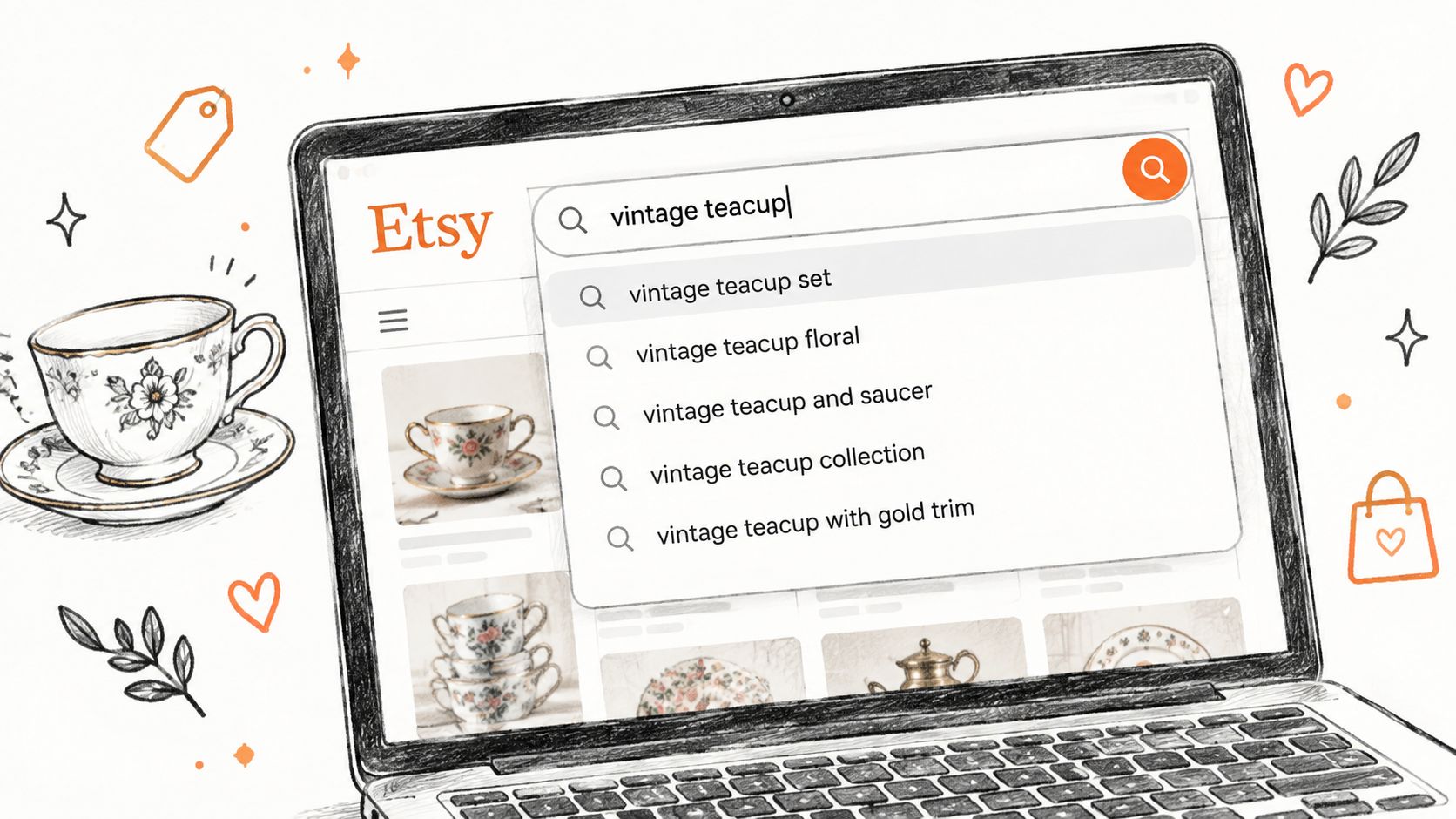
Type a broad seed such as “vintage teacup,” “nurse gift,” or “coastal sweatshirt.” Pause before selecting a result and record the autocomplete phrases Etsy surfaces. These completions can reveal more specific use cases, audiences, occasions, and product formats than the original seed. Related searches and category navigation can add another layer, especially when you're trying to separate a broad aesthetic from a sellable sub-niche.
Read search results as evidence, not proof
Search modifiers can help you inspect different kinds of marketplace activity. Sellers commonly use modifiers such as is:best and is:favorites to surface listings associated with bestseller or favorite behavior, then compare the results with ordinary search results. Timeframe controls, where available, can help you inspect a shorter recent window alongside broader four-week, 60-day, or 12-month views.
Use the sidebar filters to narrow the market by category, product type, color, personalization, and other available attributes. The purpose isn't to collect attractive listings. It's to check whether the same phrase appears consistently across titles, tags, attributes, and the products buyers engage with.
Marketplace Insights in Shop Manager provides Etsy search data, including how often buyers search for terms and the level of competition. Etsy also says the tool may show searches for items that aren't allowed on the platform, so keyword discovery never replaces policy review. Etsy's Marketplace Insights guidance
For active shops, Marketplace Insights can expose search-term rank, click share, and impression share. Access depends on shop eligibility and recent sales, so it isn't available as a universal research layer for every seller.
The limitation is important. Etsy's built-in tools can confirm activity and show what the platform is surfacing, but they don't automatically explain whether a phrase is rising, stabilizing, or fading. Etsy's trend reporting is also time-bound, based on a fixed snapshot date of February 10, 2026, while the report was updated in September 2026. That makes the date of collection part of the interpretation, not a minor footnote.
What Etsy Trend Search Actually Measures
A trending phrase doesn't receive visibility in isolation. Etsy ranking depends on how well a listing matches the query, how shoppers respond to it, how recent it is, and whether the listing and shop meet quality expectations. Etsy identifies relevancy, listing engagement rate, recency, and listing or shop quality as practical ranking signals. Etsy search disclosure guidance
Relevancy is the first filter. Etsy evaluates keywords in titles, tags, descriptions, attributes, and categories, so a popular phrase can still underperform when the product doesn't match it. A “coastal grandmother” shirt with accurate audience and style language has a stronger foundation than a generic shirt that inserts the phrase into an unrelated title.
Engagement then supplies behavioral evidence. Clicks, views, favorites, and purchases help Etsy learn whether shoppers find the result useful. New listings receive a temporary boost so Etsy can gather buyer behavior, but that initial visibility doesn't replace strong photos, accurate targeting, or conversion.
| Signal | What It Measures | Effect on Trending Results | How a Seller Can Influence It |
|---|---|---|---|
| Relevancy | Match between the query and the listing's titles, tags, descriptions, attributes, and category | Determines whether the product belongs in the result set | Use accurate phrases and complete attributes without forcing unrelated keywords |
| Engagement | Clicks, views, favorites, and purchases | Helps Etsy distinguish listings shoppers respond to from listings they ignore | Improve the first image, product fit, mockups, and offer clarity |
| Recency | How recently a listing was published or refreshed through marketplace activity | Gives newer listings an opportunity to be tested | Publish deliberately when the trend and buying window are approaching |
| Listing and shop quality | Listing completeness, customer service, and overall shop signals | Supports sustained visibility after temporary testing | Complete the listing, maintain service standards, and deliver a consistent buyer experience |
Etsy recommends using all 13 tags, adding relevant attributes, writing clear titles, and placing the strongest photo first because unused tags are missed opportunities. Its seller guidance also points to review rating, message response rate, and case rate from the past three months as customer-service signals that can affect search ranking. Etsy's listing optimization checklist
A useful way to judge a candidate keyword is to ask whether all four signals can be supported. If the phrase is relevant but the thumbnail is weak, engagement may stall. If the listing is attractive but the phrase is only loosely related, relevancy can limit reach. For a deeper way to evaluate market difficulty before investing in artwork, use this competition scoring framework.
Validating Trends With Cross-Marketplace Best Sellers
Etsy trend search tells you what shoppers are doing on Etsy. It doesn't tell you whether a phrase has durable product demand across the POD ecosystem. A keyword can appear frequently in autocomplete because of curiosity, a short-lived cultural moment, or a narrow burst of activity, while proven sellers elsewhere may show whether people buy products built around it.
The practical test is to take a promising phrase and compare it with store-first bestseller data across Etsy, TeePublic, Redbubble, and Amazon Merch. Trendlytic is a POD niche research tool built around that approach. Instead of treating random search results as representative, it examines top designs from sellers and ranks listings by sales activity over 30-day windows, then exposes category concentration and product coverage.
Consider “coastal grandmother.” First, inspect Etsy for exact phrase usage, related wording, product types, and visual repetition. Then compare the phrase across the other marketplaces.
What to record for each marketplace
- Phrase alignment: Do top listings use the exact term, or are sellers winning with adjacent language?
- Saturation: Are many sellers publishing near-identical typography, colors, and garment types?
- Product breadth: Does demand appear on tees only, or does it extend to mugs, totes, sweatshirts, and wall art?
- Commercial fit: Can the product format support a workable margin after production costs and marketplace royalties?
- Seller concentration: Is activity distributed across several stores, or does one seller account for most visible performance?
The table below is a working capture sheet. Fill it with the results from your own query rather than treating blank cells as assumptions.
| Marketplace | Top Listings Found | Avg. Price (USD) | 30-Day Sales Range | Saturation Signal |
|---|---|---|---|---|
| Etsy | Record after search and category filtering | Record current listings | Record tool output where available | Compare phrase repetition and listing density |
| TeePublic | Record store-first results | Record current listings | Record tool output where available | Check whether designs repeat across stores |
| Redbubble | Record store-first results | Record current listings | Record tool output where available | Compare product breadth and visual sameness |
| Amazon Merch | Record store-first results | Record current listings | Record tool output where available | Check phrase use, apparel concentration, and policy risk |
A phrase that appears on several stores with multiple strong sellers deserves more attention than one that exists only in Etsy autocomplete. You can also use find trending content with PostSyncer to understand whether social interest supports the marketplace evidence, but social visibility should remain a secondary signal.
The goal isn't to find a keyword with no competition. A market with no sellers may indicate no demand. The better target is a phrase with visible buyer intent, enough differentiation room, and a product format you can execute without copying the listings already winning.
Manual Search vs a POD Research Platform
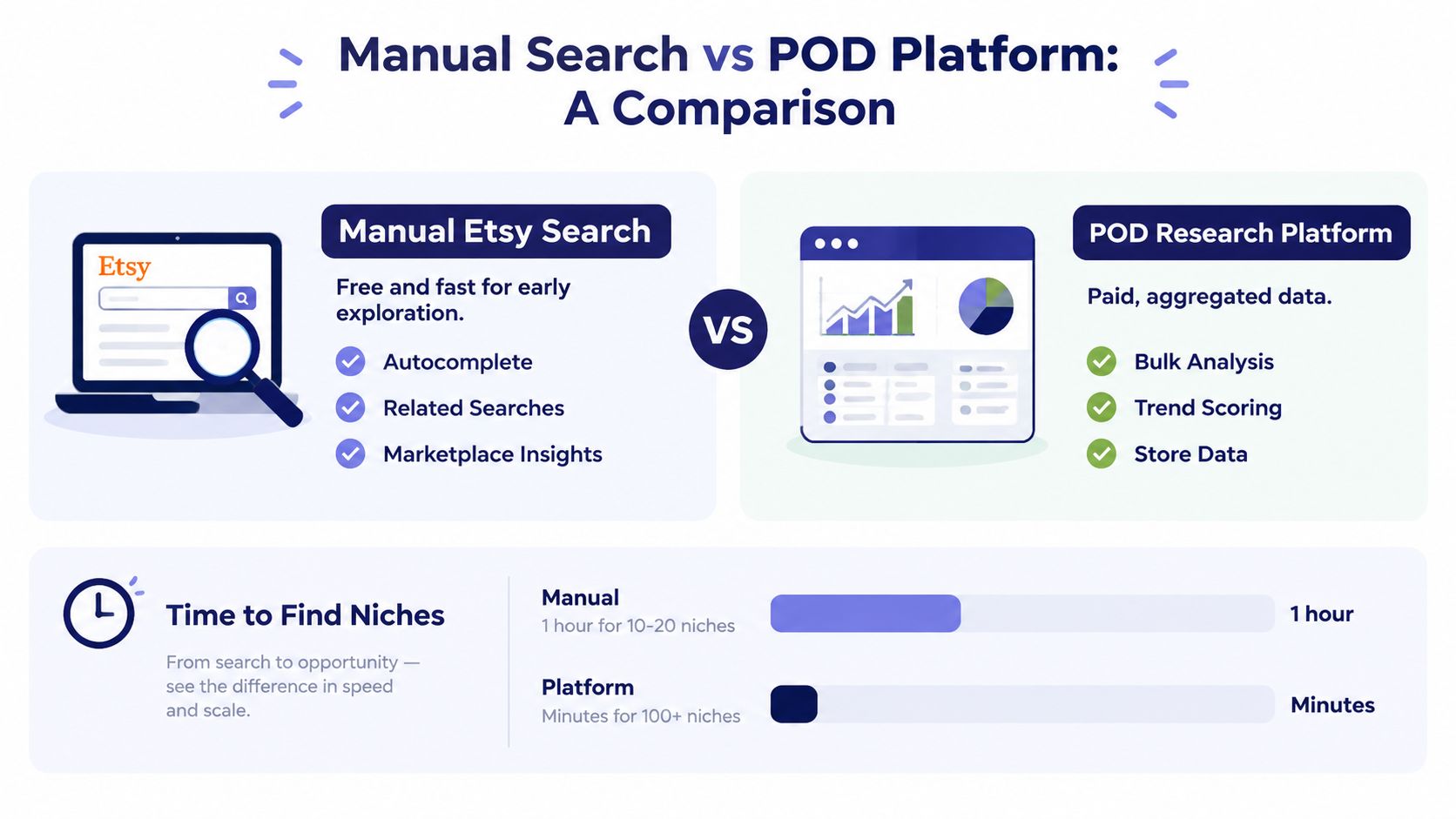
Manual Etsy trend search is useful because it's immediate and free. In a focused session, autocomplete, related searches, category filters, and Marketplace Insights can generate a workable shortlist of candidate niches. It's especially effective when you're scanning seasonal ideas or checking whether Etsy itself recognizes the wording you want to target.
The cost is scope. Manual research makes you switch between queries, stores, screenshots, spreadsheets, and policy pages. It also introduces personal bias because you tend to notice designs that match your own taste. A platform can compress that work by aggregating store data, ranking movement, and product signals in one research environment.
Choose the method based on the decision
| Research need | Manual Etsy search | POD research platform |
|---|---|---|
| Brainstorming seed phrases | Strong, because autocomplete reflects Etsy language | Useful when you need related niches at scale |
| Checking Etsy presentation | Strong, because you see live listings directly | Secondary, depending on the platform's marketplace coverage |
| Comparing several POD stores | Slow across browser tabs | Faster when store data is aggregated |
| Identifying recent bestseller movement | Limited and easy to misread | More useful when the feed ranks unit velocity or sales movement |
| Trademark screening | Requires a separate check | Useful when a USPTO trademark check is built in |
| Final listing judgment | Still requires manual inspection | Still requires manual inspection |
Trendlytic includes an hourly Trending Now feed that ranks listings by unit velocity rather than impression share, and it includes a built-in USPTO trademark check. That check matters because Etsy protects its word and logo marks and prohibits sellers from using Etsy marks or confusingly similar marks in ways that imply endorsement. It also forbids using “Etsy” in a shop or company name or in a domain name. Etsy's trademark policy
Manual search wins when you're exploring. A research platform earns its place when you're validating a shortlist, comparing Etsy with TeePublic, Redbubble, and Amazon Merch, or screening phrases before you spend money on artwork and listings. Most working sellers use both.
For a broader comparison of research workflows, see this guide to a POD niche research tool.
Spotting Seasonal and Rising Trends Early
Seasonal demand punishes late research. If you wait until the buying window is obvious, you may still need to create the design, prepare mockups, write the listing, publish it, and give Etsy time to understand its relevance. The safer approach is to start roughly 8 to 12 weeks before the expected buying window, using the planning range described in this workflow rather than treating it as a guarantee.
A practical seasonal workflow
- Review the previous cycle. Use available Marketplace Insights history and your own shop data to identify when related searches and sales began accelerating.
- Separate the occasion from the product. “Back-to-school” is broad. Staff shirts, teacher gifts, classroom signs, and student apparel address different buyers and should be researched separately.
- Check current language. Compare last season's phrases with present autocomplete suggestions. New modifiers can reveal changes in audience, style, or product use.
- Cross-check bestseller movement. Look for matching activity across Etsy, TeePublic, Redbubble, and Amazon Merch rather than relying on one listing or one platform.
- Watch recent movement. An hourly trend feed can help you notice whether a phrase is gaining momentum during the ramp-up, but it still needs manual review.
- Publish before the peak. Give the listing time to be indexed and tested instead of launching when shoppers are already buying.
Useful planning anchors include back-to-school staff shirts in late July, coastal home goods in early April, pickleball and cottagecore apparel in spring, and nurse appreciation designs beginning in mid-March. These are planning examples, not fixed rules. Buyer behavior can shift by audience, product type, and market.
The image above is repeated accidentally in the source request, so it should not be duplicated in a finished article. Instead, use the first timeline visual as the planning reference and keep the operational lesson simple: research early, produce in batches, and publish before demand reaches its loudest point.
For wider context on apparel demand and production behavior, browse these trends shaping print shops. The useful connection is not copying an industry trend directly. It's checking whether a broader apparel shift has a clear Etsy audience, a specific phrase, and a product you can fulfill well.
Etsy's own trend reporting is a retrospective snapshot, so it works best for identifying patterns and seasonal context. Marketplace Insights and current listing behavior are better for checking what buyers may be expressing now. Neither removes the need to make a judgment about timing, competition, and product quality.
Putting It All Together and Avoiding Common Traps
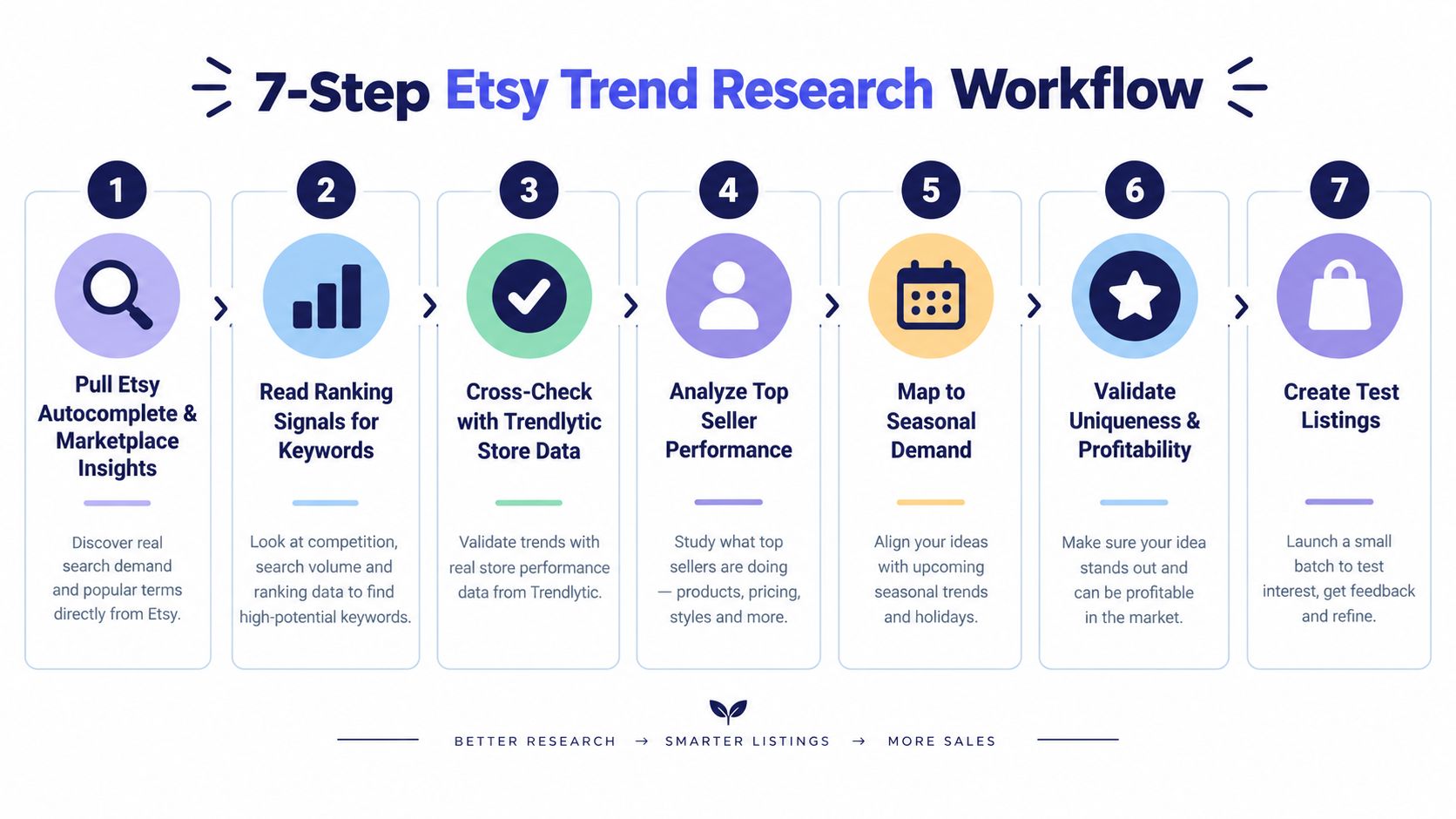
A reliable Etsy trend search process should end with a decision, not an endless spreadsheet. I use a short sequence that moves from buyer language to marketplace proof, then to legal and operational checks.
The seven checks that matter
- Pull Etsy autocomplete and Marketplace Insights. Save the exact phrases, related searches, competition notes, and product formats.
- Read the ranking signals. Confirm that the phrase fits the title, tags, attributes, category, image, and actual product.
- Cross-check store-first bestseller data. Compare Etsy with TeePublic, Redbubble, and Amazon Merch to distinguish marketplace demand from generic web noise.
- Study top-seller execution. Look for repeated audience language, product choices, image patterns, and obvious gaps you can fill without copying.
- Map the phrase to seasonal demand. Decide whether you're building for an immediate window, a recurring occasion, or a more durable use case.
- Validate uniqueness and legal safety. Run the phrase through a USPTO trademark check and avoid protected wording that could create takedown risk.
- Create test listings deliberately. Make a small, coherent product set with accurate titles, all relevant tags and attributes, strong first images, and clear policies.
The common traps are predictable. Sellers chase a search spike after it has already faded, mistake traffic for purchase intent, or publish a trademarked phrase because it looked commercially attractive. Others wait until Q4 to research holiday products, rely on one Etsy signal, or copy the visual structure of the listings already ranking.
A validated trend lowers uncertainty. It doesn't guarantee a sale.
Etsy also warns sellers not to stuff titles with keywords. Its guidance favors accurate product titles, complete shop policies and FAQs, multiple photos and video where useful, and descriptions that add meaningful context. Etsy's title and listing guidance
The final judgment is yours. Etsy signals show marketplace behavior, while cross-marketplace bestseller data shows whether the idea has broader commercial support. Use both, keep the product specific, and reject phrases that look exciting but fail relevancy, differentiation, timing, or policy review.
For a fuller version of this process, use this guide to how to do trend research. Trendlytic can then serve as one research option for comparing store-first bestseller data across Etsy, TeePublic, Redbubble, and Amazon Merch, checking trademark risk, and monitoring recent listing movement before you design.
Trendlytic brings Etsy, TeePublic, Redbubble, and Amazon Merch bestseller signals into one POD research workflow, with store-first results, trend movement, and a built-in USPTO trademark check. If you want to validate your next Etsy keyword against proven marketplace activity instead of generic web chatter, visit Trendlytic and compare the data before committing to the design.