Finding High Demand Low Competition Niches That Sell
You've probably been there: a design looks perfect in the editor, the mockups are polished, and you upload it to Etsy, Redbubble, or TeePublic expecting at least a few early sales. Then the listing disappears into an ocean of similar products. The problem often isn't the artwork. It's that the niche attracted browsers, not buyers.
I've launched enough POD designs to learn that high demand low competition niches rarely look broad or obvious. They usually sit inside a specific routine, profession, hobby, community, or identity. The strongest opportunities connect a real audience to a recognizable purchase moment, then survive checks for marketplace pressure, commercial intent, and trademark risk.
Table of Contents
- What a Good POD Niche Looks Like
- The Three Filters That Separate Winners From Time Wasters
- Why Narrow Audience Sub-Niches Beat Broad Evergreen Categories
- Reading Trend Signals and Opportunity Scores Without Fooling Yourself
- A Trendlytic Workflow From Keyword to Launch-Ready Designs
- Pitfalls, Trademark Traps, and an Honest Closing
What a Good POD Niche Looks Like
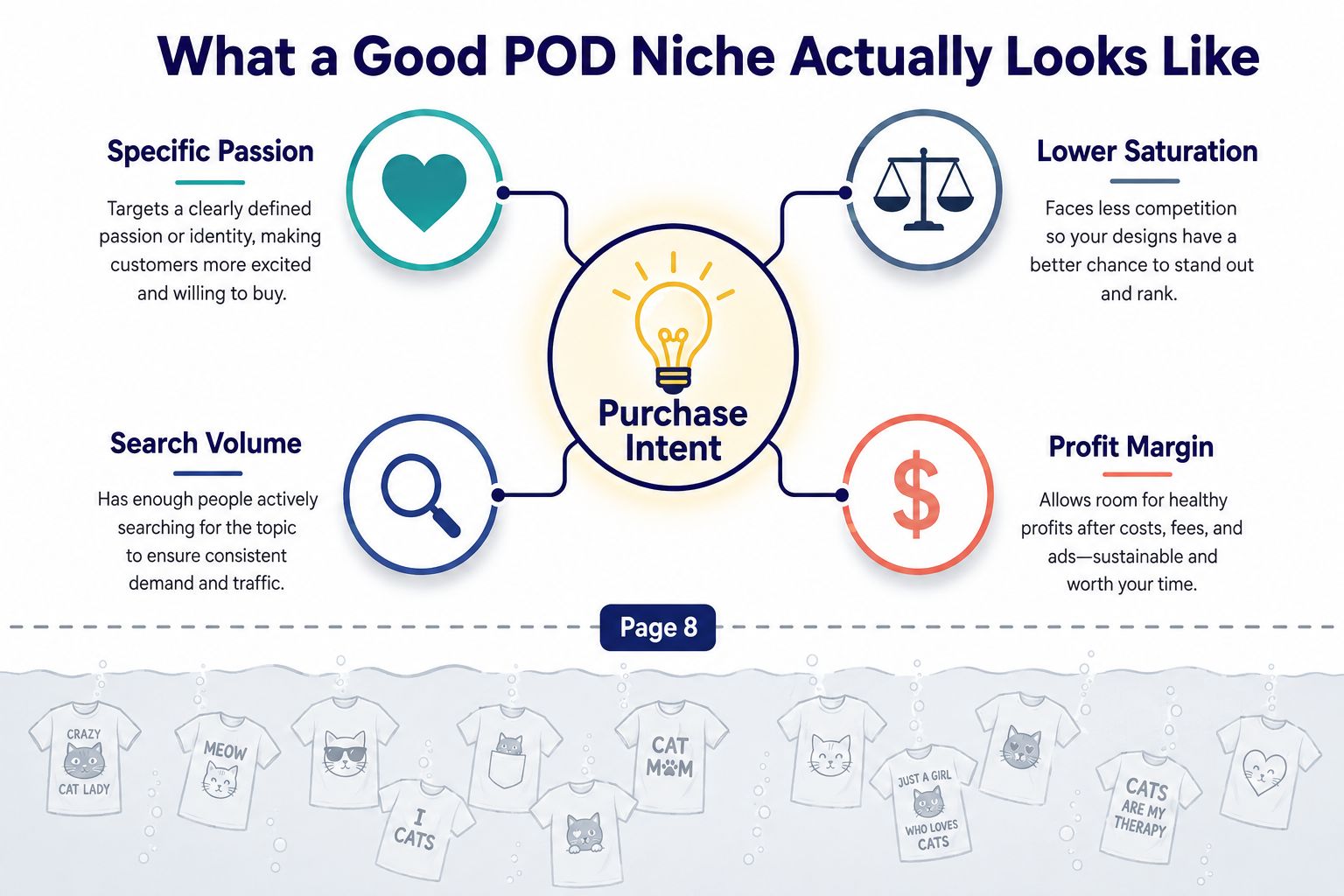
A seller can upload fifty cat designs, see steady keyword activity, and still get almost no sales. The audience is large, but the buyer has no clear reason to choose one more cat shirt. The stronger opportunity sits inside a specific routine, role, hobby, or community, such as a dog mom hiking Pacific Northwest trails, a NICU nurse buying a colleague's gift, or a pickleball player shopping for team apparel.
That distinction shapes how I judge high demand low competition niches. Across TeePublic, Amazon Merch, Redbubble, and Etsy, I look for an audience that recognizes itself quickly, a product tied to a purchase moment, and enough room to test related designs without repeating the same generic message.
The buyer matters more than the category
A useful POD niche combines three conditions:
- An identifiable buyer: You can describe who the product is for without stopping at a vague label such as “pet lovers.”
- A purchase trigger: The buyer has a reason to act, including a birthday, team event, professional milestone, trip, inside joke, or community gathering.
- Recurring demand: People search for related products often enough to support organic uploads, testing, or paid promotion.
“Pets” is a category. “Dog mom who hikes Pacific Northwest trails” gives you audience language, locations, activities, and gifting occasions to build around.
Research should follow the buyer's wording. On TeePublic, I check whether the concept expresses identity rather than generic decoration. On Amazon Merch, I look for occupational and audience phrases that can support several related designs. On Redbubble, I test whether the visual style belongs to a defined community. On Etsy, I look for evidence that shoppers are already buying around an occasion, role, or personalized use case.
A long-tail keyword research guide helps move from a broad seed term toward the narrower phrases buyers use.
Search demand still needs a commercial reason
Search volume alone does not validate a POD niche. Backlinko's analysis of 306 million keywords found that 91.8% of search queries are long-tail terms, although they represent only 3.3% of total search volume. The median keyword receives 10 searches per month (Backlinko's Google keyword study). A small phrase can still matter when it signals a product need and matches a clear audience.
Broad terms concentrate attention. The study found that the top 500 terms account for 8.4% of search volume, while the top 2,000 account for 12.2%. That makes narrow, commercially specific phrases useful entry points, especially when marketplace competition is lighter and the design serves a recognizable buyer.
A niche earns sales when the audience understands the message, fits the product, and has a reason to purchase now. Large audiences create reach. Specific purchase intent creates listings that have a chance to convert.
The Three Filters That Separate Winners From Time Wasters
A niche can show demand and still waste weeks of design work. Before creating listings, test three conditions: buyers want the product, competing sellers leave room to be seen, and the wording can survive trademark review.
| Filter | What It Measures | Key Metrics | Common Tool |
|---|---|---|---|
| Demand | Whether buyers show sustained interest | Search trend, monthly searches, marketplace activity | Trend research and marketplace reports |
| Competition | How difficult it is to earn attention | Listing density, review concentration, dominant sellers | Marketplace search and niche analysis |
| Trademark safety | Whether a phrase or character creates legal risk | Live marks, related goods, coordinated classes | USPTO search |
Filter one is demand with buying intent
Start with stable or rising multi-year search interest, then check whether the primary keyword reaches 1,000 monthly searches, following this niche validation workflow. Treat that threshold as a screening gate, not a sales forecast. A keyword can meet it while attracting browsers who never buy.
The wording of the search matters. “What does pickleball mean?” seeks information. “Pickleball team shirt” points to a product. “NICU nurse gift” identifies an audience, an occasion, and a likely format. For POD, those details shape the design brief and the listing copy.
A live landing-page test adds behavioral evidence. The same framework treats 15% to 25% waitlist signup as a strong signal, while a result under 5% can indicate weak interest or unclear positioning. Use the niche validation workflow once, then judge the response rather than relying on search volume alone.
Filter two is pressure at the top of results
Count listings, but do not stop there. Open the first results and record review counts, seller concentration, brand strength, design similarity, and freshness. A niche with 50,000 or more searches can still be saturated when a small group of sellers owns the visible results and buyer trust.
For product niches, one scoring model gives serious investigation to opportunities scoring 20 or more out of 25 (SellerSprite's niche research guidance). Use the score to sort research, not to make the decision. Listing quality, audience fit, and the cost of producing distinct designs still require manual review.
Filter three is trademark clearance
Search the phrase before it becomes artwork, a title, or a slogan. The USPTO federal trademark searching guidance notes that marks may be confusingly similar even across different international classes. The relevant question is whether buyers could believe the goods or services come from the same source.
For apparel, Class 25 covers clothing, while the USPTO groups goods and services into 45 international classes (USPTO goods and services guidance). Check live applications and registrations, then review related goods and classes. An exact-match search that returns nothing does not clear a phrase resembling an active brand, slogan, or character.
These filters work together. Demand without room for visibility produces buried listings, and a promising phrase with legal risk can turn finished designs into unusable inventory.
Why Narrow Audience Sub-Niches Beat Broad Evergreen Categories
A broad evergreen category can look safe in a spreadsheet, then produce no sales after launch. Fitness, coffee, pets, gaming, and motivational quotes keep attracting buyers, but they also bring established sellers, repeated design styles, and aggressive brand protection.
A narrow audience gives the product a clearer buying context. “Fitness” describes an interest. “Yoga for seniors,” “adaptive fitness,” “reformer Pilates,” and “aqua aerobics” identify participation groups with different language, needs, and buying occasions. Coverage of senior health and longevity also points to age-specific and participation-focused opportunities (coverage of emerging profitable content niches).
The same approach works outside fitness:
- NICU nurses may buy around professional identity, shift humor, and colleague gifts.
- Hiking moms in Arizona may respond to regional pride, trail culture, and family activities.
- True crime podcast listeners may recognize listening rituals and community language.
- Pickleball players may need team-event apparel, tournament designs, and playful identity signals.
These groups are smaller than “fitness” or “pets,” yet their searches often reveal more purchase intent. A buyer searching for a role, activity, location, or occasion has already given you clues about the product and message they want.
Practical rule: Ask what this audience repeatedly does, celebrates, wears, gifts, or complains about. Topic interest alone is not enough.
A narrower audience also guides the design brief. A generic fitness shirt competes mainly through style. An adaptive fitness design can communicate participation and belonging. A generic dog graphic competes with thousands of illustrations, while a design for a specific hiking community can use language and visual cues broad sellers miss.
The trade-off is limited expansion. Some sub-niches are too small for a full catalog, so I group related opportunities around one buyer instead of treating every phrase as its own business. That structure lets a successful design family grow without drifting into unrelated products.
Strong opportunities often come from workflow-specific or industry-specific utilities that horizontal platforms overlook, especially where buyers face recurring problems and find few targeted solutions (analysis of narrow SaaS and workflow opportunities). In POD, the comparable opportunity is a design that helps a community signal identity during a repeated activity. An attractive graphic may earn attention once. A useful identity signal has more reasons to be worn, gifted, and reordered.
Reading Trend Signals and Opportunity Scores Without Fooling Yourself
A rising phrase can still produce a weak launch. I use Trendlytic's Trending Now view to spot growing marketplace attention, then check whether the interest reflects a buying occasion or a short-lived meme. Sellers may copy an obvious treatment before a trend has time to mature, leaving little room for an original design.
Long-tail behavior adds useful context. Search demand often spreads across many specific phrases, and individual terms may have modest volume (Backlinko's Google keyword study). I therefore look for clusters of related searches that identify the same buyer, activity, and product occasion, rather than chasing one impressive keyword.
Trendlytic's Opportunity Score combines demand and competition signals in one view. I treat a score of 6 as a prompt for investigation and 9 as a stronger reason to test, never as a guarantee. Before designing, inspect the inputs: listing pressure, average reviews, seller concentration, visual similarity, and whether leading results are converting attention into products.
| Opportunity Score | Search Volume | Avg Listings | Avg Reviews per Listing | Launch Verdict |
|---|---|---|---|---|
| 6 | Promising but needs context | Inspect manually | Check concentration | Research further |
| 9 | Stronger demand signal | Confirm saturation | Look for room below leaders | Consider a small test |
| Any score | Any level | Dense or repetitive | Dominated by a few sellers | Delay or reject |
A phrase with 4,000 monthly searches and 600 listings presents a different problem from one with 12,000 searches and 9,000 listings. The first may offer more room, while the second may demand a sharper audience angle, stronger creative work, and more patience. Search volume helps compare opportunities, but it cannot establish purchase intent by itself.
I separate BSR velocity, review concentration, and design-level saturation. Fast bestseller movement suggests active demand, yet one seller may control most of it. Reviews show sales history and buyer trust. A low average can indicate weak competition, an untested category, or a product buyers do not value enough to recommend.
Product format can change the opportunity. The Dirt Cheap Headwear wholesale guide reinforces the need to examine market fit beyond the keyword. A phrase that works on a shirt may require a simpler visual treatment on a hat, while the buyer's use case may shift from everyday wear to an event, uniform, or gift.
Use a clear decision rule after following the trend research process:
- Score rises and pressure stays moderate: Move a small batch of designs toward testing.
- Score rises while listings flood in: Treat the trend as cooling and narrow the audience.
- Score falls but related phrases remain stable: Test the evergreen sub-niche instead of the trend label.
- Score looks strong but reviews are concentrated: Reject it or find a defensible angle before designing.
The score starts the review. Buyer clarity, marketplace room, and a distinct visual promise decide whether the niche deserves production time.
A Trendlytic Workflow From Keyword to Launch-Ready Designs
I start with a seed phrase from a live trend feed, but I don't upload the first idea it produces. The seed becomes a research container, not a design instruction.
Start with the report, then remove weak ideas
A Trendlytic niche report combines marketplace demand and competition signals across TeePublic, Amazon Merch, Redbubble, and Etsy, then surfaces 60-plus design opportunities with images, tags, and pricing. I use that list to create a working spreadsheet with the keyword, audience, product angle, visual concept, competition notes, and trademark status.
The first pass removes phrases that are too broad, too dependent on a current meme, or visually indistinguishable from existing results. I also reject ideas that only attract informational traffic. A phrase can be popular and still give me no clear product promise.
For sellers building many concepts, a resource on bulk T-shirt designs with AI can help with production workflows. It doesn't solve niche selection, positioning, or clearance, so I'd use it only after the research list has been narrowed.
Score the survivors on three practical axes
I score each remaining idea for:
- Buyer clarity: Can I name the person and the purchase moment?
- Marketplace room: Do the leading listings leave space for a distinct style or audience angle?
- Safety and execution: Can I make the design without relying on protected phrases, characters, or copied visual language?
The aim is a launch batch of 10 to 15 designs, each tied to one specific sub-niche. That keeps the copy, mockups, tags, and product choices focused. It also makes performance easier to interpret because I can connect each design back to the original keyword rather than mixing unrelated concepts into one upload.
Read trademark results as a stoplight
Trendlytic's trademark check is useful for flagging ownership and expiry, but I still inspect the result. A live application or registration deserves caution, especially when the goods are apparel or closely related products. The USPTO advises focusing on live marks and using coordinated classes to narrow results (USPTO federal trademark searching guidance).
I treat an active mark, a confusingly similar mark, or a phrase associated with a licensed character as a launch blocker. I save rejected phrases for review after 90 days, but I don't assume the status will change or that an expired mark automatically makes the design safe.
Before uploading, I want five files or records on disk:
- Keyword record: Original phrase, related terms, and marketplace notes.
- Competition snapshot: Leading listings, review patterns, and design observations.
- Trademark record: Search date, live results, related classes, and decision.
- Design brief: Audience, message, product, mockup direction, and tags.
- Tracking sheet: Upload date, platform, design ID, impressions, clicks, favorites, and sales.
That final sheet matters. Without it, sellers remember the designs they liked and forget the market evidence that led to them.
Pitfalls, Trademark Traps, and an Honest Closing
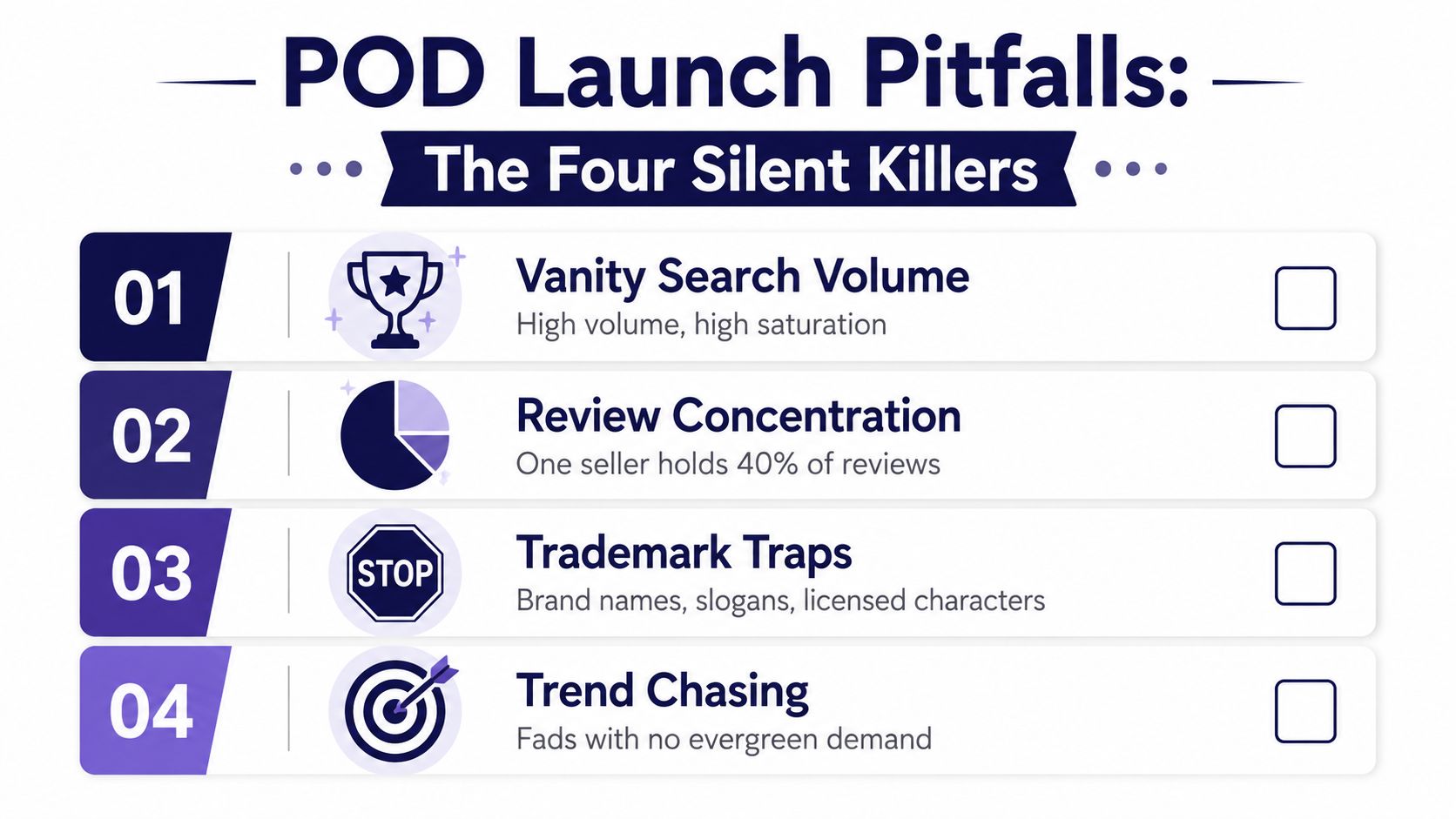
A launch can fail before the first sale, often because one quiet assumption was never tested.
Vanity volume hides saturated shelves
Search volume shows attention, not access. Set a listing limit for each phrase, inspect the first results, and look for several sellers with steady sales signals rather than one dominant store.
Review concentration needs a separate check. If one seller controls more than 80% of a market, entering that category carries high risk (SellerSprite's niche research guidance). A crowded category remains crowded even when its keyword attracts plenty of searches.
Trademark research belongs at the beginning
Run the phrase search before writing the design brief, then check live applications, registrations, and related goods. Clothing sits in Class 25, while connected classes can matter when buyers may associate products with the same source (USPTO goods and services guidance).
A live mark, a confusingly similar mark, or wording tied to a licensed character stops my launch. I keep rejected phrases for later review, but an expired mark does not automatically make a design safe.
Fees can change the test economics
Etsy charges a $0.20 USD listing fee when a listing is created or renewed, and editing does not create a new listing fee (Etsy fees policy). Multiple quantities may renew automatically after each sale, also at $0.20, so a broad testing batch can cost more than expected.
Before committing, put listing, renewal, transaction, production, return, and advertising costs into one sheet. A design can look profitable at the product level and become unattractive after fees and weak conversion are included.
Research reduces avoidable guesses. It cannot repair weak design, predict an algorithm change, or replace consistent uploads, accurate mockups, and useful product copy. The seller still has to create something people want to wear or give.
Broad trends become more useful when translated into specific communities, workflows, and participation identities. Audiences connected to older adults, accessibility, and niche fitness are examples of groups broad POD lists often overlook (coverage of emerging demographic and lifestyle shifts). A focused collection for a defined buyer is usually a better test than chasing every loud trend.
For a structured process, the POD product launch strategy organizes research, production, and tracking without treating any score as a sales guarantee.
Trendlytic analyzes live bestseller data from TeePublic, Amazon Merch, Redbubble, and Etsy, then combines demand, competition, opportunity scoring, validated design ideas, and USPTO trademark checks in one workflow. Use Trendlytic to compare niches and choose a smaller, more defensible launch.