Merch by Amazon Trademark Protection: A Seller's Guide
You wake up, open your Merch by Amazon dashboard, and find that several designs have disappeared. The email may mention a trademark complaint, or it may warn that your content violated Amazon policy. You search your memory and realize you checked the phrase before uploading, but only quickly, and only in one place.
That mistake is common because Merch by Amazon trademark protection involves more than finding a registered word mark. A phrase can create risk through an existing registration, a pending application, or Amazon's own moderation systems. The safest workflow combines legal clearance, platform awareness, and regular monitoring of designs that are already live.
Table of Contents
- Why Trademark Takedowns Happen on Merch by Amazon
- How to Search the USPTO Trademark Database
- Interpreting Trademark Search Results
- Building a Pre-Upload Trademark Checklist
- Monitoring Existing Listings and Automating Checks
- Responding to Trademark Claims and Appeals
Why Trademark Takedowns Happen on Merch by Amazon
A takedown doesn't always mean a seller deliberately copied a brand. A creator might build a design around a short slogan, use the phrase in a title, and assume it's safe because similar shirts appear in search results. Later, a rights holder may challenge the wording, or Amazon's systems may identify a conflict that the seller never noticed.
Amazon's Merch content rules place the responsibility on the seller. Trademarked designs, titles, bullet points, and descriptions can trigger rejection or removal, and sellers are expected to ensure their content doesn't violate trademark rights, as explained in this overview of Amazon Merch trademark requirements. Other sellers using the same phrase don't prove that you have permission to use it.
The three layers of risk
I think about every listing through three separate filters.
- Registered marks: A live federal registration can give the owner a strong basis for enforcement, particularly when the mark is similar to your phrase and covers related products such as clothing.
- Pending applications: An application may not yet be registered, but it signals an active claim and can still create marketplace risk. A seller who waits until registration may discover that Amazon has already acted.
- Platform moderation: Amazon can reject or remove content under its internal rules even when the legal position feels uncertain. Marketplace enforcement is a separate practical problem from proving infringement in court.
Independent Merch guidance also warns that enforcement can affect more than the reported listing. If a rights holder files against an existing design, Amazon's automated systems may remove related listings at once, which makes account-level thinking essential. The Online Brand Growth trademark guide is useful for sellers who want another practical explanation of how trademark risk can spread across a catalog.
Practical rule: A phrase isn't safe merely because it's common, funny, or already visible on Amazon. Treat every commercial use as a clearance decision.
The protection is a process that starts before upload and continues after publication. Search the phrase, inspect similar marks, review the listing language and artwork, then preserve a record of what you checked. That won't guarantee immunity from complaints, but it gives you a more defensible workflow and reduces avoidable warnings.
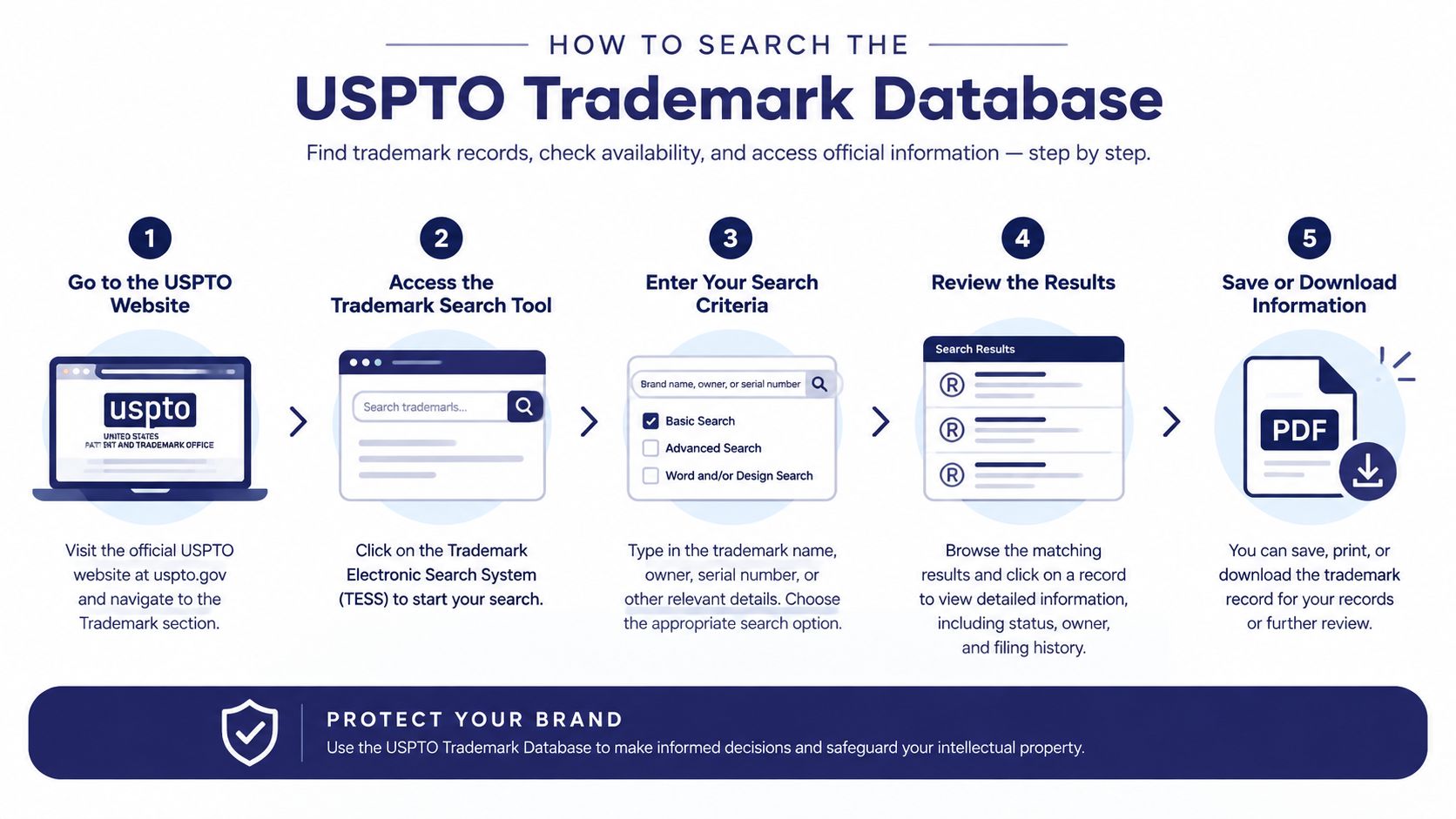
How to Search the USPTO Trademark Database
The USPTO search should be the first serious checkpoint for a new Merch concept. The practical clearance process starts with registered and pending marks, then asks whether the goods and services are related closely enough that buyers could believe they come from the same source, as reflected in the USPTO Trademark Center.
Start with the wording, not the artwork
Search the exact phrase first. Then search variations that a brand owner might use:
- Remove punctuation and spaces.
- Search singular and plural forms.
- Try common spelling variations.
- Search the key words separately.
- Check sound-alike and look-alike versions.
For example, a design phrase such as “Weekend Adventure Club” shouldn't be checked only as one exact string. Search the full phrase, the strongest distinctive words, and plausible variations. A superficial search might miss a mark filed with different spacing or a slightly different spelling.
USPTO guidance also points sellers toward image-search tools, not just standard word-mark searches. That matters when your artwork includes a recognizable logo, stylized lettering, or a symbol that resembles an existing design mark. A word search can miss visual similarity entirely.
Filter for apparel relevance
Review Class 025, which is central for clothing, and inspect adjacent classes when the mark owner's products, branding, or services overlap with apparel or lifestyle merchandise. A mark connected to unrelated industrial equipment presents a different question from a similar mark used for clothing, accessories, entertainment, or consumer products.
Check each result's status. Record whether it's live, pending, or dead, and read the listed goods and services instead of relying on the class number alone. A dead mark may not carry the same current registration risk, but it still deserves context, especially if Amazon's systems or a rights holder are actively using the phrase.
Trend research should happen separately from legal clearance. A workflow such as POD niche research can help identify demand, but popularity doesn't establish trademark permission. Research first, clear the phrase second, and only then develop the design.
Pause before uploading if a result is live or pending and the wording is distinctive, the goods overlap, or the visual identity is close. The cost of abandoning one idea is usually easier to absorb than rebuilding a catalog after a warning.
The video below offers a visual walkthrough of the search process.
Interpreting Trademark Search Results
Finding a mark doesn't automatically answer whether your design is prohibited. The harder question is whether the use could confuse buyers about the source, endorsement, or affiliation of the product. Amazon's intellectual property policy treats unauthorized trademark use as typically infringing when that likelihood of confusion exists, as stated in its trademark infringement policy.
A mark used for an unrelated service may create less practical risk than a similar mark used directly on apparel. Clothing has broad consumer overlap, so a phrase associated with shirts, fashion, entertainment, clubs, or lifestyle products deserves closer review than a mark tied to an unrelated commercial field.
Read the record as a decision, not a label
Live means the mark appears active in the federal record. Pending means an application is still moving through the examination process, and it can signal an owner who is actively trying to establish rights. Dead means the application or registration is no longer active in the same way, but it isn't a shortcut to approval.
Compare the mark's wording, design, owner, goods, and marketplace context. A registered mark for a specialized product may be less relevant to a basic shirt than a pending phrase aimed at clothing or consumer merchandise. Similarity can also come from sound, appearance, or overall commercial impression, not only identical spelling.
| Mark Status | Class Overlap | Similarity | Risk Level | Recommended Action |
|---|---|---|---|---|
| Live | Clothing or closely related goods | High | High | Do not upload without qualified legal clearance or permission |
| Pending | Clothing or closely related goods | High | High | Treat as blocked until the conflict is resolved |
| Live | Unrelated goods or services | Low | Lower, not zero | Review context and avoid brand-like presentation |
| Dead | Related goods | Moderate | Context-dependent | Investigate current use and similar live filings |
| Live or pending | Related goods | Low to moderate | Moderate | Search variants, inspect ownership, and consider a different concept |
The table is a screening tool, not a legal opinion. Amazon may apply its own moderation standards, and a rights holder may object based on marketplace use that isn't obvious from a database entry.
The safest go or no-go decision considers status, similarity, relatedness, and presentation together.
A common mistake is treating the USPTO record as the only authority. It isn't. The database helps you identify formal filings, while Amazon's systems evaluate listing content, artwork, and marketplace signals. That's why a phrase can look defensible in isolation and still be a poor Merch choice.
Building a Pre-Upload Trademark Checklist
Clearance needs to cover the entire listing, not just the words printed on the shirt. Amazon's Merch rules can apply to the artwork, title, bullet points, and description, so I review every customer-facing field before publishing.
The first pass is fast and mechanical. The second pass asks whether the listing creates the impression that a brand, organization, event, or franchise approved the design.
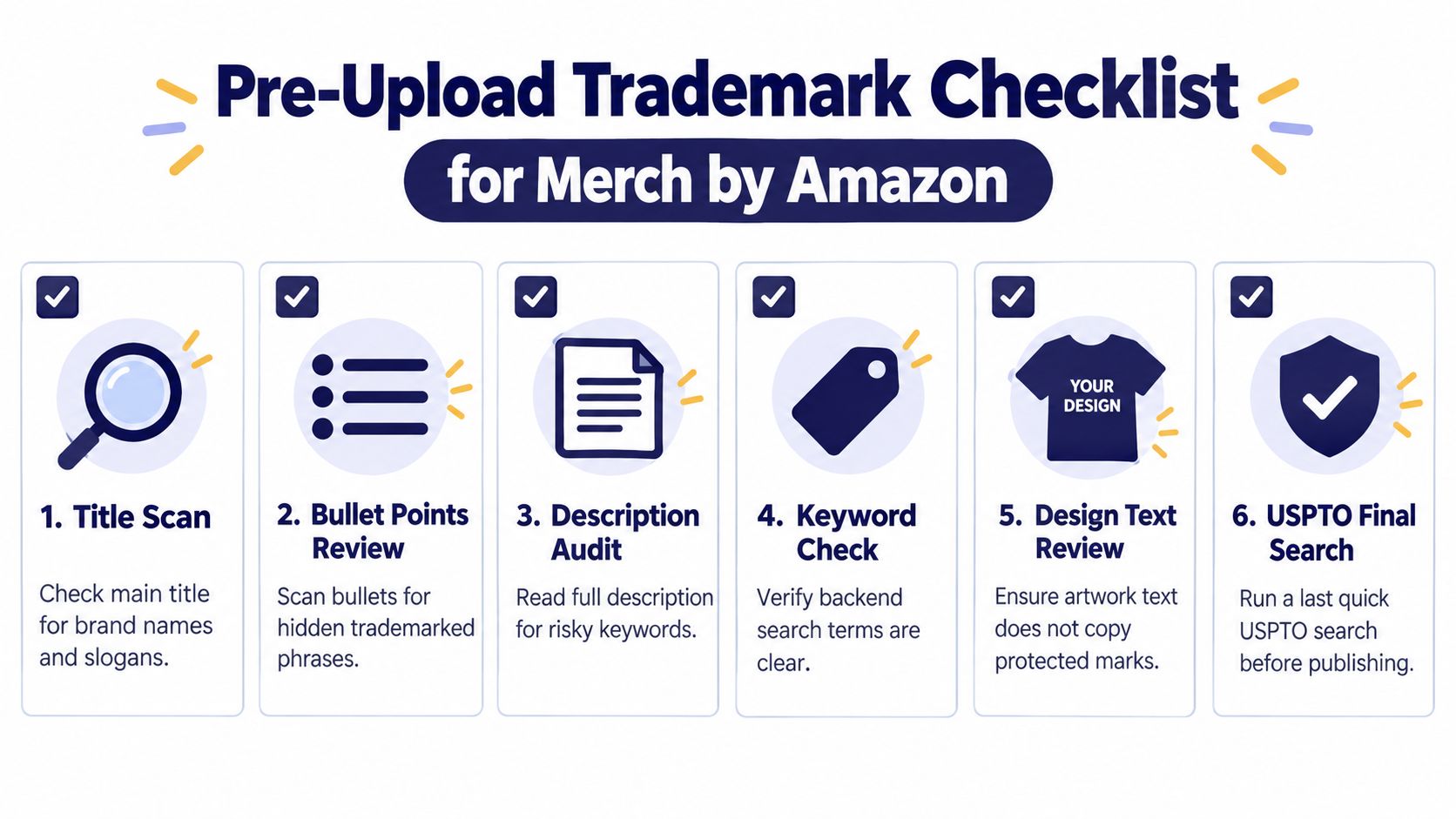
Check every place a mark can hide
- Title scan: Remove brand names, distinctive slogans, and names that make the shirt sound officially licensed. A title describing the design's subject is safer than one borrowing a brand identity.
- Bullet review: Read each bullet as a rights holder would. Marketing language can create trouble even when the artwork itself is original.
- Description audit: Look for references to teams, shows, organizations, product lines, or events. Descriptive copy still matters.
- Backend keyword check: Search terms can create exposure even when customers don't see them prominently. Don't use a protected phrase to capture traffic.
- Artwork text review: Inspect every word, letter arrangement, logo-like shape, and emblem. A custom illustration can still contain a risky phrase.
- Final USPTO search: Run the phrase again immediately before publishing, particularly if the concept changed during design.
Amazon guidance emphasizes checking sound-alike and look-alike marks, and it warns that improper filings can delay registration, as reflected in this trademark search reference for Merch sellers. That check catches the shortcuts many sellers miss.
Rewrite instead of rationalizing
Suppose your first title uses a distinctive phrase connected to a brand. Don't keep it because the phrase also has an ordinary dictionary meaning. Replace it with wording that describes the visual concept without reproducing the recognizable expression.
The same applies to parody. A joke may be creative, but Amazon's moderation decision can arrive before you have an opportunity to explain the legal theory. If the design depends on a buyer recognizing a specific brand phrase, the commercial risk may outweigh the search value.
Keep a simple record with the searched phrase, variations, status, relevant classes, date checked, and your decision. A product launch strategy can organize the broader release process, but trademark notes should remain attached to the individual design and listing copy.
Monitoring Existing Listings and Automating Checks
A listing that passed clearance last month isn't permanently protected. New applications can appear, owners can expand their commercial activity, and Amazon can change how it evaluates content. The maintenance habit I trust most is a catalog review that treats old designs as active assets rather than finished work.
Review distinctive phrases and recognizable artwork on a recurring schedule that fits your catalog. Recheck immediately when a rights holder contacts you, when Amazon removes a related design, or when you expand into another marketplace or country.
Build a practical monitoring routine
Start with a spreadsheet or catalog note for each design. Store the phrase, major variations, relevant classes, the status you observed, the search date, and the source of any license or authorization. That record won't make a risky design safe, but it prevents repeated guesswork and gives you a clear history if a complaint arrives.
For larger catalogs, automation can reduce manual repetition. Trendlytic is a POD niche research tool covering TeePublic, Amazon Merch, Redbubble, and Etsy, with a built-in USPTO trademark check. Its research workflow checks keywords against active USPTO trademark records and flags ownership and expiry information, so sellers can use it as an early screening layer before manual review. It shouldn't replace reading the underlying record or getting legal advice where the conflict is serious.
A sustainable workflow separates three jobs:
- Discovery: Find ideas and related phrases.
- Clearance: Review registered and pending marks, similarity, and related goods.
- Monitoring: Recheck live listings and record changes over time.
The international picture also deserves attention. USPTO materials identify a projected 2026 filing change under which international trademark filings move from TEASi to WIPO Madrid e-filing beginning July 31, 2026, making cross-border activity harder to track through a U.S.-only search, according to background on trademark protection for Merch sellers.
That doesn't mean every U.S. design requires a global legal investigation. It does mean a phrase can become more complicated when you sell internationally, use global storefronts, or build a brand intended for multiple markets. A POD niche research tool can support discovery and keyword screening, but ongoing rights review still requires judgment.
Responding to Trademark Claims and Appeals
A complaint creates pressure, but panic usually makes the response worse. First save the notice, identify every affected ASIN or listing, and pause related uploads while you determine whether the same phrase, artwork, or wording appears elsewhere in your catalog.
Amazon's stated enforcement path directs sellers to Account Health for appeals. Amazon may request an invoice, order ID, letter of authorization, or licensing agreement before reinstating content, as described in its appeal process for intellectual property complaints.
Decide whether an appeal is sensible
Appeal when you have a clear factual basis and supporting records. Useful material may include your original artwork files, dated design notes, clearance screenshots, licensing documents, or correspondence showing authorization. Explain what happened, what you removed or changed, and how you'll prevent the same issue from recurring.
Don't submit a defensive essay arguing that other sellers use the phrase. Amazon's decision concerns your account and your content. A concise plan with evidence is more useful than claims about fairness or marketplace inconsistency.
Accept the takedown when the phrase is clearly tied to a live or pending mark, the goods overlap, and you can't show permission. Removing one design is usually safer than preserving it while similar listings remain active. Search your titles, bullets, descriptions, keywords, and artwork for related uses, then document the cleanup.
Keep your evidence before you need it. Reconstructing a clearance search after a warning is slower and less reliable.
If the issue is complex, a qualified trademark lawyer is the right resource. For administrative support, research preparation, and document organization, some sellers also consider virtual legal assistants companies, but an assistant shouldn't replace legal advice on infringement, licensing, or a formal response.
Trendlytic combines POD niche research across TeePublic, Amazon Merch, Redbubble, and Etsy with a built-in USPTO trademark check for keywords. If you want a faster first-pass screen before designing, visit Trendlytic, then verify important results in the USPTO record and pause when the risk isn't clear.