Mileage Rate for 2024: POD Seller Tax Guide

The IRS standard mileage rate for 2024 is 67 cents per mile for business use, effective January 1, 2024. That rate applies to cars, vans, pickups, and panel trucks, including electric and hybrid-electric vehicles.
You may be looking at a notebook full of supplier runs, post-office trips, sample pickups, and design research errands while trying to remember which miles belonged to your Print-on-Demand business. The trips feel small when you make them, but a year of scattered driving can become a meaningful business expense if you classify and document it properly.
The important distinction is simple: business driving can qualify, while ordinary commuting generally doesn't. The rate gives you a practical calculation method, but it doesn't turn every trip connected to your workday into a deductible mile.
Table of Contents
- Understanding the 2024 Standard Mileage Rates
- Comparing Business Medical and Charitable Categories
- What the Business Rate Covers
- Calculating Your Deductions with Real Examples
- Defining Business Miles Versus Commuting
- A Day in the Life of a POD Seller
- Recordkeeping Rules and Audit Protection
- Common Mileage Mistakes and Final Thoughts
Understanding the 2024 Standard Mileage Rates
A POD seller might drive to collect packaging materials, visit a printer, drop off samples, or meet a supplier. The IRS standard mileage method lets a qualifying business owner multiply documented business miles by the applicable rate instead of calculating every fuel, maintenance, insurance, and depreciation cost separately.
For 2024, the business rate is 67 cents per mile, effective January 1, 2024, according to the IRS standard mileage rate guidance. The rate covers eligible business use of cars, vans, pickups, and panel trucks, and the IRS states that it applies to electric and hybrid-electric vehicles as well as gasoline and diesel vehicles.
Start with the trip, not the deduction
Before doing any math, identify why you drove. A trip to pick up blank products for a customer order has a clearer business purpose than a general shopping trip where you happened to browse office supplies. Your notes should make the connection understandable to someone who wasn't in the car.
The standard method is optional. It provides a consistent way to calculate the vehicle portion of qualifying business use, but it doesn't replace the need to determine whether a trip was business-related. If a drive was personal, applying the rate won't make it deductible.
A practical POD workflow
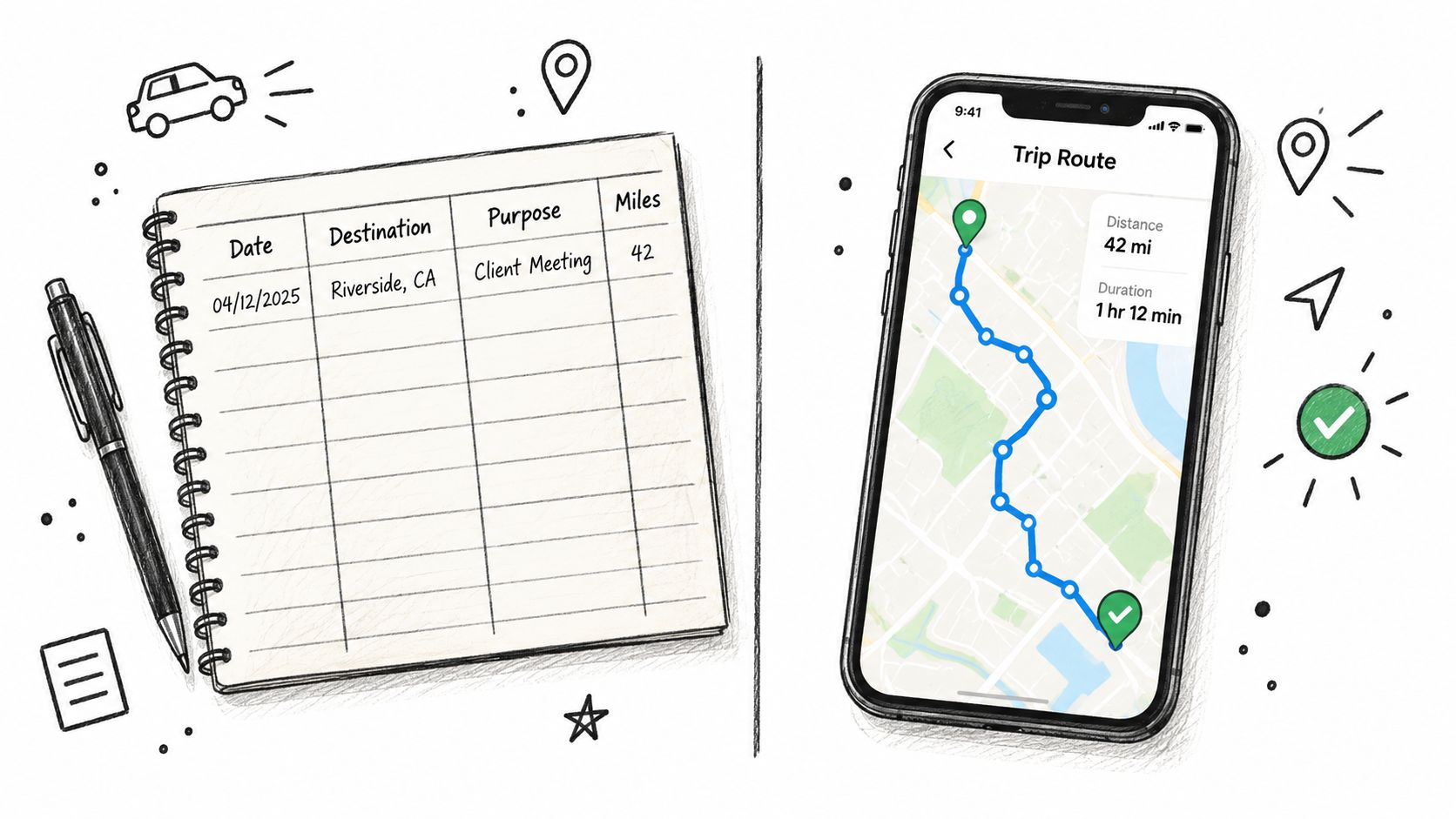
Keep a running mileage log rather than waiting until tax preparation. Record the date, destination, business purpose, and miles while the trip is still fresh.
A useful description might be “picked up packaging for Etsy orders” or “supplier meeting for sample garment review.” “Errands” is too vague to explain the business connection later.
Practical rule: Treat the 67-cent rate as a calculation tool, not permission to claim every mile you associate with your store.
The rate is also different from a reimbursement promise. If you sell through marketplaces, the platform doesn't automatically reimburse your vehicle costs. For a self-employed seller, qualifying mileage generally becomes part of the business expense calculation, subject to the broader tax rules that apply to the business and tax return.
Comparing Business Medical and Charitable Categories
The IRS uses separate mileage categories, and the business rate shouldn't be applied to medical, moving, or charitable driving. A POD seller's trip to a wholesale supplier belongs to a different category from a volunteer delivery for a qualified charity, even if both journeys use the same car.
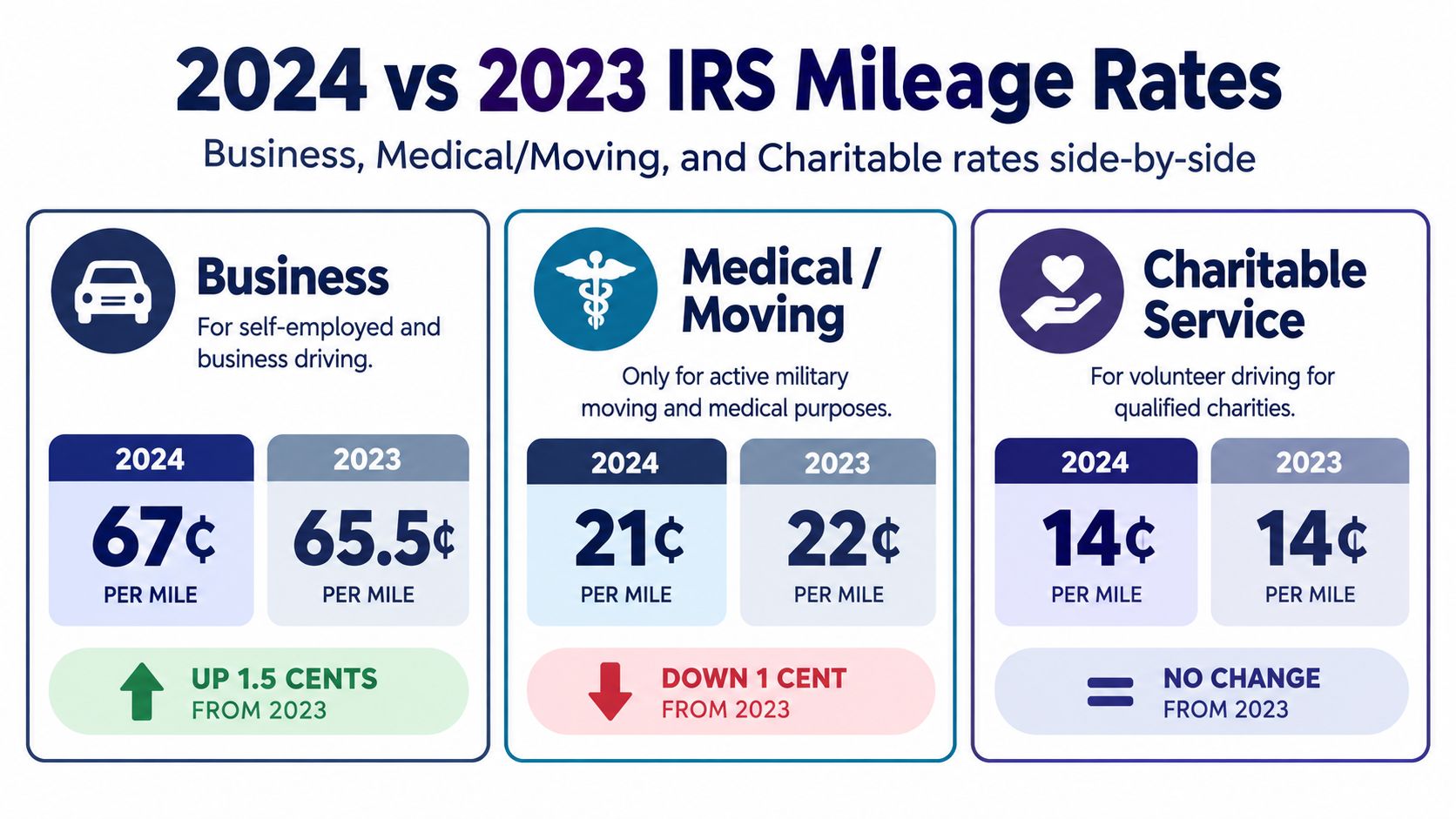
The 2024 rates were 67 cents for business, 21 cents for medical or moving purposes, and 14 cents for charitable service. The medical or moving rate is limited to qualified medical or moving use, with the moving provision applying to qualified active-duty members of the Armed Forces. The charitable rate is maintained by statute, as described in the IRS 2024 mileage notice.
2024 versus 2023
| Category | 2024 Rate | 2023 Rate | Change |
|---|---|---|---|
| Business | 67 cents per mile | 65.5 cents per mile | Up 1.5 cents |
| Medical or moving | 21 cents per mile | 22 cents per mile | Down 1 cent |
| Charitable | 14 cents per mile | 14 cents per mile | No change |
The business rate increased from the prior year's rate, while the medical or moving rate decreased. The charitable amount stayed the same because it is set by statute, rather than being adjusted in the same way as the business rate.
Keep the categories separate
For a POD shop, most relevant vehicle trips will involve potential business use, not medical or charitable use. Still, a mixed day can contain several categories. For example, driving to a supplier is potentially business-related, while a separate trip to volunteer for a qualified charity belongs in the charitable category.
Don't combine those miles in one undifferentiated total. A clean log should identify the purpose for each journey, because the category determines which rate, if any, applies.
The medical category also deserves care. A personal medical trip isn't a business expense because you work for yourself, and the moving rate has a specific eligibility restriction. If a trip doesn't fit the applicable rule, leave it out rather than forcing it into the business column.
What the Business Rate Covers
For a POD seller, a mileage deduction covers more than fuel. The standard business rate represents a broader share of vehicle operating costs, including the vehicle's loss of value through depreciation.
For 2024, the IRS notice included a 30-cent-per-mile depreciation component within the 67-cent business rate, as stated in the official IRS notice for 2024. The calculation therefore accounts for costs beyond gasoline or electricity used during a trip.
Why depreciation changes the decision
A vehicle loses value as it ages and accumulates miles. The standard method includes an allowance for that decline alongside other vehicle costs. You do not claim depreciation as a separate payment when using the standard mileage method. It is already built into the per-mile rate.
That distinction matters when comparing the standard method with actual vehicle expenses. A seller with substantial driving, expensive insurance, or high operating costs may want to discuss the actual-expense method with a tax professional. Another seller may choose the standard method because it avoids sorting every fuel receipt and maintenance invoice between business and personal use.
The trade-off is administrative effort versus potentially different results. The appropriate method depends on the vehicle, business use, records, and tax rules that apply to your situation.
Do not treat the rate as profit
A mileage deduction is not money deposited into your account at the full rate. It reduces taxable business income when the expense qualifies and is properly reported. Its practical value depends on your broader tax position.
For a POD seller, this distinction helps with budgeting. A trip to source samples, deliver inventory, or handle another documented business task creates a vehicle expense that the deduction may measure. It does not turn every mile into an equivalent cash return. Personal drives and ordinary commuting remain separate from qualifying business mileage.
Calculating Your Deductions with Real Examples
The basic calculation is straightforward:
Documented qualifying business miles × 67 cents = mileage amount
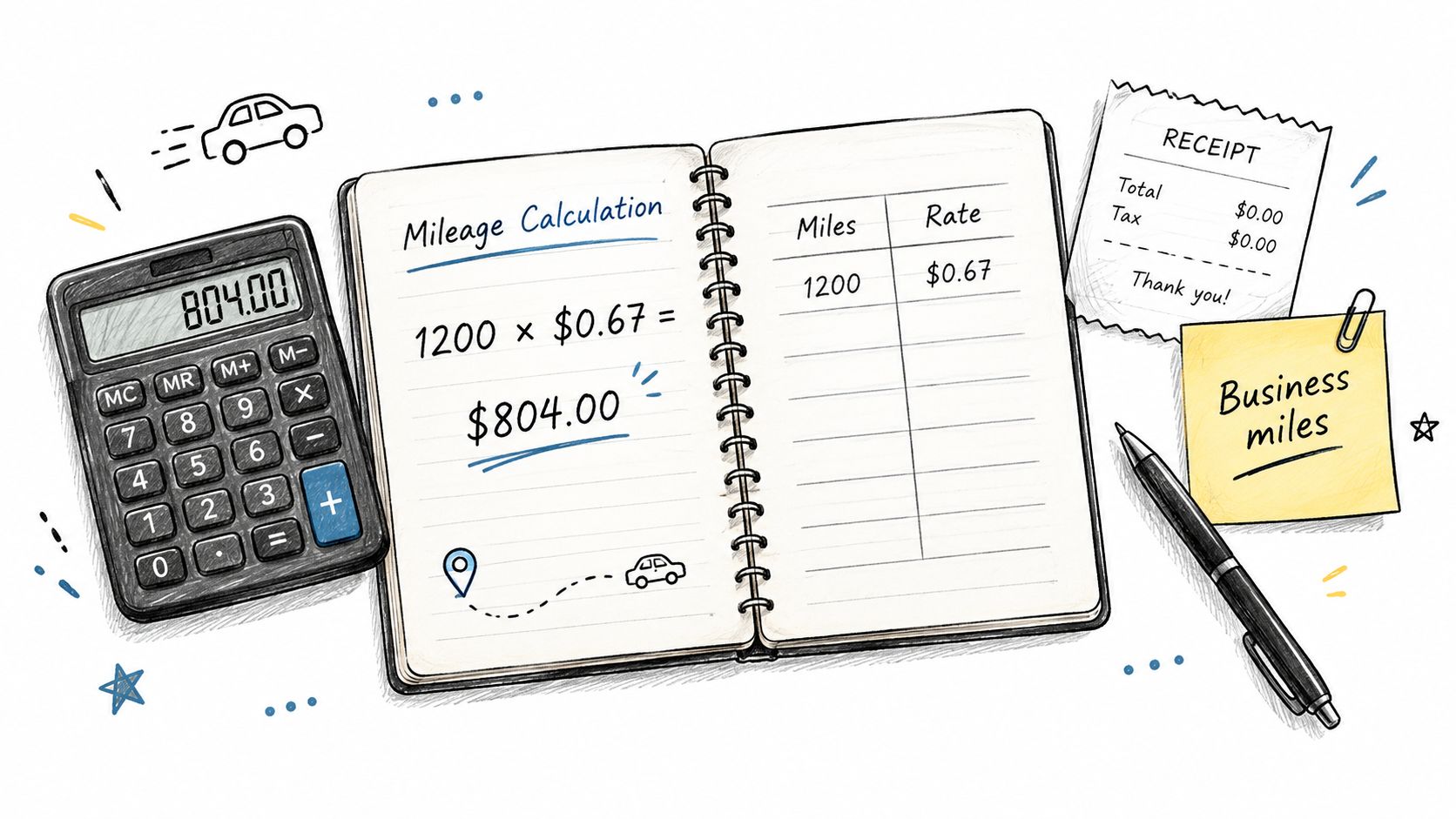
Suppose a POD seller records 1,200 business miles during 2024. The calculation is:
1,200 miles × $0.67 = $804
The IRS mileage rate guidance supports the 67-cent business rate used in that calculation.
Use a repeatable calculation process
Start with your mileage log, not your memory. Add only trips with a documented business purpose, then separate personal and commuting miles before multiplying.
For partial-year vehicle use, count the qualifying business miles from the date you began using the vehicle for the business through the end of the tax year, or through the date business use stopped. The rate itself doesn't change because you began operating midyear. Your total miles reflect the period you recorded.
A useful worksheet can include:
- Trip date: When did the drive occur?
- Destination: Where did you go?
- Purpose: What business activity required the trip?
- Miles: What distance did the trip cover?
- Classification: Business, personal, commuting, medical, moving, or charitable.
Keep the expense picture complete
Mileage is only one part of running a POD business. Sellers also need a reliable way to organize platform fees, software, packaging, contractor payments, and other expenses. If your records are spread across bank statements, email receipts, and notebooks, outsourced controller expense insights can provide useful context for building a cleaner bookkeeping process.
Driving also connects to operational planning. If you're heading to suppliers or printers because you're preparing a launch, keep the trip purpose aligned with the project record. A POD product launch strategy can help you plan the commercial activity around those errands, while your mileage log documents the vehicle use separately.
For sellers outside the United States, don't assume the IRS method applies. The U.K. uses a different Approved Mileage Allowance Payments structure, so international sellers need to check the rules for the country where the business activity and tax reporting occur.
Defining Business Miles Versus Commuting
The most common mistake is assuming that every drive between home and a business-related destination qualifies. Ordinary commuting to a regular place of business is generally treated differently from travel between business locations or travel for a specific business errand.
A trip from home to a dedicated office or studio is generally commuting. That remains true even if you answer customer messages or design products after arriving. The fact that work happens at the destination doesn't automatically change the character of the drive.
Where the business begins matters
A home-based POD seller may have a different fact pattern when a dedicated space in the residence functions as the principal place of business under the applicable rules. In that situation, travel from the qualifying home office to another business location can potentially be business travel, provided the trip itself has a genuine business purpose.
The home-office question is technical. A dining table used occasionally for designs isn't automatically the same as a dedicated office that meets the relevant requirements. Keep the mileage analysis separate from the question of whether the home office itself qualifies.
A business purpose must explain the trip. It isn't enough to say that you were thinking about your store while driving.
Classify common POD trips
| Trip | Likely treatment | Reason |
|---|---|---|
| Home to a regular office or studio | Generally commuting | Travel to a regular place of work |
| Qualifying home office to a supplier | Potentially business | Business travel from the work location |
| Office or studio to a post office | Potentially business | Delivery of business materials or orders |
| Home to a post office | Depends on the facts | The home-office and commuting rules matter |
| Personal shopping with a business stop added | Mixed trip | Only the qualifying business portion should be considered |
A stop at the post office may be business-related if you're sending samples, customer orders, or other business materials. A trip to an office supply store may qualify when the purchase serves the shop, but combining it with personal shopping requires careful separation.
Don't claim the entire round trip because one stop involved the business. Record the route and remove the personal portion when the journey includes both purposes.
A Day in the Life of a POD Seller
Consider a Tuesday for a seller who works from a dedicated home office. The morning starts with design research, listing updates, and niche review at home. No mileage is created by sitting at the desk, of course, but the seller's work records can help explain why later trips were made.
The seller uses a niche research tool to evaluate ideas before preparing sample products. After choosing a direction, they leave for a post office with sample garments and customer packages. The trip has a direct business purpose, so the qualifying portion may be business mileage.
The route matters. If the seller drives from a qualifying home office to the post office, that journey is different from commuting from home to a regular outside office. If the seller has no qualifying home office, the analysis may change, and a tax professional should review the facts.
The afternoon route
After the post office, the seller visits a supplier to discuss blank apparel and then stops at an office supply store for packaging materials. Those legs have identifiable business purposes. The seller should record each destination separately rather than entering one vague line that says “business errands.”
The supplier visit may support product development, while the packaging purchase supports order fulfillment. Both purposes are more useful in a log than a generic label, especially if the seller later needs to explain why the trips were necessary.
The seller then drives home and stops at a grocery store. The supplier-to-home portion may require a mixed-use analysis, and the grocery stop is personal. The seller shouldn't assume every mile on the route remains business mileage after the business activity ends.
Good records follow the route, not just the destination.
Applying the same test every day
A useful test is to ask three questions:
- Why did I leave? Identify the business action that required the trip.
- Where did I go? Name the supplier, post office, printer, or other destination.
- Which part was personal? Remove commuting and personal detours from the business total.
Sellers who are still learning the workflow can use this Print-on-Demand guide for beginners to understand how research, product preparation, and fulfillment fit together. That operational context doesn't decide tax treatment, but it makes it easier to describe the purpose of a trip accurately.
Recordkeeping Rules and Audit Protection
A mileage deduction is only as defensible as the record behind it. Reconstructing a full year's driving from memory is weaker than keeping a contemporaneous log that captures each trip as it happens.
Your basic record should identify the date, destination, business purpose, and total miles. Add notes when a journey includes multiple stops or a personal detour. The goal isn't to create a dramatic narrative. It's to leave a clear trail that connects the vehicle use to the business activity.
Paper logs and digital tools
A paper notebook works if you use it consistently. Keep it in the vehicle, write down the trip before the details fade, and use a consistent format. The weakness is that paper records can be lost, hard to total, and difficult to reconcile with calendar appointments.
GPS mileage apps can reduce manual entry by recording routes and dates. They may make categorization and exporting easier, but they still need review. An app can't reliably decide whether a trip was commuting, business, or personal without your input.
A simple weekly review often works better than a complicated system you abandon. Match your log against your calendar, supplier invoices, post-office receipts, and order records.
Build a low-friction routine
- Log immediately: Enter the trip while the destination and purpose are clear.
- Review weekly: Correct classifications before several months blur together.
- Save supporting records: Keep appointment details, purchase receipts, and order information with the relevant bookkeeping period.
- Reconcile totals: Compare the mileage log with vehicle odometer records and your business calendar.
- Separate categories: Don't combine business, commuting, medical, moving, charitable, and personal trips.
For broader documentation habits, the WP TieOut record keeping guide offers useful bookkeeping context beyond vehicle expenses. A mileage log shouldn't live in isolation. It should fit into the same financial system you use for marketplace income, advertising, software subscriptions, and fulfillment costs.
If you're building a store from scratch, the guide to starting a Print-on-Demand business can help you think through the operational records you'll need from the beginning. Good organization is easier to maintain when it's part of the workflow, not a year-end rescue project.
Common Mileage Mistakes and Final Thoughts
The costliest mileage mistakes usually come from routine habits rather than difficult math. POD sellers round up trips, forget the business purpose, add personal stops to business routes, or try to rebuild the year from bank statements.
A full round trip is another common error when only one direction served the business. Failing to record the vehicle's starting odometer reading for the year also makes it harder to reconcile business miles with total use. A regular commute remains commuting, even if you work on product listings or store tasks after arriving.
Fix the process before tax season
If an old entry lacks support, do not guess. Mark it for review, remove it when the business purpose cannot be established, and improve the record for future trips. A smaller deduction with credible documentation is safer than a larger figure based on vague estimates.
Set a weekly reminder to review mileage. Keep the log in one place, use a consistent naming convention for business purposes, and separate mixed trips as you record them. These habits make questions from a tax professional easier to answer.
| Mistake | Better habit |
|---|---|
| Recording “errands” | Name the business purpose and destination |
| Claiming every mile from home | Check whether the trip is commuting |
| Reconstructing mileage at year-end | Log trips near the time they happen |
| Combining personal and business stops | Separate the qualifying portion |
| Ignoring the odometer | Reconcile the vehicle's overall mileage |
The mileage rate for 2024 provides a starting point for POD sellers, but the rate does not decide the deduction by itself. Classification, records, and consistent treatment matter as well. A home office, multiple vehicles, mixed-use routes, or substantial actual vehicle costs can make method selection less straightforward. A qualified tax professional can help you choose and apply the appropriate method.
Just as disciplined mileage tracking protects your deductions, disciplined niche research protects your product launches. Trendlytic helps POD sellers research niches across TeePublic, Amazon Merch, Redbubble, and Etsy, while its built-in USPTO trademark check helps you review keywords before building products around them. Visit Trendlytic to organize niche research, then apply the same discipline to mileage and expense records throughout the year.