10 Sustainable Design Ideas for POD Sellers
Sustainable design starts before the product is printed. The popular advice is to choose an organic blank and call the job done. That choice can matter, but it's only one decision in a much longer chain: whether the graphic stays useful, whether the product can serve more people, how much material and packaging it uses, how it ships, and whether every environmental claim can be verified.
Print-on-demand gives sellers a structural advantage because products can be made after an order rather than stocked in advance. It doesn't automatically make every blank, ink, package, or delivery route sustainable. Those details depend on the platform, fulfillment partner, product type, and evidence the supplier can provide.
The sustainable design ideas below focus on choices a POD seller can control. Some are design decisions. Others involve supplier selection, listing language, accessibility, packaging, or niche research. I'll separate practical advantages from claims that require documentation, so you can build a sustainability story without promising more than your operation can deliver.
Before investing in a sustainability-led niche, Trendlytic can help compare demand and competition across TeePublic, Amazon Merch, Redbubble, and Etsy. Its built-in USPTO trademark check can also screen proposed collection or brand names before you build a storefront around them.
Table of Contents
- 1. Circular Design Systems
- 2. Bio-Based and Organic Materials
- 3. Minimalist Design Aesthetics
- 4. Upcycled and Deadstock Utilization
- 5. Zero-Waste Packaging Solutions
- 6. Inclusive and Accessible Design
- 7. Local and Ethical Supply Chains
- 8. Design for Longevity and Timelessness
- 9. Regenerative Agriculture and Soil Health
- 10. Digital and Dematerialized Design
- 10 Sustainable Design Ideas Comparison
- Choose the Claim You Can Actually Prove
1. Circular Design Systems
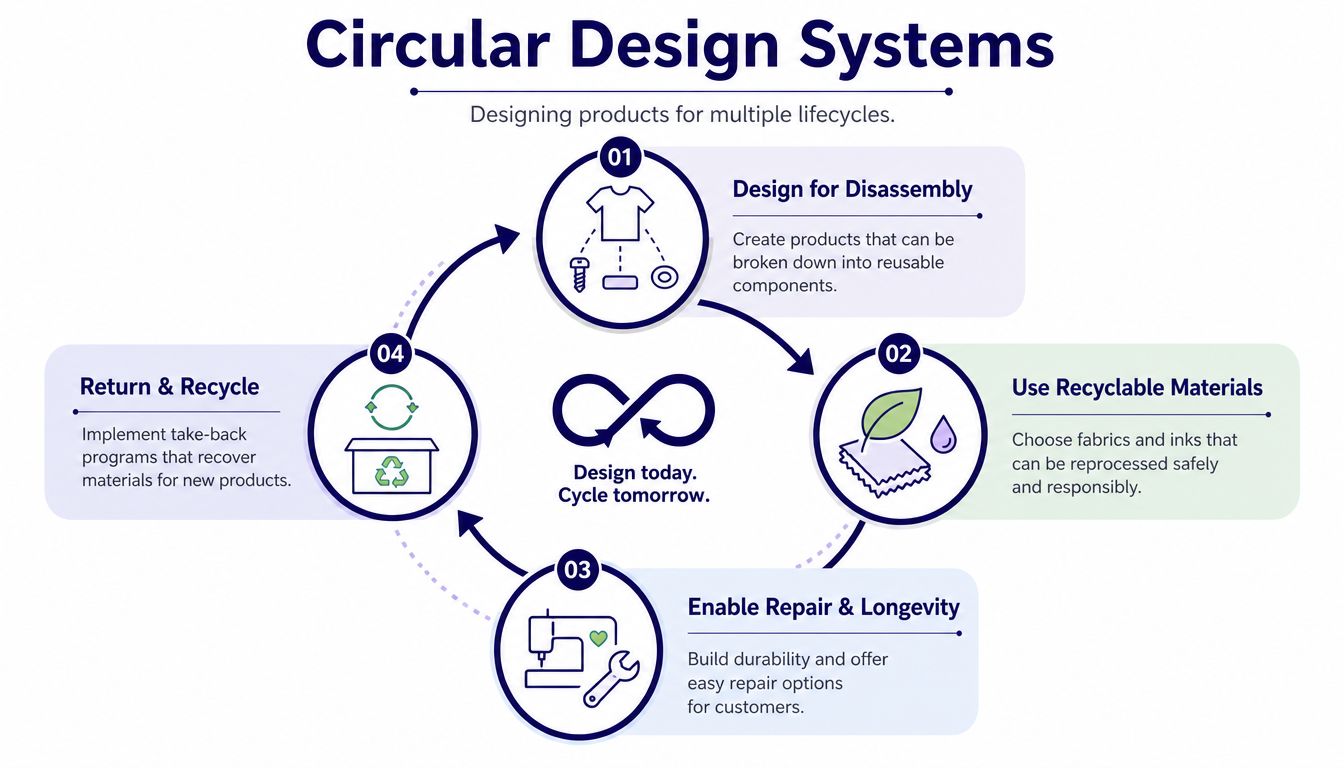
A circular product is planned for continued use, repair, reuse, or responsible recovery rather than a short trip from purchase to disposal. POD sellers rarely control the entire physical system, but they can still design products and collections with a longer life in mind.
Start with graphics that remain appealing after repeated washing and across changing trends. Avoid artwork that depends entirely on a short-lived event, date, or novelty phrase. Add clear care guidance to product descriptions, because customers are more likely to protect a product when they understand how to wash and store it.
A circular approach also changes how you build a collection. Instead of releasing disconnected designs, create related graphics that work across shirts, totes, posters, and other products. Customers can keep using the visual system even when they replace one item. Modular artwork, reversible presentation, and interchangeable accessories are easier to apply to some products than to standard POD apparel, so don't claim recyclability or repairability unless the supplier supports it.
Practical rule: Treat “circular,” “zero-waste,” and “recyclable” as claims that need evidence, not decorative branding language.
Trendlytic can help you identify audiences searching for ideas such as “eco-friendly apparel” or “durable basics,” then compare the competition before you commission a large design set. A trademark search is also sensible before using sustainability language as a collection name. Review this practical zero-waste sewing guide for a useful perspective on designing with material efficiency in mind.
2. Bio-Based and Organic Materials
Material choice can strengthen a sustainable product, but only when the wording matches the supplier's documentation. Organic cotton, hemp, bamboo-derived textiles, and bio-based alternatives all sound attractive. Their relevance depends on the actual composition, processing, certification, and fulfillment route behind the blank.
For a POD listing, replace broad language such as “green fabric” with a precise statement supported by supplier evidence. If a blank is certified, identify the certification accurately. If it contains a stated percentage of a material, use the documented composition rather than a simplified headline that could mislead shoppers.
The practical workflow is straightforward:
- Request evidence: Ask the POD partner for current material specifications and certification details.
- Match the listing: Use only claims that apply to the exact product variant and marketplace.
- Keep records: Save supplier pages, certificates, and product data before publishing.
- Explain care: Direct customers to guidance on caring for organic cotton so the material story includes useful ownership information.
Trendlytic is useful before the sourcing decision, not instead of it. Search combinations such as “organic cotton yoga apparel” or a material term paired with your niche to see how established sellers position the idea. Its validated design reports can also show how competitors present materials, but don't copy a claim until your own supplier confirms it.
3. Minimalist Design Aesthetics
Minimalism can reduce visual excess, but it isn't automatically sustainable. A one-color graphic still uses a physical blank, ink, packaging, transport, and customer resources. The useful contribution is more specific: restrained artwork can require fewer design elements, remain wearable across contexts, and avoid the rapid obsolescence of an overly topical graphic.
A simple design also gives you room to improve the product page. Use readable typography, strong contrast, and enough negative space for the design to work on different garment colors. Test how the artwork looks in a thumbnail and on the actual product mockup. A minimal graphic that disappears against the blank won't deliver a good customer experience because it uses fewer visual elements.
I use niche specificity to keep minimalism from becoming generic. “Minimalist dog lover” is more actionable than “clean lifestyle design,” because the first phrase gives the artwork a clear audience and search context. The same principle applies to sustainable living, gardening, low-waste cooking, or other communities with recognizable interests.
For current design references, compare trending shirt designs rather than assuming every clean graphic has equal demand. Trendlytic's Opportunity Score can help you inspect niches with a more favorable relationship between interest and competition, while Trending Now can reveal concepts gaining attention.
Less artwork can make production simpler, but it won't compensate for an unverified blank or an unusable design.
4. Upcycled and Deadstock Utilization
Upcycling gives surplus materials a second use. Deadstock fabric, leftover apparel, and textile offcuts can become valuable inputs instead of remaining unused. In ordinary apparel production, a designer may have more control over those materials. In POD, the constraint is sharper: most sellers choose from a supplier catalog, and the catalog may not identify whether a blank is deadstock or made from recovered material.
That limitation should shape the offer. If a fulfillment partner provides deadstock blanks, treat the collection as limited and document the product variation customers may see. Color, texture, and availability can change, so your listing should explain the constraint instead of presenting inconsistency as a defect.
A responsible product description might cover:
- Material origin: State what the supplier confirms.
- Availability: Explain that a limited blank may not be restocked.
- Variation: Tell buyers that small differences can occur when the material stream isn't uniform.
- Design intent: Use the limited nature of the product as context, not as pressure built on an unsupported scarcity claim.
Freitag's use of recovered truck tarpaulins is a recognizable example of turning an existing material stream into a new product category. That model doesn't transfer directly to every POD catalog, but it illustrates the design question well: what material already exists, and how can the next product keep it useful?
Use Trendlytic to inspect “upcycled” or “recycled” alongside your niche before paying a premium for sourcing. Check proposed brand names through its trademark screening, and avoid treating a sustainability term as available because it describes a product approach.
5. Zero-Waste Packaging Solutions
Packaging is visible to customers, yet POD sellers often control only part of it. A fulfillment partner may select the mailer, tape, insert, and protective layer. Choose partners with suitable options, but describe packaging as compostable, recyclable, or plastic-free only after confirming the exact materials used for the product and destination.
Start with a test order. Photograph the complete parcel, including the outer mailer, label, inserts, and protective materials. Ask the supplier whether these components change by product, region, or fulfillment facility. Keep the answers with your product records so listing claims match actual orders.
A useful packaging audit should record:
- What arrives: List every material the customer receives.
- What the supplier controls: Separate your artwork and listing choices from the partner's standard system.
- What customers can do: Provide disposal guidance only when the material and local facilities support it.
- What you can remove: Avoid adding cards, tissue, stickers, or promotional inserts that do not serve the order.
Packaging control varies by sales channel. An Etsy seller may have more room to explain choices or add a permitted insert. Redbubble, TeePublic, and Amazon Merch can use different product and shipping systems, so keep any statement specific to the platform and fulfillment route. If the blank or order destination changes, review the claim again.
Use Trendlytic to compare packaging language and customer responses across competing Etsy and Redbubble listings. You can also review MSP Packaging sustainable examples for ideas, but verify the final wording through your own fulfillment evidence. A zero-waste goal should guide the audit, not replace material-level verification.
6. Inclusive and Accessible Design
A product that excludes people through sizing, contrast, typography, or usability has a shorter practical reach. Inclusive sustainable design makes products useful to more customers and reduces the need to create separate versions after launch.
For POD sellers, accessibility begins with the artwork and the listing. Use color combinations that remain distinguishable for people with common forms of color-vision deficiency. Avoid tiny lettering, low-contrast text, and decorative fonts that become unreadable in thumbnails. Run designs through a colorblindness simulator, then inspect the actual mockup at the size customers are likely to view.
Accessibility also includes product range and communication:
- Offer available sizes: Review the blank catalog rather than assuming every product supports the same range.
- Write descriptive alt text: Describe the artwork, garment color, and relevant visual details on Etsy, Redbubble, and other platforms that support image descriptions.
- Show the product clearly: Include views that help buyers understand fit, placement, and color.
- Use precise language: Don't call a product adaptive, accessible, or universally designed unless its construction supports that claim.
Search Trendlytic for combinations such as “plus-size sustainable fashion” or “adaptive clothing” to find communities that may be underserved. The opportunity isn't adding a larger size or changing a palette. It's listening to the needs of the audience and checking whether the selected supplier can deliver consistently.
Fabletics, Target's Universal Thread line, and Zappos Adaptive illustrate how inclusion can be treated as a product requirement rather than a promotional afterthought. Their categories aren't identical to POD, so use them as design references, not proof that your own offer meets the same standard.
7. Local and Ethical Supply Chains
A sustainability claim is incomplete when it describes the graphic but ignores the people and facilities producing the item. POD sellers should understand who prints the product, where production occurs, what the supplier discloses about labor and environmental practices, and which claims are backed by certification or published policy.
This isn't a request for a dramatic supplier story. It's a verification task. Save the fulfillment partner's current information, record the product and facility details that apply to your listing, and avoid turning a general corporate statement into a claim about every order.
The strongest product pages distinguish between known facts and brand interpretation:
- Known production detail: Name the supplier or facility only when the information is current and applicable.
- Certification detail: Identify the certifying organization and scope instead of using “ethical” as a substitute for evidence.
- Location detail: Say where production occurs when the supplier confirms it.
- Unknowns: Leave out wage, working-condition, or local-sourcing claims you can't document.
A transparent supply chain can support trust, but it may also introduce constraints. A local option might have a narrower catalog, higher base cost, or limited delivery coverage. A large network might offer broader product availability while giving you less control over facility selection.
Before committing, use this guide to starting a print-on-demand business alongside your supplier review. Trendlytic can show how competitors use words such as “ethical” or “fair trade,” but market language isn't evidence. Check the proposed brand name through its USPTO screening, and only use certification terms when your documentation supports them.
8. Design for Longevity and Timelessness
The most sustainable graphic may be the one a customer still wants to wear after the original trend has passed. Longevity begins with an intentional design system, not a promise that a garment will last forever. Durable construction matters, but a product that becomes culturally irrelevant can still leave the customer's wardrobe quickly.
I separate short-term attention from sustained interest. Trendlytic's hourly Trending Now rankings can help identify what is gaining traction, while its design archive lets you compare concepts over a longer period. A viral phrase may be useful for a quick experiment, but a durable niche often comes from a broader identity, activity, or value that customers continue to recognize.
Use these design decisions as filters:
- Choose flexible palettes: Test black, white, navy, and earth-tone blanks before committing to a narrow seasonal color.
- Limit dated references: A class year or event date has a built-in expiration point.
- Build recognizable collections: Related designs can stay relevant without repeating the same artwork.
- Prioritize readable placement: A design that looks balanced on the blank is easier to keep wearing.
Uniqlo's basic apparel, classic band tees, and restrained branding demonstrate the appeal of familiar forms. Supreme's simple graphics show another route, where a small visual system can remain recognizable without constant ornament. Those examples don't guarantee POD performance, but they make the design principle tangible.
Use Automated Niche Discovery to look for enduring subtopics within a growing category. The aim isn't to avoid every trend. It's to avoid building an entire collection on a reference that customers will understand only briefly.
9. Regenerative Agriculture and Soil Health
Regenerative sourcing asks a more demanding question than “does this material have a lower impact?” It asks whether the agricultural system supports healthier soil and ecological function through practices such as crop rotation, cover cropping, and reduced tilling. For a POD seller, the important point is that this story usually sits upstream, beyond the artwork and often beyond the seller's direct control.
That makes verification essential. If a blank supplier refers to regenerative cotton or a related claim, ask which farm, program, or certification supports it. Regenerative Organic Certified is one example of a third-party framework buyers may recognize, but you should confirm that the certification applies to the specific product rather than assuming a brand-level statement covers every blank.
A regenerative claim should identify the material, the standard, and the product it covers.
Explain the concept in plain language. Many customers understand “organic cotton” more readily than “regenerative agriculture.” A useful listing can describe the soil-health focus without claiming that one shirt restores an ecosystem or offsets unrelated impacts.
Before paying for a premium blank, search Trendlytic for “regenerative” alongside the intended niche. Its design and pricing analysis can help you understand how competing sellers frame the concept, but it can't validate the agricultural claim. Keep the supplier certificate, scope, and date in your product records, then review whether the claim remains current when the blank changes.
The Regenerative Organic Alliance and brands associated with regenerative fiber sourcing provide useful examples of how the story can be communicated. They aren't substitutes for supplier documentation, and they shouldn't be presented as evidence about your own product.
10. Digital and Dematerialized Design
Print-on-demand's clearest structural advantage is that production follows an order. You don't need to guess how many units will sell before creating a listing, and you can test artwork without purchasing a conventional inventory run. That reduces one kind of overproduction risk, but it doesn't erase the materials, energy, packaging, transport, returns, or waste associated with the physical order.
The honest listing language is simple: describe the item as made to order when that is how the platform fulfills it. Don't convert that statement into a sweeping claim such as “zero waste” unless you can support every part of the claim. Digital products, downloadable artwork, and other dematerialized offers remove physical production, but they still require clear licensing, file quality, customer support, and accessible delivery.
A sensible POD workflow looks like this:
- Test digitally first: Develop and compare artwork before committing to physical samples or a broad collection.
- Keep slow movers on demand: Let the fulfillment model absorb uncertain demand rather than pre-making stock.
- Use platform-specific research: Compare Amazon Merch, Redbubble, Etsy, and TeePublic because their audiences, controls, and product catalogs differ.
- Document the model: State what “made to order” means for the product and supplier you use.
For a deeper workflow, see POD design research methods. Trendlytic can compare live bestseller data across the four marketplaces and surface validated designs, tags, images, and pricing so you can investigate demand before expanding production.
10 Sustainable Design Ideas Comparison
| Item | Implementation Complexity 🔄 | Resource Requirements ⚡ | Expected Outcomes 📊 | Ideal Use Cases 💡 | Key Advantages ⭐ |
|---|---|---|---|---|---|
| Circular Design Systems | High, design for disassembly, take-back logistics | High, material research, reverse logistics | Significant waste reduction; higher lifetime value; premium pricing | Eco-conscious POD sellers targeting quality buyers | Builds strong loyalty; clear sustainability differentiator |
| Bio-Based and Organic Materials | Medium, sourcing and certification management | High, costlier materials and certification fees | Lower chemical exposure; certification credibility; premium margins | Wellness, yoga, lifestyle niches; health-aware consumers | Proven market demand; certification alignment enhances trust |
| Minimalist Design Aesthetics | Low, fewer colors and simpler production | Low, reduced ink use, easy scaling | Lower costs; faster production; broad, timeless appeal | New sellers; saturated markets; versatile niches | Cost-effective; timeless and widely marketable |
| Upcycled and Deadstock Utilization | Medium–High, variable sourcing and quality control | Medium, depends on supplier relationships and inventory | Reduced demand for new materials; unique limited editions; strong story | Sellers with supplier access targeting conscious niches | Cost-saving potential; scarcity drives urgency and narrative |
| Zero-Waste Packaging Solutions | Medium, sourcing verified compostable/recyclable options | Medium, higher per-unit packaging cost | Less packaging waste; stronger brand perception; shareable unboxing | Premium DTC and sellers controlling fulfillment | Reinforces brand values; enhances customer experience |
| Inclusive and Accessible Design | Medium, design adaptations and accessibility testing | Low–Medium, design work; expanded size production | Broader market reach; fewer returns; improved loyalty | Sellers targeting underserved or adaptive markets | Access to loyal, underserved customers; reputation boost |
| Local and Ethical Supply Chains | High, vetting, audits, and supplier management | High, higher supplier costs; limited capacity | Strong ethical credibility; lower transport emissions; premium pricing | Established sellers able to manage supplier relationships | Authenticity and reduced reputational risk |
| Design for Longevity and Timelessness | Medium, creative restraint and durable construction | Medium, better materials and build quality | Evergreen sales; reduced churn; lower marketing needs over time | Sellers building passive-income, long-term catalogs | Consistent long-term revenue; reduced need for new launches |
| Regenerative Agriculture and Soil Health | High, certification and traceable sourcing | Very High, limited supply and premium pricing | Real climate benefits; elite sustainability positioning | Premium brands targeting ultra-conscious, affluent buyers | Highest-tier environmental impact; strong premium justification |
| Digital and Dematerialized Design (POD) | Low, production-on-demand workflows are standard | Low, minimal capital, no inventory overhead | Eliminates overproduction; flexible testing; lower financial risk | All POD sellers and digital-first creators | Inherent sustainability; scalable without inventory burden |
Choose the Claim You Can Actually Prove
Sustainable POD works best as a sequence of reliable decisions, not as a large promise placed on the product page. Start with made-to-order production and design choices that support continued use. That means avoiding disposable references, testing readable artwork, selecting products customers can understand and care for, and keeping slower-moving designs in an on-demand workflow.
Then improve the parts your fulfillment partner allows you to improve. Material composition, organic certifications, packaging, facility information, print processes, and delivery options may vary across TeePublic, Amazon Merch, Redbubble, and Etsy. A claim that is accurate for one blank or supplier may be inaccurate for another. Keep the product, marketplace, and fulfillment route attached to every sustainability statement.
I recommend creating a small evidence file for each collection before publishing it. Save the current blank specification, certification information, packaging details, supplier policy, and any disposal guidance you give customers. If a product changes, review the listing rather than assuming the old wording still applies.
Pay special attention to terms that sound broader than they are. “Organic,” “recycled,” “regenerative,” “carbon-neutral,” “plastic-free,” “fair trade,” and “zero-waste” can each imply a defined standard or a complete system. If the supplier only confirms one component, describe that component. Don't let a true detail about the blank become an unsupported claim about the whole product.
The building sector shows why these decisions matter at scale. The Global Alliance for Buildings and Construction reports that buildings and construction account for nearly 50% of global material extraction, 37% of global emissions, and 28% of global energy consumption. In 2024, global building floor area reached 273 billion square metres after expanding by 1.7%, with an estimated 12.7 million square metres added each day. The report also records an 8.5% fall in global building energy intensity, nearly tripled green-building certifications over the last decade, and renewables supplying 17.3% of buildings' energy demand in 2024. These figures come from the Global Status Report for Buildings and Construction, and they underline a practical point for POD sellers: sustainability is about measurable systems, not an aesthetic category.
For product decisions, life-cycle assessment provides a stronger basis than intuition. SimaPro's Environmental Footprint database uses European Product Environmental Footprint Category Rules to compare a product with the average European product in the same category. An LCA can help identify whether materials, manufacturing, distribution, or end of life deserves attention first. You don't need to publish a complex assessment for every shirt, but you should use the same logic: find the stage you can influence and avoid claiming that a small improvement solves the entire lifecycle.
The same discipline applies to material health. Cradle to Cradle Certified's Material Health Certificate Version 4.1 became effective on 1 July 2024, products certified under earlier versions must transition under the program policy, and each certificate remains valid for three years before recertification. The framework focuses on chemical optimization and avoiding substances assessed as X or grey, with banned-list and supplier-declaration checks included in the process. If a supplier references this framework, confirm the product certificate and version rather than repeating a general brand statement. You can review the Material Health Certificate standard and user guidance for Version 4.1.
Embodied carbon is another useful distinction. It covers greenhouse-gas emissions associated with materials and construction processes across stages such as extraction, transport, manufacturing, delivery, installation, and sometimes end of life. For a POD seller, the comparable lesson is to ask where the product's largest impacts may occur, request environmental product declarations when available, consider salvaged or refurbished inputs where the model supports them, and design products or components for disassembly when that is possible. The UBC review of embodied-carbon policy provides the relevant framework.
Occupant-satisfaction research also offers a reminder that sustainability isn't separate from use. In an Australian higher-education study, green buildings scored higher than non-green counterparts on several design and facilities-management factors, including building image, with Rho = 0.84, cleaning, with Rho = 0.81, perceived health, with Rho = 0.47, and productivity, with Rho = 0.22. Employees who had spent at least one year in the building reported significant satisfaction differences, while newer occupants did not. The study on green-building occupant satisfaction supports a useful POD analogy: don't assume the sustainability story is enough. Observe whether customers can use, understand, wash, wear, and keep the product.
Use Trendlytic to validate demand across the four marketplaces before naming a collection. Its Opportunity Score, live niche reports, store-first bestseller analysis, 60-plus validated designs, hourly Trending Now rankings, automated Niche Discovery, and USPTO trademark screening can shorten the research process. The tool can show what deserves investigation, but it can't verify a supplier's claim or guarantee sales.
Choose the claim you can prove, then deliver the product that claim describes. If you can't verify the material, packaging, certification, or production statement, remove it or rewrite it more narrowly. That restraint protects customer trust and gives your sustainable design ideas a stronger foundation than a polished but fragile label.
Trendlytic helps POD sellers compare demand and competition across TeePublic, Amazon Merch, Redbubble, and Etsy, then inspect validated designs, tags, images, and pricing before building a sustainability-led collection. Visit Trendlytic to shorten manual niche research, and use the USPTO trademark check to screen collection names before you publish them.