How to Find High Demand Low Competition Products for POD
You're probably in the same loop most POD sellers hit sooner or later.
You find a niche that looks hot. You open Redbubble or Etsy, search it, and see page after page of the same jokes, the same layout, the same clip art treatment. It feels active, but it also feels late. So you either publish something anyway and hope it sticks, or you keep researching until you're too cautious to launch at all.
That's usually the wrong frame.
The job isn't finding a product nobody has thought of. In POD, that almost never matters. The job is finding a pocket of demand where buyers are already spending money, but sellers still haven't organized the market into strong, clear offers.
Table of Contents
- Why High Demand Low Competition Matters More in POD Right Now
- What High Demand and Low Competition Actually Look Like
- A Practical Workflow to Discover Winnable POD Niches
- How to Evaluate Competition and Spot Room to Win
- Validation Checklist Before You Publish Anything
- Listing and Scaling Tips That Keep Niches Profitable
Why High Demand Low Competition Matters More in POD Right Now
POD feels crowded because broad themes are crowded.
Cats, nurses, camping, birthdays, teachers, gym quotes. Those markets are full, and most sellers start there because the demand is obvious. The problem is that obvious demand attracts obvious competition.
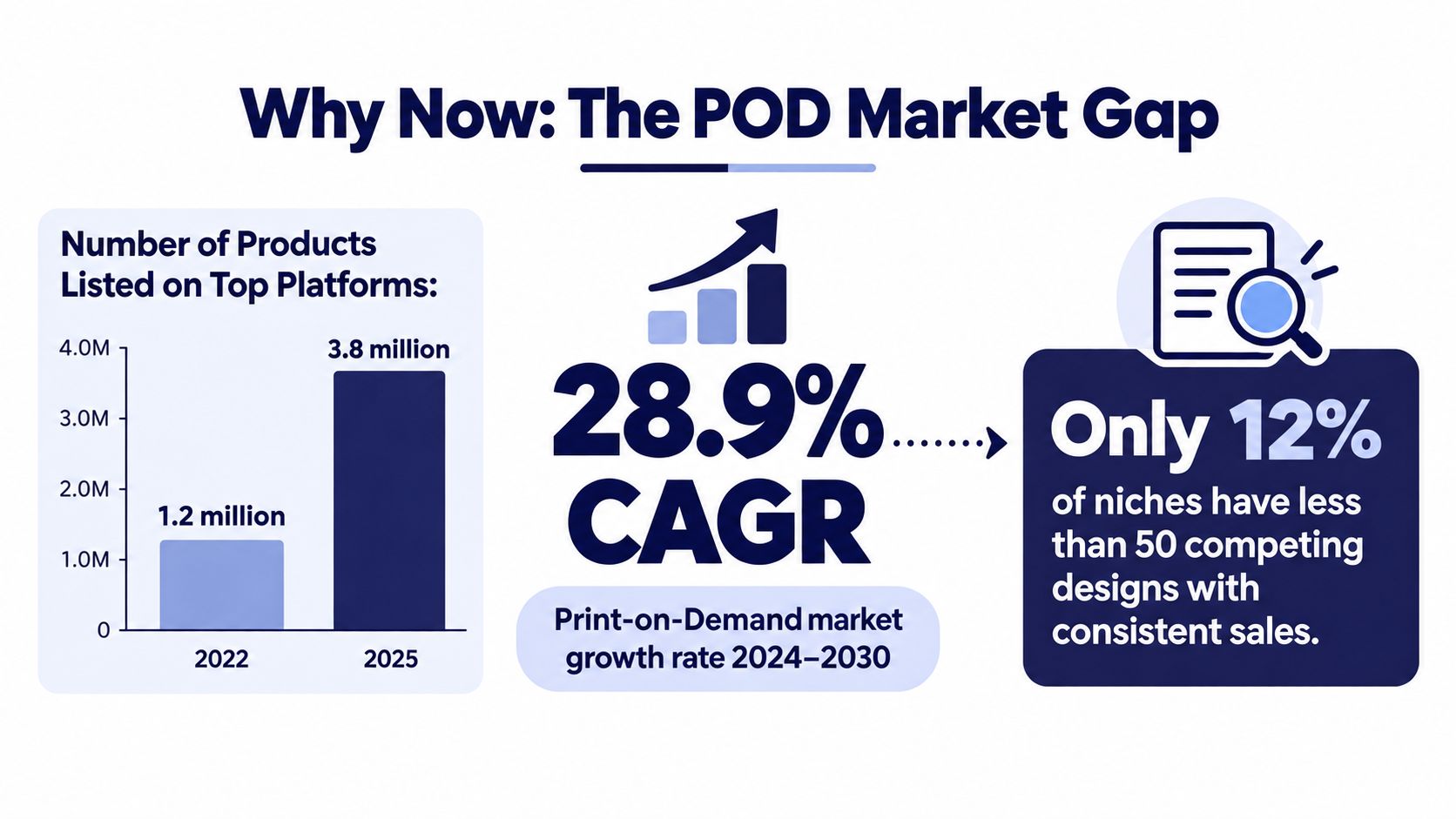
What's changed is the size of the market itself. The print-on-demand sector has grown into a major global market, with 2026 estimates ranging from about USD 9.3 billion to USD 15.19 billion, and projections showing roughly 20.0% to 25.8% CAGR through 2031 to 2034, depending on the forecast in Mordor Intelligence's print-on-demand market research. One projection in that same report expects the market to rise from USD 15.19 billion in 2026 to USD 46.43 billion by 2031, implying 25.05% CAGR.
That matters because large, fast-growing markets create more micro-niches than most sellers can track manually.
Saturated themes and open pockets aren't the same thing
I've seen sellers confuse a crowded topic with a closed market. They aren't the same.
A broad niche like “dog shirts” is crowded. But “agility dog mom typography,” “funny dachshund gardening,” or “rescue pitbull memorial art” can still be fragmented. Sales exist, but the listings often look interchangeable, the angles are shallow, and no single design language really owns the space.
That's where POD still works.
Practical rule: Don't ask whether a category is saturated. Ask whether buyers can already see what they want, and whether sellers are still presenting it poorly.
Another reason this matters now is simple. The cost of being wrong in POD isn't inventory. It's time, design hours, upload effort, and account risk. If you chase demand without screening competition, you can burn through a week of work on niches that were never winnable.
What usually fails
Three patterns waste the most time:
- Broad-volume chasing: Sellers go after terms that look active but are too generic to differentiate.
- Late trend copying: A design style is already everywhere by the time it feels safe.
- No market-structure check: The niche has sales, but top listings all solve the buyer intent the same way, better than you can.
A better approach is to look for fragmented demand. That means buyers are there, but the market still feels messy. Products exist. Strong positioning doesn't.
That's the sweet spot for learning how to find high demand low competition products in POD.
What High Demand and Low Competition Actually Look Like
Most bad niche decisions happen because sellers define demand too loosely and competition too narrowly.
They see a lot of listings and assume demand. Or they see a keyword with activity and assume low competition if the artwork looks weak. Neither is enough.
Demand is more than a busy search result
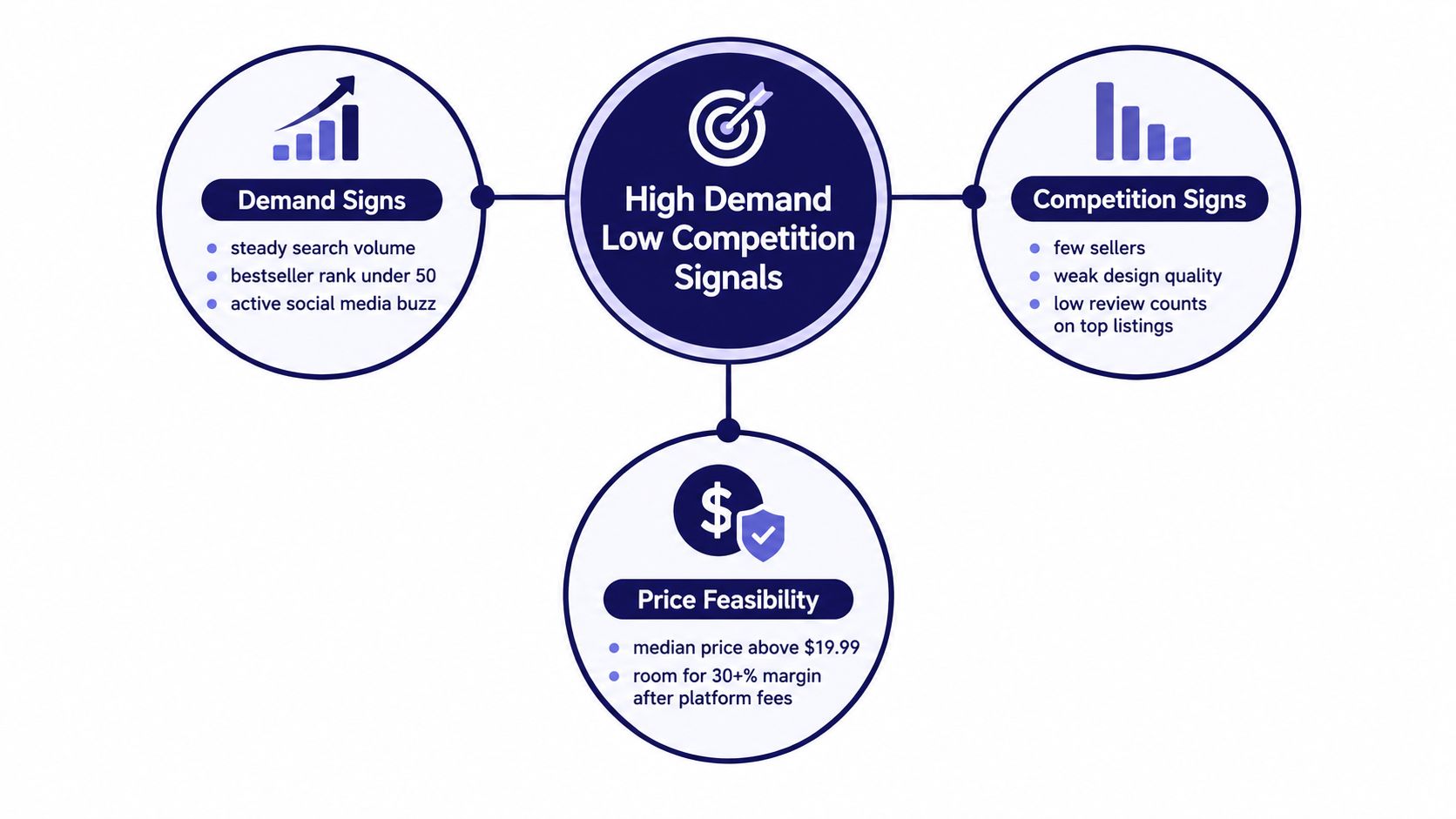
I treat demand as a stack of signals, not one metric.
You want evidence of searches, purchases, and repeat purchases. Independent product-research data reported that products chosen with research tools are 50% more likely to become bestsellers in their first 90 days, and sellers using a structured research process see 2x better conversion rates than sellers relying on instinct, according to ZIK Analytics product research statistics.
The same source adds an important filter. Low-competition keywords with 1,000+ monthly searches drive 2.4x more clicks on marketplaces such as Etsy, while products with fewer than 100 competitors and at least 3 unique selling points are 2.7x more likely to succeed.
That doesn't mean you should only chase neat thresholds. It means demand works best when it's paired with screening and differentiation.
Competition isn't just listing count
I care less about how many results exist and more about what those results look like.
A niche can show a lot of listings and still be beatable if the top offers are weak, repetitive, or badly positioned. Current coverage on this topic gets this part right: the better question isn't “what product has low competition?” but “where is demand present but the market is still unstructured?” That fragmented-market angle is laid out well in Winning Hunter's discussion of high-demand, low-competition products.
Here's what low competition often looks like in practice:
- Interchangeable top listings: Similar slogans, same composition, same colors.
- Weak buyer targeting: Listings are aimed at everyone instead of a specific identity or use case.
- Loose visual language: No clear style leader has set the expectation buyers now copy.
- Shallow variation: A niche has one obvious joke or motif, but not many well-developed design directions.
If the first page looks busy but forgettable, that's often better than a niche with fewer listings and stronger offers.
Three signals worth trusting
| Signal | What it suggests | What to ignore |
|---|---|---|
| Repeated bestseller themes across stores | Real buyer interest exists | A single viral-looking design |
| Stable pricing bands | Buyers accept the product value | One underpriced listing trying to force a race down |
| Weak differentiation in top results | Room to enter with a sharper angle | Raw result count by itself |
One more point matters. The same ZIK Analytics source says nearly 63% of failed stores admitted they didn't spend enough time validating demand before launch. That lines up with what most sellers learn the hard way. Research isn't the delay before the work. It is the work.
A Practical Workflow to Discover Winnable POD Niches
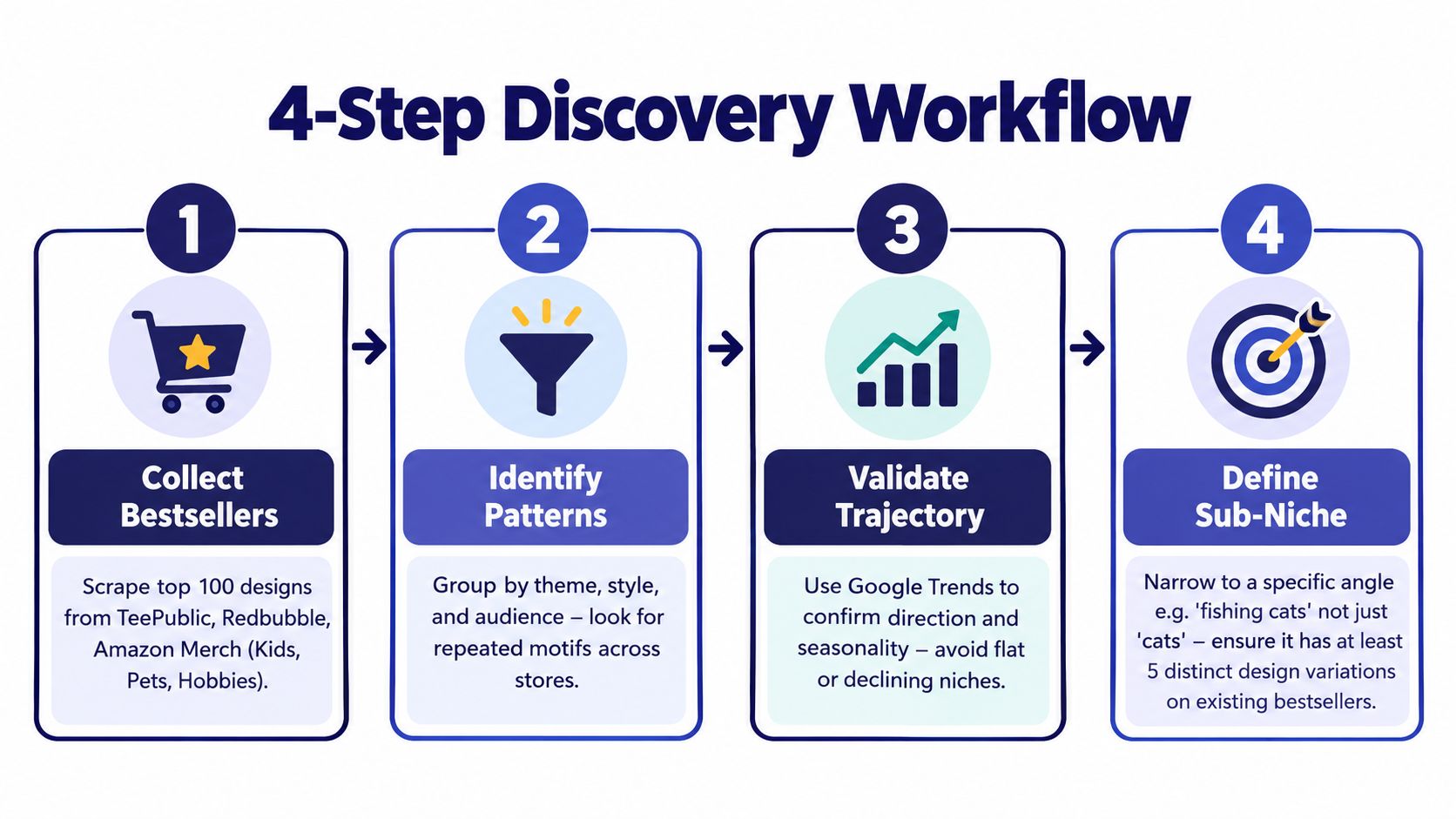
The cleanest workflow starts from stores and bestsellers, not from isolated keywords.
If I'm researching a niche, I want to know what's already earning attention on TeePublic, Amazon Merch, Redbubble, and Etsy. That tells me more than a blank search bar does, because I'm looking at what buyers already reward.
Start with proven sellers, not idea generation
A store-first method solves a common problem. It keeps you from building around niches that only look good in search but don't show real marketplace traction.
I usually scan live bestseller patterns first. Which themes keep appearing across top designs. Which audiences show up in multiple shops. Which art styles repeat without becoming identical. That tells you where a niche has moved beyond theory.
If you want a separate framework for spotting movement early, the revid.ai niche discovery guide is useful because it pushes you to compare signals instead of trusting one trend source.
Narrow with demand and competition together
Once a pattern looks promising, the next move is to narrow the angle until it becomes useful for design.
“Fishing” is too broad. “Retired bass fisherman” is still broad. “Funny fly fishing for dads with vintage badge styling” is getting closer. The point isn't to make the niche tiny for the sake of it. The point is to land in a sub-market where buyer identity is clear and top listings still leave room.
One practical way to do that is to review a niche report that combines demand level, competition level, related keywords, and real bestseller examples in one place. Tools that pull from live marketplace data can shorten the scan dramatically. For example, Trendlytic tracks bestseller data across TeePublic, Amazon Merch, Redbubble, and Etsy, and shows demand, competition, related niches, pricing, and tags, which is useful when you want to compare proven sub-niches instead of guessing from search results. If you want a broader workflow for reading trends before you choose the niche, Trendlytic's article on how to do trend research is a practical companion.
What I look for in a fast scan
I'm usually trying to answer five questions quickly:
- Are multiple stores selling into this theme? One successful seller can be an outlier. Several shops usually means broader demand.
- Do the top designs cluster around one motif? If yes, there may be room for a better variation.
- Do related keywords branch naturally? If they do, the niche can scale.
- Are prices holding? Stable pricing usually means sellers aren't trapped in a race to the bottom.
- Can I name a specific buyer immediately? If not, the niche is still too vague.
A short video walkthrough helps if you prefer seeing this process in motion.
Keep the machine work separate from the judgment call
Automation helps with collection. It doesn't replace taste.
Recent reporting says AI referral traffic quadrupled in 2025, which is a useful reminder that discovery is being shaped more by structured information quality, marketplace signals, and machine-readable relevance, as covered in Retail Asia's report on AI referral traffic and product discovery shifts. That means your workflow can't stop at “keyword looked good.”
A niche can test well in data and still fail if the design angle is flat, the buyer identity is fuzzy, or the metadata doesn't match what the platform can understand.
Human judgment still does the final filtering. The tool shows the market. You still have to decide whether your version will deserve the click.
How to Evaluate Competition and Spot Room to Win
A niche is only useful if you can enter it without fighting on price alone.
That's why I like a simple gate system. One practical Amazon research framework uses five checks before sourcing: enough demand, beatable competition, 25 to 30% net margin after COGS, fees, and PPC, clear differentiation, and manageable logistics or regulatory risk, as explained in LNH31's guide to product research and winning products. POD has different production mechanics, but the logic carries over cleanly.
The five gates I actually care about
Some gates are obvious. Others get ignored until they become expensive.
- Demand has to be visible. Not imagined, not “I think people would like this.” You should be able to see active listings, recurring themes, and proof that buyers exist.
- Competition has to be beatable. Not absent. Beatable means top offers leave gaps in style, audience fit, or message clarity.
- Margin has to survive reality. Fees, ads, discounts, and returns matter. A niche that only works at the fantasy margin isn't a niche.
- Differentiation has to be real. Better feature set in physical products becomes better angle, stronger art direction, smarter bundle, or tighter identity in POD.
- Operational risk has to stay manageable. This includes trademark exposure, touchy phrases, and themes that attract platform scrutiny.
Crowded vs winnable POD niches at a glance
| Signal | Crowded Generic Niche | Winnable Fragmented Niche |
|---|---|---|
| Listing quality | Top results are polished and intentional | Top results feel uneven or rushed |
| Tag overlap | Everyone targets the same broad terms | Related tags branch into sub-audiences |
| Price pressure | Sellers undercut each other fast | Prices hold because positioning differs |
| Buyer identity | Too broad to speak clearly | One type of buyer is easy to name |
| Brand story potential | Hard to say why this design exists | Easy to connect design to identity or moment |
| Visual differentiation | Variations feel cosmetic | New angle actually changes the appeal |
If you want a deeper way to think about this side of research, Trendlytic's piece on competition scoring for POD niches is worth reading because it pushes past raw listing counts.
What room to win actually looks like
I'd rather enter a niche with visible sales and mediocre offers than a niche with fewer listings but strong incumbents.
For example, “funny teacher shirt” is noisy and generic. Most sellers can't say anything new there. But a narrower angle like a subject-specific, grade-specific, personality-specific teacher niche can stay open longer if current listings all lean on the same tired line and basic text treatment.
Decision test: If you can describe your future listing as “the same thing, but mine looks cleaner,” keep looking. If you can describe it as “same audience, clearer identity, better angle,” you may have something.
The main failure I see isn't weak demand. It's weak economics and weak distinction. Sellers find a niche that has life, then publish a design that doesn't add enough.
That's not a research problem. That's an offer problem.
Validation Checklist Before You Publish Anything
A niche can look good and still be a bad launch.
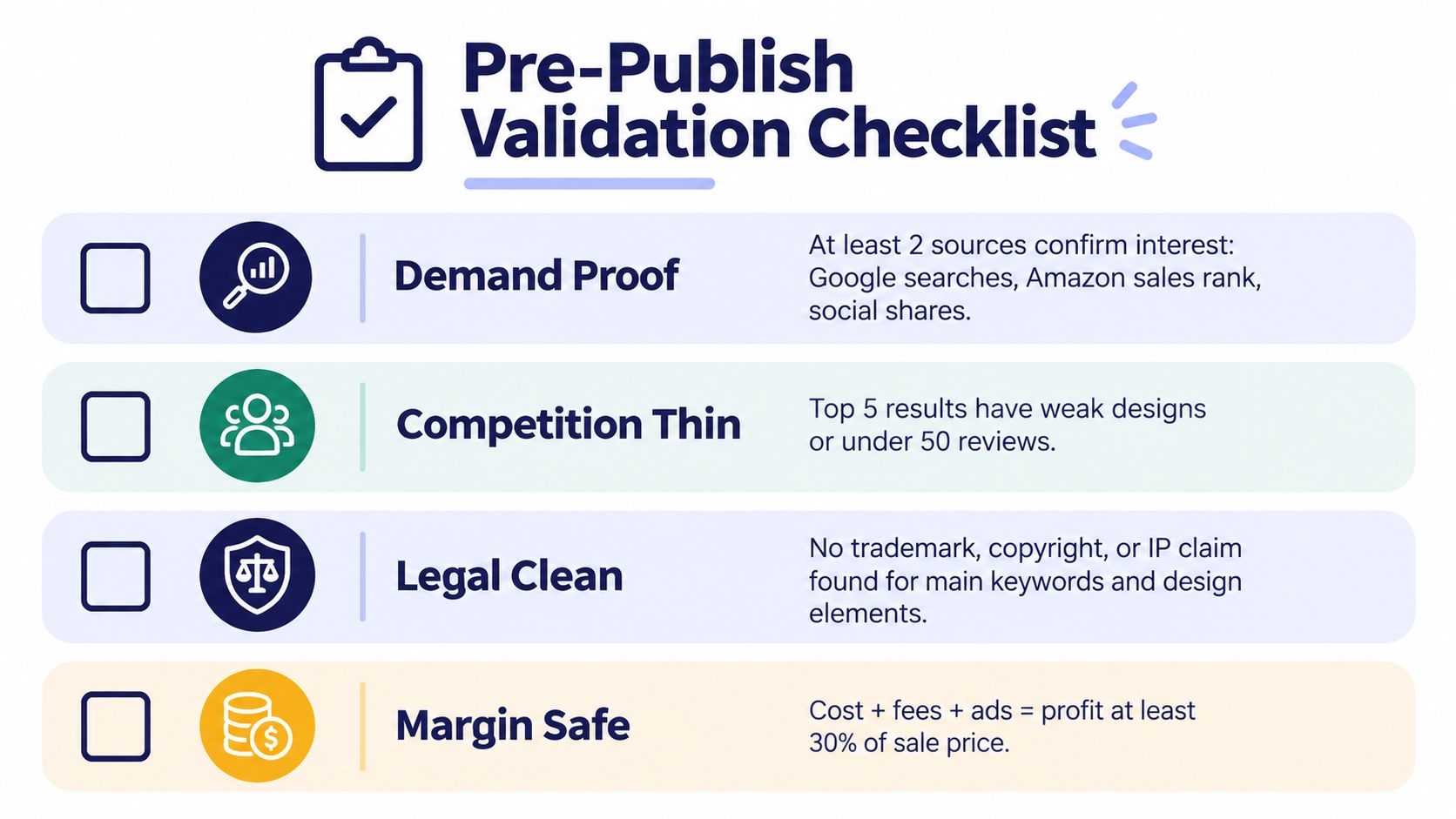
Before anything goes live, I want one tight pass that checks demand, competition, differentiation, legal risk, and margin. A lot of avoidable mistakes get caught.
Check the market again with less optimism
A surprising number of weak designs get published because the seller falls in love with the niche before validating the angle.
I like to ask simple questions:
- Would I still choose this niche if I saw it for the first time today?
- Do the current top listings leave an obvious gap, or am I forcing one?
- Can I explain the buyer in one sentence?
- Does this design add a fresh point of view, or just cleaner execution?
If the answers get vague, I pause.
Trademark screening isn't optional
This part matters more than people want it to.
The USPTO says a trademark clearance search should check whether a mark is confusingly similar in sight, sound, meaning, or commercial impression, and whether the goods or services are related enough that consumers could think they come from the same source, according to the USPTO trademark search guidance. It also notes that related goods and services don't need to sit in the same international class.
That means “I changed one word” or “it's a different product type” often isn't enough.
The USPTO also recommends focusing mainly on live trademarks, because only live applications and registrations can block registration, and it advises starting narrow, then broadening the search, beginning with exact wording before moving into wildcard and alternate-word searches in its federal trademark searching guide.
For hands-on searching, the USPTO database supports wordmark, general, goods and services, and owner searches, and its TMsearch help documentation explains that exact-match single-term searches can be done through dropdown options while more complex searches use uppercase field tags and the search builder.
Search the phrase you want. Search close variants. Search alternate spellings. Search the idea, not just the exact text.
Platform process is real, not informal
Sellers sometimes act like trademark disputes are a gray area until a platform flags them. They aren't.
Redbubble has a dedicated trademark section and says it will be in touch within 48 hours on trademark-related issues in its Redbubble trademark help section. That tells you these reviews are formal operational processes, not casual moderation.
A practical workflow helps here. If your research stack includes a built-in trademark check against 850K+ active marks, that saves time and reduces missed phrases during niche validation. More important, it keeps trademark screening in the research phase instead of turning it into a last-minute panic right before publishing.
My pre-publish checklist
| Check | What I want to confirm |
|---|---|
| Demand | The niche shows repeated buyer interest, not one isolated listing |
| Competition | Top results are active but still leave angle or positioning gaps |
| Differentiation | My design has a distinct audience, message, or style |
| Trademark safety | Core phrase and close variants clear a live-mark review |
| Margin | Pricing still works after platform costs and likely ad pressure |
That checklist isn't glamorous. It saves more time than any design trick.
Listing and Scaling Tips That Keep Niches Profitable
Finding a good niche is only half the job. Bad listings can waste good research.
I've seen solid POD ideas disappear because the title was too vague, the tags were generic, and the design variation strategy was lazy. Discovery is getting more layered now, especially as platforms and recommendation systems rely more on metadata and structured relevance. Your listing has to help both the shopper and the system understand what it is.
Write for intent, not just keywords
Titles and tags should describe the actual buyer and use case.
If the niche is built around left-handed fly fishing dads, say that clearly where it makes sense. Don't retreat back into broad words because they feel safer. Specific phrasing is often what keeps a niche profitable, because it attracts the right click instead of the widest click.
Trendlytic's article on SEO for print-on-demand listings is useful here if you want a tighter way to structure titles and tags around intent.
Scale sideways, not randomly
When a design works, most sellers either clone it too aggressively or jump into unrelated niches.
A better move is to scale sideways. Expand into adjacent keywords, nearby buyer identities, and related occasions. If one hobby-audience combination works, test neighboring versions that still make sense to the same shopper.
That kind of expansion is safer because it keeps your store coherent.
- Extend by audience: Dad version, mom version, beginner version, retired version.
- Extend by mood: Funny, sentimental, vintage, minimalist.
- Extend by occasion: Birthday, holiday, club event, gift angle.
- Extend by adjacent sub-niche: Same buyer, narrower use case.
Protect the niche while it's still working
The fastest way to kill a good niche is to flood your own catalog with low-effort variations.
Keep the profitable angle clean. Watch whether seasonal shifts change the keyword language. Monitor whether newer listings are improving their positioning. If the niche starts drifting toward sameness, don't keep uploading into it out of habit.
Small, repeated wins usually beat one giant niche swing. POD stores grow better when each launch teaches you where the next related opening sits.
That's the loop I trust most. Research. Validate. Publish carefully. Expand only where the market still gives you room.
If you want that workflow in one place, Trendlytic pulls live bestseller data from TeePublic, Amazon Merch, Redbubble, and Etsy, then shows demand, competition, related niches, and built-in USPTO trademark checks before you publish. If your current process involves too many tabs and too much guessing, it's a practical way to validate niches faster and keep your launches tighter.