SEO for Print on Demand That Actually Ranks Listings
You publish a clean design, write what seems like a sensible title, add a handful of tags, and wait. A week later, the listing has almost no views. The design may be good, the mockup may look professional, and the product may solve a real gift need, but buyers still aren't finding it.
That situation is common because SEO for print on demand isn't a matter of adding keywords to a product page. Etsy, Amazon Merch, Redbubble, and TeePublic each handle titles, tags, indexing, and buyer intent differently. Trademark rules can also make an attractive keyword unsafe to use, while fast-moving trends can turn a promising phrase into a crowded one before a listing gains traction.
I've launched hundreds of POD listings, and the most expensive mistake wasn't always a weak design. It was spending time on broad phrases, ignoring platform rules, and treating SEO as something finished at publishing. A better system starts with a winnable search phrase, adapts the listing to its marketplace, clears the language and artwork, then reviews performance often enough to respond to changing competition.
Table of Contents
- Why SEO for Print on Demand Works Differently
- Finding High Value Long Tail Keywords That Buyers Use
- Optimizing Titles Tags Descriptions and Images by Platform
- Avoiding Trademark Takedowns While Choosing Keywords
- Measuring Results and Scaling Winning Niches Over Time
- Your Next Listings Optimized and Ready to Publish
Why SEO for Print on Demand Works Differently
A generic blog post can target one topic and build authority over time. A POD listing has a narrower job. It must match a buyer's wording, communicate the product quickly, satisfy a marketplace's search system, and convert attention into a sale.
That difference matters because buyers rarely search only for a product category. Someone looking for a shirt may add a recipient, occasion, style, hobby, identity, or personalization detail. “T-shirt” describes an object. A phrase such as a personalized hiking gift for a dad expresses a much clearer reason to buy.
The economic backdrop is also becoming more competitive. The print-on-demand market analysis from Mordor Intelligence places 2026 estimates in a broad range, from roughly USD 11 billion to USD 15.2 billion, depending on the estimate, with projections reaching about USD 45.1 billion to USD 84.7 billion by 2033 or 2034. More sellers entering the market means more listings competing for the same visible searches.
Search visibility follows buyer intent
Organic search remains important in ecommerce. A 2026 ecommerce SEO summary citing BrightEdge reports that organic search represents 53.3% of trackable website traffic across industries, while retail accounts for about 41% of organic search share, as reported in this ecommerce SEO statistics summary. The same source says established ecommerce stores with at least 12 months of SEO investment can capture 35% to 55% of total traffic from organic search.
Those figures don't mean every Etsy or Redbubble listing will receive the same share. They do show why search deserves more than leftover attention. A listing that reflects the way buyers describe a gift or niche product has a better chance of being considered than one built around a vague category term.
Practical rule: Treat the design as the creative asset and the listing as the discovery asset. They need different decisions.
Marketplaces control the rules
A phrase that works in an Etsy title may be awkward in an Amazon Merch title. A long tag list may help on one marketplace but become useless or invalid on another. Product descriptions also have different roles. Some platforms give them more room to answer buyer questions, while others depend more heavily on the title, tags, or catalog structure.
I also don't treat publishing as the end of SEO. Competition changes, seasonal demand passes, and once-obscure phrases can become crowded. The practical system is simple: find specific demand, publish accurately, check rights, watch movement, and refresh the listing when the evidence changes.
Finding High Value Long Tail Keywords That Buyers Use
The strongest POD keyword usually isn't the broadest one. It gives the search engine enough context to understand the product and gives the buyer a reason to click.
Ahrefs' large keyword database found that roughly 98% of keywords had 100 or fewer monthly searches, according to this long-tail SEO explanation from Practical Ecommerce. That pattern is useful for POD because many viable opportunities sit in specific, low-volume searches rather than in enormous head terms.
Start with a product seed
Begin with the actual product and design, not with a vague industry phrase.
For example, a seed phrase might be:
- Product: embroidered-style hiking shirt
- Audience: trail-loving dad
- Occasion: Father's Day gift
- Style: vintage national park illustration
- Personalization: custom name or trail
Then expand each part into natural buyer language. You aren't trying to cram every variation into one title. You're identifying a cluster that can support a product page, collection, or related design set.
Useful expansions may include:
- hiking gift for dad
- personalized national park shirt
- vintage trail shirt
- camping birthday gift
- custom outdoors dad present
The exact phrase still needs validation. A keyword tool can suggest language, but live listings reveal whether sellers are already using that language successfully.
Filter for specificity and intent
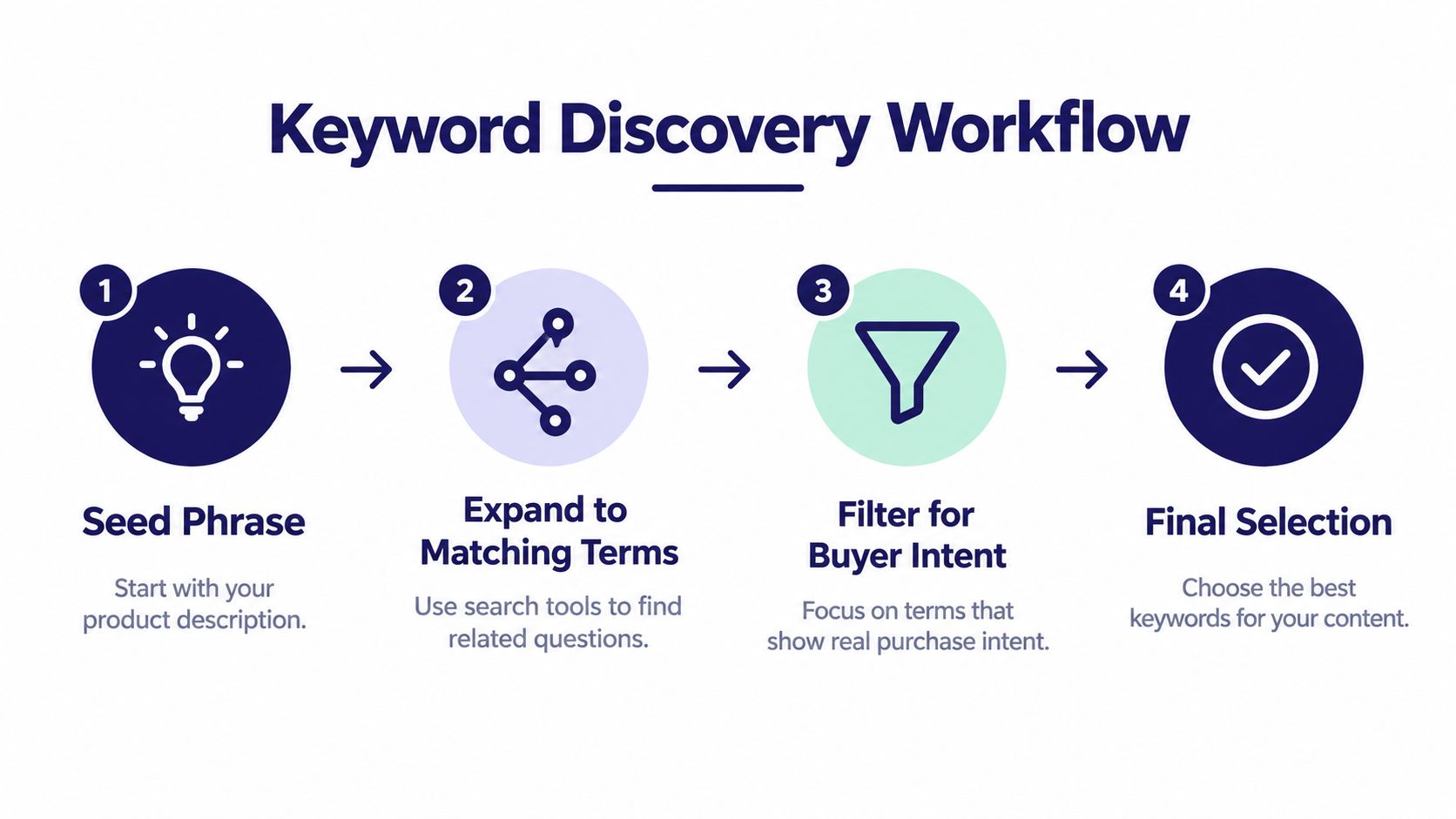
The workflow I use is:
- Write the seed phrase. Describe the product in ordinary language.
- Expand matching terms. Add recipient, occasion, style, use case, and personalization variations.
- Filter for low monthly volume. Don't discard a phrase because it looks small. Specific searches can carry stronger buying intent.
- Check live results. Look for listings whose titles and tags closely match the phrase.
- Group related terms. Build a cluster instead of forcing unrelated keywords into one listing.
- Assign one primary phrase. Use secondary phrases only when they accurately describe the design.
I use a tool such as Trendlytic when I want marketplace-specific signals rather than a general keyword list. It covers TeePublic, Amazon Merch, Redbubble, and Etsy, and its niche reports surface bestseller data, demand and competition levels, an Opportunity Score, and validated designs with images, tags, and pricing. Its USPTO trademark check also belongs later in the workflow, before publishing, not as a substitute for keyword judgment.
For a deeper explanation of finding related terms, this related keyword research guide fits naturally into the expansion stage.
Choose keywords with a simple decision matrix
| Keyword signal | What I do | Why |
|---|---|---|
| Specific phrase, clear recipient, relevant live listings | Target first | Strongest alignment between query and product |
| Specific phrase, weak live competition, obvious buyer use | Test carefully | May reveal an underserved niche |
| Broad category term with crowded results | Use only as a supporting phrase | Too ambiguous for a new listing |
| Trend phrase with unclear rights or unclear meaning | Investigate before use | Visibility isn't useful if the phrase is unsafe |
| Phrase that doesn't describe the artwork | Reject | Relevance matters more than apparent demand |
Build clusters, not keyword piles
A cluster might center on a recipient, then branch into occasion and style. One product page can target the primary phrase in its title, use closely related terms in the description, and support a collection page built around the same buyer need.
What doesn't work is adding every vaguely related word. A hiking design shouldn't target unrelated camping slogans, generic outdoor apparel, and a famous brand phrase just because those terms appear popular. Relevance protects both click quality and account safety.
The output of this process should be a short, defensible brief: one primary long-tail phrase, several related phrases, the buyer's occasion or use case, and a note about any terms requiring rights clearance.
Optimizing Titles Tags Descriptions and Images by Platform
Keyword research only helps after the listing communicates the right information in the right fields. I write the primary phrase early in the title, then make the rest readable. Search engines need context, but buyers still need to understand what they're looking at.
A weak title might be:
Funny shirt gift outdoors camping hiking dad present
A clearer version could be:
Personalized Hiking Gift for Dad, Vintage Trail Shirt
The second title gives the buyer a recognizable product, recipient, style, and personalization angle without turning the listing into a word pile.
Put the strongest language where the platform can use it
Titles should lead with the main phrase or its natural equivalent. Don't sacrifice clarity to place a minor variation in front of the product. Etsy sellers can benefit from studying specialist guidance such as Outrank's Etsy SEO tool guide, but the final title still needs to sound like something a person would search for and buy.
Tags should cover distinct concepts. Use a recipient tag, an occasion tag, a style tag, and a product or use-case tag when each one accurately applies. Repeating the same phrase with tiny wording changes wastes limited space.
Descriptions should answer questions that stop hesitation. Explain who the product is for, what the artwork represents, whether it can be personalized, and what the buyer receives. Write each description uniquely. Copying the same paragraph across a catalog creates thin, interchangeable pages.
Images should show the product clearly. Use descriptive filenames and relevant alt text where the platform supports them, but don't treat alt text as a hidden tag field. Large customizer previews can also slow a page, so the image should communicate the product without forcing unnecessary scripts or oversized assets.
Platform rules change the execution
| Platform | Title and Tag Rule | SEO Implication |
|---|---|---|
| Etsy | Use a readable title built around the primary buyer phrase, supported by accurate tags | Relevance and buyer clarity matter more than stuffing every variation into the title |
| Amazon Merch | Follow marketplace title conventions and clear the wording before publishing | A commercially attractive phrase can still create rights or compliance risk |
| Redbubble | Listings allow 15 tags, each up to 50 characters; Google crawls the first 10 tags, while on-site search counts the first 15 and ignores tags beyond the character limit, according to Redbubble's tagging guidance | Put the most important valid tags first and remove anything too long |
| TeePublic | Keep the title and tags directly tied to the artwork and product | Specific relevance supports discovery without relying on broad category wording |
Redbubble's rule is especially easy to mishandle. If the first tags are weak, invalid, or overly broad, the listing may waste the fields that matter most. I put the primary phrase and its closest accurate variants first, then add recipient, occasion, and style terms.
For Amazon Merch sellers, a focused reference to Merch by Amazon store setup can help separate catalog organization from listing-level optimization. Don't assume that a well-optimized title compensates for poor product selection or unclear artwork.
The listing should read naturally even if every tag disappears. Tags support discovery. They don't replace a useful product explanation.
Avoiding Trademark Takedowns While Choosing Keywords
A keyword can attract buyers and still be unsafe to use. Trademark review belongs in the SEO workflow before publication, not after a platform removes the listing.
Obvious brand names carry risk, but the same problem appears in slogans, character references, team language, event names, logos, and distinctive symbols. Recognition often drives search demand, yet it can also signal that the phrase belongs to another party. Treat keyword choice and rights screening as one decision.
Amazon seller intellectual-property guidance places responsibility on sellers to avoid fulfilling orders that infringe a trademark owner's rights. That includes infringing content supplied by a customer in a customized order. Personalization does not remove that responsibility.
Clear words and artwork separately
The USPTO public trademark system provides an image-search feature for logged-in users. The USPTO also explains that federal registration informs the public that a mark is protected and gives the owner tools to defend it.
Use a two-part pre-publish check:
- Search the wording: Check the exact phrase, close variations, and how the wording appears within the artwork.
- Search the visual elements: Review logos, distinctive symbols, and recognizable design components separately from the product title.
Trendlytic's built-in check can flag keyword conflicts against 850K+ active USPTO trademarks, with ownership and expiry information. Treat that output as screening, not legal clearance. A flagged phrase needs further investigation. An unflagged phrase still does not authorize copying a protected design.
Separate descriptive language from borrowed identity
“Mountain hiking gift” describes a buyer need and can support an original product. A protected brand slogan or team phrase may identify another party's commercial property, even if the listing earns clicks.
Amazon Merch compliance guidance also recommends searching the USPTO for words and phrases before publishing, as described in its trademark protection resource. For sellers building a repeatable workflow, this Amazon Merch trademark protection guide adds a practical reference for checking risk before a listing goes live.
The trade-off is direct: abandoning a tempting keyword can reduce immediate reach, but it preserves your ability to fulfill orders and keep the listing active. I would rather replace a risky phrase with accurate audience, occasion, or design terms than rebuild a listing after a takedown.
Customer personalization is not a loophole. If buyers can enter text through a customizer, set boundaries around prohibited brand names, protected slogans, and other risky content. Search visibility has little value if the platform removes the product or restricts the account.
Measuring Results and Scaling Winning Niches Over Time
Publishing starts an operating cycle, not a finish line. I do not optimize every SKU at once. I select a small group of listings with commercial potential, then track whether they gain visibility, clicks, and sales. That focus matters because search position changes the amount of traffic a listing can receive. The first organic result gets about 27.6% of clicks, the top three receive about 54.4% collectively, and only about 0.63% of users click beyond page one, according to these ecommerce SEO statistics.
A listing moving toward page one deserves more attention than one that stays buried after repeated edits.
Track movement and commercial quality together
Use one tracker for each priority listing:
- Record ranking movement: Note whether the page reaches the top 10, then whether it moves closer to the top three.
- Check click-through behavior: Impressions with weak clicks usually point to an unclear title, weak keyword match, or unhelpful main image.
- Compare conversion: Ecommerce organic conversion rates commonly fall around 1.8% to 4.2%. Use that range as context, not as a promise for a specific POD store.
- Review page speed: Customizers and live previews should not hide the main product content or make the page slow.
- Mark revenue pages: Link related products from listings that already show commercial interest.
A ranking increase without sales may reflect broad traffic, weak intent, or a product mismatch. A listing with clicks but poor conversion needs a different response, such as clearer product information, stronger mockups, or a more accurate keyword promise.
Rich product schema can help search engines interpret product information, while unique descriptions keep a catalog from appearing thin. Personalized pages can rank when the customizer leaves product content accessible and does not undermine speed. Extra features do not automatically improve performance. A lightweight page that answers buyer questions can serve customers better than an elaborate preview that loads slowly.
Refresh before a phrase becomes stale
POD trends change quickly. An open phrase can become crowded, and a seasonal opportunity can lose relevance after its buying window. The Etsy SEO guide from InsightAgent recommends refreshing listings periodically and auditing top listings monthly as competition changes.
Monthly review does not require rewriting every listing. Check:
- Whether the keyword still appears in relevant live listings.
- Whether competitors now use a more specific buyer phrase.
- Whether the artwork matches the current trend rather than an older version.
- Whether the title, first tags, description, and image still agree.
- Whether to expand, refresh, or leave the listing unchanged.
For wider visibility monitoring, this guide to AI SERP tracking explains how search visibility is changing. Use trend signals to form research questions, not to justify automatic uploads. Every trend still needs a clear buyer, original artwork, rights clearance, and a product you can fulfill reliably.
Your Next Listings Optimized and Ready to Publish
Good POD SEO is less exciting than chasing a sudden viral phrase. It looks more like a repeatable production habit.
Start with a product seed, then narrow it through recipient, occasion, style, use case, and personalization. Validate the phrase against live marketplace results. Write a readable title, order platform-specific tags correctly, and make the description answer the questions a buyer has.
Clear the language and artwork before publishing. A phrase that attracts attention but creates a trademark problem isn't an asset. It can expose the listing, the fulfillment process, and the account to unnecessary risk.
After launch, measure ranking movement and sales together. A page that gains impressions but no clicks needs a different fix from a page that earns clicks but fails to convert. Keep the technical side lightweight, especially on personalized pages, and connect related products through useful internal links instead of forcing every design into one generic collection.
The practical sequence is demand, relevance, clearance, measurement, and refresh.
I don't expect every listing to rank, and I don't believe a tool can replace design judgment or consistent publishing. Research tools can reduce the time spent opening marketplace tabs and manually comparing tags, but the seller still decides whether the niche is original, fulfillable, and worth pursuing.
For sellers who want to connect research with repeatable publishing, resources on AI-powered merch drop workflows can help organize the operational side. Use automation to support a clear process, not to flood marketplaces with thin variations.
The next listing should have a reason to exist before you upload it. Give it a specific buyer, a defensible phrase, a platform-correct structure, and a review date. That approach won't produce instant certainty, but it gives you evidence you can use for the listing after it.
Trendlytic researches live bestseller data across TeePublic, Amazon Merch, Redbubble, and Etsy, then surfaces niche demand, competition, Opportunity Score data, validated designs, tags, and pricing alongside a built-in USPTO trademark check. Visit Trendlytic to turn your next keyword shortlist into a cleaner, platform-aware POD publishing workflow.