How to Run Limited Edition Drops for POD
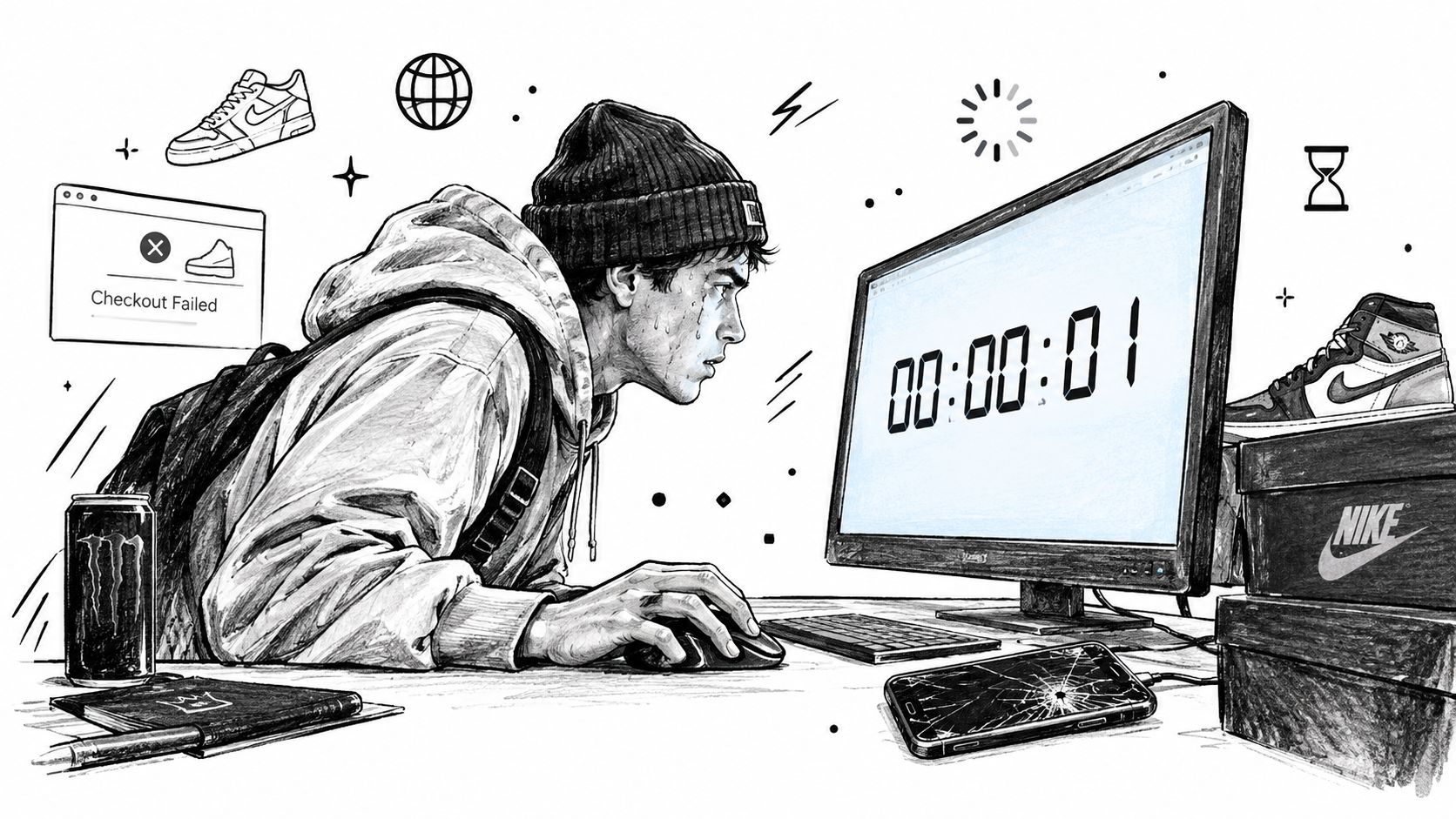
You've launched the design, posted the countdown, and watched the product page stand still while the closing time approaches. The artwork may be strong, the mockups may look polished, and the scarcity message may be technically accurate. None of that guarantees that buyers will care.
I've tested limited edition drops across POD platforms, and the pattern is consistent: urgency works best when it supports a product people already want. When the only reason to buy is “this won't be here later,” the countdown often creates pressure without creating demand.
Table of Contents
- Why Limited Edition Drops Work (And When They Don't)
- Understanding the Psychology Behind Scarcity
- Designing Your Drop as a Controlled Experiment
- Matching Scarcity to Product and Audience
- Using Trendlytic to Validate Niches and Protect Accounts
- Executing the Drop From Announcement to Close
- Tracking Results and Planning the Next Drop
Why Limited Edition Drops Work (And When They Don't)
The limited drop model grew from 1990s streetwear and skate culture, with Supreme widely credited as an early pioneer. The formula was simple but powerful: constrain supply, shorten the sales window, and turn a product release into a scheduled event instead of leaving it permanently available. Shopify's overview of limited drops describes how that model has moved beyond specialist streetwear and into mainstream shopping behavior.
In the United States, a 2025 survey of more than 2,000 shoppers found that 43% had participated in a product drop, flash sale, or private sale during the preceding month. That tells me drops are no longer an unfamiliar format. It doesn't tell me that every limited shirt deserves a countdown.
A design needs a reason to be collected, worn during a particular season, connected to a community, or remembered as part of an event. A numbered illustration, a seasonal artwork series, or a distinct collaboration can support scarcity. A regular catalog design with a red “last chance” banner usually feels different.
Practical rule: A drop should make the product feel meaningfully specific, not merely temporarily unavailable.
Scarcity also fails when sellers confuse a quick sell-out with a healthy launch. If customers miss the product because the seller disclosed too little, used unclear sizing information, or allowed one buyer to take the available stock, the short-term result can create long-term frustration. The best drops make access limited while keeping the terms clear.
Understanding the Psychology Behind Scarcity
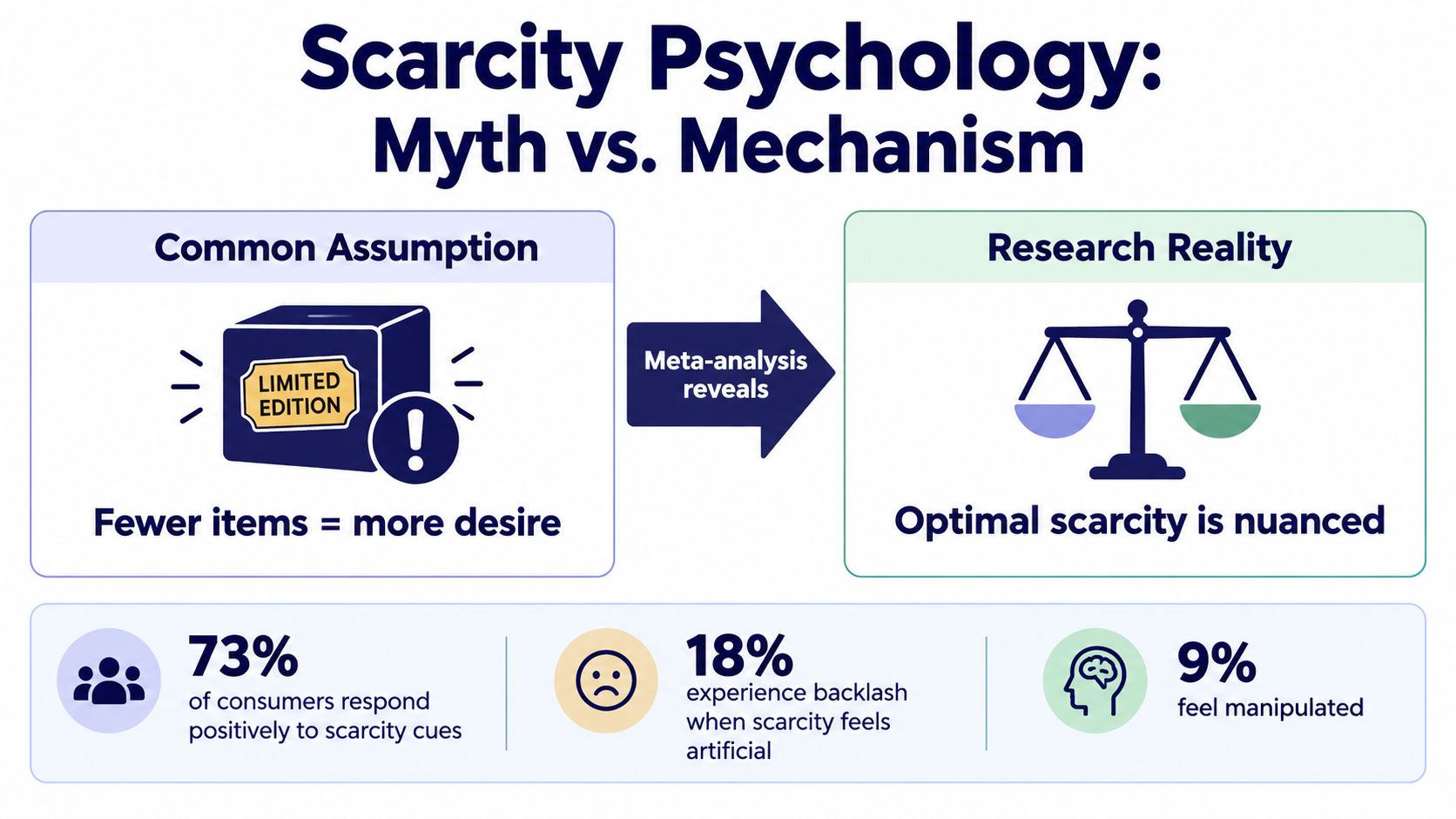
The common assumption is that fewer products automatically create more desire. The evidence is more conditional. A meta-analysis of product-scarcity studies found a mean purchase-decision effect of 0.2776, with a 95% confidence interval of 0.2243–0.3209. It also found that limited-quantity and limited-time urgency weren't consistently the strongest drivers. Excessive-demand cues, variety scarcity, social signaling, and seasonality performed better in the studies reviewed.
That distinction matters for POD. A buyer may want a shirt because it signals membership, expresses an identity, or completes a collection. The scarcity mechanism supports that motivation, but it doesn't replace it.
Match the message to the buyer
Research on scarcity messaging found that supply-based claims, such as “only a limited quantity exists,” raised purchase intention among consumers with a high need for uniqueness. The same message lowered purchase intention among consumers with a low need for uniqueness when compared with demand-based scarcity messaging. The Frontiers in Psychology study gives a useful reason not to use one scarcity message for every audience.
A collector may respond to:
- Numbered editions: Each item has a defined place in a series.
- Distinctive artwork: The design looks unlike the permanent catalog.
- Fixed quantity: The seller states what won't be reproduced.
A broader audience may respond better to a seasonal ordering window, social proof, or a clear connection to an event. A countdown can help them decide, but it may not create the original interest.
For sellers working on crowdfunding or pre-order campaigns, these scarcity techniques for Kickstarter backers are useful because they frame urgency around access, rewards, and campaign structure rather than relying only on pressure.
FOMO can increase willingness to pay, but motivation changes the outcome. In collectible markets, self-presentational motives strengthened the relationship between FOMO and willingness to pay, while self-expressive motives weakened it. A design that helps someone communicate who they are may need stronger creative identity and community relevance, not a more aggressive timer.
Designing Your Drop as a Controlled Experiment
Treat a drop as a controlled experiment, not as a test of whether a countdown looks exciting. Before publishing the product page, write down the rules that will let you evaluate what happened.
Start with a clear scarcity mechanism
Choose one of these structures:
- Fixed quantity: You'll sell a defined number of units, ideally with numbering or another visible record.
- Fixed selling window: Customers can order during a stated period, after which production closes.
- Both: The order window closes at a specific time, or earlier if the stated quantity sells out.
Pre-register the edition size, launch time, price, and end-of-sale rule in your own launch document. If you decide to extend the window later, record that change and explain it publicly. A changing rule makes the original scarcity claim difficult to defend.
Before designing the artwork, validate the niche through existing product-level sales, audience engagement, search behavior, and comments. The keyword research process can help structure that research, but don't mistake keyword activity for proof that your particular design will convert.
Separate the audiences
A collectible art shirt and a practical work shirt may use the same fulfillment provider, but they don't necessarily need the same scarcity treatment.
Ask what the buyer is purchasing:
- A collectible: Use a numbered quantity, edition name, and clear provenance.
- A seasonal item: Use a time-limited window tied to the season or event.
- A community symbol: Emphasize the story, group identity, or creative theme.
- A practical product: Test a pre-order window before restricting quantity.
Hold out a comparison group
If you control your own storefront or email traffic, randomly split comparable visitors between scarcity messaging and standard-availability messaging. Keep the artwork, price, mockups, and audience source as consistent as possible.
Track conversion rate, units sold per visitor, average order value, refund rate, and post-launch demand. A fast sell-out can look impressive while hiding weak margins, high refunds, or customers who wanted the item but couldn't access it. The strongest result is incremental improvement that survives after you account for support costs and fulfillment problems.
Matching Scarcity to Product and Audience
The right scarcity method depends on what the product means to the buyer. Quantity scarcity gives a product a collectible boundary. Time scarcity gives a customer a decision deadline. Neither is automatically better.
| Product situation | Better starting mechanism | Why it can fit | Example |
|---|---|---|---|
| Collectible artwork | Fixed quantity | Buyers can understand the edition and provenance | A numbered art print or illustrated shirt |
| Seasonal design | Fixed selling window | The product has a natural period of relevance | A summer event tee |
| Community release | Quantity plus a story | The item represents participation in a specific moment | A club or creator anniversary shirt |
| Utilitarian apparel | Time-limited pre-order | Demand can be gathered without pretending the item is rare | A practical hoodie in several sizes |
A limited quantity tends to suit hedonic and collectible products because ownership itself carries meaning. A time-limited window may suit utilitarian products, especially when the seller needs to confirm demand before ordering or fulfilling a batch. That doesn't mean the categories are rigid. Test the mechanism instead of assuming the label will tell you the answer.
Scarcity and sustainability can pull apart
Recent industry reporting claims that 29% of global limited-drop buyers in 2025 considered secondary-market resale value a primary purchase factor, up from about 18% in 2021. The same industry report cites a 2025 survey in which 71% of global streetwear consumers aged 18–34 were willing to pay more for sustainably produced products.
Those motivations can conflict. Scarcity may encourage duplicate buying, impulse purchases, resale speculation, or rush shipping. Sustainability claims may require durable blanks, slower fulfillment, minimal packaging, and honest information about the product lifecycle.
A useful reference for translating identity and community into apparel is T-Shirt Envy's band merch advice. The broader lesson is that a design can feel special because it carries meaning, not only because the seller restricts the inventory.
Using Trendlytic to Validate Niches and Protect Accounts
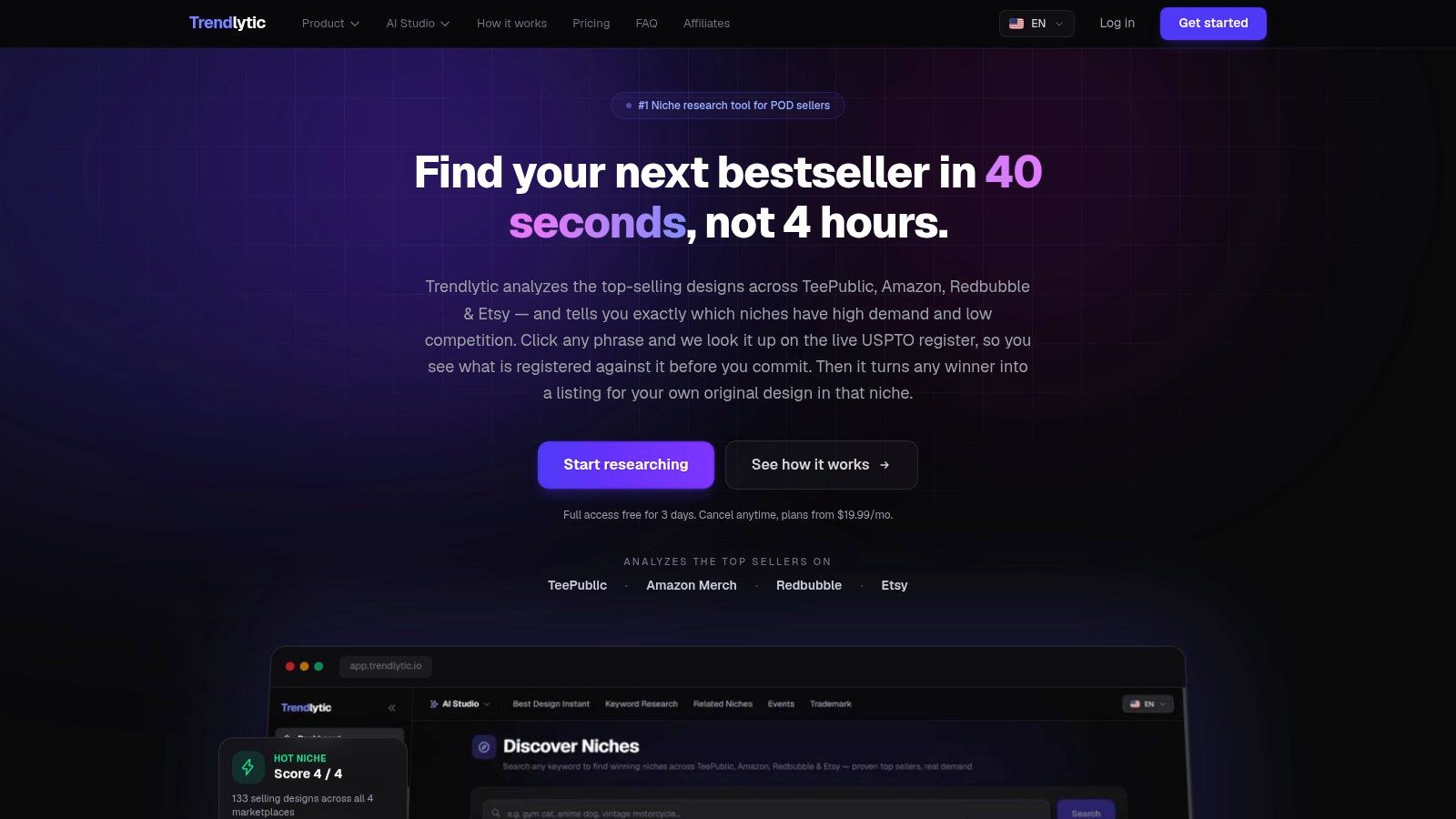
Before committing to a drop, I want evidence that the niche has active buyers and enough room for a distinct design. Trendlytic is a POD niche research tool covering TeePublic, Amazon Merch, Redbubble, and Etsy, with a built-in USPTO trademark check.
That makes it useful for the first stage of drop planning. I can compare live bestseller patterns across those marketplaces, look at the balance between demand and competition, and use the Opportunity Score as one input rather than treating it as a guarantee. The key question isn't “Is this niche popular?” It's “Can this specific edition be recognizable among the designs already selling?”
Validate before you limit
I use niche research to make three decisions:
- Audience fit: Does the subject attract buyers who collect, identify with, or gift within the niche?
- Creative space: Are existing bestsellers concentrated around one visual style, or is there room for a different angle?
- Account safety: Does the keyword create trademark concerns that could turn a promising drop into a takedown problem?
The built-in USPTO check is particularly relevant when a phrase sounds generic but may be used in a protected commercial context. It doesn't replace legal advice, and a clean keyword result doesn't make every design automatically safe. It does give sellers a practical screening step before they build a collection around a phrase.
Hourly Trending Now rankings and automated Niche Discovery can also help expand one validated idea into related themes. I'd still review each suggestion manually, check the actual marketplace listings, and confirm that the new design has a reason to exist. Strong research reduces avoidable mistakes, but it can't manufacture creative demand.
For the production side, a separate quality assurance process is useful because a scarce product with a printing error, poor sizing information, or inconsistent mockup can damage trust faster than a standard catalog item.
Executing the Drop From Announcement to Close
A transparent drop has a short operational chain. Produce a deliberately constrained first batch, announce the edition and release window, open sales with reasonable controls, and close the listing according to the rule you published.
Queueing, bot controls, and per-customer limits can help when demand is concentrated. They shouldn't become obstacles that make ordinary buyers feel punished. State whether the edition will return, whether a later release will be materially different, and what happens if a fulfillment issue delays delivery.
Track the funnel at hourly intervals during launch:
- Announcement click-through: Are people moving from the announcement to the product page?
- Product-page conversion: Does the offer make sense once visitors see the details?
- Checkout completion: Are shipping, sizing, or payment issues blocking orders?
- Sell-through percentage: How much of the stated quantity has sold?
- Revenue per visitor: Does the traffic produce worthwhile commercial value?
- Support contacts: Are customers asking questions caused by unclear stock or delivery terms?
A study of 442 collectible-market consumers found that scarcity cues increased FOMO, and FOMO positively affected willingness to pay. Self-presentational motivation amplified that relationship, while self-expressive motivation weakened it, according to the collectible-market research.
That finding supports a practical conclusion. A strong creative concept and a credible community connection can matter as much as the inventory restriction. If the artwork is expressive, pushing harder on urgency may be less useful than improving the story, product photography, or explanation of the edition.
Manufactured urgency may produce an order. Verifiable scarcity gives the customer a reason to trust the next release.
The most damaging move is overproducing after a sell-out and relisting the same edition. If replenishment is necessary, announce it as a replenishment. Better still, use a staged release, measure the pilot, and make any later edition visibly distinct.
Tracking Results and Planning the Next Drop
A single drop gives you a data point. A series gives you a strategy, but only if you record the results beyond the first sales rush.
Start with a simple post-launch review. Compare the scarcity version with your ordinary releases where possible, then look at the quality of the demand:
| Result to review | What it can reveal |
|---|---|
| Sell-through | Whether the stated quantity moved within the planned period |
| Refund rate | Whether urgency led to poor-fit purchases or unclear expectations |
| Repeat purchases | Whether the release created durable customer interest |
| Unsubscribes | Whether the promotion felt excessive or manipulative |
| Support contacts | Whether the rules, stock, or delivery details were unclear |
| Resale signals | Whether buyers treated the item as collectible, usable, or speculative |
If a drop underperforms, separate the possible causes. A weak result may reflect a poor niche, an unfamiliar design, an unconvincing product page, the wrong audience, or a scarcity mechanism that doesn't match the product. Reducing the edition size won't automatically solve any of those problems. Experimental research found that quantity limitation can increase product selection compared with no limitation, but different limitation levels didn't produce statistically significant differences, so shrinking an edition doesn't guarantee a proportionally stronger response. The experiment is available here.
Disclose the edition size, restock rules, and closing date in plain language. Distinguish limited quantity from limited time, because buyers should know whether the item is rare, temporary, or both.
Drop mechanics are now mainstream rather than niche. One 2025 survey reported that 43% of more than 2,000 U.S. shoppers had participated in a product drop, flash sale, or private sale during the preceding month, as reported by Hard Life Apparel's limited-edition guide. That makes clear disclosure more important, not less. Experienced shoppers recognize vague scarcity language quickly.
For the next release, use your competition scoring workflow to reassess the niche, then change one meaningful variable at a time. Test a new theme, audience segment, quantity rule, or ordering window. Keep the provenance consistent, close editions when promised, and let the calendar grow at a pace your fulfillment and community can support.
Trendlytic helps POD sellers compare live bestseller data across TeePublic, Amazon Merch, Redbubble, and Etsy, assess niche competition, and screen keywords with its built-in USPTO trademark check. Use Trendlytic to validate the niche and creative space before you announce your next limited edition drop.