Quality Assurance Processes for POD Sellers
A POD seller can spend a full afternoon polishing a design, publish it across several marketplaces, and still wake up to an account warning because one phrase in the title matched a protected brand. Another seller can pass every digital check and then deal with returns because the artwork is poorly aligned, the colors look different from the mockup, or the wrong variant reaches the customer.
These problems feel unrelated, but they usually have the same cause: quality checks happen too late, inconsistently, or only when something has already gone wrong. Quality assurance processes give a small POD team a repeatable way to prevent defects, document decisions, and protect the store before a listing reaches customers or a marketplace reviewer.
Table of Contents
- The Real Cost of Skipping Quality Checks
- Moving From End of Line Inspection to Preventive Control
- Building a Risk Based QA Framework for Your Store
- Navigating Trademark and IP Compliance Across Marketplaces
- Validating AI Generated Designs and Niche Research
- Monitoring Physical Print Runs and Supplier Consistency
- Implementing Your First Quality Assurance Workflow
The Real Cost of Skipping Quality Checks
A seller notices a promising niche and moves quickly. The design looks original, the mockup is convincing, and the listing goes live on Amazon Merch, Etsy, or Redbubble. A few days later, an email arrives about a trademark complaint. The seller removes the design, but the same artwork has already been adapted into several listings and uploaded to other platforms.
That response is reactive quality control. It starts with a takedown, refund, customer complaint, or account warning, then asks the seller to reconstruct what happened. Which source file was used? Was the phrase checked? Did the risk come from the artwork, the brand field, the tags, or the product description? Without records, even a careful seller is forced to investigate from memory.
Preventive QA changes the order of events. The design is screened before publication. The title, tags, description, and selected brand are reviewed separately. The seller records the search result, source files, approval decision, and marketplace destination. If a concern appears, the listing stays in draft until someone resolves it.
Reactive fixes versus preventive controls
Reactive work is expensive because it interrupts other work. A takedown can require removing related listings, contacting a platform, answering customers, replacing orders, and checking whether the same phrase appears elsewhere in the catalog. A return can expose a supplier or rendering problem that affects many products, not just the order that triggered the complaint.
Preventive QA doesn't eliminate every failure. It makes failures easier to catch while they are still contained.
Practical rule: If a mistake can affect account standing, customer safety, intellectual property, or a large group of listings, check it before publication and keep evidence of the decision.
A useful process separates two questions:
- Did the workflow prevent the problem? This is quality assurance.
- Did the finished listing or product meet the acceptance criteria? This is quality control.
A small team needs both. A checklist that nobody follows is paperwork. A final inspection with no upstream controls is firefighting.
The value of a QA process isn't that it makes a catalog look more professional. It gives the seller a defensible operating system. When the catalog grows, memory stops being a reliable control. A documented workflow becomes the safety net that allows a team to move quickly without treating every launch as a gamble.
Moving From End of Line Inspection to Preventive Control
Quality assurance evolved from final inspection into process control during the 1920s. At Bell Telephone Laboratories, Walter A. Shewhart developed the control chart in 1924, creating a repeatable way to distinguish normal, common-cause variation from unusual, special-cause variation. The method allowed organizations to monitor measurements over time and intervene when results moved beyond statistically derived control limits, rather than checking every finished item only after production. The history of statistical quality control describes why that shift remains foundational.
The lesson transfers cleanly to POD. A seller shouldn't wait for a customer to report a misaligned print before asking whether the artwork was exported correctly, whether the supplier changed production settings, or whether the mockup concealed the problem. The process should identify a control point before the product reaches the customer.
From inspection to process evidence
For a POD listing, the workflow can be treated as a sequence of measurable stages:
- Research: The niche, phrase, and intended audience are recorded.
- Creation: The artwork is checked for originality, legibility, dimensions, and prohibited elements.
- Clearance: Text, symbols, brand fields, and metadata receive an IP review.
- Publication: The listing is checked against each marketplace's rules.
- Fulfillment: Orders, returns, complaints, and supplier defects are monitored.
At each stage, define what acceptable looks like. A design might need a readable phrase at thumbnail size, a correctly sized transparent file, a documented trademark search, and a listing whose title matches the artwork. These aren't abstract standards. They're pass or hold decisions.
Measuring variation in a digital catalog
A control chart isn't necessary for every seller, but the principle is useful. Log recurring problems by type and look for unusual changes. If a supplier suddenly generates more alignment complaints, or one designer repeatedly submits files with incorrect dimensions, that pattern points to a process condition rather than isolated bad luck.
The quality assurance process improvement guide is useful background for teams that want to connect process definition, monitoring, corrective action, and continuous improvement. The important point for POD is practical: record the failure, identify where it entered the workflow, correct that stage, and check whether the same problem returns.
ISO 9001 helped turn this approach into a broad management practice. The standard includes documented processes, customer focus, performance evaluation, corrective action, and continual improvement. The 2024 observatory data reported approximately 1,474,118 active ISO 9001 certificates worldwide, while the historical total was 46,571 certificates in 1993. Asia accounted for approximately 2,081,672 active management-system certificates, or 70.2% of the worldwide total, across the standards and countries recorded. The International Accreditation Forum observatory provides that certification context.
A small POD business doesn't need an enterprise certification program. It does need the same underlying discipline: named checks, consistent evidence, clear acceptance criteria, and a corrective action record. Standardization beats relying on the one person who happens to remember every exception.
Building a Risk Based QA Framework for Your Store
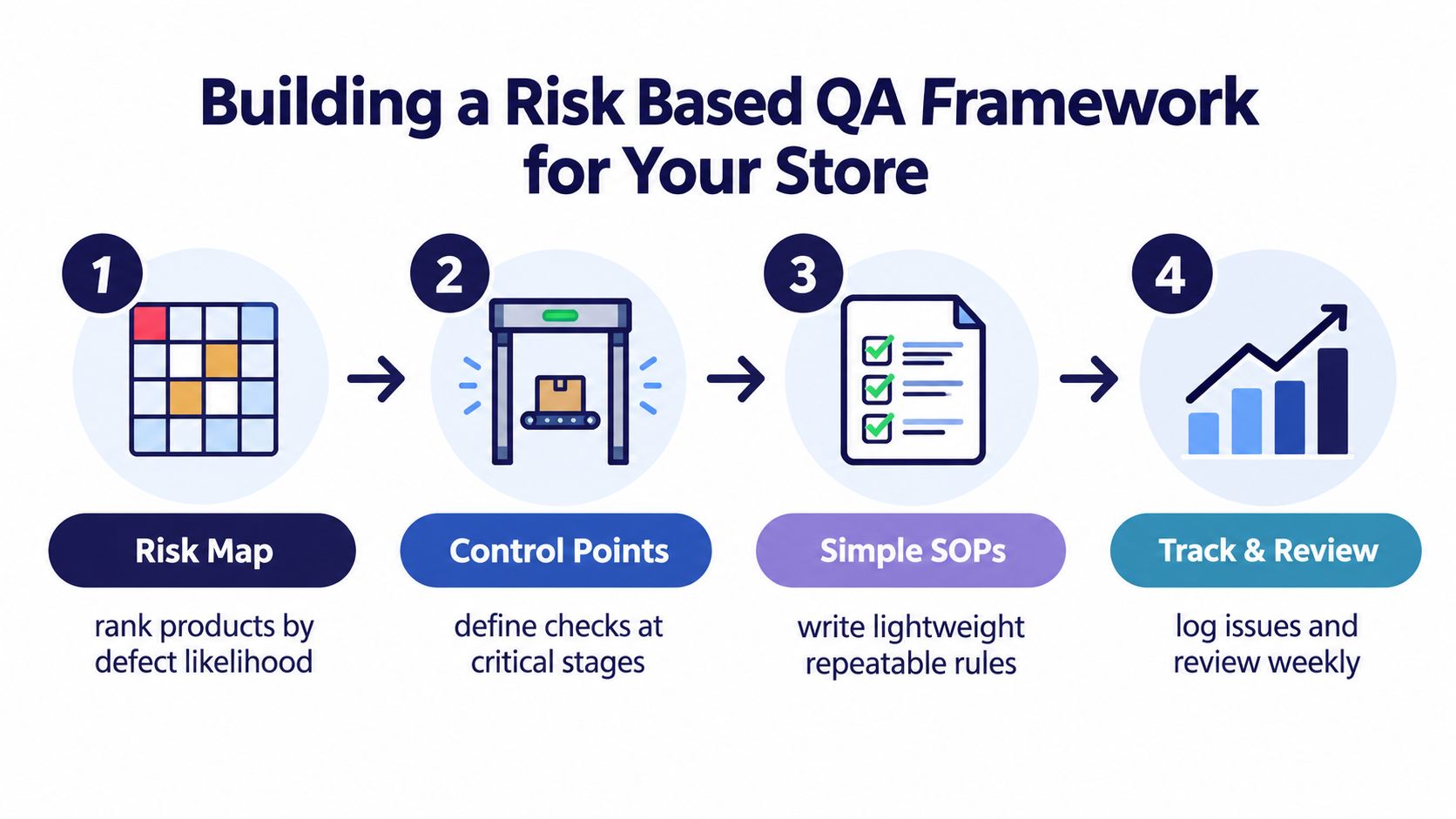
A small team can't inspect every possible change with the same depth. The sensible approach is to rank risks, place controls where they matter most, and sample lower-risk work. The ISO 9001:2015 process and risk-based approach combines process thinking with Plan, Do, Check, Act. That framework adapts well to a POD store.
Start with a simple risk register
Create a spreadsheet with these fields:
- Workflow: Research, artwork, listing, fulfillment, or customer support.
- Failure mode: For example, an unlicensed phrase, incorrect price, missing variant, or poor print alignment.
- Impact: Account risk, refund exposure, customer dissatisfaction, or wasted production.
- Likelihood: Your practical assessment based on previous incidents and workflow complexity.
- Control: The check that should prevent or detect the issue.
- Owner: The person responsible for completing and recording the check.
- Evidence: A screenshot, source file, search result, approval record, or supplier note.
- Corrective action: The process change required if the check fails.
Don't make the register theoretical. A trademark concern should point to a search and a human decision. A rendering concern should point to a product preview or test order. A pricing error should point to the source of the price and the final marketplace value.
Define acceptance criteria before creation
Acceptance criteria prevent subjective approval. For each design, decide what must be true before publication:
- The artwork has a known source or creation record.
- Text is legible in the marketplace thumbnail and product preview.
- The file uses the required format, dimensions, and transparent background where applicable.
- The title, tags, description, and brand field don't introduce unsupported IP claims.
- The price, product type, color options, and variants are accurate.
- A reviewer has recorded a pass, hold, or rejection decision.
Prioritization matters here. The 2025 Software Testing & Quality Report found that teams aimed to automate 63% of testing while averaging 40% currently, with test breakages, data problems, and skill gaps remaining common. 47% cited understaffing as a major barrier. The same report found that 86% of teams with strong automation and CI/CD reported faster releases, while 71% reported fewer production defects. The Software Testing & Quality Report coverage supports a sober conclusion: automation can improve speed, but it doesn't replace risk-based human review.
Apply Plan, Do, Check, Act
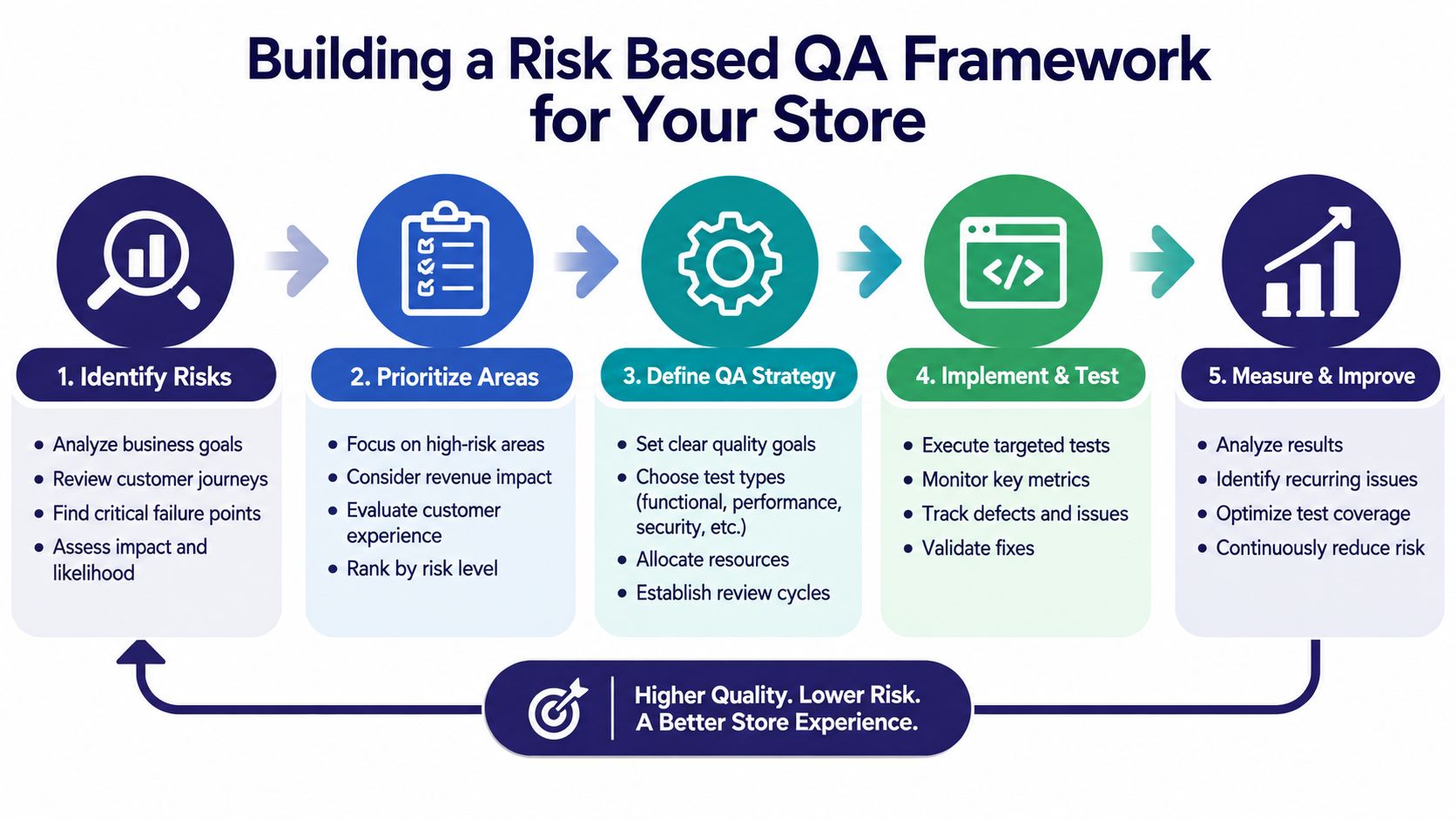
Plan the highest-cost failure modes first. For many POD sellers, that means IP, marketplace policy, file integrity, pricing, and fulfillment reliability.
Do the work using lightweight standard operating procedures. A checklist in a shared document can be enough if it has an owner and a required record.
Check the output and the process. A listing may be correct even though the reviewer skipped the required search, which is a process failure that needs attention.
Act on the cause. If several designs contain risky brand names, improve the research and copywriting stage. Don't just delete each listing and continue with the same workflow.
A good framework also specifies what happens when inspection is impossible. Test the customer-critical path first, sample low-risk edits, and hold publication when the evidence is incomplete. That trade-off is more realistic than pretending a small team can perform complete testing across a changing catalog.
Navigating Trademark and IP Compliance Across Marketplaces
One IP checklist rarely fits every platform. The artwork matters, but so do the words around it. Amazon Merch states that third-party intellectual property restrictions cover the product design, product name, description, bullet-point text, and selected brand name. Its guidance also warns that noncompliant submissions may be rejected or removed and that violations can place an account at risk of suspension or closure. Amazon Merch content rules make the publication review broader than an image scan.
Etsy presents a different operational risk. When it receives a compliant infringement report, its policy says it will remove or disable access to the reported material. Etsy also advises sellers not to create additional listings for the same content while the issue remains unresolved, and says repeat or multiple notices can lead to termination of selling privileges at its discretion. Etsy's intellectual-property policy is why a seller should pause related designs instead of changing only the title or mockup and reposting substantially identical work.
Redbubble's policy identifies trademarks as words, symbols, designs, or logos that identify and distinguish the source of goods. Its community guidelines state that work found to infringe copyright or trademark protection may be removed. Redbubble's IP and publicity rights policy matters because a phrase can create risk even when no logo appears in the artwork.
Marketplace IP Enforcement Focus
| Platform | Primary QA Focus | Consequence of Failure |
|---|---|---|
| Amazon Merch | Review the design, title, description, bullet points, tags, and selected brand name for unauthorized third-party IP. | Rejection or removal, with account suspension or closure risk. |
| Etsy | Keep records of permissions, source files, searches, and takedown history. Pause related listings after a notice. | Material may be removed, and repeated or multiple notices may affect selling privileges. |
| Redbubble | Review source-identifying wording, symbols, logos, and franchise identifiers, not only copied artwork. | Work may be removed for copyright or trademark infringement. |
A repeatable clearance sequence
Search exact wording first, then plausible spelling variations, shortened forms, and related phrases. The USPTO retired TESS in 2023 and replaced it with a cloud-based system offering basic and advanced search interfaces. The agency describes its trademark database as an important part of a clearance search before applying for registration, and the database includes marks that are registered or applied for. The USPTO's search-system update explains the change.
A keyword match is only an early flag. Review the mark's status, goods and services classification, similarity to your intended use, and whether the wording functions as branding rather than ordinary decoration. Save the date, search terms, result, and reviewer decision. A built-in trademark check can help surface concerns, but it isn't a substitute for human judgment or legal advice.
For a practical example of how niche language can influence a product concept, review this guide to children's birthday T-shirts, then apply the same clearance discipline to every phrase before publication.
Validating AI Generated Designs and Niche Research
AI can generate a large number of designs and niche suggestions quickly. That output is not proof of originality, demand, legality, or product quality. An AI system can repeat a familiar phrase, imitate a recognizable visual style, recommend a weak niche, or produce a design that looks attractive but fails at thumbnail size.

The most important control is to validate the generated output, rather than just produce more of it. A 2025 assessment reported that 8.3% of generated test executions were flaky and identified semantically duplicated coverage, limited explainability, and a tendency for large language models to alter mutated tests toward expected outcomes. The assessment of AI-driven testing risks is about software testing, but the implication applies directly to automated POD research and design workflows.
Human review gates for AI output
Use a human checkpoint before an AI-generated concept enters the production queue.
- Review the intent. Can the reviewer explain who the product is for and why the wording belongs in the niche?
- Check originality. Compare the phrase and visual composition against existing marketplace results and known brands.
- Test the customer path. View the design as a thumbnail, on the selected garment, and in the final marketplace preview.
- Run independent checks. Search trademarks, examine related goods and services, and verify that the recommendation reflects real customer demand rather than generated confidence.
- Record the decision. Keep the prompt or source, output version, edits, search result, and approval reason.
A design should fail review when the reviewer can't explain its source, audience, or clearance status. It should also fail when the AI has produced a near-duplicate of an existing design, even if the wording has changed.
A separate issue affects automated testing. Peer review can prevent defects, but speed matters. An empirical analysis of 371 and 246 Personal Software Process programs found review rate remained significant after accounting for developer ability and other process variables. At approximately 200 lines of code per hour or slower, reviewers detected nearly two-thirds of design defects and more than half of code defects. The PSP review analysis offers a useful operational analogy: a fast approval queue can hide shallow review.
For POD, the equivalent isn't counting lines of code. Track how many generated designs are reviewed per hour, how often reviewers find duplicate concepts, how many phrases are held for IP concerns, and which approved designs later generate complaints or returns. High output with weak defect detection is not efficiency.
The keyword research process can provide useful structure for evaluating a niche, but no research tool should be treated as an approval oracle. Demand signals still need a relevance check, an IP check, and a product-quality check.
A generated suggestion becomes publishable only when a person can defend the decision independently of the system that produced it.
Monitoring Physical Print Runs and Supplier Consistency
A clean digital file can still produce a disappointing product. Fulfillment partners introduce variation through garment changes, print alignment, color handling, curing, packaging, and order routing. A QA process that stops at the upload stage misses the part of the customer experience that generates returns.
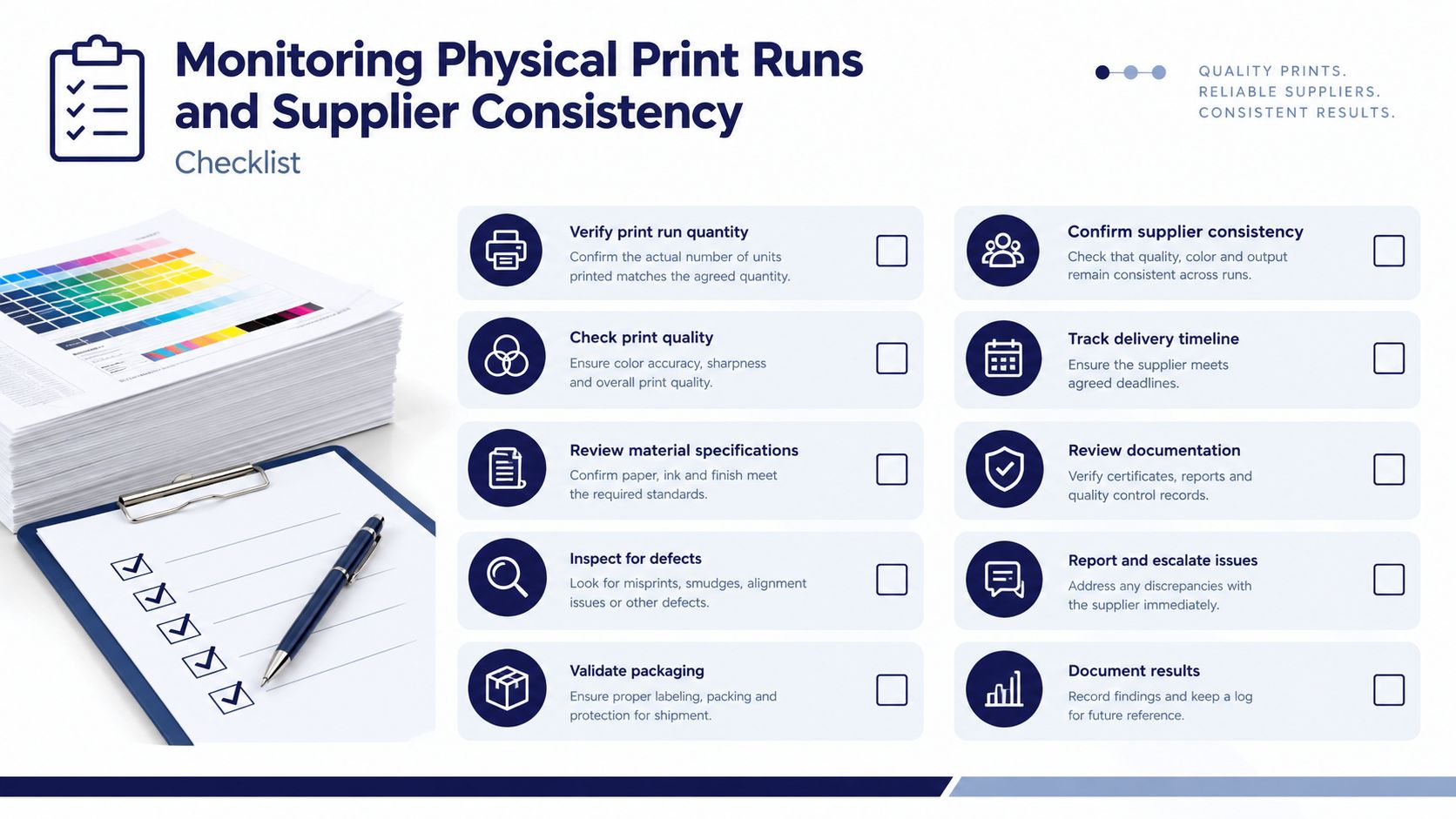
Small teams don't need to inspect every order. They need a sensible sampling plan and a record that connects physical defects to a supplier, product, file version, and date.
Build a practical sample loop
Order a test print when you use a new supplier, introduce a new garment type, change a high-volume design, or notice a cluster of complaints. Inspect the product against the listing and record:
- Placement: Is the print centered and positioned as shown?
- Color: Does the physical result broadly match the artwork and mockup?
- Legibility: Can the customer read the design at normal viewing distance?
- Garment quality: Does the fabric, size, color, and finish match the product description?
- Packaging: Did the item arrive protected and correctly labeled?
The aim isn't to create a laboratory protocol. It's to establish a consistent baseline. A single disappointing item may be isolated variation, while repeated alignment problems from the same facility indicate a supplier control issue.
Use returns as process evidence
Record the reason for every return and complaint using consistent categories. “Poor quality” is too broad to guide action. Separate misalignment, color mismatch, wrong size, missing item, damaged garment, late delivery, and customer expectation mismatch.
Link each report to the order, supplier, product, and artwork version. If complaints cluster around one design, inspect the file and mockup. If they cluster around one facility across several designs, investigate the supplier. If the customer expected a different product because of unclear copy, the issue belongs in the listing workflow rather than production.
Correct the source, not only the symptom
A failed sample should trigger a decision. Hold the design, request supplier clarification, revise the file, replace the mockup, or move the product to a more reliable facility. Keep the decision in the same record as the defect.
A supplier may be acceptable for simple designs but unsuitable for detailed artwork or premium garments. That distinction is more useful than labeling a supplier universally good or bad. The time-to-market workflow discussion is relevant here because faster launches only help when the release process still protects product quality.
A return is not just a customer-service task. It is evidence about which part of the product system failed.
Review the sample and complaint log at a regular interval. Look for changes, not just totals. New garment colors, revised artwork, a different production facility, and a new marketplace can all change the failure pattern. When the process identifies the source, the team can fix the workflow instead of refunding the same problem repeatedly.
Implementing Your First Quality Assurance Workflow
A first QA workflow should be small enough to use on a busy launch day. Start with the controls that protect account standing and customer trust, then add detail only when the records show a recurring problem.
A publication checklist that people will follow
Before a listing goes live, confirm:
- Niche relevance: The concept matches a defined audience and isn't based solely on an automated suggestion.
- Design source: The artwork has a documented source, creation record, or permission record.
- Visual review: The design is readable, correctly positioned, and suitable for the selected product.
- IP review: The artwork, phrase, title, tags, description, and brand field have been checked.
- Marketplace fit: The listing follows the destination platform's content and metadata rules.
- Commercial accuracy: Price, product type, colors, sizes, and variants match the intended offer.
- Approval evidence: A reviewer records the date, decision, and any conditions.
- Post-publication watch: Complaints, takedowns, returns, and supplier defects are logged against the listing.
The checklist should include a clear hold state. “Needs review” is better than forcing a yes or no decision when evidence is incomplete. A held listing can be resolved later. A published listing with an avoidable IP or product error may create work across several channels.
Review performance, not just completion
Track defects by source. If most failures come from metadata, improve copy review. If physical complaints dominate, revisit supplier sampling. If reviewers approve many AI-generated designs that later need removal, tighten the originality and clearance gates.
Corrective action should have an owner and a follow-up date. The process is working when the team can show what changed after a failure and whether the same failure became less common. A completed checklist with no learning is only an archive.
Quality assurance also benefits from good editorial discipline. Teams producing visual assets can use the journalism quality assurance steps as a reminder to verify sources, inspect details, and keep a clear review trail before publication.
Keep the system proportional
Don't automate a low-risk check while leaving trademark review to memory. Don't add a ten-page form that slows every listing if the team never reads it. The right workflow is the lightest system that reliably controls the risks that matter most.
Start with one shared register, one publication checklist, one owner for final approval, and one weekly review of defects, returns, complaints, and takedowns. Add supplier sampling and deeper review where the evidence shows exposure. As the catalog grows, split responsibilities so the person creating a listing isn't always the only person approving it.
Quality assurance processes won't make every launch successful. They will make decisions more deliberate, failures more visible, and corrections more targeted. For a small POD team, that is a practical way to scale without treating account health and customer satisfaction as matters of luck.
Trendlytic helps POD sellers research live niches across TeePublic, Amazon Merch, Redbubble, and Etsy, then review demand, competition, validated designs, and trademark risk in one workflow. Visit Trendlytic if you want to bring stronger research and pre-publication checks into the same process you use to protect your catalog.