Childrens Birthday T Shirts POD Guide
You've got a birthday coming up, a blank product template open, and a design that looks charming on screen. Then the practical questions arrive. Will the shirt fit a real child? Can the print and blank supplier support U.S. children's product requirements? Is the phrase safe to sell, and will the design still look current after the party?
Those questions matter more in children's apparel than they do in a typical adult POD listing. Children's birthday T-shirts are a large, segmented product category, but the work sits at the intersection of compliance, fit, trend timing, and marketplace research. A good graphic is only the starting point.
Table of Contents
- The Reality of the Kids Birthday Apparel Market
- Navigating Safety Compliance and Tracking Labels
- Getting the Fit Right with Child Specific Sizing
- Validating Niches and Clearing Trademarks
- Design Trends and Listing Optimization Strategies
- Your Pre Launch Checklist for Sustainable Growth
The Reality of the Kids Birthday Apparel Market
The market is much larger than a few novelty number tees. One major U.S. retailer currently lists 1,658 birthday-related kids' clothing results and 44,830 results for the broader query “kids birthday shirt”, which points to a commercially active segment rather than a tiny side niche (Jopokart's birthday kids collection). The same retailer offers birthday graphic tees for milestone ages including 1, 2, 3, 4, and 5, so age-specific apparel is an established buying pattern.
That volume creates opportunity, but it also creates noise. A generic “birthday boy” design competes with character graphics, glitter effects, oversized numbers, matching family sets, and countless personalized variations. Uploading another bright number tee without a clear audience usually gives you a crowded listing, not a differentiated product.
From novelty shirt to segmented category
The product has a longer history than many new POD sellers realize. Children's birthday shirts emerged in the 1920s and 1930s as mass production made clothing more affordable. Iron-on transfers expanded customization during the 1950s and 1960s, making names, ages, and dates easier to add. Inkjet printing later widened the design possibilities, and online retail eventually made birthday shirts available for nearly every age and theme (The Children's Place birthday shop overview).
That history explains why buyers now expect personalization. They aren't only shopping for a shirt with a number. They may be looking for a particular age, sibling coordination, a favorite color family, a nature theme, or something that works for party photos and everyday wear.
A useful way to find a less crowded angle is to study high-demand, low-competition niches without assuming every visible bestseller is worth copying. Look for the gap between what mainstream retailers repeat and what independent sellers can execute with a distinct point of view.
The 2026 trend gap
Recent children's fashion coverage for 2026 points toward oversized fits, muted earth tones, nature motifs, and family matching sets (SIUKid's kids' shirt ideas). Mainstream birthday assortments still lean heavily toward loud colors and licensed-character energy, which leaves room for quieter designs that feel more like current kidswear.
That could mean a simple “three” in a warm clay color, a small botanical illustration, or a coordinated sibling set with restrained typography. The trade-off is obvious. Minimal designs may have broader visual appeal, but they need stronger typography, better mockups, and more precise personalization because there's less decorative clutter to hide weak execution.
Navigating Safety Compliance and Tracking Labels
Children's apparel requires a different launch process from adult T-shirts. If the product is intended primarily for children 12 years old or younger, U.S. rules can apply to the garment, its components, its printing, and its labeling. The safest workflow is to confirm your fulfillment partner's responsibilities before you publish the listing.
Start with the product classification
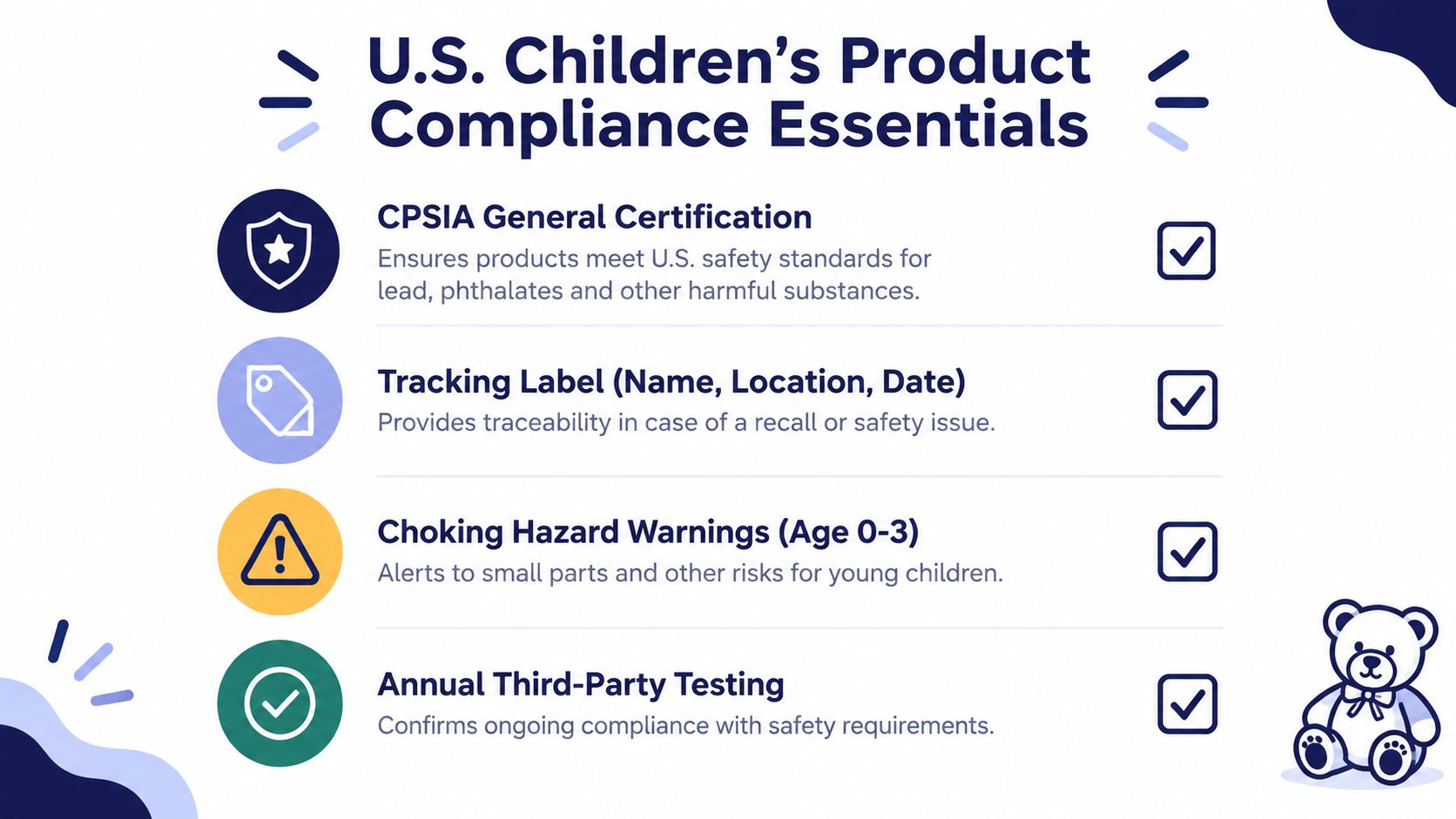
Ask your POD supplier whether the specific blank and decoration method are approved for children's products. U.S. children's products must stay below 100 ppm total lead in any accessible component part, while surface coatings and printing processes treated as semi-liquid coatings are subject to a 90 ppm lead limit (CPSC guidance on infant and children's garments).
That makes ink chemistry relevant. It also makes trims, snaps, decorative hardware, and supplier substitutions relevant. A shirt that looks like a simple cotton tee can still create compliance questions if the production method or component materials change.
Use this pre-listing sequence:
- Confirm the intended age range. Don't assume a youth blank is covered by the same process used for adult garments.
- Ask about third-party testing. Request documentation for the actual blank and decoration process, not a general statement about the supplier.
- Review ink and coating information. Pay particular attention to printing methods that may be treated as surface coatings.
- Confirm the Children's Product Certificate. The responsible party needs documentation supporting compliance before sale.
- Check the labeling workflow. Find out where permanent tracking information appears on the finished garment.
Tracking information is part of the product
Tracking labels aren't an optional branding detail for children's apparel. NIST guidance states that products designed and intended primarily for children 12 years old and younger need tracking labels, including the manufacturer or private labeler, manufacturing location and date, and other batch-level identifiers where practicable (NIST apparel compliance guidance).
CPSIA guidance also covers applicable flammability and lead requirements and calls for permanent tracking information when practicable (CPSC textile compliance training). If your POD provider can't explain how those labels are handled, pause the listing rather than guessing.
Practical rule: Treat compliance documentation as a launch asset. If you can't locate it before publishing, you won't be able to produce it calmly after a customer complaint or marketplace review.
Getting the Fit Right with Child Specific Sizing
A design can be excellent and still generate returns if the blank fits poorly. Children's sizing isn't a reliable miniature version of adult grading because body proportions change across age groups. A toddler shirt and a youth shirt need different decisions around neck opening, torso length, sleeve balance, and wearing ease.
Research using 3D body scanning created a dedicated children's dataset and expert-assessed fit evaluation, while sizing work for major UK retailers treated children's sizing as a specialized measurement problem rather than a simple adult scale-down (children's apparel fit study). For POD sellers, the practical lesson is straightforward: use child-specific measurements and validate the finished garment, not just the graphic placement.
Compare the blank before comparing the artwork
| Fit Metric | Adult-Scaled Blank | Child-Specific Blank |
|---|---|---|
| Neck opening | Often proportioned from adult grading, which can feel too loose or awkward | Developed for children's head and neck proportions |
| Torso length | May become long and boxy when reduced | Adjusted for the child's shorter or changing torso |
| Shoulder width | Can look broad relative to the body | Balanced for the relevant age band |
| Sleeve relationship | May preserve adult-style proportions | Shaped for children's arm length and movement |
| Ease | Can create excess fabric or restrict movement unpredictably | Evaluated against child posture and activity |
| Graphic placement | Centered using adult proportions | Positioned for a shorter body and different chest area |
This is why a 2T shouldn't be treated as a smaller youth medium. The wearer's proportions, movement needs, and dressing experience differ. A narrow neck opening may frustrate parents, while excessive ease can make a birthday graphic look low on the body.
Before choosing a supplier, order samples across the age groups you plan to sell. Measure the garment itself, compare it with the published chart, and photograph the design on a realistic child-specific mockup. A useful kids size guide with conversions can help organize size terminology, but it shouldn't replace the fulfillment partner's actual garment measurements.
Build customer guidance around measurements
Avoid relying only on labels such as toddler, youth, or small. Give buyers chest width, body length, and the method used to measure them. If the blank has a slim cut, relaxed cut, or oversized silhouette, say so plainly.
The best sizing copy reduces uncertainty without promising a perfect fit for every child. It also gives customer service a consistent answer when a parent asks whether to size up.
Validating Niches and Clearing Trademarks
Research should happen before illustration, not after you've built a full collection. I start by separating the broad phrase from the buyer's actual reason for purchasing. “Birthday shirt” is a starting point. “Muted botanical shirt for a child turning three,” “matching sibling birthday set,” and “minimal typography party outfit” are more useful design directions.
Use a store-first research workflow
Trendlytic is one option for this stage. It covers TeePublic, Amazon Merch, Redbubble, and Etsy, and uses a store-first approach that pulls a seller's top designs instead of treating random search results as proof of demand. For a birthday apparel search, I'd inspect the repeated themes, personalization patterns, color choices, and price positioning, then discard ideas that depend on copying another seller's artwork.
A simple research pass looks like this:
- Start broad: Search birthday shirts, birthday boy, birthday girl, milestone ages, sibling sets, and nature-led themes.
- Group the results: Separate age, audience, aesthetic, color palette, and personalization.
- Look for repetition: Repeated demand signals are more useful than one unusual listing.
- Check execution difficulty: A design that requires complex personalization may be harder to deliver consistently.
- Choose a narrow test: Build a small group around one clear buyer intent rather than uploading unrelated graphics.
The goal isn't to predict a guaranteed winner. It's to decide whether a design has a recognizable audience and whether you can make it safely, accurately, and distinctly.
Clear wording before you publish
Trademark checks deserve their own pass. In the USPTO system, most apparel marks for products such as T-shirts fall under International Class 25, which covers clothing, footwear, and headwear. The USPTO's goods-and-services guidance specifically lists T-shirts as an example of goods described in that class (USPTO goods and services guidance).
Search the exact phrase, close variations, and related wording. Don't assume a phrase is safe because it sounds common, or because another marketplace seller uses it. Trendlytic includes a built-in USPTO trademark check that flags ownership and expiry information across its trademark database, but I'd still review the official record for any phrase that could create risk.
For a deeper account-protection workflow, this guide on Merch by Amazon trademark protection is a useful reference.
Use the video below as a practical companion to the research process, then verify the final phrase and artwork independently before listing.
Design Trends and Listing Optimization Strategies
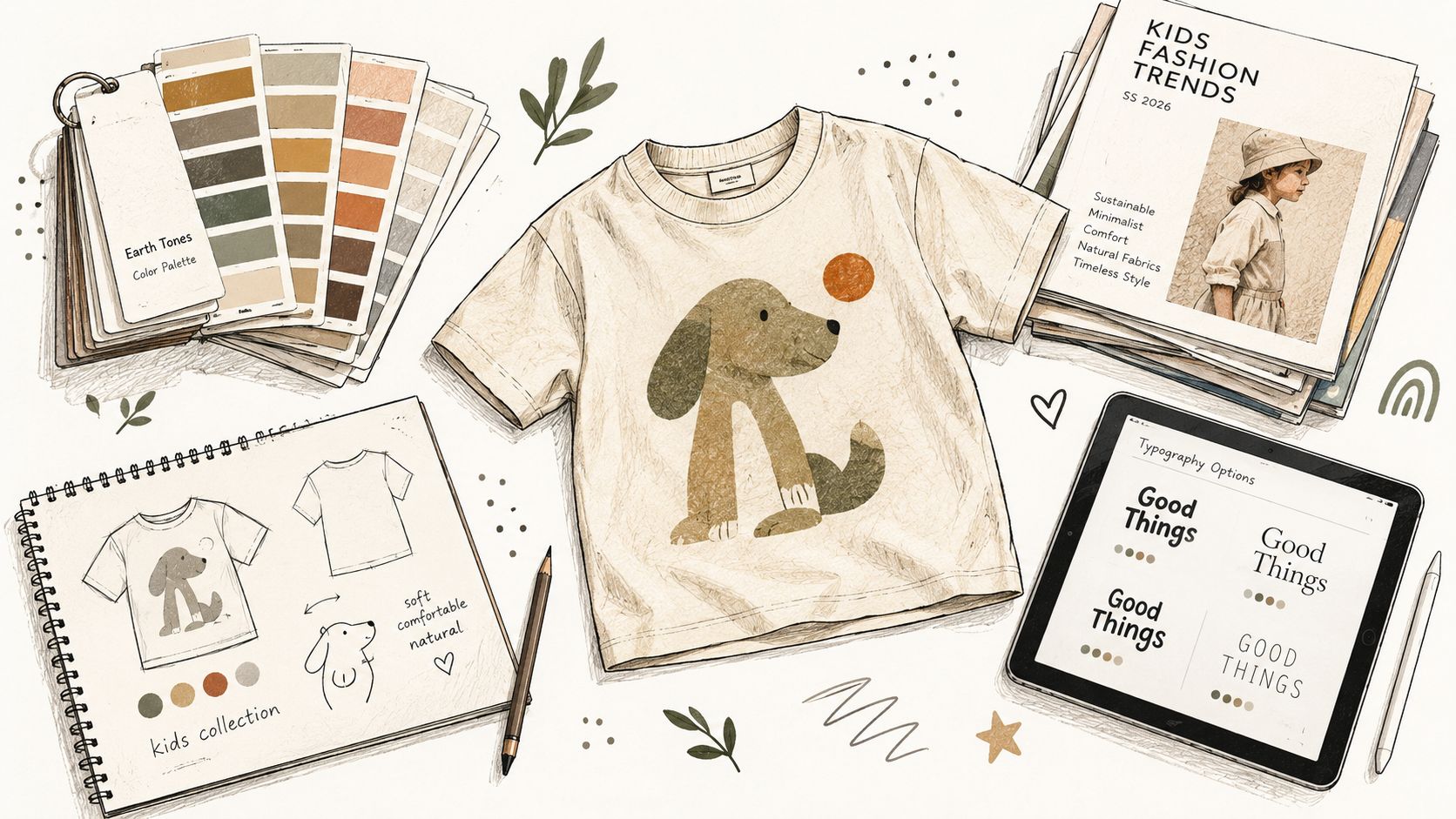
The strongest birthday designs translate a broader kidswear direction into a product that still feels celebratory. For 2026, current children's fashion coverage highlights oversized silhouettes, muted earth tones, nature motifs, and coordinated family looks (SIUKid's kids' shirt ideas). Those ideas work well for POD when the artwork stays legible and the garment shape supports the visual hierarchy.
A practical design system might use a warm neutral blank, a compact animal or botanical mark, and a large age numeral in one contrasting tone. Another option is minimal typography with the child's name and age, supported by a small illustration rather than a full character scene. These approaches avoid licensed characters and can look natural in family photographs.
Make the listing match the design
A restrained design needs precise copy. Instead of stacking every possible keyword, describe the actual product: “personalized third birthday shirt with botanical animal graphic” is clearer than a title filled with disconnected variations.
Keep the same language across the title, description, and tags. Mention the age, recipient, style, personalization, and occasion only when they apply. For Shopify sellers, the RankEngine Shopify SEO guide offers useful context on writing product information for search experiences without turning the listing into keyword clutter.
Pricing follows the same positioning logic. A minimal, trend-aligned shirt shouldn't be described as a bargain substitute for a bright character tee. Explain the value through the design direction, personalization, garment fit, and suitability for photographs or coordinated family outfits. Don't claim premium quality unless your supplier's blank, print process, and documentation support that claim.
Researching trending shirt designs can help you compare current visual patterns, but trends are inputs, not instructions. Keep the parts that make sense for a child's birthday and remove anything that compromises readability, comfort, or production reliability.
Your Pre Launch Checklist for Sustainable Growth
Treat the final review as quality control. Open the product listing, supplier specification, mockups, and customer message templates at the same time. Comparing these materials side by side exposes mismatched measurements, personalization instructions, and delivery promises before a buyer finds them.
Start with the garment. Confirm the blank model, available sizes, cut, and measurement chart. Check that the mockup represents a child's proportions rather than an adult torso with a reduced graphic. For an oversized style, state the fit clearly and confirm that the artwork remains balanced across the larger front area.
The quiet checks that prevent avoidable problems
- Supplier documentation: Confirm testing records, certificate responsibilities, ink details, and tracking label placement. Keep the CPSIA paperwork and label information matched to the product.
- Artwork proofing: Review personalization fields, spelling, age numbers, contrast, and print boundaries.
- Sizing support: Give buyers a short method for measuring a similar shirt and choosing between sizes. Child-specific proportions make a generic age label unreliable.
- Marketplace safety: Recheck phrases, character references, logos, and design elements before publication.
- Delivery expectations: Explain that POD production can take longer than ready-stock retail, particularly near a birthday date.
- Customer service: Prepare answers about fit, wash care, personalization, and replacement policies.
Review the commercial side without treating traffic as demand. Comparing lead generation tactics helps separate visitor acquisition from an offer that earns trust. For birthday apparel, trust rests on accurate measurements, clear images, documented safety checks, and realistic delivery information.
Sustainable POD is intentionally unexciting. Research a narrow buyer need, verify the phrase, inspect the blank, publish carefully, and improve the listing from real customer questions.
Launch with a manageable group of related designs instead of a huge catalog. Record repeated questions, confusing color choices, and misunderstandings about personalization. Update the product page, mockups, and sizing guidance before adding more variations.
Trendlytic helps POD sellers research niches across TeePublic, Amazon Merch, Redbubble, and Etsy, compare demand and competition signals, review store-first bestseller data, and check phrases against USPTO trademark records. If you're building childrens birthday t shirts, visit Trendlytic to validate a focused design direction before investing time in a full collection.