Niche Market Identification for POD: Practical Workflow
The design folder is open, the coffee is cold, and you're staring at TeePublic search results wondering whether “camping dad” is a real opportunity or just another crowded phrase. A few bestseller badges look promising, but the first page is full of similar shirts, uncertain wording, and designs you can't safely reproduce. That's the point where many POD sellers either keep guessing or spend the evening collecting screenshots that never become a decision.
Niche market identification works better as a repeatable process. I look for three things together: evidence of demand, a competition level I can work with, and a defensible way to serve a specific buyer. Marketplace activity supplies clues, but it doesn't grant permission to use a phrase or guarantee that a design will sell.
The practical workflow is simple to describe, even if it takes discipline to follow: start with a seed, expand it into related buyer and use-case terms, inspect live sellers across marketplaces, read the report rather than worshipping one score, screen trademarks immediately, and run a small validation test before committing meaningful time or inventory.
Table of Contents
- Staring at TeePublic at 2 AM
- What a Defensible Niche Actually Looks Like
- The Research Workflow From Seed Keyword to Scored Report
- Reading Demand, Competition, and the Opportunity Score
- Same-Session Trademark and Platform Checks
- Validating Demand Before You Commit a Batch
- Where to Take This Workflow Next
Staring at TeePublic at 2 AM
I've had plenty of late research sessions where the problem wasn't a lack of ideas. It was too many half-ideas. One tab showed a shirt with strong visible sales, another showed a similar phrase with thousands of competing listings, and a third revealed that the wording might belong to someone else. The design folder grew, but confidence didn't.
A bestseller is useful evidence, not a business plan. It tells me that someone found a product relevant enough to buy, but it doesn't tell me whether the same wording is available, whether the demand is still active, or whether I can create a meaningfully different design for the same audience.
That distinction matters in print on demand because marketplaces expose live commercial signals. TeePublic, Amazon Merch on Demand, Redbubble, and Etsy each show different combinations of sellers, listings, prices, reviews, and bestseller activity. I can use those surfaces to replace some guesswork with observation, provided I read them as separate environments rather than treating every marketplace as one blended market.
Practical rule: A niche earns more research time when demand, competition, and defensibility point in the same direction.
The workflow also protects creative energy. Instead of spending an hour polishing a design before checking whether the phrase is crowded or risky, I can spend a short research block deciding whether the idea deserves an hour at all. That doesn't eliminate uncertainty. It puts uncertainty in the right place, before production rather than after publication.
My working question is no longer, “Can I make something for this keyword?” Almost any keyword can produce a graphic. The better question is, “Can I identify a buyer, offer a distinct angle, and use the wording without creating an avoidable problem?”
That's the standard used throughout the process below. Inspiration still matters, especially for visual execution, but it shouldn't be responsible for market selection.
What a Defensible Niche Actually Looks Like
A niche isn't merely a small keyword. It's a recognizable group of buyers connected by a preference, identity, use occasion, or unmet need. The intellectual foundation comes from modern market segmentation, which Wendell R. Smith formally introduced in 1956, arguing that markets aren't homogeneous and that sellers should adapt products and promotion to smaller, relatively homogeneous groups. The historical account from Harvard Business School describes segmentation as a way to recognize differing preferences and respond more precisely.
For POD, I translate that idea into three tests. A viable niche should have an identifiable audience, observable demand, and enough room to express a specific identity or moment. “Funny shirt” fails because it describes a format, not a buyer. “Night-shift respiratory therapists who use dry humor to mark their profession” gives a designer a clearer audience, vocabulary, and context.
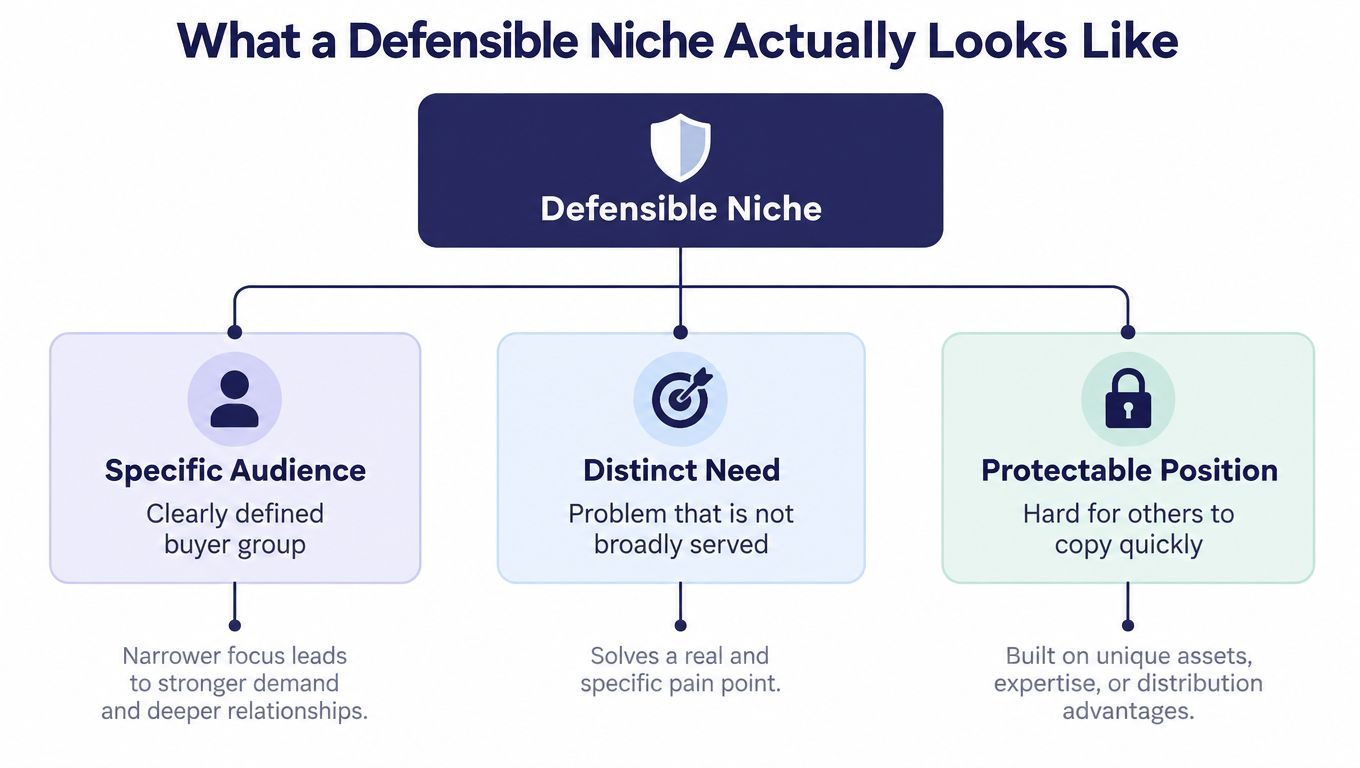
The three tests I use
Specific audience. I should be able to describe who might buy the item without hiding behind “people who like X.” Profession, life stage, local culture, hobby sub-community, and buying occasion can all sharpen the description.
Distinct need or motivation. The buyer may want recognition, belonging, humor, a gift for a particular event, or a design that reflects a very specific identity. A niche can be commercially interesting even when the product itself is ordinary, if the emotional reason for buying is clear.
Protectable position. “Protectable” doesn't mean a phrase is automatically legally protected. It means the offer has something beyond a generic keyword, such as a distinctive visual system, a clear audience angle, original copy, or a use occasion that competitors haven't fully served.
I also separate a real niche from an obscure phrase. Low visibility can mean low competition, but it can just as easily mean nobody is looking or buying. The most useful opportunities often sit where a recognizable audience meets a specific motivation, not where a keyword happens to have few results.
If you're exploring audience-led online businesses beyond POD, this broader resource on profitable YouTube niches without filming is useful for seeing how identity and format can combine into a focused market. The same principle applies here: start with the audience and their reason for caring, then choose the product expression.
Before opening a report, I write one sentence:
“This product is for [specific buyer] who wants [identity, emotion, or occasion] expressed through [product and design angle].”
If I can't write that sentence without using a vague mass-market label, I'm not ready to score the niche.
The Research Workflow From Seed Keyword to Scored Report
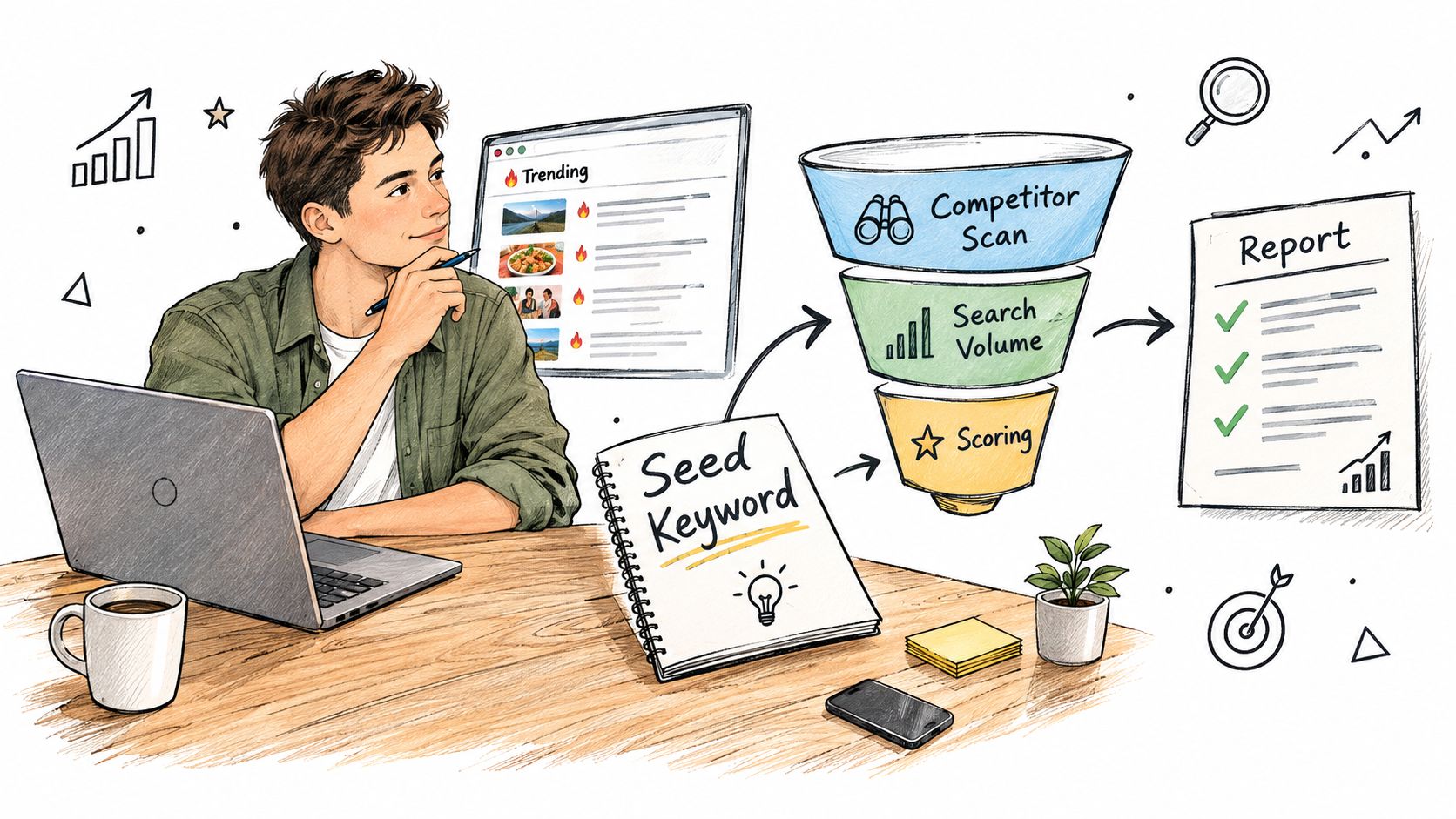
I usually begin with a phrase that comes from a customer conversation, a design idea, or a live trend feed. A seed such as “book club shirt” is only a starting point. I expand it into related identities, occasions, roles, and language: romance readers, library staff, introverted readers, reading challenges, literary gifts, and humorous book-club phrases.
That expansion prevents a single keyword from controlling the research. It also creates a better basis for the keyword research process, because related terms often reveal the audience more clearly than the original phrase.
Start with the store, not the random listing
The next move is a live bestseller pull across TeePublic, Amazon Merch on Demand, Redbubble, and Etsy. I'm not only asking which designs rank for the phrase. I want to see the stores behind the visible results and inspect each seller's top one to three designs.
That store-first view answers questions a search page can't. Does the seller repeatedly succeed with the same audience? Are the designs built around one recognizable identity? Do the top products vary by occasion, garment, or visual style? If every strong seller has a broad catalog with no clear audience pattern, the keyword may be less focused than it first appeared.
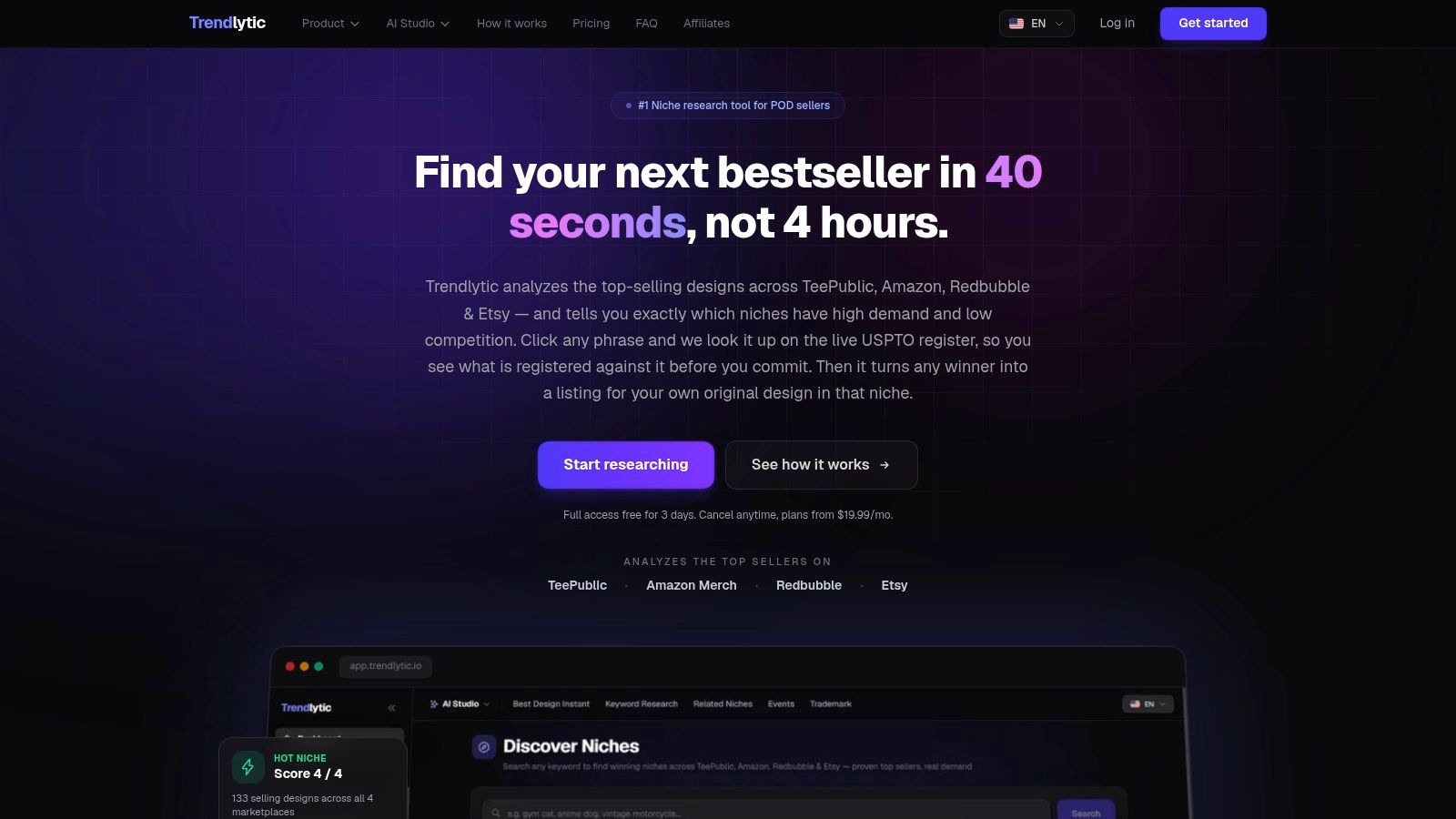
A tool such as Trendlytic can pull live bestseller data from those marketplaces, extract tags and related phrases, and return a report with demand, competition, an Opportunity Score, and validated design examples. I treat that output as a research surface, not a final verdict.
The workflow then becomes a single chain:
- Seed the idea: Enter the phrase that triggered the research.
- Expand the language: Collect related keywords, tags, identities, and occasions.
- Inspect top stores: Read the leading one to three designs from each relevant seller.
- Separate marketplaces: Note where the phrase appears active and where competition looks concentrated.
- Build the report: Record demand, competition, design angles, prices, and possible risks.
The video below shows the kind of research process I mean. The important point isn't the interface. It's keeping the evidence tied to one candidate niche instead of collecting disconnected ideas.
I save the original phrase, the expanded terms, and the strongest design patterns before I sketch anything. That record makes it easier to explain why a niche moved forward, and it gives me something concrete to revisit if the launch underperforms.
Reading Demand, Competition, and the Opportunity Score
A candidate niche earns attention when its signals support one another. High demand with high competition can still leave room for a narrower identity or design angle. Low competition with weak demand may indicate a market that buyers do not value enough to support.
Trendlytic's Opportunity Score combines recency, repeat bestseller presence, review velocity, price acceptance, and competitor concentration into one comparable signal. I use it to rank candidates for closer research, not to make the decision for me. The component signals show whether the score reflects active interest, repeated sales patterns, or a crowded field. For a closer explanation of how competition scoring works, review how competition levels are weighted before relying on the combined result.
A simplified report can be read like this:
| Signal | Weak reading | Strong reading | What it tells you |
|---|---|---|---|
| Demand | One visible seller or an old bestseller | Several recent signals across relevant listings | Whether interest appears active rather than incidental |
| Competition | Many near-identical designs | Competitors exist, but buyer identities or angles remain distinct | How difficult it may be to earn attention |
| Recency | Interest appears tied to a past moment | Newer listings continue to surface | Whether the niche may still have energy |
| Repeat bestseller presence | A single outlier carries the result | Multiple sellers repeatedly show related winners | Whether the pattern is more than one lucky listing |
| Price acceptance | Competing products cluster around unclear or weak offers | Buyers appear to accept established product pricing | Whether the category supports a commercial test |
| Competitor concentration | A few sellers dominate every angle | The market has activity without one complete owner | Whether a new entrant can find an opening |
“Camping dad” may show stronger overall demand while offering a dense field of nearly interchangeable graphics. “Retired park ranger gifts” may show less activity, but its audience, vocabulary, and gifting occasion are clearer. I would test the second first if I could create original designs for that identity.
The score does not assess my design quality, fulfillment reliability, brand trust, or legal clearance. It also cannot confirm that a phrase will connect with the audience I have in mind. Those judgments require platform knowledge, creative review, and validation with actual listings or products.
The trademark check belongs in the same research session because filing activity can make a phrase less practical to use. The next section covers the relevant USPTO search and review process in detail.
Campaign speed matters only after the niche passes those checks. faster campaign rollout tips can help with production and promotion, but faster execution does not replace evidence. A strong score supports a test. It does not guarantee a sale.
Same-Session Trademark and Platform Checks
A promising phrase can still be unusable. I run the trademark screen before I create artwork because changing a slogan after design, listing, and promotion wastes more than a few minutes.
The USPTO says its database contains every mark that has been registered or applied for. It recommends searching before filing because existing applications or registrations may conflict with a proposed mark, and only live marks can prevent registration. The practical starting point is the USPTO trademark search guidance.
Search broadly, then read the context
I search the complete phrase first. Then I search the distinctive words separately, meaningful combinations, plural or related forms, and variations that preserve the same commercial impression. An exact-match result is only one part of the screen.
Next, I filter out dead records when I'm looking for marks that could block a use, then inspect the live records. I read the owner, status, filing or registration details, and the relevant goods and services classes. A phrase may be harmless in one context and risky in another, so a simple word match isn't enough for commercial clearance.
The database check is a first filter, not legal advice. If the phrase is central to a brand, campaign, or substantial investment, qualified legal review is the safer step.
Amazon Merch on Demand adds another layer. Amazon requires submitted content to comply with its Conditions of Use, Community Guidelines, Content Policies, intellectual-property laws, and other applicable laws. Its content operations team monitors orders for compliance, and Amazon can reject content or suspend the ability to place orders.
That means a visible bestseller is not permission to copy its wording, artwork, character, logo, or brand reference. I record the phrase I found, remove protected references unless I have authorization, and then review the design under the platform's rules.
A built-in USPTO check, such as the one available in Trendlytic, can place the alert beside the niche evidence while I'm still deciding whether to proceed. That's more useful than discovering a conflict after I've built a product line.
The same habit applies when researching adjacent categories. For example, wholesale hat market insights can help frame a broader product opportunity, but the product category doesn't change the need to screen slogans, names, and brand-adjacent language.
Validating Demand Before You Commit a Batch
A niche report is a starting point. The next question is whether a specific offer can turn attention into a measurable action.
I narrow the candidate to one product, one buyer angle, and one design concept. Then I put that concept in front of qualified traffic through a focused product page or waitlist. I track where visitors came from, what price they saw, and whether the page clearly explained who the design was for.
Published validation research treats 15% to 25% visitor-to-waitlist conversion as strong, while below 5% is weak. It also treats 20% or more waitlist-to-purchase conversion as evidence that interest has become demand. These are directional benchmarks, not laws. Channel quality, price, trust, and category friction can change the result, so I use them as prompts for investigation rather than automatic pass or fail rules. The figures are discussed in published product research validation guidance.
Make the commitment progressively stronger
A click is a weak signal. A waitlist signup is stronger, and a preorder, deposit, or purchase gives me better evidence that the buyer values the offer enough to act.
For a small test, I might compare two creative directions for the same audience. One could emphasize professional identity, while the other focuses on a gifting moment. If one receives attention but neither produces meaningful commitment, I don't automatically blame the niche. The problem may be the phrase, mockup, price, landing page, or audience source.
I set the decision rules before seeing the results:
- Go: The offer produces meaningful buyer actions and the margin remains workable.
- Revise: People engage, but the design angle or product presentation needs another test.
- Stop: Traffic is qualified, the offer is clear, and there's no meaningful commitment.
A trend feed can help me notice a phrase while it's still relevant, but speed creates its own trap. A short-lived spike may produce attention without repeat demand. I want the trend signal to trigger a test, not justify a large batch.
For sellers building scarcity into their launch calendar, this guide to limited-edition drops offers a useful way to think about controlled releases. I still keep the test small enough that a weak result is affordable.
The validation loop is straightforward: discover a candidate, create one focused offer, measure behavior, learn from objections, and either improve, stop, or scale. That loop is more honest than treating marketplace popularity as proof that my particular design will sell.
Where to Take This Workflow Next
A practical niche market identification routine doesn't need to be complicated, but it does need a fixed order.
First, define the buyer and the reason they might care. Then run a live cross-marketplace report, inspect seller density and top designs, read demand beside competition, and check the phrase against trademark records in the same session. Only after that should I create a focused offer and validate it with a small test.
A tool can compress research time, but it can't promise sales. Trendlytic is described as reducing roughly four hours of manual research to about forty seconds, yet that speed only helps if I still inspect the underlying evidence. A strong Opportunity Score is a green light to test, not a guarantee of profit.
The advantage comes from running the loop consistently. I'd rather reject a tempting phrase early than spend a week building around a keyword that had demand but no usable angle, no room to compete, or no safe path to publication.
If you want to run this workflow in one place, visit Trendlytic to compare live POD demand and competition across TeePublic, Amazon Merch on Demand, Redbubble, and Etsy, then use the built-in USPTO check before you design. Treat the report as a structured starting point, validate the offer yourself, and let the results decide whether the niche earns a larger launch.