Niche Positioning for POD Sellers That Actually Sells
You've probably had this happen: you spot a promising POD phrase, open Amazon or Etsy, and find pages of nearly identical shirts competing for the same buyer. You make a few designs anyway because the keyword feels popular, then discover that popularity alone doesn't tell you whether people will click, buy, or pay enough to make the listing worthwhile.
I've tested hundreds of niches across multiple POD platforms, and the shortcuts that failed were usually the same. Broad themes, bestseller lists, and personal enthusiasm produced busy catalogs, not defensible positions. The useful question isn't “What niche can I design for?” It's “Which buyer, with which problem or identity, is most likely to choose this design over the next listing?”
Table of Contents
- The Niche Problem Most POD Sellers Get Wrong
- What Niche Positioning Actually Means
- Why Niche Positioning Matters for POD Revenue
- The Four Variables of a Defensible Niche
- How the Same Niche Plays Across POD Platforms
- Running Positioning Research With Trendlytic
- Your Niche Positioning Checklist and Templates
- Common Questions About Niche Positioning
The Niche Problem Most POD Sellers Get Wrong
Most new sellers pick a niche in the wrong order. They browse a list of “best niches,” fall in love with a keyword, or upload a batch around a broad theme such as dogs, coffee, nurses, or fishing. Uploading feels like progress, but a large catalog built around an undifferentiated theme can leave every design fighting the same crowded search results.
The problem is that a popular category isn't automatically a viable position. “Dogs” describes an enormous audience with different identities, occasions, budgets, and buying habits. A design for a retired greyhound owner, a veterinary technician who fosters senior dogs, and someone shopping for a generic dog-lover gift may sit under the same broad topic while responding to completely different messages.
Practical rule: Your enthusiasm for a theme is useful for sustaining research and design work. It isn't evidence that buyers want your version of it.
Experienced sellers usually reverse the process. They observe what buyers search for, how they describe themselves, what products they save or purchase, and which subgroups appear underserved. Then they narrow the audience until a design has a clear reason to exist.
The broad-theme trap
A saturated category page creates a difficult comparison. Buyers see many shirts with similar wording, familiar clip-art treatments, and interchangeable product photography. If your listing doesn't speak to a more precise identity or occasion, you're asking the buyer to choose on appearance alone.
That can work occasionally, but it's a weak foundation. It also makes your research harder because broad keywords blur together several types of demand. A seller may see activity around “coffee” and mistake it for proof that a particular coffee-related message will sell.
Niche marketing gained traction partly because broad-market competition became more difficult. A 2025 industry summary of niche markets describes the pressure niche marketers have placed on mass-market companies since the 1980s and frames niche marketing as a specialized approach that expanded across the economy. For POD, the practical lesson is simple: specificity is a competitive decision, not just a creative preference.
The four variables I use to replace gut feel are buyer behavior, demand size and growth, competitor density, and willingness to pay. A niche becomes interesting only when those variables work together.
What Niche Positioning Actually Means
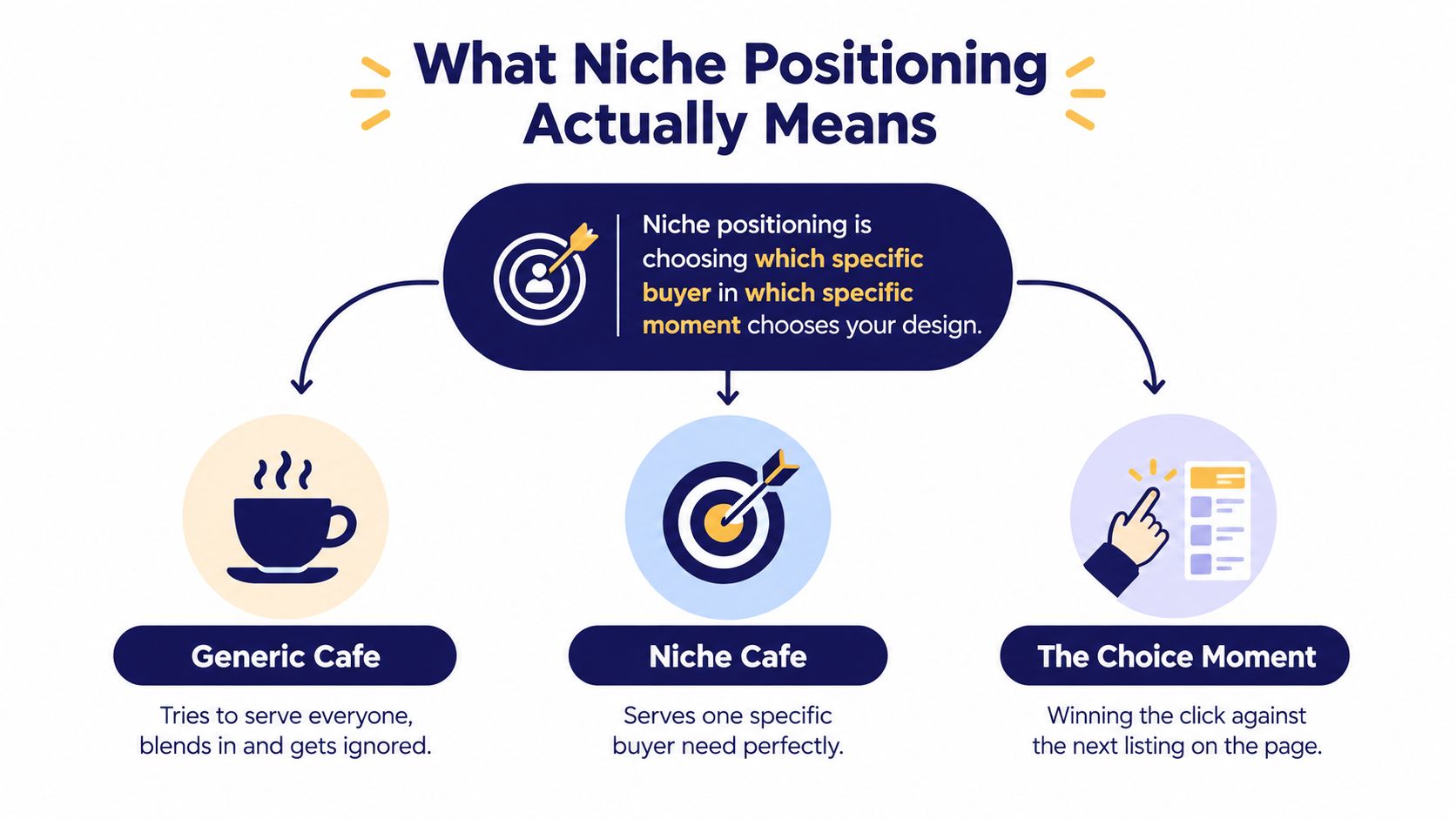
Niche positioning is the deliberate choice of which specific buyer, in which specific moment, will choose your design over the next listing on the page. That definition is more useful than just naming a category because it forces you to identify the decision you're trying to win.
Consider two coffee shops. The generic shop sells coffee to everyone nearby. It competes on location, convenience, and whatever happens to be available. The positioned shop serves remote workers who read paper books, need a quiet table, and want a place that feels separate from a loud chain. It may attract fewer people overall, but its offer makes immediate sense to a particular customer.
POD works the same way. A mass-market seller targets a broad keyword and hopes an average design earns attention. A positioned seller chooses a slice defined by identity, occasion, role, or subculture, then creates copy and visuals that make the intended buyer feel recognized.
From category to choice moment
“Yoga” is a category. “Yoga teachers who want a dryly funny shirt for studio staff days” is closer to a position. “Astronomy” is a category. “Amateur stargazers buying a retro-style gift for a friend who attends meteor-shower nights” gives you a buyer, context, and design direction.
The distinction matters because a niche can still be too broad to guide a listing. Positioning adds the reason someone should select your product now. That reason might be a gift occasion, an inside joke, professional pride, or a specific lifestyle signal.
Positioning also needs to show up consistently. Your design, title, tags, product choice, imagery, and social content should all point toward the same buyer. Advice on building a standout social media brand is useful here because a clear external identity should reinforce the same audience definition as your product listings.
For keyword discovery, I also use Trendlytic's guide to finding niche keywords as a practical reference. The central shift is from asking what you can make to asking which narrow audience you can serve more clearly than the surrounding listings.
Why Niche Positioning Matters for POD Revenue
Niche positioning matters because it changes several commercial variables at once. A precise listing can match search intent more closely, reduce irrelevant clicks, support a stronger price justification, and create a design people feel comfortable wearing or giving to someone specific.
The available figures point in the same direction, though they shouldn't be treated as a promise for every listing. A 2025 business guide on finding a niche market reports 23% higher profit margins for companies that successfully identify and serve specific niches than for businesses competing broadly. The same source cites 67% of new businesses failing because they try to serve everyone, while a separate 2026 marketing-statistics summary reports conversion improvements of up to 60% and engagement gains of 50% for niche marketing versus broad-market approaches.
A segmentation-focused article in that same research set reports that 80% of companies using market segmentation report increased sales. These figures describe broad marketing evidence, not guaranteed results for a particular POD store, so I use them as directional support for better targeting rather than as a sales forecast.
Where the lift comes from
| Metric | Broad Theme Listing | Niche-Positioned Listing |
|---|---|---|
| Search match | Broad and ambiguous | Specific to an audience or occasion |
| Direct comparison | Often crowded with similar designs | Narrower comparison set |
| Price justification | Usually depends on decoration alone | Can include identity, usefulness, or gifting context |
| Engagement | May appeal to casual browsers | More likely to resonate with a defined buyer |
| Expansion path | More generic variations | Related roles, moments, and product formats |
The commercial effect is cumulative. Better fit can improve the quality of traffic, while lower direct competition can make the listing easier to distinguish. A buyer who sees the product as “for people like me” may also accept a higher price than someone comparing generic alternatives.
The same principle applies outside apparel. If you're comparing POD with adjacent creator income models, a grounded overview of realistic earnings from selling photos helps keep expectations practical. Different products have different margins, but all depend on matching a real buyer need rather than assuming a large audience will do the selling for you.
The Four Variables of a Defensible Niche
A defensible niche depends on four variables working together: buyer behavior, demand size, competitor density, and willingness to pay. I score each from 1 to 5, then record the evidence behind every score. The number creates consistency; the notes prevent wishful thinking.
Buyer behavior
Start by identifying how the audience shops. A yoga teacher looking for a professional gift may search a precise phrase and compare several products. A Nurses Week shopper may browse themed collections, respond to timing, and select from coordinated visual bundles.
That distinction changes the listing. Intent-heavy niches need precise wording and close keyword relevance. Browse-led niches need strong images, product variety, and a visual system buyers can recognize across a collection.
Demand size
Demand should support more than one design without becoming so broad that every seller targets the same audience. Vintage marine biology illustrates the balance. It combines a defined interest with subtopics such as field research, sea life, and academic identity.
I assess demand across related terms, sales signals, and trend direction rather than relying on one keyword. I also check whether the audience has enough occasions, roles, and identities to support new products after the first design.
Competitor density
Count strong direct competitors, not every listing that shares a word. A broad dog-mom phrase may attract buyers, yet established sellers can already own the obvious angles. A narrower opening might focus on a breed, profession, event, or humor style.
For a repeatable assessment, use Trendlytic's competition scoring methodology to quantify competitor density instead of judging the search page by instinct. using Zemith for market intelligence can also structure competitor benchmarking beyond a quick review. Record what the leading products share, where they differ, and which buyer need they leave under-served.
Willingness to pay
Price tolerance varies by product and platform. Etsy customers may accept more for a considered print or personalized gift, while a Merch buyer may compare standard shirts against a familiar ceiling. Trademark risk affects the margin too. The USPTO's trademark basics guidance is useful before building a phrase-based product line.
Score all four variables, then explain each score in one sentence. Strong demand does not compensate for weak pricing or dense competition. It signals that the analysis still needs work.
How the Same Niche Plays Across POD Platforms
The same niche can behave differently depending on where you publish it. Retro astronomy may work as a keyword-led apparel design on Amazon Merch, a sticker and poster collection on Redbubble, a broader lifestyle graphic on TeePublic, or a premium wall-art product on Etsy.
| Platform | Discovery | Top Products | Price Ceiling | Trademark Risk | Review Velocity |
|---|---|---|---|---|---|
| Amazon Merch | Keyword relevance and marketplace search | Apparel, especially shirts | Buyers compare familiar shirt prices | Treat phrase checks seriously before publishing | Depends on account activity and listing performance |
| Redbubble | Browse, tags, and recommendations | Stickers, apparel, posters, home products | Varies by product and artist markup | Review every phrase and visual reference | Often influenced by browse exposure |
| TeePublic | Search, browse, and themed discovery | Apparel and lifestyle graphics | Promotional pricing can shape expectations | Avoid protected phrases and recognizable brands | Depends on campaign and marketplace exposure |
| Etsy | Search, personalization, gifting, and shop trust | Prints, apparel, gifts, and bundles | Higher for differentiated or personalized products | Trademark checks remain essential | Reviews can matter heavily to conversion |
Reposition the design, not just the upload
On Merch, I'd tighten the copy and keep the title and tags closely aligned with the specific astronomy audience. On Redbubble, I'd test the same artwork as a sticker, poster, and duvet design because the platform supports a wider product range. TeePublic may reward a more general lifestyle treatment, while Etsy gives room for a higher-margin framed print with a descriptive, search-focused title.
A niche that depends on direct keyword intent may struggle on a browse-heavy platform if the thumbnail doesn't explain the identity quickly. Conversely, an expressive subculture design can perform better on a recommendation-led marketplace than in a strict search environment.
Amazon Merch also has a measurable tier structure. Commonly reported 2026 guidance describes progression from Tier 10 to Tier 25, Tier 100, Tier 500, Tier 1,000+, and higher levels as sales volume increases, while emphasizing that more uploads alone don't guarantee larger catalog limits or better royalty rates. Product selection and demand validation therefore matter before you spend limited publishing capacity.
Running Positioning Research With Trendlytic
A practical research workflow starts broad enough to find ideas, then narrows until the audience and buying context are clear. Trendlytic covers TeePublic, Amazon Merch, Redbubble, and Etsy, and includes a built-in USPTO trademark check, so it can be used as one workspace for comparing the same niche across platforms.

Start with a behavior-led seed
Use Niche Discovery with a broad seed such as “retro astronomy,” “studio yoga teacher,” or “marine biology gift.” Don't accept the first suggestions as final niches. Look for related phrases that reveal a role, occasion, or identity, then note whether the language sounds like a search query or a browsing theme.
Next, use Opportunity Score to separate ideas with visible demand from terms that may have a low ceiling. I treat the score as a screening signal, not a verdict. A promising result still needs a manual look at design quality, competitor strength, product fit, and trademark exposure.
Use Trending Now to identify direction. A rising curve may justify faster testing, while a flat evergreen niche may deserve a slower catalog plan. Trends are useful for timing, but they can also attract a wave of copycat designs, so competitor density has to remain part of the decision.
Research habit: Save the reason a niche passed, not just the score. A week later, the written rationale is more useful than a list of unexplained keywords.
Before publishing, run the phrase through the USPTO check. A hit isn't automatically a legal conclusion, but it is a red light for investigation. You may pivot to a generic description, remove a branded expression, or abandon the phrase if the risk outweighs the opportunity.
For a repeatable process, Trendlytic's POD niche research tool guide provides a relevant starting point. My weekly workflow is straightforward:
- Generate seed ideas from observed buyer behavior.
- Compare related niches by demand, competition, and Opportunity Score.
- Check the trend direction.
- Inspect the strongest listings manually.
- Run trademark checks on the exact phrases.
- Choose the platform where the product and discovery mechanism fit.
- Record the decision and revisit the niche after the first test cycle.
The tool compresses research, but it doesn't replace judgment. The final position still comes from understanding what the buyer is trying to signal, solve, or give.
The video below adds another visual way to understand the research workflow.
Your Niche Positioning Checklist and Templates
I keep a validation sheet for every niche before making a full design batch. It prevents a strong-looking keyword from skipping the uncomfortable questions.
| Field | What to record |
|---|---|
| Niche name | Audience plus problem, role, or outcome |
| Behavior note | Search intent, browse behavior, or buying occasion |
| Demand range | Trendlytic search and marketplace demand signals |
| Competitor count | Direct designs competing for the same buyer |
| Price floor | Lowest acceptable price after platform costs |
| Trademark status | Clear, investigate, pivot, or walk away |
| Opportunity Score | Screening score and your written interpretation |
| Platform fit | Merch, Redbubble, TeePublic, Etsy, or a combination |
Pre-launch checklist
- Behavior evidence: Identify the phrase or context showing what the buyer wants.
- Demand check: Review whether the audience can support more than one product idea.
- Trend direction: Record whether interest is rising, stable, or fading.
- Competitive gap: Name the specific angle that existing listings miss.
- Price margin: Confirm that the product can sell at a viable floor.
- Trademark clearance: Check the exact phrase and relevant product class.
- Design fit: Make the audience recognizable without relying on protected language.
- Listing quality: Align title, tags, description, mockup, and product choice.
- Platform choice: Match the niche's discovery behavior to the marketplace.
- Review plan: Decide what evidence will justify improving, expanding, or stopping.
Use the 1,000 monthly query threshold only where Trendlytic shows it for the relevant term, and don't treat it as universal proof of sales. A separate working filter may be fewer than 30 active designs on Merch for the exact phrase, provided the listings are comparable rather than merely related.
For marketplace evidence, I'd also look for at least one listing with a 4.4-star average, while remembering that review quality and volume can vary by platform and product. These are decision filters, not guarantees.
A template reduces the cost of each test, but it can't tell you whether the design feels native to the audience. Keep the sheet, inspect the listings, and let the evidence change your mind when it should.
Common Questions About Niche Positioning
| Question | Short Answer | Detailed Guidance |
|---|---|---|
| Do broad niches still work? | Yes, in the right context | Etsy can support broad themes through personalization, gifting, and bundles. Merch usually benefits more from a precise identity or occasion because generic terms create heavier comparison. Keep a broad niche when the product has a strong personalization angle, a clear gift use, or a distinctive visual hook. Narrow it when the listing looks interchangeable. |
| How long should validation take? | Match the timeline to the niche | Trend-based niches can be evaluated over 7 to 14 days, while evergreen ideas may need 30 to 60 days of observation and testing. Those timelines are practical testing windows, not guarantees. Stop early when the phrase attracts no relevant engagement, the competition leaves no credible gap, or trademark risk prevents a clean design direction. |
| What if a phrase is trademark restricted? | Investigate, pivot, or leave | Don't assume a small wording change removes risk. Replace branded language with a genuinely generic description only when the new phrase still describes a real audience and remains legally appropriate. If the protected wording is the entire reason buyers want the product, walking away is often the sensible choice. |
Broad versus narrow in practice
“Dog mom” or “nurse” can still be useful starting points, especially on Etsy where personalization and gifting can add context. They become weak positions when the design, title, and product offer remain generic. A broad niche beats a narrow one when it carries a strong buying occasion or lets you create a product family that customers can personalize.
On Merch, I'm more cautious with broad phrases because a large audience also attracts a large number of similar listings. Specificity doesn't guarantee sales, but it gives you a clearer reason to be selected.
Timing and early exits
A trend-based idea deserves quick observation because interest can move before the catalog catches up. Evergreen niches need more patience, but patience shouldn't become attachment. If the audience language is unclear, the competitive gap disappears, or the price floor leaves no workable margin, the niche has already given you useful information.
Amazon Merch royalties also vary by tier and product economics. Commonly reported 2026 figures for a $19.99 T-shirt are about $2.44 in Creator, $4.88 in Plus, and $5.27 in Premium, with Plus commonly associated with roughly 15% to 34% external traffic and at least 10 monthly sales, and Premium with 35% or more external traffic and at least 10 monthly sales, as summarized in Amazon Merch tier and royalty guidance. Treat those figures as reported structure, and verify current platform terms before relying on them.
If you want to reduce guesswork, Trendlytic combines marketplace niche research, demand and competition signals, related niche discovery, trending rankings, and a USPTO trademark check. Visit Trendlytic to test a few audience-plus-problem ideas, compare the platform fit, and decide which one deserves your next design batch.