Print on Demand Hoodies: A Practical Seller's Guide
You've finished a design that looks good on a tee, and now you're staring at the product editor wondering whether it belongs on a hoodie instead. That choice changes more than the mockup. A hoodie has a different blank cost, print area, fabric behavior, shipping profile, size expectation, and return conversation.
I've shipped enough hoodie orders to know that the artwork is only one part of the sale. A strong graphic can still create avoidable refunds if the garment fits differently than the buyer expects, the print sits too close to the pocket, or the listing promises delivery before production and shipping can support it.
Print on demand hoodies work best when you treat design, garment format, production, and post-purchase support as one decision. The workflow below starts with live demand signals, then moves through decoration, files, fulfillment, pricing, and the operational details that decide whether a listing remains profitable after checkout.
Table of Contents
- Why Hoodies Deserve a Real Plan
- Finding a Hoodie Niche That Already Has Buyers
- Choosing the Right Printing Method for Hoodies
- Preparing Design Files That Print Clean
- Matching Fulfillment Partners to Your Storefront
- Pricing Hoodies for Real Margin
- Launching, Scaling, and Handling the Boring Stuff
Why Hoodies Deserve a Real Plan
A seller I know once prepared two launches for the same audience. One design was a simple chest slogan aimed at a broad lifestyle niche. The other was a more detailed illustration built around a specific hobby. The first could work on a tee, crewneck, or hoodie. The second needed the larger surface and heavier feel of a hoodie to make sense.
The mistake would have been uploading both products immediately and waiting for sales to decide. That approach hides the question: what garment would this buyer choose, and what will happen after the order is placed?
Hoodies often support a higher perceived value than lighter apparel, but that doesn't automatically create better profit. The blank costs more, the package weighs more, and a sizing complaint can involve a substantial garment rather than a basic tee. Fleece can also expose problems that aren't obvious in a digital mockup, especially around texture, seams, pocket placement, and dark fabric.
Practical rule: Choose the niche, garment format, decoration method, and supplier before you finalize the artwork.
The category itself has room for serious planning. The global custom-printed sweatshirts and hoodies market was valued at US$3,519.1 million in 2024 and is projected to reach US$6,187.1 million by 2030, a 9.9% CAGR from 2024 to 2030, according to Grand View Research's custom-printing market data. Asia Pacific generated the most revenue in 2024, while China is projected to have the highest CAGR from 2025 to 2030, so demand isn't confined to North America or Western Europe.
That growth doesn't excuse guesswork. It makes the basics more important because more sellers are competing for the same attention. A little actionable planning for Shopify stores can help organize the launch, but the product decisions still need to come from buyer evidence, sample checks, and honest margin calculations.
Finding a Hoodie Niche That Already Has Buyers
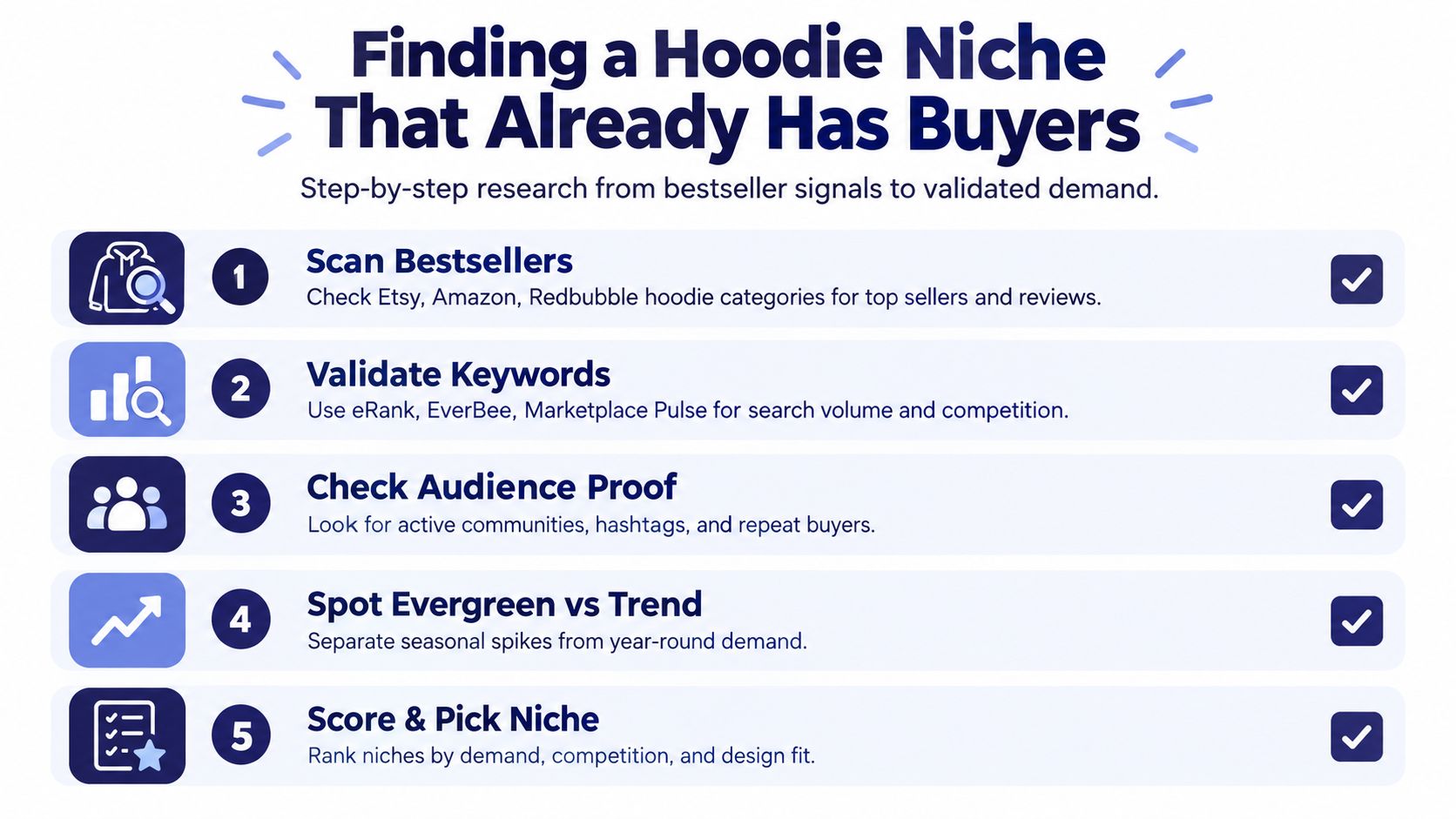
Start with evidence, not a blank canvas. I usually scan bestseller areas on Etsy, Amazon, and Redbubble, looking for recurring buyer language rather than copying a single graphic. A phrase such as “golf dad hoodie” or “ICU nurse hoodie” tells you more when it appears across several listings with reviews, varied designs, and active sellers.
Start with marketplace behavior
Shortlist three to five niche angles. Don't treat a bestseller badge as proof by itself. Check:
- Review depth: A listing with substantial buyer feedback gives you stronger evidence than an isolated product with polished photography.
- Listing age: Older listings can show durability, while newer listings with early engagement may reveal a fresh angle.
- Seller activity: Sellers who continue adding related designs are giving you a useful signal that the niche remains worth testing.
- Design variety: If every top result looks identical, the keyword may be crowded or too narrow for your own interpretation.
Then use eRank, EverBee, or Marketplace Pulse to compare search demand and competition for the exact angle. Search volume without a clear buyer is weak evidence. A keyword like “funny hoodie” may be broad, while “ICU nurse graduation hoodie” communicates a use case, audience, and gift intent.
Pinterest trend pins, Reddit discussions in relevant communities, and Google Trends comparisons add context. Look for people discussing the identity, event, or problem behind the product. A spike tied to one short season needs a different launch plan from a hobby that buyers discuss throughout the year.
For broader product research outside apparel, Cosmy's guide to AliExpress product research for sellers offers a useful reminder to inspect buyer signals before committing resources. You can also compare promising angles with Trendlytic's high-demand, low-competition niche research.
Use this shortlist before opening your design software:
| Niche angle | Target buyer | Primary keyword | Demand evidence | Design direction |
|---|---|---|---|---|
| Golf dad gift | Golfing parents and gift buyers | golf dad hoodie | Reviews, recurring gift language, active listings | Minimal crest or course-inspired graphic |
| ICU nurse identity | Nurses and coworkers | ICU nurse hoodie | Community discussion, role-specific designs | Strong typography with restrained medical symbols |
| Cozy reading | Book lovers and homebody buyers | book lover hoodie | Pinterest saves, gift intent, repeated phrases | Soft illustration or literary humor |
Ignore copied slogans, inflated social engagement, and designs that only appear in one marketplace without buyer discussion. The winner isn't always the loudest trend. It's the angle where the audience, garment format, and design idea fit naturally.
Choosing the Right Printing Method for Hoodies
There isn't one universal winner for hoodie decoration. The right choice depends on run size, fabric content, artwork detail, print surface, and the price you can support.
DTG prints directly onto the garment and suits detailed, full-color artwork on cotton-rich hoodies. A Custom Ink guide to hoodie printing methods identifies 100% cotton face fleece as a strong DTG substrate because the ink performs best on a suitable cotton surface. DTG is less forgiving when the hoodie has a rough, thick, or synthetic face.
DTF prints the design onto transfer film, adds adhesive, and heat-presses the result onto the garment. That construction makes it more flexible across cotton, polyester, poly-cotton, and fleece, as explained in Print It My Way's DTF hoodie guide. It's often the practical option for vivid designs on dark fleece and blends.
Screen printing makes more sense for larger runs with simple spot-color artwork. Each additional color increases setup complexity, so the economics improve when the same design is printed repeatedly. Embroidery works well for small left-chest logos, initials, and premium branding on stable, heavier garments, but stitch files, setup, and limited color detail can make it a poor fit for illustrations.
| Method | Best run size | Fabric fit | Color range | Typical cost | Best for |
|---|---|---|---|---|---|
| DTG | Single pieces and small runs | Cotton-rich face fleece | Detailed full color | Higher for difficult fleece | Illustrations, gradients, photographic art |
| DTF | Single pieces and small runs | Cotton, polyester, blends, fleece | Vivid full color | Often practical for flexible fabric choices | Dark hoodies, sharp graphics, complex transfers |
| Screen printing | Larger repeated orders | Common hoodie fabrics, especially stable fleece | Spot colors | Setup-heavy, then efficient at volume | Simple artwork and event or team orders |
| Embroidery | Small to repeated logo orders | Stable, heavier hoodies | Limited by stitch detail | Setup and digitizing required | Premium logos, monograms, left-chest marks |
A method comparison from AJDN reaches the same practical distinction: DTG favors detailed artwork on cotton-rich garments, DTF handles more fabric types, and embroidery suits premium logo work.
Before listing, ask what happens to the design on the actual blank. A soft gradient that looks excellent on a screen may lose character on textured fleece. A large front print may collide with a kangaroo pocket. The decoration method should be selected before the final export, not after a customer has already ordered.
Preparing Design Files That Print Clean
A hoodie file needs to respect the garment. A standard pullover chest print can use a window around 10 by 12 inches, while a left-chest or hood mark may fit closer to 4 by 4 inches. Confirm the provider's actual template before drawing, because pockets, zippers, seams, and hood panels can reduce the usable area.
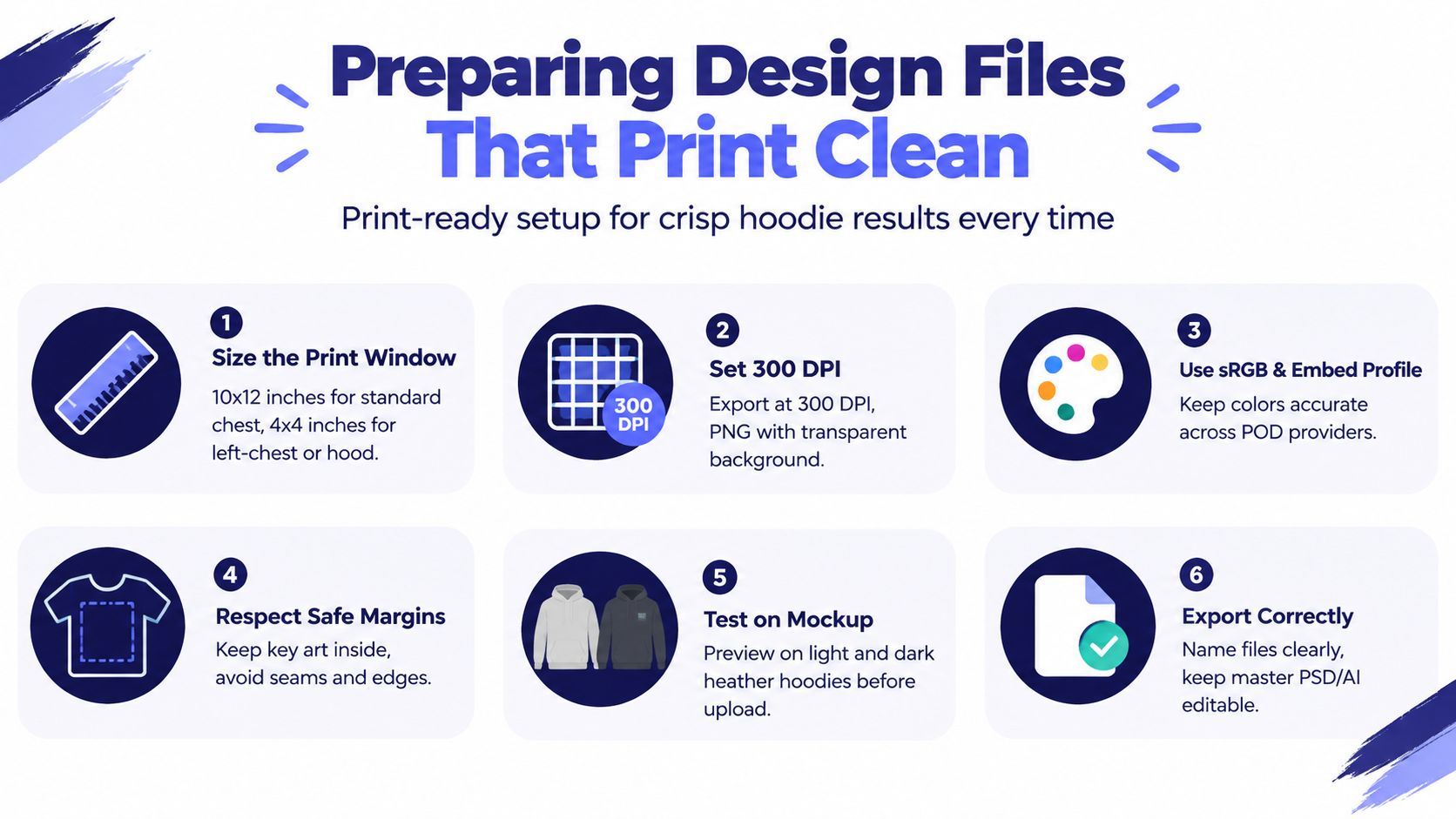
Export raster artwork at 300 DPI as a transparent PNG. For artwork that needs scalable edges or precise color references, use SVG or AI files, outline the fonts, and include Pantone callouts where color consistency matters. Keep the front and back as separate files rather than flattening a multi-placement design into one image.
Use a repeatable preflight check
Add a 0.125-inch bleed where the provider requires one, and keep important artwork inside a safe zone away from seams and edges. RGB is generally used for DTG workflows, while screen-print production may require CMYK separations. Embroidery artwork needs a stitch file before listing, so the fulfillment partner doesn't redraw a logo after the customer has paid.
Before upload, inspect the artwork at 200%:
- Remove stray pixels: Transparent backgrounds often hide tiny marks that appear on the garment.
- Check placement: Make sure the print sits below the hood seam and above the pocket line.
- Inspect dark and light versions: A color that works on black may disappear on heather gray.
- Confirm file names: Use clear labels such as
golf-dad-front.pngandgolf-dad-back.png. - Keep masters editable: Save the PSD, AI, or equivalent working file separately from the upload exports.
The print-on-demand design research workflow from Trendlytic's blog is useful before production because the chosen keyword and buyer angle should influence how much detail the garment needs. A busy design may need a larger back placement, while a gift-oriented phrase may work better as a restrained left-chest embroidery.
Don't trust the mockup alone. A file can look centered in the editor and still sit too low once the hoodie's pocket and hood are physically present.
Matching Fulfillment Partners to Your Storefront
A hoodie can look right in a listing and still create problems after purchase. The fulfillment partner affects the blank, fit, color consistency, delivery estimate, packaging, and the way you handle a return. Choose it with the storefront in mind, then test the exact product before sending traffic.
Etsy sellers often use established providers such as Printful and Printify, but the listing still needs clear information about the blank, production, sizing, and shipping. Shopify gives you more control over the customer experience, so you can compare providers, test regional fulfillment, and define your own support process. Amazon Merch on Demand follows Amazon's upload, mockup, production, and customer-service rules. Outside providers cannot replace those program requirements.
Compare the actual hoodie, not the dashboard
A provider dashboard can show a large catalog while hiding the differences that buyers feel. Compare fabric composition, weight, fit, color range, decoration method, production timing, shipping coverage, and mockup quality. A hoodie fabric weight guide from Three Layer groups light summer hoodies at 5.9 to 7.38 oz/yd², all-year weights at 7.38 to 8.85 oz/yd², and cozy winter weights above 8.85 oz/yd². The weight changes how warm the hoodie feels, how it hangs, and what a customer expects from the listing.
| Provider | Blank quality | Print methods | Average production + ship | Mockup options | Best fit storefront |
|---|---|---|---|---|---|
| Printful | Brand-led and generally consistent | Primarily in-house apparel decoration | Common apparel fulfillment can be around 2 to 5 business days, with shipping varying by destination | Broad generator and product views | Etsy, Shopify, branded stores |
| Printify | Varies by selected print provider and blank | Provider-dependent, including DTG and other options | Production and shipping depend on the chosen facility | Large catalog of provider mockups | Etsy and Shopify sellers comparing costs |
| Amazon Merch on Demand | Amazon-controlled blanks and workflow | Amazon-controlled | Amazon-controlled production and delivery | Amazon's required listing assets | Amazon marketplace sellers |
| Gelato | Regionally sourced options | Provider and product dependent | Local production can vary by destination | Product mockup tools | International Shopify and marketplace sellers |
| CustomCat | Apparel-focused catalog | Multiple apparel decoration options | U.S.-focused fulfillment options | Built-in product visuals | Sellers prioritizing domestic fulfillment |
Treat timing as a planning range, not a promise. Apparel production is commonly described as 2 to 5 business days, with shipping adding roughly 2 to 8 domestic days and 5 to 14 international days, depending on the market and carrier, as outlined by Print On Demand Business. Put the provider's current estimate in the listing, and leave room for weekends, carrier delays, and seasonal volume.
Order the exact sample
Order the exact blank, color, size, and print method before the listing goes live. A heavyweight cotton-poly fleece can feel very different from ring-spun cotton. A black hoodie may also use a different surface treatment from a heather option. If similar SKUs come from different providers, customers may receive inconsistent sizing, color, packaging, and delivery timing.
The sample should also test the post-purchase experience. Measure the garment against the provider's chart, check the print after washing according to the care instructions, inspect the hood and pocket construction, and record the package dimensions and delivery time. These details give you better sizing guidance and make support replies more specific when a buyer reports a fit or print problem.
Your gallery should answer the questions a flat ghost mannequin cannot:
- Front flat-lay: Show the full artwork and its position relative to the pocket.
- Three-quarter model view: Reveal fit, sleeve placement, and garment shape.
- Print close-up: Let buyers inspect texture and edge quality.
- Back view: Include this when the design has a back graphic.
- Sizing or lifestyle image: Use a readable measurement chart or a worn shot that shows scale.
Use supplier mockups for consistent presentation, then add a styled lifestyle image showing the hoodie in a relevant setting. Do not place artwork onto stock photography at an awkward angle. Buyers notice when a design ignores seams, folds, or fabric tension. A reliable partner is the one whose actual sample matches the promise in the listing, not the one with the most products.
Pricing Hoodies for Real Margin
Hoodie pricing needs a complete cost sheet. The retail price isn't being compared with the blank alone. It has to cover the blank, production, shipping, marketplace or payment fees, refunds, replacements, and any advertising used to acquire the order.
A workable formula is:
Selling price minus blank and print, shipping, platform fees, payment fees, and advertising equals operating margin.
The brief example makes the problem visible. Suppose the blank and print cost $22, production adds $5, you absorb shipping, and platform fees take 8%. At a retail price of $39.99, the remaining margin can fall into the single digits before advertising, support time, or a replacement order. The precise result depends on the shipping charge and fee structure, so calculate the actual provider quote rather than relying on a generic calculator.
| Cost line | Low estimate | High estimate |
|---|---|---|
| Blank plus print | $22 | $22 |
| Additional production fee | $5 | $5 |
| Customer shipping absorbed by seller | Varies | Varies |
| Platform fee | 8% | 8% |
| Advertising and support | Varies | Varies |
| Remaining margin at $39.99 | Single-digit margin possible | Lower after extra costs |
The useful lesson isn't that one price works for every shop. It's that free shipping and color-rich artwork are not free to the seller. Oversized prints, extra placements, embroidery setup, and dark-garment treatments can all change the quote.
Build the listing around buyer intent
A title should lead with the primary phrase, add supporting context, and finish with a descriptive or emotional term. For example:
- Weak:
Funny Hoodie Gift - Stronger:
Golf Dad Hoodie, Funny Father’s Day Golf Gift, Comfortable Course Pullover
The second title gives the marketplace clearer information about audience, occasion, and product type. Put buyer language in tags and categories, not internal jargon. If the buyer searches for “golf dad gift,” that phrase matters more than a supplier's blank name.
Your description should answer practical questions before the buyer asks:
- What fabric and weight does the blank use?
- Is the fit standard, oversized, or unisex?
- Where does the print sit?
- How should the garment be washed?
- When will production finish?
- What happens if the print arrives damaged?
For pricing strategy, test tiered shipping, bundle discounts, and a higher anchor such as $44.99 when the garment and presentation support it. Don't use a higher price to disguise weak quality. Use it only when the blank, photography, decoration, and service justify the buyer's expectation.
Before publishing, run the exact phrase through the USPTO trademark database. Check common misspellings, related brand categories, logos, mascots, sports references, and taglines. Sellers regularly create problems by using protected team language, entertainment references, celebrity names, and phrases that seem generic but belong to an active brand category.
A product launch strategy for POD sellers can help sequence the research and publishing work, but the final trademark decision still requires careful review. Trendlytic also includes a built-in USPTO trademark check, which can act as an early screening step rather than a substitute for legal advice.
Launching, Scaling, and Handling the Boring Stuff
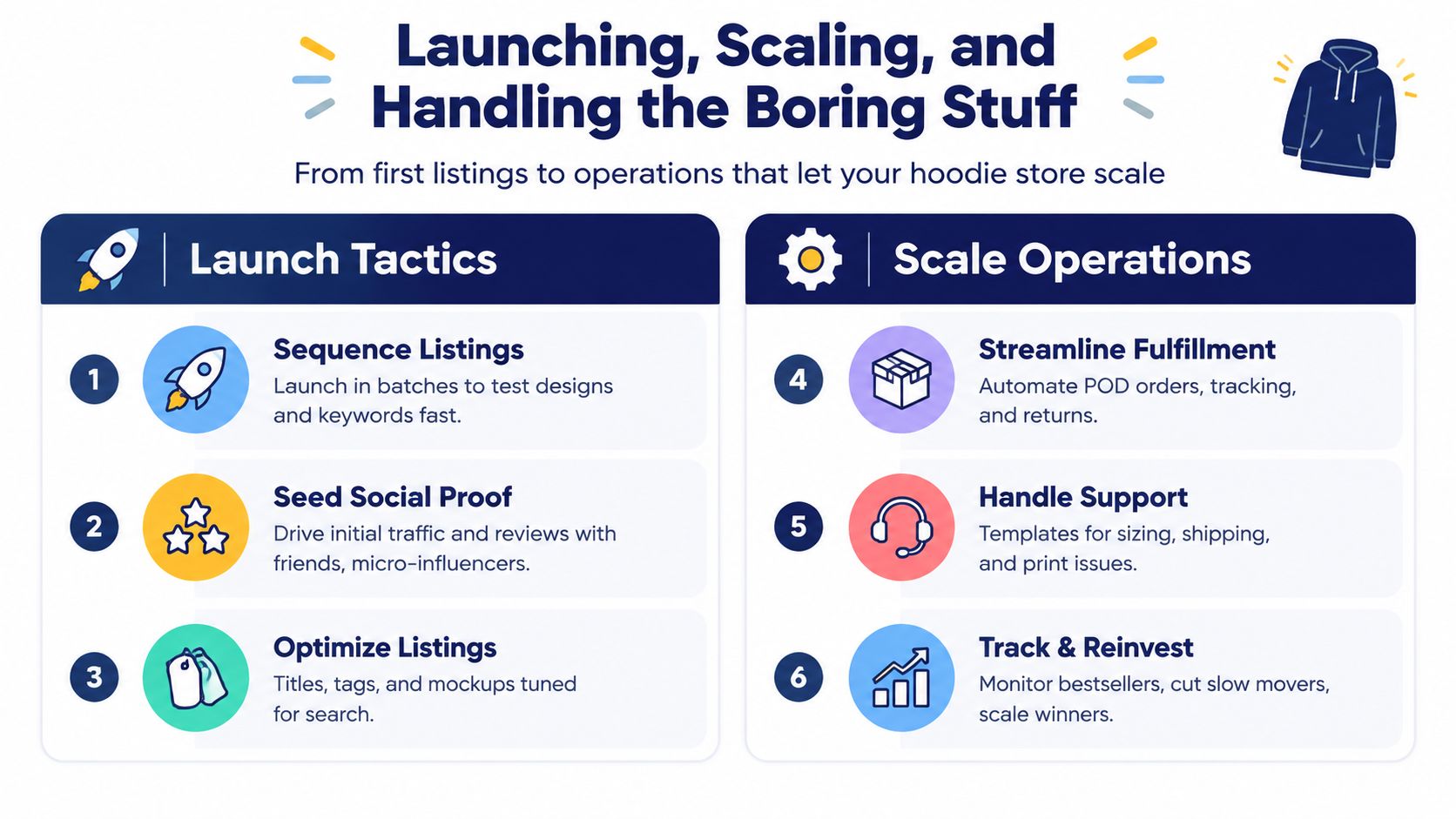
A hoodie can look promising in mockups and still fail after the first orders. Launch with a small group of related designs, keep the niche and garment format consistent, then compare attention with actual orders. A compliment, saved post, or social like is useful feedback, not commercial proof. Early buyers should reveal whether the design, fit, color, and price work together.
Organic search and Pinterest usually take time to build. Paid traffic belongs later, after the listing has a clear title, useful photos, dependable fulfillment, and enough margin to absorb acquisition costs. Once one design has earned evidence, extend the same buyer angle into selected colors or a related sweatshirt and crewneck format. Hold back near-identical variations until you know which combination converts.
Prevent avoidable support tickets
Post-purchase friction is often created before checkout. Add a sizing chart with chest and garment-length measurements in inches, state whether the fit is standard, relaxed, or oversized, and explain how measurements were taken. Customers can then compare the garment with their own measurements instead of relying on an unrelated retail size chart.
Keep production separate from delivery. Apparel production commonly takes about 2 to 5 business days, while shipping time varies by destination and service. Show both ranges in the listing and order confirmation. A single promised arrival date creates avoidable support work when the carrier or destination adds time.
Returns need the same precision. POD policies commonly distinguish change-of-mind requests from damaged or misprinted products, as described by Quoted Truth's POD merchandise FAQ. State what evidence a defect claim requires, the response window, and whether you will offer a replacement or refund. Clear instructions reduce back-and-forth when an order arrives with a print problem.
Keep this operating checklist visible:
- Sync inventory and variants: Match colors, sizes, and provider SKUs across every sales channel.
- Review sample orders: Recheck the blank, placement, and print after supplier or garment changes.
- Track defects: Separate print, sizing, shipping, and packaging complaints so recurring issues are visible.
- Audit monthly: Remove or revise designs that have not paid back production, listing, and promotion costs.
- Protect response time: Prepare replies for size questions, delivery updates, and damaged-print claims.
Trendlytic scans live bestseller signals across Etsy, Amazon Merch, Redbubble, and TeePublic, then organizes niche demand, competition, keyword evidence, pricing, and trademark checks for POD sellers. Visit Trendlytic to research hoodie niches from marketplace signals before committing to another design.