Print on Demand Puzzles: A Practical Seller's Guide
You've already got shirts, mugs, and wall art in your POD dashboard. Then you notice puzzles and pause. The product looks simple, but the artwork, production cost, box quality, marketplace fit, and intellectual-property risk all work differently from apparel.
That hesitation is reasonable. Print on demand puzzles aren't a shortcut to passive income. They're better understood as long-tail adult gifts and leisure products, where a strong image can keep finding buyers long after a novelty shirt disappears from search. The opportunity is real, but only if you treat the category as a physical experience rather than another printable surface.
Table of Contents
- Why Puzzles Are Worth a Serious Look
- What the Puzzle Market Actually Looks Like in 2026
- Margins and Economics Compared to Other POD Products
- Suppliers, File Specs, and Die Line Realities
- Choosing Between TeePublic, Merch, Redbubble, and Etsy
- Validating a Puzzle Niche Before You Design
- From Validation to First Sale
Why Puzzles Are Worth a Serious Look
A seller I know began with the usual catalog: slogan tees, mugs for seasonal occasions, and a few poster designs. Puzzles sat in the dashboard for months because the expected sales volume looked less obvious. A shirt can be understood in one glance. A puzzle needs a buyer to imagine an afternoon, a gift exchange, or a finished image on a table.
That difference is also the reason puzzles deserve attention. Adult buyers often purchase them for the experience, not just for the printed artwork. A family photo can become a birthday gift. A retirement group can receive a shared memory. A pet portrait can turn into a keepsake rather than another disposable object.
The category also has a different competitive shape from apparel. A puzzle listing with a clear audience, a satisfying composition, and gift-ready presentation can remain relevant without chasing every short-lived phrase. Research into trending products for POD sellers is useful here, but puzzle research needs a specific question: does this idea give someone a reason to spend time with the product?
The product is the activity
A weak puzzle design usually treats the box image as the whole product. A beautiful photograph with broad areas of nearly identical color may look excellent in a mockup, but it can create a flat, frustrating solving experience. Stronger designs distribute detail across the image, create recognizable zones, and give the buyer small visual landmarks.
That's why a local scene, a layered botanical illustration, or a carefully composed family scene can outperform a generic decorative pattern. The customer isn't only buying wall decor. They're buying a process with a beginning, a middle, and a satisfying finish.
Practical rule: Design for the table, not just the thumbnail.
Puzzles can also suit gifting occasions that don't depend on a single holiday. Birthdays, anniversaries, retirements, family reunions, memorial gifts, and quiet weekend hobbies all create different entry points. That doesn't guarantee consistent sales, but it gives a well-positioned listing more than one reason to be found.
The trade-off is slower validation and more operational scrutiny. Before adding a large collection, check margins, image resolution, fixed die lines, box presentation, marketplace economics, and trademark exposure. A puzzle line can become a useful second catalog, but it shouldn't replace basic product testing or responsible clearance work.
What the Puzzle Market Actually Looks Like in 2026
A buyer searching for an adult gift may reach a puzzle listing through a regional marketplace, a seasonal query, or an image-led search rather than a toy category. That buying path matters more than a single global forecast. One estimate values the worldwide jigsaw puzzle market at USD 2.23 billion in 2025, rising to USD 2.32 billion in 2026 and reaching USD 3.36 billion by 2034, a 4.73% CAGR from 2026 to 2034. The same jigsaw puzzle market analysis reports that North America held 35.35% of the market in 2025, while paperboard and cardboard represented 33.19% in 2026.
For a POD seller, those figures support a focused conclusion. The category has enough commercial depth to test seriously, while cardboard remains relevant because it matches familiar formats, practical shipping requirements, and buyer expectations.
A separate forecast places the market at USD 2.42 billion in 2026 and USD 3.63 billion by 2033, with a 6.0% CAGR. It gives paperboard and cardboard 36.5% share in 2026 and Europe 34.2% of the market. Treat these forecasts as directional rather than combining them into one precise market size. Historical market segmentation reports online distribution at 52.4% of revenue in 2025 and adult buyers at 41.7% of revenue in the same year.
Use demand forecasting methods to separate durable gift demand from short-term toy spikes before committing to a collection.
The useful signals for sellers
| Seller signal | Practical action |
|---|---|
| Paperboard and cardboard lead both cited forecasts | Start with familiar board formats and confirm each supplier's material and packaging details |
| Europe and North America both show substantial demand | Test regional gifting language instead of launching localized catalogs everywhere |
| Adult buyers account for 41.7% of revenue in 2025 | Prioritize gift-occasion keywords over generic puzzle terms in the first 10 listings |
| Online distribution accounts for 52.4% of revenue in 2025 | Make product photos, delivery information, and marketplace search visibility part of the initial test |
| Forecasts use different market totals and growth rates | Compare direction and buyer segments, not false precision |
The regional picture still requires judgment. A small seller does not need collections for every territory. Start with adult leisure, personalization, gifting, and visual identity, then use marketplace results to identify which audience responds.
Premium adult formats, eco-conscious materials, and custom gifts can support stronger perceived value when the design and presentation justify them. Licensed collaborations may attract buyers, but trademark screening and clearance work come before publishing the listing. Search interest labeled “toys” can also hide demand from adults seeking a meaningful gift or a screen-free activity.
Margins and Economics Compared to Other POD Products
Puzzle economics punish casual price copying. A seller may see a shirt priced near a puzzle and assume the products have comparable room for profit. They don't. A puzzle carries more production material, more complex fulfillment, and a box or packaging experience that can affect whether the item feels giftable.
The right comparison is contribution after the supplier's base cost, marketplace deductions, payment processing, shipping treatment, and promotional discount. Since providers and marketplaces vary, use the table below as a decision framework rather than a promise of standard returns.
| Product | Typical Retail | Royalty Range | Key Cost Driver |
|---|---|---|---|
| Adult POD puzzle | $22 to $35 | Supplier and channel dependent | Piece count, substrate, box printing |
| Standard tee | Comparable apparel pricing | Supplier and channel dependent | Garment blank, print area, fulfillment |
| Mug | Usually lower-ticket gifting | Supplier and channel dependent | Ceramic blank, packing, breakage risk |
| Poster | Format and paper dependent | Supplier and channel dependent | Paper grade, size, tube or flat shipping |
The $22 to $35 puzzle retail range is the practical band often considered for a POD puzzle line, but it doesn't tell you the royalty. A puzzle in that range can produce a smaller absolute return than a $25 tee because the base production cost takes a larger share. Piece count, board quality, box printing, packaging, and shipping all matter before your margin reaches the seller.
Where the money disappears
A low-piece-count format may be easier to price for casual gifting, while a larger adult puzzle supports a stronger perceived value but consumes more material and can cost more to ship. Premium matte finishes can improve the tactile impression, yet they only help if the buyer notices the difference in the listing and the supplier delivers it consistently.
Box printing is another frequent blind spot. The product may arrive as a plain polybag or a generic container, which can undermine a listing positioned as a birthday or anniversary gift. A custom box can improve presentation, but it adds cost and may introduce more file preparation.
For broader POD portfolio thinking, the shirt-in-a-box case study from AdManage.ai is a useful reminder that packaging changes how customers perceive a familiar product. The same principle applies more strongly to puzzles because the box is part of the gift moment.
Margin test: Calculate profit from the packed product and the actual delivery route, not from the artwork alone.
Puzzles often bring fewer sales per design than broad apparel phrases, but they can support a higher average order value and a more deliberate purchase. That changes the portfolio strategy. Instead of expecting one design to carry the store, build a focused set of related images, occasions, and buyer problems. A seller moving from shirts into hoodies should also understand the different POD hoodie economics, then apply the same discipline to puzzle formats rather than assuming every catalog item behaves alike.
Suppliers, File Specs, and Die Line Realities
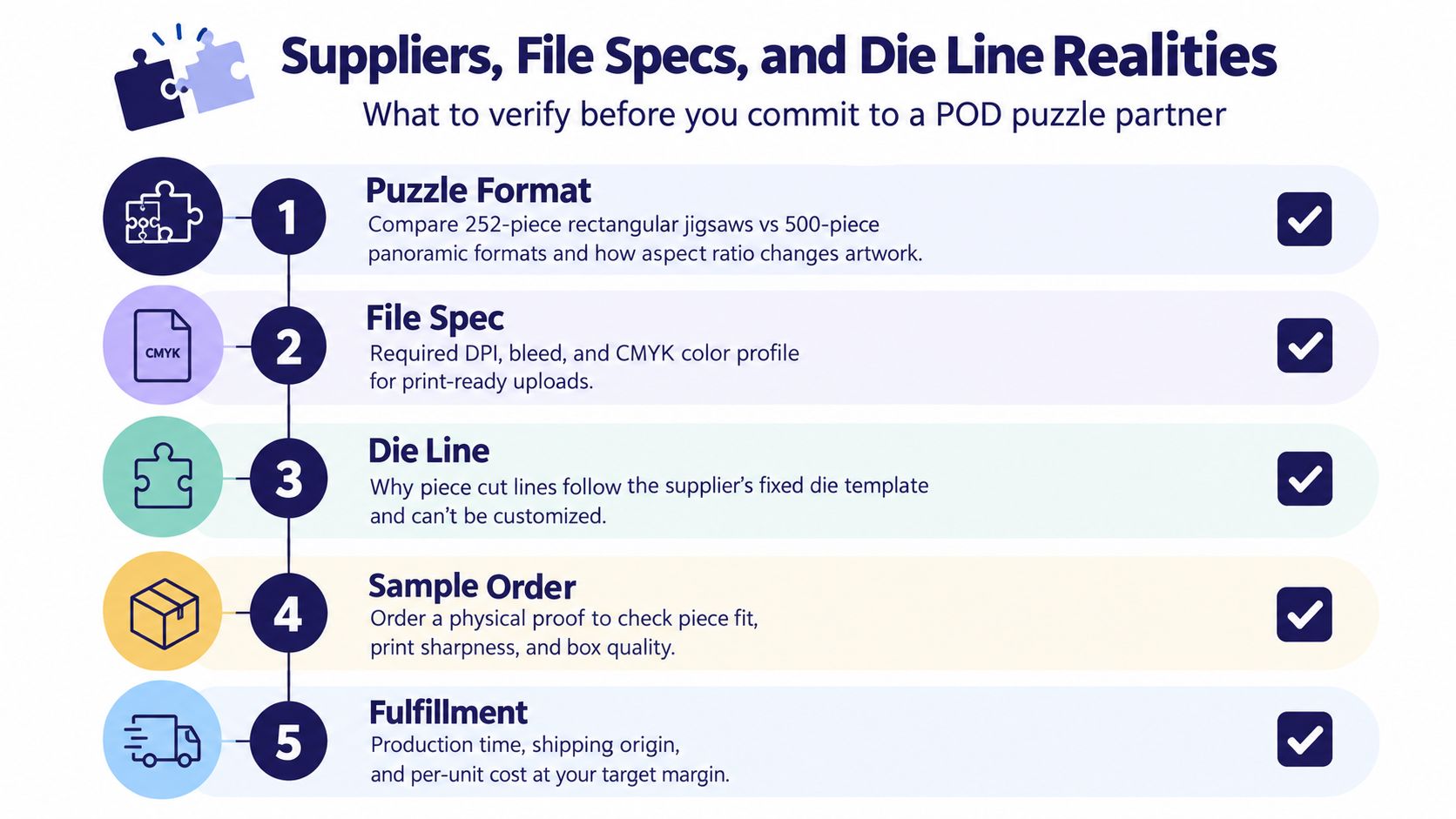
Production begins with the supplier's template, not your preferred canvas. A 252-piece rectangular puzzle and a 500-piece panoramic puzzle can require different aspect ratios, finished dimensions, and visual pacing. If you design first and choose the product later, important faces, text, or focal objects may land too close to the trim or be forced into an awkward crop.
Prepare artwork for the physical result
Most custom POD puzzle suppliers converge on a 300 DPI source-image target for best output quality, as described in this puzzle printing guidance. Lower-resolution files can show visible pixelation at arm's length, while 200 DPI may be acceptable for larger formats viewed from farther away. The important calculation is effective resolution at the finished physical size, not the pixel count advertised by the original image.
Use the partner's exact template for bleed and safe areas. A 0.125-inch bleed is a common production requirement, but confirm it before exporting because the die line and printable dimensions vary. Keep faces, names, and important text away from the cut boundary.
Color handling also needs a deliberate choice. Some partners accept CMYK or RGB, while many art marketplaces work smoothly with sRGB uploads that the production system converts. PNG files with either transparent or solid backgrounds are commonly accepted, but the supplier's upload panel remains the final authority.
Fixed dies limit the artwork
Most POD partners use a standard die line for each piece count. You usually can't request a custom piece shape or move the cut pattern to protect a particular detail. The image is printed first, then cut, so sharp source art still needs enough contrast and variation for the finished puzzle to remain enjoyable.
Substrate choices affect both feel and perceived value. Blue cardboard, chipboard, and premium matte finishes can differ in thickness, stiffness, glare, and how the printed image looks under indoor light. Shrink wrap protects the product, but a giftable box often communicates more value than a plain bag.
Printful, Printify, Gelato, and Contrado don't necessarily offer identical piece counts, tile thicknesses, box formats, or fulfillment arrangements. Compare the actual product pages and order a proof before building a collection. A partner that produces a neat gift box may fit adult gifting better than one that offers a cheaper product in minimal packaging.
Choosing Between TeePublic, Merch, Redbubble, and Etsy
The best marketplace depends on how the adult buyer discovers the idea. A phrase-led puzzle may need search intent and gifting context, while an artwork-heavy design can benefit from a visual browsing environment. None of these channels removes the need for a strong image, accurate product details, and rights screening.
| Marketplace | Discovery Model | Typical Royalty/Fee | Adult-Gift Fit |
|---|---|---|---|
| TeePublic | Curated marketplace and tag-driven discovery | Platform-dependent royalty | Suitable for bold niche illustrations |
| Amazon Merch on Demand | Search-led discovery and content review | Platform-dependent royalty | Useful when the phrase has clear search intent |
| Redbubble | Artist-first browsing and marketplace search | Commission tiers affect returns | Good for artwork, but price needs scrutiny |
| Etsy | Listing SEO, titles, tags, and buyer intent | Listing and transaction fees apply | Strong fit for custom and occasion-led gifts |
TeePublic can suit an illustration with a clear audience and disciplined tags, but a quiet adult-gift concept may disappear if the thumbnail doesn't communicate its use. Amazon Merch on Demand brings strong search behavior, alongside stricter content review and an algorithm that can make broad creative positioning difficult.
Redbubble's artist-first environment is comfortable for visual work, yet commission tiers matter more on a higher-priced product such as a 500-piece jigsaw. Check the payout after the base cost and account-level deductions rather than assuming a visible retail price reflects your return.
Etsy needs buyer language
Etsy is often the most natural fit for custom gifts because shoppers arrive with an occasion, recipient, or personalization need in mind. That doesn't mean uploading a generic image and relying on the platform. Titles, tags, photos, personalization instructions, processing details, and shipping expectations all have to agree.
A listing called “abstract puzzle” is weaker than one that explains who the gift suits and what makes the image distinctive. Avoid keyword stuffing. Use the validated buyer phrase naturally, then clarify piece count, finished format, personalization limits, and packaging.
Pinterest can support discovery for visual gifting products, especially when the image communicates a room, occasion, or finished activity. Sellers who want to build that channel can try Pin Generator for Etsy, but the pins still need accurate product pages and a reason to click.
Validating a Puzzle Niche Before You Design
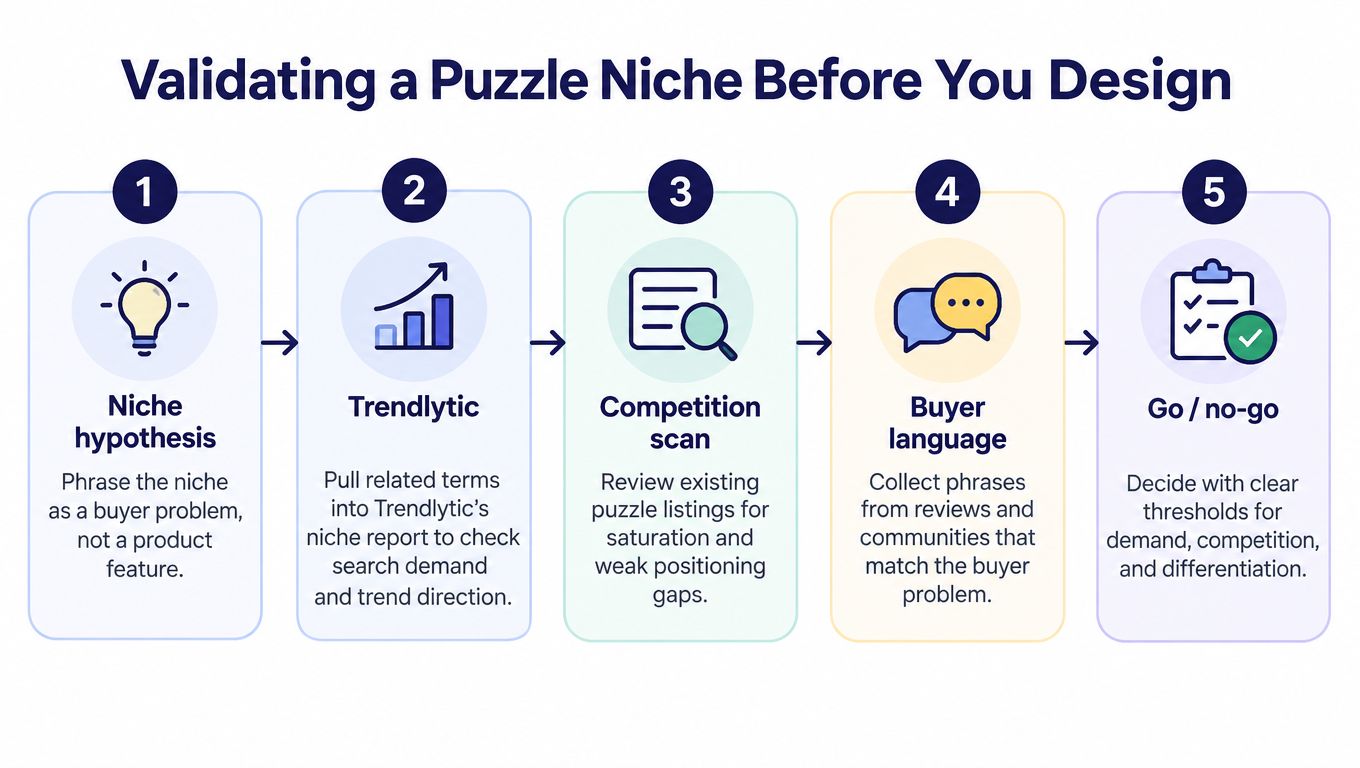
Start with a buyer problem, not a product feature. “I need a thoughtful gift for a cat-loving parent” gives you a clearer validation path than “I want to sell a cat puzzle.” The first statement suggests an occasion, audience, and emotional reason to buy.
Build a narrow research loop
Write the hypothesis. Define the recipient, occasion, and visual promise. Examples include a personalized pet memorial, a local landmark gift, or an illustrated hobby scene for an adult puzzler.
Check demand direction. Trendlytic covers TeePublic, Amazon Merch on Demand, Redbubble, and Etsy, and its custom puzzle workflow reads those marketplaces in one pass. Use its niche report to compare related terms, demand movement, seller competition, and the actual designs appearing in the category.
Filter for the product. Generic apparel traffic can mislead you. Review puzzle-specific listings and search language, then separate evergreen gifting terms from phrases that only make sense during a short event or trend.
Inspect the competitive gap. Look for poor cropping, weak box mockups, unclear personalization, and images that don't show the adult use case. Competition isn't automatically a reason to quit. It can reveal that buyers exist, while weak presentation shows where a new listing might be more useful.
Screen the phrase and artwork. The USPTO trademark search process recommends starting with exact wording, then expanding to related wording, alternate spellings, design elements, and design codes. The live database also supports image search through an uploaded image or URL, which matters when the risk is visual rather than textual.
The USPTO database uses labels including “Live” for an active filing and “Registered” for a mark approved by the office. Puzzles appear in International Class 028, so don't treat the product as an unclassified craft item. A database check is a screening step, not legal advice.
Use examples carefully
A phrase such as “cat dad jigsaw” can be screened as a candidate for original artwork and ordinary descriptive use. “Marvel hero collage” should be flagged because it invokes recognizable branded characters and a protected entertainment property. Don't reproduce the phrase as a product claim merely because shoppers search for it.
Trendlytic's custom puzzle research discussion is also useful for understanding why fan art and character illustration create poster-like clearance risks. Its marketplace workflow and built-in live USPTO lookup can help with initial research, but neither replaces your responsibility to review ownership and platform rules.
From Validation to First Sale
A validated idea still needs a controlled launch. I'd prepare the final artwork against the chosen supplier's template, export the correct color and resolution, and check the safe area at the actual product ratio. Then I'd inspect the mockup closely. If the marketplace image shows a square box while the supplier ships a rectangular one, the listing starts with a trust problem.
Launch one channel before expanding
Publish the first listing on one marketplace so you can isolate indexing, content review, fulfillment, and customer response. Keep the title readable, place the validated phrase where it belongs, and use tags that describe the recipient, occasion, image, and product without repeating the same term mechanically.
Before sending traffic, confirm:
- Supplier proof: Check piece fit, print sharpness, edge quality, and box construction.
- Listing promise: Show the correct piece count, finished size, packaging, and personalization process.
- Pricing: Start with per-unit production cost, marketplace deductions, shipping, and the margin you require.
- Fulfillment: Verify production location, delivery expectations, tracking, and how rigid packaging will be protected in transit.
- Customer support: Explain what buyers may upload and confirm that they own the rights to submitted photographs or artwork.
Observe the listing through a fixed test window before making a conclusion. Monitor impressions, click-through rate, conversion rate, customer questions, and return reasons. If people see the listing but don't click, improve the thumbnail, title, or audience framing. If they click but don't buy, inspect price, mockup accuracy, personalization friction, shipping, and box presentation. If buyers complain about the image or piece quality, pause the design and order another physical sample rather than increasing promotion.
Packaging matters more for puzzles than for soft goods because the box can arrive scuffed, dented, or visibly different from the product image. Direct-to-buyer sellers should photograph the actual package and choose protective fulfillment that matches the gift promise.
A creator-led launch can help when the design has a visual process worth showing, such as a time-lapse assembly, a close-up of the finish, or a personalized reveal. The guidance on executing a creator-led launch is relevant, but keep the campaign proportional to the evidence. One clear audience and one dependable product are more useful than a wide launch built around an untested concept.
Trendlytic helps POD sellers research puzzle niches across TeePublic, Amazon Merch on Demand, Redbubble, and Etsy, then review demand, competition, designs, pricing, and trademark risk before investing in artwork. Visit Trendlytic to test a puzzle idea with a more disciplined research workflow before you commit to production.