Best Selling Merch by Amazon T Shirts
Nearly 90% of Amazon's apparel comes from third-party sellers, while marketplace apparel listings rose 30.5% year over year, according to Retail Dive's reporting on Amazon's apparel marketplace. That combination changes how I evaluate best selling Merch by Amazon t-shirts. The opportunity is large, but independent sellers are competing inside a catalog shaped by millions of marketplace listings and fast-moving buyer intent.
A design can look popular and still be a poor launch candidate. Strong search interest may hide weak purchase intent, a good-looking niche may be saturated, and a phrase that sells today may carry trademark risk. My approach is to combine search demand, live Best Sellers Rank data, historical sales records, and trademark screening before investing serious design time.
Table of Contents
- Why Meticulous Research Matters for Merch by Amazon T Shirts
- Understanding Demand and Competition Metrics
- Building a Structured Merch Research Workflow
- Validating Niches and Checking Trademarks
- Using Trendlytic to Spot Top T Shirt Designs
- Action Steps to Replicate Best Sellers
Why Meticulous Research Matters for Merch by Amazon T Shirts
I once reviewed a shirt idea that seemed almost impossible to miss. The phrase matched a familiar identity-based joke, the mockup looked clean, and competing products appeared regularly in Amazon search results. A quick review would have called it promising. A deeper review would ask a harder question: are those listings generating durable demand, or are they visible because the niche is crowded?
Amazon's apparel marketplace is unusually dependent on independent merchants. Retail Dive reported that Amazon offered 1.12 million apparel items, marketplace listings increased 30.5%, and only 11.1% of apparel was sold directly by Amazon during the period covered in its report. Those figures make one point clear: the t-shirts competing for attention are largely supplied by third-party sellers, not by Amazon's own retail assortment.
That structure creates both access and pressure. Sellers can reach an established apparel audience without buying inventory, but they're also entering a marketplace where many merchants can respond to the same trend. A generic trend list won't tell me whether a niche has room for another design.
Why t-shirts remain the starting point
T-shirts are the largest product category on Merch on Demand, according to Merch Informer's category analysis. Amazon's broader apparel business reinforces the reason sellers keep returning to the format. Industry reporting on Wells Fargo research estimated Amazon apparel and footwear sales at over $41 billion in 2020, while its U.S. market share reached nearly 13% in 2024, with sales exceeding $67 billion.
I don't interpret those figures as proof that any particular shirt will sell. I interpret them as evidence that t-shirts sit inside a large, repeatable buying environment. The seller's job is to find a specific demand cluster where buyer intent is clear and competition isn't already overwhelming.
Practical rule: Treat trend inspiration as a starting hypothesis, not as evidence that a design deserves an upload slot.
For account mechanics, publishing limits, royalties, and the basic Merch workflow, Skup's Merch by Amazon guide provides useful background. I'd use that kind of overview to understand the platform, then rely on live listing and sales evidence to choose niches.
Understanding Demand and Competition Metrics
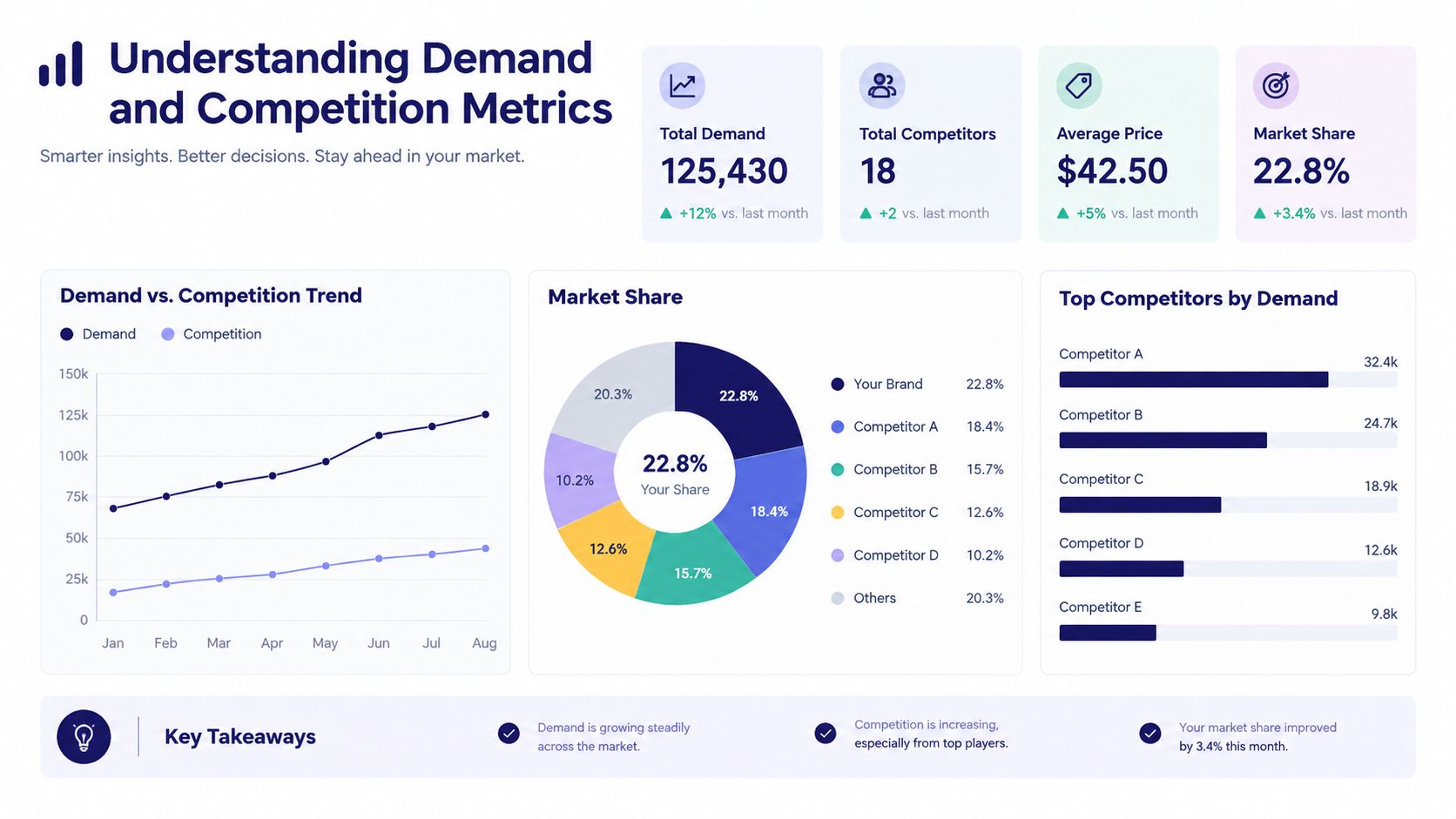
Demand and competition answer different questions. Search volume suggests that buyers are looking for a topic, while Best Sellers Rank, or BSR, helps show whether particular listings are converting that attention into sales. Neither metric works well alone.
Independent analysis cited by Merch Informer found an average BSR of 26,986 for top-performing t-shirt listings and reported 267,598 monthly searches for the phrase “tshirts for.” The same analysis identifies t-shirts as Merch on Demand's largest product category. I see this as a useful contrast: broad demand can be substantial, but the category with the most demand can also attract the most competition.
How I read BSR
BSR is a live listing signal, not a permanent quality score. A lower rank generally indicates stronger recent sales relative to other products in the relevant category, but the number changes over time and can react sharply to a short-lived event.
A single listing with a strong BSR isn't enough for me. I compare several shirts targeting the same buyer intent and look for the shape of the results:
| Signal | What it can indicate | What I check next |
|---|---|---|
| Lower BSR across several listings | Commercial activity exists in the niche | Whether designs are near-identical |
| Strong keyword demand with weak BSRs | Search interest may not translate into purchases | Buyer intent and listing quality |
| Rapid BSR movement | A trend or event may be driving sales | Whether the opportunity has durability |
| Wide BSR range | Demand may be uneven or concentrated | The design and positioning of stronger listings |
The phrase “tshirts for” illustrates why broad keyword volume requires caution. It covers many possible intents, from gifts and occupations to hobbies and identities. I'd rather find a smaller, clearer cluster where multiple listings show credible sales signals than chase a large phrase with no specific audience.
For a separate framework on evaluating demand against competition, see this guide to finding high-demand, low-competition products. The same principle applies here: search volume creates a lead, but BSR distribution helps test the lead.
Building a Structured Merch Research Workflow
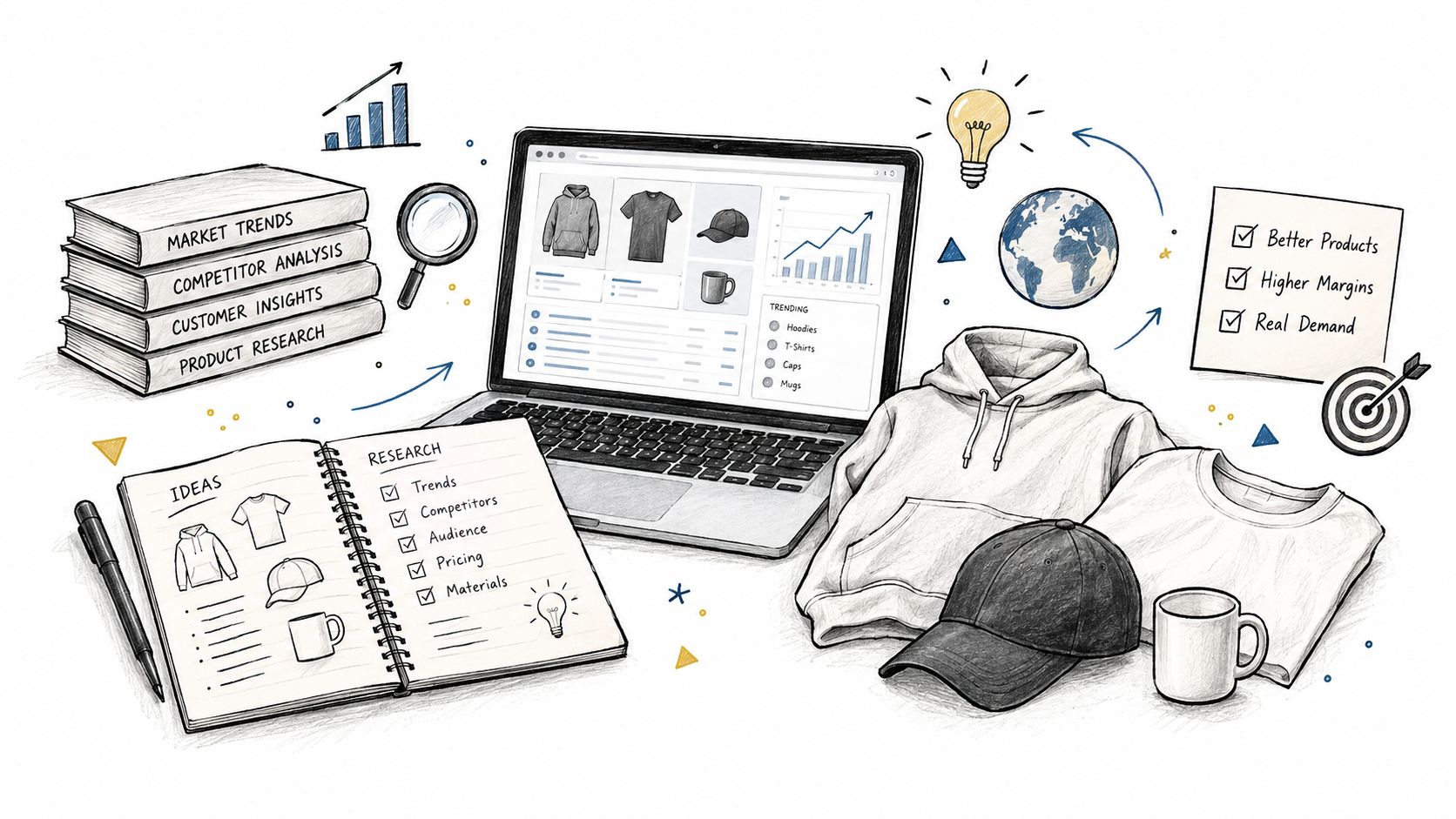
A research workflow should reduce guesswork before it increases upload volume. I start with the platform's own sales records, then add live Amazon observations. This keeps the analysis tied to what sold rather than what merely appeared in search.
Merch by Amazon sales reports can be exported as CSV files, but only 90 days of data can be downloaded at a time, according to Merch Informer's Merch analytics workflow. I treat each export as one piece of a longer record rather than as a complete business picture.
A practical sequence
Export each available CSV period: Save the files with clear date labels so you can distinguish one reporting window from another.
Consolidate the records: Combine the periods in a spreadsheet or analytics tool. Keep design identifiers, product type, list price, units sold, royalties, returns, and cancellations where available.
Separate sales from reversals: A design with sales but frequent returns or cancellations deserves a different interpretation from a design with consistent completed orders.
Map performance over time: Look for designs that continue to sell across multiple periods. A short burst may reflect a temporary event, promotion, or trend spike rather than a durable niche.
Compare price points and listing periods: The purpose isn't to find one magical price. It's to see whether certain designs remain commercially active under different conditions.
A short window can distort the result. If a design catches a brief trend, its recent performance may look stronger than its longer-term sell-through. Consolidated history helps expose seasonality, ranking decay, and the difference between a repeatable seller and a temporary winner.
Why snapshots mislead
Amazon page browsing is useful for identifying competitors and collecting BSR observations. It can't replace sales history because a listing snapshot shows the current state, not how the product arrived there.
The strongest candidate isn't always the listing with the most visible momentum. It may be the one whose performance remains explainable after returns, cancellations, and time are included.
I'd use live BSR to generate research questions, then use CSV history to test whether those questions hold up.
Validating Niches and Checking Trademarks
A niche isn't ready for design work until it passes two separate tests. First, buyers must show enough commercial intent to justify entry. Second, the wording and visual concept must be legally safer to use. A profitable-looking phrase can still create account or listing risk if another party controls its trademark rights.
I begin with the exact wording I plan to place in the title, bullets, tags, or artwork. I search the USPTO database for live marks, then review whether the wording is registered or pending in goods and services related to clothing. A trademark check isn't a substitute for legal advice, but it is a sensible screening step before publishing.
The saturation test
I then compare several live listings serving the same buyer intent. Experts recommend using BSR from the Product Description or Features and Details area, favoring lower BSRs, and treating rapid rank movement as evidence of trend sensitivity rather than lasting demand, as described in this Merch research guide.
Consider a cause-based niche. I wouldn't ask only whether shirts use the cause's broad phrase. I'd separate the market into supporters, participants, gift buyers, and identity-led humor. Then I'd examine whether the strongest listings use distinct messages or repeat the same visual formula.
A cause niche with several lower-BSR listings but near-identical wording may be active and saturated at the same time. A niche with varied designs and clear buyer segments may offer more room, even if its broad keyword appears less exciting.
My pre-upload checklist
- Search the exact phrase: Check USPTO records before finalizing the artwork or metadata.
- Review related wording: Variations, abbreviations, and slogans can create separate risks.
- Compare multiple BSRs: Don't rely on one successful listing.
- Inspect design repetition: Count how many competitors share the same composition, joke, or typography.
- Classify the trend: Rapid movement can signal an event spike rather than durable demand.
- Document the decision: Save the search terms, competing listings, and reasons for entering or rejecting the niche.
For a closer look at the legal side, this resource on Merch by Amazon trademark protection fits naturally into the screening process. I'd complete the check before creating a large design batch, not after a takedown makes the issue urgent.
Using Trendlytic to Spot Top T Shirt Designs
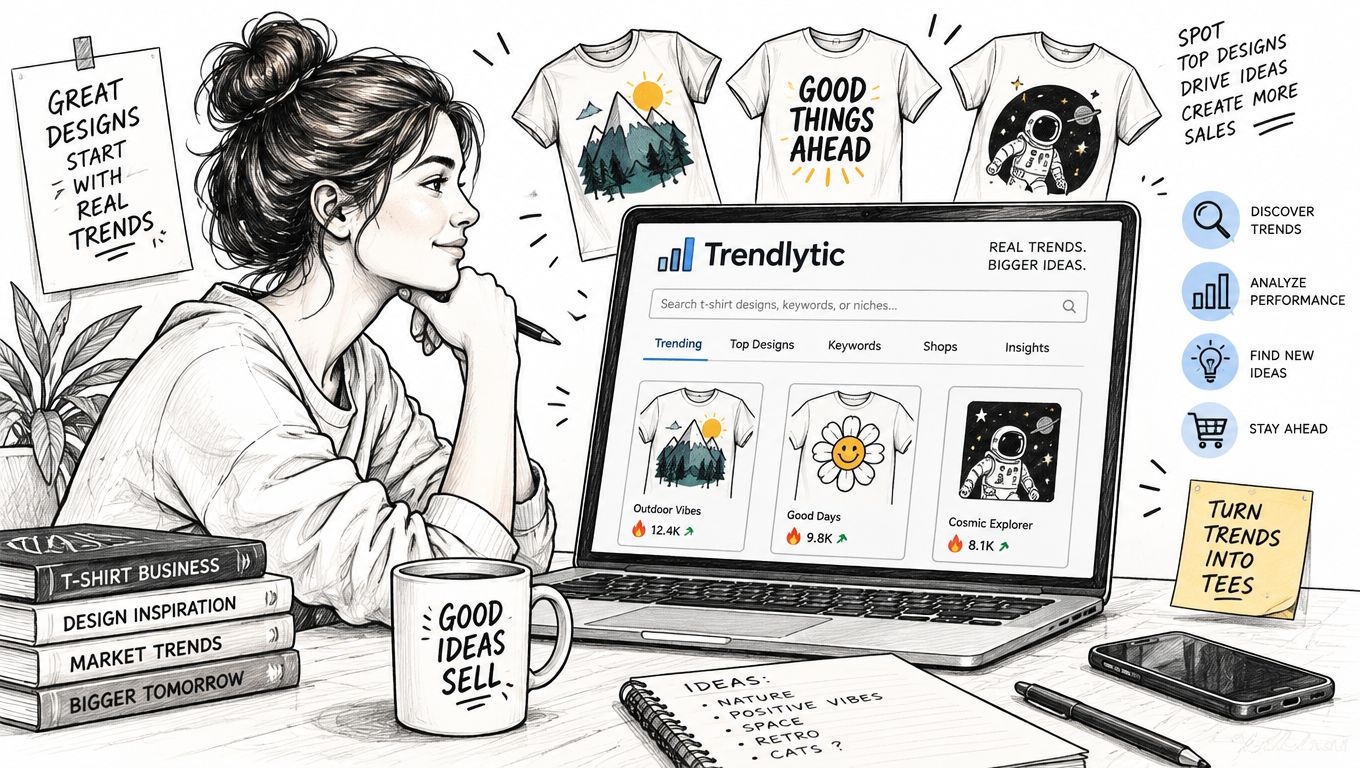
A manual search can identify competitors, but it becomes inefficient when I need to compare several marketplaces or separate a seller's strongest designs from random uploads. Trendlytic is a POD niche research tool covering TeePublic, Amazon Merch, Redbubble, and Etsy, with a built-in USPTO trademark check.
How I would use the platform
I'd begin with a narrow buyer-intent keyword, not a vague request for “best t-shirts.” A query around an occupation, identity, hobby, event, or cause gives the results a clearer commercial meaning. The platform then surfaces live bestseller information across its supported marketplaces and presents an Opportunity Score intended to help compare demand and competition.
The useful distinction is store-first discovery. Instead of treating every search result as equally meaningful, Trendlytic pulls a seller's top designs, helping me inspect whether that seller has a consistent niche position or only one isolated listing. Reports include validated designs with images, tags, and pricing, which makes side-by-side analysis easier.
I'd use the output as a research layer, not as an automatic upload list:
- Review the niche report: Check the demand and competition context before studying individual designs.
- Inspect leading designs: Look for repeated buyer intent, not just repeated colors or fonts.
- Compare marketplace behavior: A concept that appears on Amazon Merch may have a different audience context on TeePublic, Redbubble, or Etsy.
- Run the trademark screen: Treat flagged wording as a reason to pause and investigate.
- Check trend movement: Hourly “Trending Now” rankings can expose event-driven spikes, but fast movement still needs durability testing.
That process supports the wider method described in this POD niche research tool guide. I wouldn't copy a winning design. I'd identify the underlying buyer intent, then create an original concept with a distinct message and verify the wording before listing.
Action Steps to Replicate Best Sellers
Replication should mean reproducing the commercial logic, not duplicating another seller's artwork. The safest path is to identify why buyers might want the shirt, then build an original design around that reason.
I use this checklist before publishing:
- Define the buyer: State whether the shirt targets an occupation, identity, hobby, cause, gift occasion, or event.
- Check demand: Review relevant search language, then compare it with live listing BSRs.
- Measure saturation: Study several competitors and note repeated phrases, layouts, and visual treatments.
- Review historical performance: Consolidate CSV exports and separate completed sales from returns and cancellations.
- Screen trademarks: Check the exact wording and close variations through USPTO records.
- Create original variations: Change the message, composition, typography, and visual framing rather than making a near-copy.
- Test timing carefully: Use seasonal or event-led ideas when the buyer context is clear, but don't mistake a short spike for evergreen demand.
- Improve the listing: For title structure, bullets, keywords, and overall presentation, this guide to Amazon listing optimization is a useful companion.
Pricing should follow the royalty math rather than guesswork. Merch royalties are the amount left after Amazon's fixed production costs are subtracted from the list price. One guide reports a standard tee royalty of about $2.44 at a $19.99 list price for the Creator tier and about $5.27 at the same price for the Premium tier when external traffic thresholds are met in its examples, as summarized by this Merch by Amazon royalty guide.
I'd launch only designs that survive both commercial and legal review. That discipline may reduce the number of uploads, but it also reduces the chance of spending time on crowded or risky concepts.
Trend coverage identifies buyer-intent clusters such as identity, humor, and cause themes as useful places to search for growth without assuming that every trend is under-saturated, according to this analysis of best-selling Merch by Amazon t-shirts. My practical conclusion is simple: start with the audience's reason to buy, validate the competition, and protect the wording before you scale a design family.
Trendlytic helps POD sellers compare live bestseller data across Amazon Merch, TeePublic, Redbubble, and Etsy, while its built-in USPTO check flags potential trademark issues during niche research. Visit Trendlytic to test a buyer-intent niche, compare competition signals, and decide whether a t-shirt idea deserves your next design slot.