Blue Ocean Strategy for Print-on-Demand Niche Discovery
A new POD seller spots a bestseller on TeePublic, creates ten variations, and republishes them across Redbubble and Etsy. For a few days, the idea feels sensible. Then the same tags fill with near-identical designs, copycat listings appear, and sales slow to a crawl.
The seller responds by adding more keywords, lowering prices, and uploading more variations. The work increases, but the listing still competes for the same buyer, inside the same crowded search results, with the same basic promise.
That pattern is familiar because most sellers begin with a visible demand signal and stop there. Blue ocean strategy adds a harder question: can you reshape the offer so you aren't fighting every other seller on the same factors?
Table of Contents
- A Familiar POD Story That Blue Ocean Strategy Explains
- What Blue Ocean Strategy Actually Means
- The Strategy Canvas and ERRC Grid in Practice
- Classic Examples and How They Translate to POD
- The Honest Critique Every Seller Should Hear
- A Practical Playbook for POD Niche Discovery
- Bringing Blue Ocean Strategy Into Your Week
A Familiar POD Story That Blue Ocean Strategy Explains
A bestseller can validate a subject without giving every seller a durable opportunity. Once a design gains attention, other sellers often copy its audience, wording, visual style, and tags. The original listing becomes a signal that attracts competition as quickly as it attracts buyers.
The category then starts behaving like a red ocean. Products cluster around the same promise, search tags fill with similar listings, and prices move toward the royalty floor. Reaching bestseller visibility becomes harder unless a seller can improve exposure or reduce production costs.
A blue ocean approach begins with a different research question: which people, occasions, workflows, or meanings do the current listings overlook? The opportunity may sit beside the obvious niche rather than inside it. Trendlytic can serve as the research lens here, helping a seller compare search interest and competition before turning an observation into a product.
Consider a broad “dog mom” category. Generic paw prints and familiar slogans place a seller in direct competition with established designs. A closer look at Trendlytic signals, related searches, and audience language might point toward people who train therapy dogs, volunteer with rescue organizations, or coordinate animal-assisted visits. Those groups may have different occasions, vocabulary, and reasons to purchase.
That route does not guarantee demand. It gives the seller a clearer hypothesis to test, such as whether a specific community responds to a design that reflects its work rather than a generic identity.
Practical rule: A low competition count is only a starting clue. A useful niche combines a reachable audience with a distinct reason to buy.
The original Blue Ocean Strategy framework was published in 2005 after more than 15 years of research and a historical review of more than 150 strategic moves across 30 industries over roughly 100 years, as described in the authors' account of how Blue Ocean Strategy developed. That account reports that 86% of 108 launches were incremental moves in existing markets, while 14% created blue oceans and generated 38% of revenues and 61% of profits.
For a POD seller, the lesson is not to search for a magical niche with no competitors. Use competition counts as one clue, then inspect the audience, product promise, design choices, sales channel, and cost of serving that audience. That turns blue ocean strategy from an abstract business idea into a repeatable part of daily niche research.
What Blue Ocean Strategy Actually Means
Blue ocean strategy means pursuing differentiation and low cost at the same time. Its central mechanism is value innovation, which aims to increase buyer utility while lowering cost through a different configuration of the offer, as explained in this academic treatment of the framework.
For a POD seller, the mental shift is straightforward. Stop fighting for the same buyers, at the same price, through the same tags, with a slightly different graphic. Instead, find a buyer context where you can offer something more relevant while removing work, complexity, or production choices that don't contribute to the purchase.
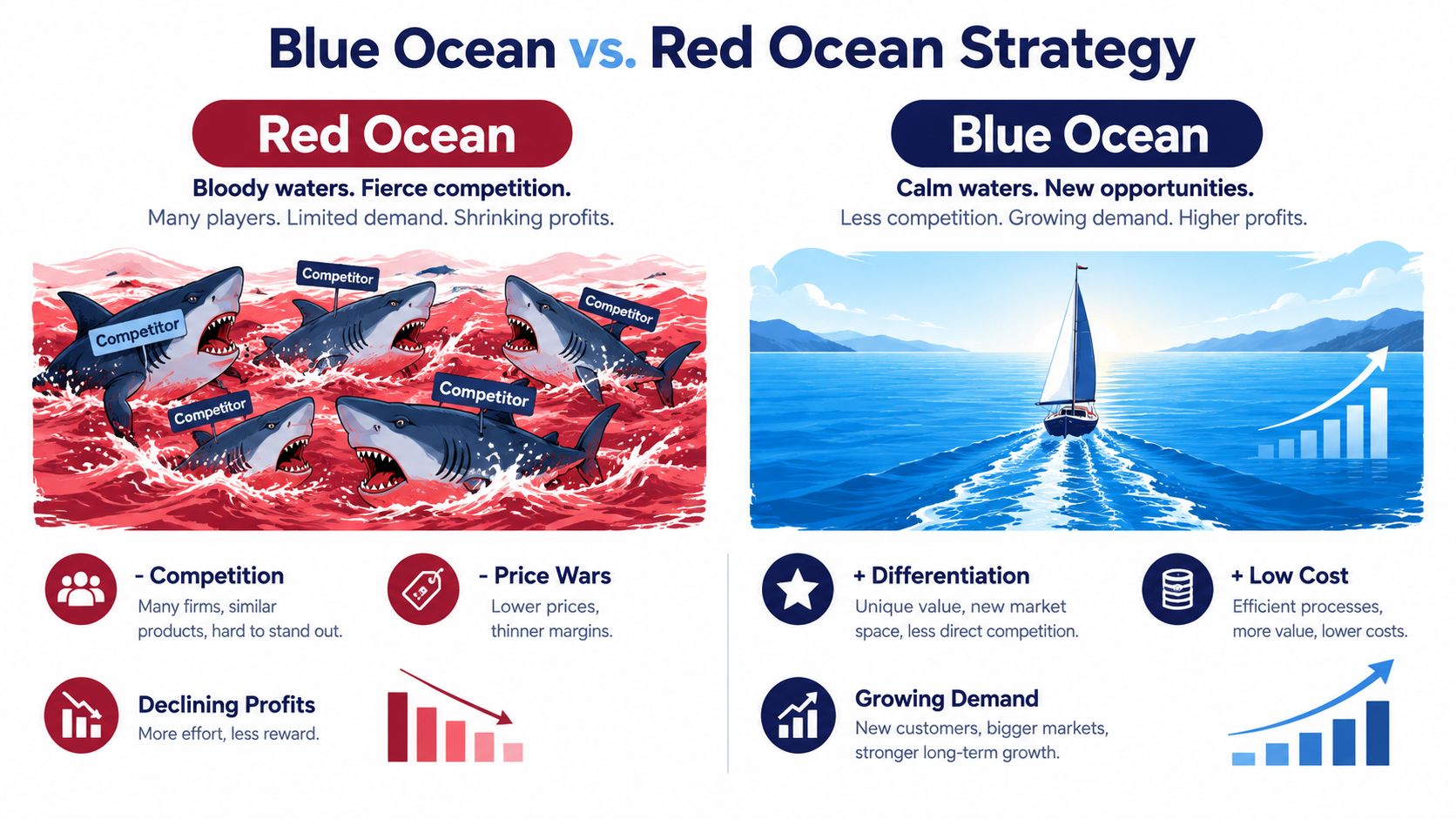
Red oceans and blue oceans in POD
A red ocean might be a broad “funny nurse shirt” category. Sellers compete on familiar slogans, common fonts, standard mockups, and small visual changes. Buyers already understand the category, so listings often become interchangeable.
A blue ocean approach might focus on a specific nursing context, such as a shift handoff ritual, a specialist community, or an inside joke understood by a defined group. The point isn't merely to narrow the keyword. The point is to create a different value curve around relevance, identity, clarity, and use.
The framework doesn't mean choosing a niche just because few sellers have entered it. Low competition at any cost can indicate weak demand, poor discoverability, or an audience that doesn't buy apparel in that context. A blue ocean still needs a credible buyer, a useful product, and an accessible route to purchase.
It also doesn't mean adding unusual features for their own sake. If you create a highly specific design that nobody recognizes or wants, you've made a curiosity, not a market. The better test is whether your changes remove friction or create meaning for people who are poorly served by existing offers.
A working definition
Think of blue ocean strategy as a deliberate redesign of the factors that determine why a buyer chooses one POD listing over another. You may change the audience, occasion, message, style, product mix, channel, or buying experience.
The strategy canvas and the ERRC grid make those decisions visible. One shows how existing offers compete. The other forces you to decide what to eliminate, reduce, raise, and create.
The Strategy Canvas and ERRC Grid in Practice
A strategy canvas compares the factors an industry competes on with the level of offering competitors provide. In POD, those factors aren't limited to the artwork. Buyers may weigh design style, niche specificity, mockup quality, product variety, price band, garment fit, and tagline clarity.
Start with a small sample of visible listings in one category. Don't try to make the chart mathematically perfect. Rate each factor as low, medium, or high, then place the leading listings and your proposed offer on the same page.
If every curve rises and falls in roughly the same pattern, you're looking at a crowded category. A blue ocean hypothesis should look different. It might score lower on product variety but higher on audience specificity and message clarity. It could reduce decorative complexity while raising educational accuracy.
A useful companion is the guide to finding high-demand, low-competition products, but competition should remain one input rather than the entire strategy.
Applying the ERRC grid
The Four Actions Framework, also called the ERRC grid, asks sellers to eliminate factors the industry takes for granted, reduce factors below the usual standard, raise selected factors above that standard, and create factors the category hasn't offered before. The official ERRC worksheet presents these as four concrete questions for reshaping a value curve.
Suppose you're exploring a “veteran therapy dog handler” listing. A weak approach would copy generic military typography, add a paw graphic, and place the phrase on several garment colors. An ERRC approach starts by changing the decisions behind the listing.
ERRC Grid Applied to a POD Listing
| Action | Question to Ask | POD Listing Example | Rationale |
|---|---|---|---|
| Eliminate | What does the category use without questioning it? | Remove generic stock-art badges and unrelated patriotic clichés. | Less visual noise can make the message more specific and reduce dependence on overused assets. |
| Reduce | What can sit below the category norm? | Use fewer colors and fewer decorative elements. | A restrained palette can support a clear, professional identity and simplify production choices. |
| Raise | What matters more to this audience than generic buyers? | Raise copy quality, role accuracy, and garment-fit information. | The listing becomes more credible to people who understand the work. |
| Create | What useful factor is missing from ordinary listings? | Create a trademark-safe phrase system built around handler responsibilities and training contexts. | The offer gains a distinct reason to exist beyond a familiar slogan. |
ERRC is a design constraint, not a prompt to make something merely clever. Each action should change the buyer's reason to choose the listing and, where possible, improve the economics of producing or presenting it.
The strongest grids also reveal tradeoffs. If you raise detail, you may need to reduce visual clutter. If you create a highly specific phrase, you may need to eliminate broad tags that attract the wrong audience. Those decisions are the strategy.
Classic Examples and How They Translate to POD
Cirque du Soleil is often used to show how the framework works because it did not just make a traditional circus more polished. IMD highlights the company's removal of costly animal acts as an example of the Eliminate action in practice.
The move also reduced elements associated with the traditional circus model, raised artistic atmosphere, and created a theatrical experience with a different emotional appeal. The important lesson isn't “make a premium version.” It is to change the combination of factors so the offer serves a different audience and carries a different cost structure.
The translation for a POD seller
Take a micro-niche such as sober-curious pet lovers. A typical marketplace search may return generic pet slogans, broad recovery references, and clip-art aesthetics. A seller applying the same logic might remove familiar pet clichés, reduce decorative clutter, raise typography quality and message sensitivity, and create a curated visual theme around mindful routines with animals.
That doesn't prove demand. It creates a hypothesis that can be tested.
A second example could involve vintage astronomy educators. Instead of producing another planet illustration, the seller could eliminate generic space puns, reduce decorative effects, raise scientific accuracy and legibility, and create a coherent classroom-oriented series. The audience might include teachers, museum educators, and amateur astronomy groups, each with different buying occasions.
ERRC Mapping: Cirque du Soleil vs a POD Niche Launch
| ERRC Action | Cirque du Soleil Case | POD Niche Translation |
|---|---|---|
| Eliminate | Animal acts and other costly circus conventions. | Generic slogans, stock graphics, and unrelated visual references. |
| Reduce | Elements that supported the traditional three-ring circus format. | Excessive colors, tiny details, and broad messaging. |
| Raise | Artistic atmosphere and theatrical quality. | Typography, accuracy, garment information, and audience relevance. |
| Create | Story, music, dance, and a theater-like experience. | A recognizable design system tied to a specific audience and occasion. |
The Blue Ocean Strategy canvas framework describes value curves as a way to compare industry factors and identify where an offer can diverge. For POD, that divergence may come from the audience and workflow around the product as much as from the artwork itself.
A seller who copies only the surface of Cirque du Soleil misses the point. Premium typography alone doesn't create a blue ocean. The value comes from a connected system of choices, including whom the product serves, what it removes, what it emphasizes, and why the buyer understands the difference.
The Honest Critique Every Seller Should Hear
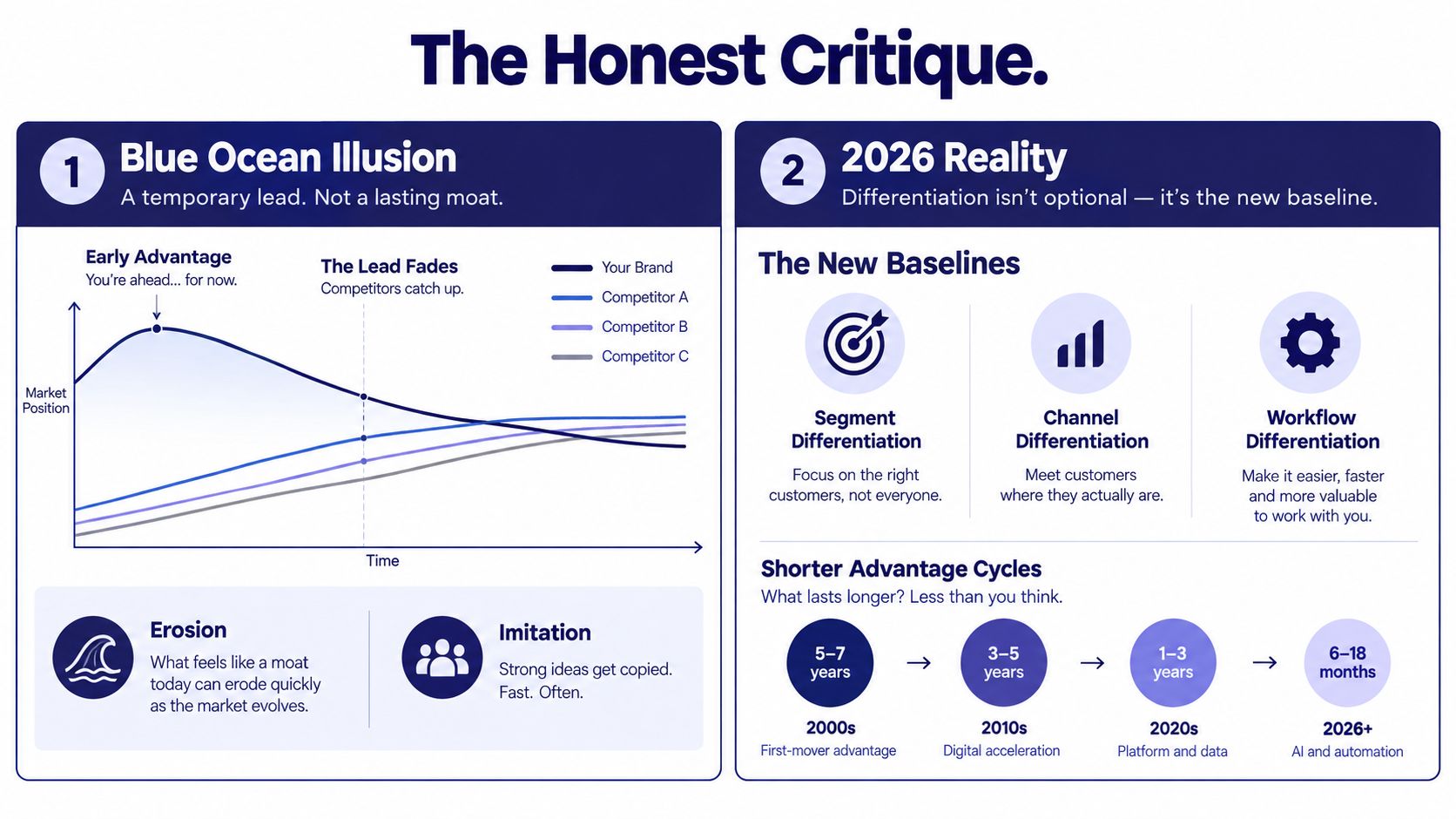
Blue ocean strategy does not create a permanent force field. Once a niche shows promise, imitators can enter, copy its visible design language, and target the same audience.
That risk is especially clear in POD. A seller can reproduce a concept quickly and place it across several marketplaces. A listing that feels distinctive today may look ordinary after competitors fill the tags, or after a marketplace changes how it ranks products.
Recent coverage argues that blue ocean advantages are often temporary because imitators move into profitable spaces. A systematic review published in 2026 also concludes that durable results increasingly depend on combining the framework with complementary strategy models rather than using it alone.
Features aren't the safest moat
A feature-only approach is fragile. Another seller may reproduce a new phrase style, mockup treatment, or product variation with little difficulty.
Commentary focused on 2026 makes a useful contrarian point. Durable opportunities are more likely to come from segment, channel, and workflow choices than from adding product features, as discussed in this analysis of modern blue ocean positioning.
For a POD seller, defensibility may come from understanding a community's language, building a coherent collection, reaching buyers through a trusted channel, or developing a repeatable research and launch process. These choices cannot guarantee sales, but they can be harder to copy than one graphic.
Use a niche review informed by how competition scoring works, and ask:
- Audience depth: Does the group have recurring occasions, communities, or identities that support more than one design?
- Community ownership: Can you understand the audience's language without flattening it into generic merchandise?
- Trademark clarity: Have you checked whether key phrases belong to someone else?
- Seasonal durability: Does the buying context recur, or does it depend on a brief moment?
- Channel fit: Does the audience discover products on the marketplace you plan to use?
Trendlytic can serve as the research lens here. Compare competitor density with demand signals, then examine whether the audience has enough recurring relevance to support a collection. A low-competition score alone does not prove that buyers exist.
The shipping-industry evidence also challenges the idea that blue oceans are completely uncontested. A statistical industry-level study found overlap between blue-ocean-like and competitive strategies. In its sampled shipping industry, the relationship between the number of firms and average profits was positive over the period studied from 1982 to 2000, as reported in this industry analysis.
Competition is not automatically good news. Some expanding markets create new demand instead of dividing a fixed pool. For POD, look for expanding relevance and a defensible workflow, rather than a category with no rivals.
A Practical Playbook for POD Niche Discovery
Blue ocean strategy becomes practical before you open a design editor. The goal is to connect creative decisions to a buyer hypothesis that can be tested through Trendlytic research and a small market experiment.
1. Write the niche hypothesis
Start with one sentence naming the buyer, situation, and emotional payoff. For example: “I want to create apparel for veteran therapy dog handlers who want a professional way to express pride in their role.” The idea is specific enough to guide research while remaining provisional. This niche positioning guide offers a useful way to frame the buyer and the value of the offer.
Begin with a situation in which someone might buy, not with an artwork you already want to make.
2. Inspect demand and competition
Review live bestseller data across TeePublic, Amazon Merch, Redbubble, and Etsy. Study leading designs, wording, visual conventions, product types, and audience signals. Compare competitor density with average review counts. One bestseller is a clue, not proof of a market.
Trendlytic can help you use these signals as a research lens. An underserved audience may appear around an adjacent use case rather than the broad keyword that first caught your attention. The aim is to distinguish a real opening from an empty category.
3. Check trademark risk
Run important phrases through a USPTO trademark search before building a collection around them. A phrase may sound generic yet still create a legal or marketplace problem when used commercially.
Keep demand validation and trademark checking separate. Evidence that buyers may want a phrase does not clear it for commercial use.
4. Complete the ERRC grid
Before producing art, write four explicit decisions. Identify what to eliminate, reduce, raise, and create.
For the therapy dog handler idea, you might eliminate generic military clip art, reduce decorative colors, raise role-specific language, and create a consistent set of trademark-safe phrases. If the four choices are difficult to explain, the concept may be only a keyword variation rather than a distinct offer.
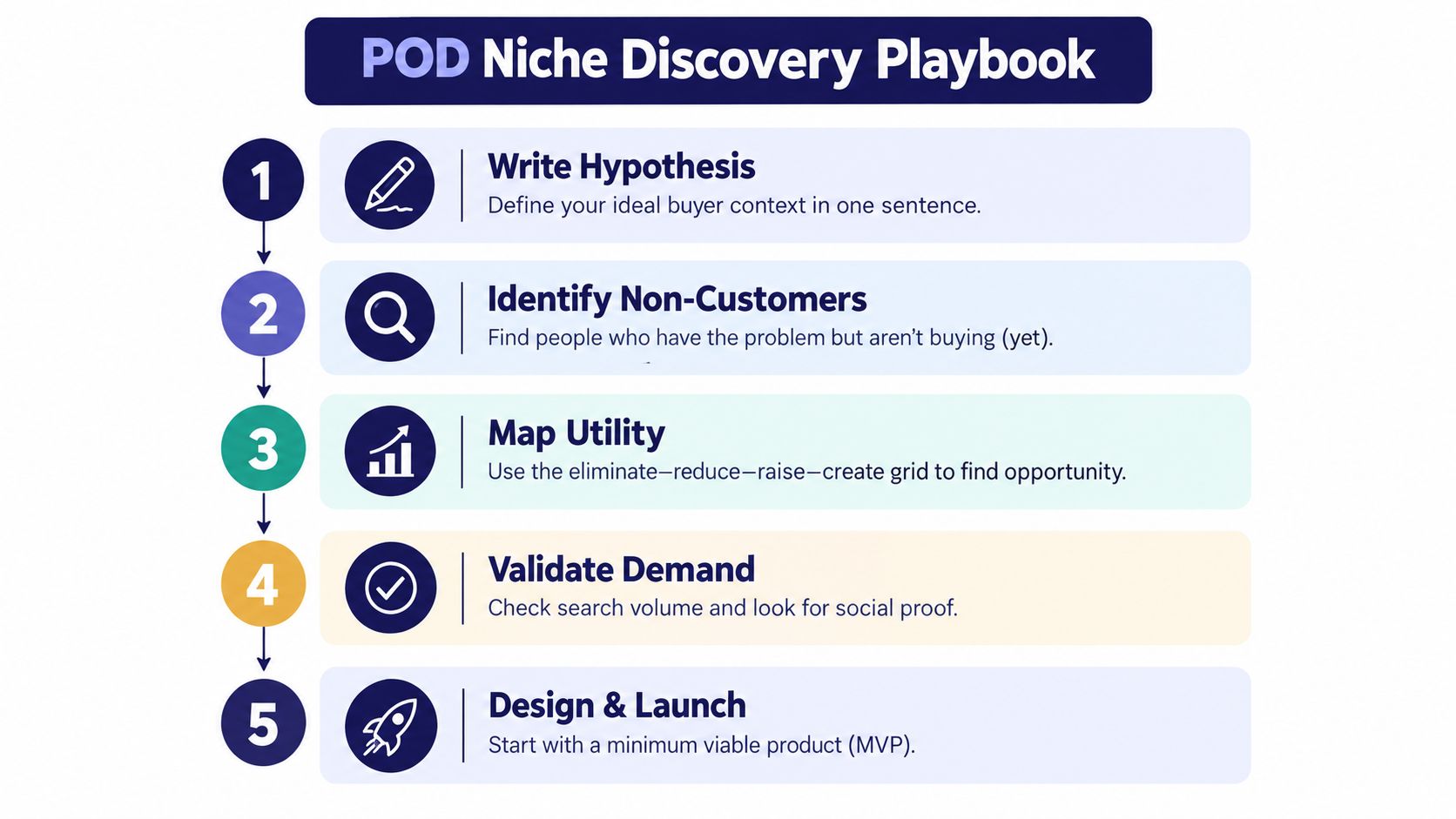
5. Launch a small test batch
Publish a limited group of designs instead of committing to a large collection. Track conversion rate, click-through rate, and 30-day sales velocity to compare the hypothesis with buyer behavior.
These measures need context. A low conversion rate may reflect the artwork, price, mockup, product choice, or a mismatch between the search phrase and landing page. Treat the first batch as evidence for the next decision, not a final verdict on the audience.
For marketplace planning beyond shirts, this Etsy seller's scalable guide can help you assess product formats and shop expansion without losing focus.
Include non-customers in the research. Ask who understands the category but does not currently buy its products, then identify the friction. Existing designs may feel childish, too broad, visually loud, or disconnected from the buyer's work.
That question can reveal more than another scan of saturated tags. It shifts the task from copying a design to understanding why a potential buyer remains outside the category.
Bringing Blue Ocean Strategy Into Your Week
The working mental model is short:
- Stop competing for the same buyer at the same price.
- Redesign the factors that shape the buying decision.
- Verify the hypothesis before investing in a large collection.
Blue ocean thinking works best as a weekly habit of questioning defaults. It isn't a guarantee that a niche will sell, and it doesn't remove the need for sound design, clear listings, marketplace fit, or patient testing.
Use this checklist during one focused research session:
- Pull one adjacent bestseller list: Choose a nearby POD niche rather than another broad category you already know is crowded.
- Sketch one Strategy Canvas: Compare the factors buyers appear to weigh, including specificity, clarity, style, product choice, and price.
- Draft an ERRC grid: Write one concrete eliminate, reduce, raise, and create decision.
- Search top phrases with USPTO: Remove risky terms before they become the foundation of your collection.
- Ship one test design: Give the idea a real market test instead of refining it indefinitely in private.
Most POD sellers don't need more uploads. They need a calmer process for choosing where to compete, what to remove, and which assumptions deserve evidence.
Trendlytic helps POD sellers research TeePublic, Amazon Merch, Redbubble, and Etsy through live bestseller data, niche opportunity signals, validated designs, and a built-in USPTO trademark check. If you want a research lens for finding less crowded niches and channels, visit Trendlytic and use it to test your next hypothesis, not to replace your judgment.