Book Lover Merchandise: A Practical POD Seller's Guide
You've probably searched “book lover merchandise” on Redbubble, seen page after page of stacked books, literary quotes, and bookmark illustrations, then wondered whether there's any room left. I've had that reaction myself after scrolling through a crowded marketplace. The category looks saturated when you search broadly, but broad search hides the useful distinction: readers don't all buy the same visual language.
A cozy reader, a dark-academia fan, a romantasy reader, and a middle-grade enthusiast may all identify as book lovers, yet they shop for different products. The practical opportunity isn't another generic “I'd rather be reading” shirt. It's a focused product built for a recognizable reader identity, validated for demand, and screened for trademark risk before it reaches a listing page.
Table of Contents
- Why Book Lover Merchandise Still Has Room for New Sellers
- Validating Demand Before You Design Anything
- Picking a Reader Sub-Niche That Converts
- Designing Listings That Match How Book Shoppers Search
- Choosing Between TeePublic, Amazon Merch, Redbubble, and Etsy
- Running the USPTO Trademark Check the Right Way
- Launching and Scaling Without Overpromising
Why Book Lover Merchandise Still Has Room for New Sellers
The first time I looked seriously at this category, I made the same mistake many sellers make. I searched a broad phrase, saw thousands of similar designs, and treated the whole niche as one market. That approach makes every result look like competition, including products aimed at completely different buyers.
A dark, vintage design for a reader who collects gothic novels isn't competing for exactly the same purchase as a warm cat-and-mug tote for someone who reads on the sofa. A romantasy sweatshirt speaks to another audience again. The visual cues, product formats, gifting occasions, and search phrases change with each group.
The category is fragmented by identity
Book-themed products have commercial roots that go well beyond current social media trends. The first American gift book appeared in December 1825, and literary annuals and gift books were described as highly profitable publishing formats from the 1820s through the 1860s. Early Christmas gift advertising reportedly featured books as more than half of the promoted gifts, which connects reading with seasonal, emotionally driven buying rather than with reading alone. The Library Company of Philadelphia's history of gift books provides the historical context.
Modern book lover merchandise follows that same pattern. Apparel, mugs, totes, stationery, bookmarks, and reading accessories let buyers display a literary identity and give that identity to someone else. The product doesn't need to reference a specific title to feel personal.
The underlying audience is also substantial. The U.S. book market generated about $9.1 billion in revenue in 2022, with hardback books contributing over $3.2 billion and audiobooks reaching about $1.8 billion, according to Statista's book market overview. Global estimates place book-market revenue in the $150 billion range in the mid-2020s, with roughly 2.2 billion books sold annually and print representing about 78% of total book revenue in 2025, also covered in that source.
Practical rule: Don't ask whether book lover merchandise is crowded. Ask which reader identity is underserved by the listings you've actually reviewed.
A narrow angle gives your design language somewhere to go
Generic products usually rely on familiar quotes and obvious stacks of books. Those can sell, but they're difficult to differentiate and easy for competitors to imitate. A better starting point is a sub-niche with its own palette, symbols, tone, and buying occasion.
Current trend reporting points toward that fragmentation. Searches for book totes rose 148%, literature rose 93%, romantasy rose 77%, paperback rose 73%, bookmark rose 49%, and book club rose 40%, according to the Faire Forecast report on the well-read bookish trend. Those figures don't mean every product will work. They do show that the audience is looking for ways to signal reading culture through different formats and aesthetics.
I'd rather launch a small collection for one clearly defined reader than upload disconnected designs for every bookish theme. A coherent first collection gives you cleaner demand signals, more consistent thumbnails, and a better chance of learning what buyers respond to.
Validating Demand Before You Design Anything
Designing first feels productive, but it's often an expensive way to avoid research. I use a short validation process before opening Illustrator or preparing print files. The purpose isn't to predict a guaranteed winner. It's to find evidence that real buyers are already searching, browsing, or purchasing around the angle.
Start with marketplace evidence
Begin on TeePublic and Redbubble. Search a specific phrase, then inspect category filters, tags, bestseller placement, product types, and the visual patterns repeated across strong listings. Don't copy artwork. Look for recurring buyer language and note whether the leading products are shirts, sweatshirts, totes, mugs, or paper goods.
Cross-check the same phrase on Amazon Merch and Etsy. On Etsy, search terms such as “dark academia tee” or “romantasy sweatshirt” can reveal how sellers frame the product, which occasions they target, and whether listings appear current. On Amazon Merch, review bestseller rank and the Opportunity Score where available. Treat it as a demand-versus-supply gauge, not a promise. A score around 500K or higher, combined with capped inventory, is the type of signal some sellers use to identify room without assuming the niche is empty.
Freshness matters. A sub-niche with steady new sales activity is more useful than one with an attractive rank but no recent movement. Likewise, a phrase producing roughly 10 listings per day can be healthier to investigate than one producing 200, because extreme volume may indicate intense competition rather than easy demand.
For a broader research workflow, I keep this trend research process nearby while comparing platforms and phrases.
Use one sheet, not a collection of impressions
A simple spreadsheet prevents the loudest listing from becoming your entire strategy. I record the same fields for every phrase:
| Keyword / Phrase | Platform | Top 5 Listing Titles | Avg Price | Last Sale (days) | Demand Signal | Go / No-Go |
|---|---|---|---|---|---|---|
| dark academia tee | Amazon Merch | Record five leading titles | Record observed price | Record observed age | Rank, freshness, reviews | Decide after cross-check |
| romantasy sweatshirt | Etsy | Record five leading titles | Record observed price | Record observed age | Search activity, new listings | Decide after cross-check |
| cozy reader tote | Redbubble | Record five leading titles | Record observed price | Record observed age | Bestseller placement, tags | Decide after cross-check |
The exact numbers you enter should come from your live observations, not assumptions. Trendlytic is one option for this stage. It covers TeePublic, Amazon Merch, Redbubble, and Etsy, and includes a built-in USPTO trademark check, so it can reduce the amount of manual comparison when you're researching a phrase across several marketplaces.
Give each candidate a final 24-hour check. Search it again the next day, review whether fresh listings or sales signals appear, and remove anything that only looked promising because of one strong thumbnail. If the phrase still has a clear audience and manageable competition, move to concepts. If it doesn't, you've saved yourself hours of design work.
Picking a Reader Sub-Niche That Converts
Readers buy products that help them recognize themselves. “Book lover” is a broad identity, but the purchase becomes easier when the design reflects a specific habit, mood, or community.
Match the product to the reader's behavior
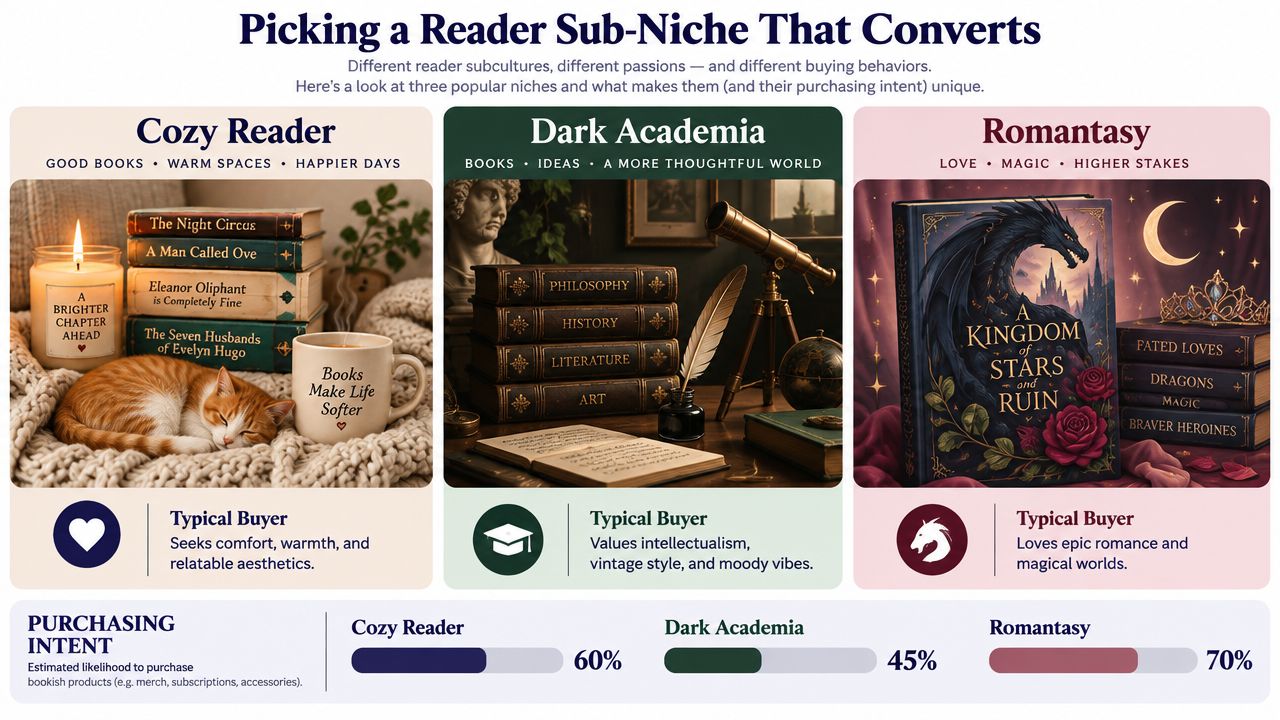
Cozy readers tend to respond to warmth and domestic details: candles, cats, mugs, blankets, worn paperbacks, and soft colors. Totes and mugs make sense because they fit reading routines and work naturally as gifts. A cozy collection can feel inviting without using a quote at all.
Dark academia needs restraint. Muted colors, vintage type, desks, libraries, academic objects, and old-book textures give the niche a recognizable visual system. Crewnecks and sweatshirts are strong formats to test because the artwork benefits from a larger canvas and fits cooler-season gifting. The timing also makes sense around August through October, when back-to-school and fall reading interest create a natural context.
Romantasy combines emotional and fantasy signals. Florals, dragons, swords, stars, ornate borders, and illustrated couples can work, but the design should avoid looking like unofficial merchandise for a particular protected series. Sweatshirts and crewnecks are practical tests for this audience, particularly around holiday gifting.
Booktrovert designs are more personality-led. Introvert humor, quiet-reading references, and lightly ironic wording can translate well to stickers, notebooks, and smaller accessories. These products let buyers signal an identity without committing to a large graphic on clothing.
Other viable segments include book-club shoppers, indie-romance readers, classics readers, and kids' middle-grade audiences. For middle-grade buyers, sticker packs, notebooks, and sweatshirts may be more appropriate than adult-oriented apparel, but the artwork and language need to be suitable for the actual purchaser.
The available market reporting points to seasonal strength from October through December, including one niche estimate of a 340% search-volume increase during that period, with observed average order values of $35 to $48 and a repeat-customer rate of 23% versus a 12% Etsy average. The Korean Book Industry report on book-related gift demand gives the broader planning context. I'd still validate each micro-audience separately, because a strong seasonal category doesn't make every design profitable.
Commit your first 20 designs to one sub-niche. That constraint helps you build a collection instead of scattering effort across unrelated aesthetics.
Designing Listings That Match How Book Shoppers Search
Most beginners write titles from the designer's perspective. Buyers search by product, audience, occasion, and style, so your listing needs to connect those elements in a readable order.
I start by collecting phrases from strong marketplace listings, then separate them into four groups:
- Primary product phrase, such as book tote, romance sweatshirt, or reading journal.
- Audience descriptor, such as cozy reader, romantasy reader, or dark academia fan.
- Product format, such as crewneck, mug, sticker pack, or notebook.
- Style or occasion cue, such as gothic, vintage, book club gift, or holiday present.
A workable title structure is primary keyword + audience descriptor + format + style cue. For example, “Romantasy Reader Sweatshirt, Fantasy Book Lover Crewneck, Dragon and Rose Gift” is clearer than a poetic title that never names the product.
Build two concepts before you build a collection
For a romance audience, I might test a floral book stack with a restrained phrase such as “One More Chapter,” then compare it with a character-free design built around roses, marginalia, and a vintage library card. For fantasy readers, I'd compare a dragon curled around a closed book with a more minimal constellation and sword motif.
The point is not to guess which artwork is prettier. It's to test whether the audience responds more strongly to romantic softness, fantasy symbolism, humor, or lifestyle identity. This print-on-demand SEO workflow is useful when translating that research into searchable listing language.
Use tags as a deliberate mix rather than repeating one phrase. On a platform with a 13-slot tag structure, I'd combine broad terms, sub-niche terms, product terms, and gift or occasion modifiers, removing tags that don't describe the actual item.
| Element | Romance Reader Example | Fantasy Reader Example |
|---|---|---|
| Primary keyword | romance reader sweatshirt | fantasy reader sweatshirt |
| Audience descriptor | romance book lover | romantasy book lover |
| Format | crewneck pullover | fantasy crewneck |
| Style cue | floral vintage reading gift | dragon gothic reading gift |
| Supporting tags | romance reader, book club, cozy reading | dragon reader, magical library, fantasy gift |
| Bundle idea | sweatshirt with matching tote | crewneck with bookmark and sticker pack |
Pricing should reflect the role of each product. Stickers can attract a lower-commitment purchase, while hoodies and crewnecks provide more room for margin. Bundles can make a tote, bookmark, and sticker set feel like a complete gift instead of three unrelated items.
Mockups matter because book-themed products are often bought for atmosphere. Use a reading chair, library table, bookstore, or bedside scene when it matches the product. Once you have enough listing data to identify a stronger angle, rotate the hero image rather than permanently trusting the first mockup.
Choosing Between TeePublic, Amazon Merch, Redbubble, and Etsy
There isn't one universal launch platform for book lover merchandise. Each marketplace changes how much work you need to do before the buyer sees the design.
Amazon Merch is useful when you can write precise, keyword-aware titles and maintain a steady upload rhythm. Search intent is central, so a clear phrase often matters more than an elaborate storefront. Redbubble leans more heavily on tags, browsing, and algorithmic discovery, which makes it suitable for testing several related designs and product types.
TeePublic has a smaller marketplace feel and a built-in audience of casual gift buyers. It can suit straightforward designs that communicate quickly in a thumbnail. Etsy requires more ownership from the seller. Branding, mockups, descriptions, bundles, customer service, and shop cohesion all influence the buying experience.
Compare the operational trade-offs
| Platform | Audience Fit | Commission Range | Best Product Types | Launch Priority |
|---|---|---|---|---|
| Amazon Merch | Search-led shoppers seeking clear product matches | Varies by product and marketplace terms | Apparel, especially focused keyword designs | High if you prefer structured search |
| Redbubble | Browsing shoppers and gift buyers | Varies by account and product settings | Apparel, stickers, totes, mugs | High for broad design testing |
| TeePublic | Casual gift shoppers and graphic-apparel buyers | Varies by product and promotion | Tees, sweatshirts, stickers | High for concise niche concepts |
| Etsy | Buyers seeking curated gifts and cohesive collections | Varies by listing, transaction, payment, and advertising choices | Bundles, stationery, accessories, apparel | High if you can manage a branded shop |
I wouldn't launch on all four immediately. The workload multiplies when you adapt titles, tags, mockups, policies, and customer support for every channel. Pick one marketplace that matches your design and operational strengths, then add another after you understand which products attract attention.
If you use Amazon FBA for physical merchandise or related inventory, Packaging Panda's Amazon FBA packaging compliance guide is a useful reference for checking packaging requirements before shipping stock.
Trademark enforcement also differs by platform, but no marketplace should be treated as a safety net. Screen phrases before uploading, especially when a design resembles fandom merchandise or uses language associated with a named series.
Running the USPTO Trademark Check the Right Way
Book-themed sellers often assume a phrase is safe because it sounds ordinary. That assumption creates avoidable risk. A short phrase can still be protected for a specific product category, and a listing can be removed before you've had time to build sales history.
The USPTO organizes trademark searching around particular goods and services. Its guidance recommends searching for marks used on a specific good or connected with a specific service, and coordinated classes should be considered when goods or related goods could create confusion. The USPTO trademark search help page explains that a proper search should include relevant classes for both your goods and related goods.
Search the phrase, then the category
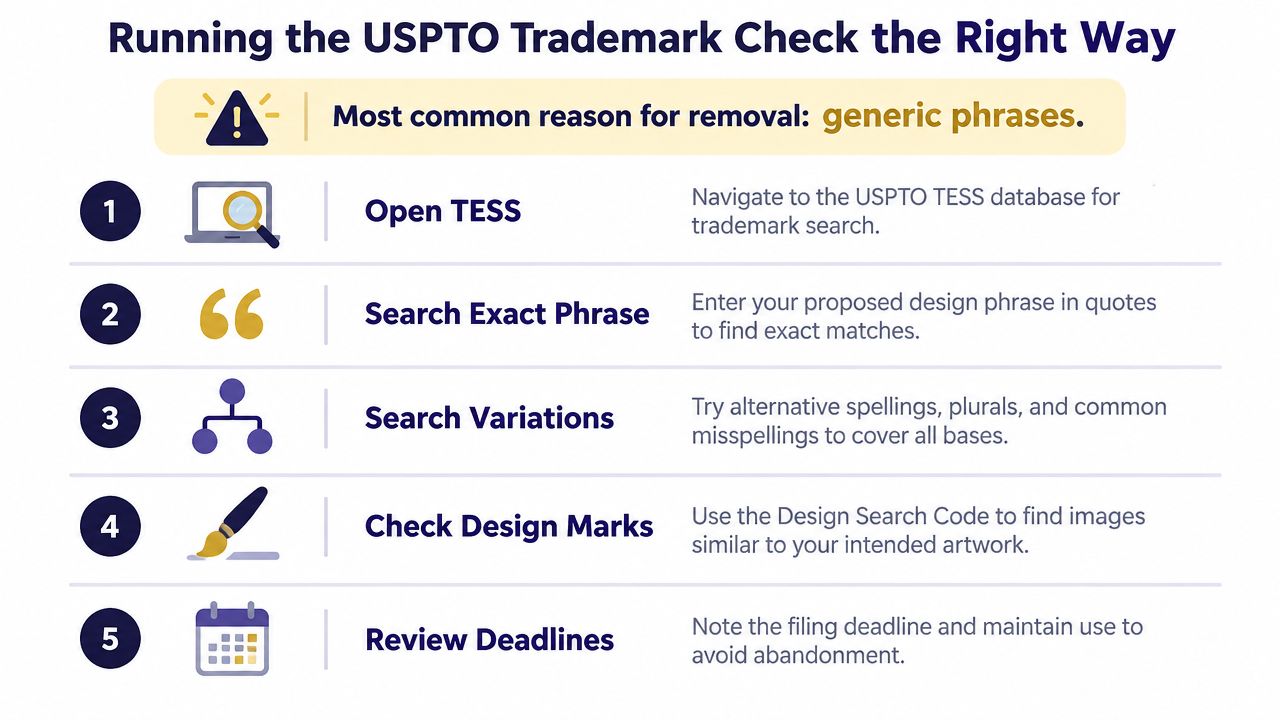
Open the USPTO search system and enter the exact phrase first. Then try singular and plural forms, alternate spacing, spelling variations, and phrases with or without common connecting words.
For book lover merchandise, I pay particular attention to:
- Class 25, which covers clothing.
- Class 16, which covers paper goods and printed matter.
- Class 21, which is relevant to mugs and drinkware.
- Class 41, which covers education and entertainment services.
The USPTO identifies 45 total international classes, and its goods-and-services guidance describes Class 16, Class 25, and Class 41 in those terms. The USPTO classification overview is the right place to confirm the class descriptions rather than relying on marketplace folklore.
A phrase doesn't have to appear in the same class to create a problem. The USPTO notes that goods can be related when consumers might think they come from the same source, including when they're sold together, used by the same purchasers, advertised together, or sold by the same manufacturer or dealer. The USPTO's federal trademark searching guidance covers those relationship factors.
Review the mark's live status, owner, filing details, and listed goods or services. Save a screenshot or note in your launch checklist, especially when you decide not to use a phrase because the result is ambiguous.
Screening habit: Search the wording before you polish the artwork. A finished design is harder to abandon emotionally.
A built-in tool can help with triage, but it doesn't replace judgment. Trendlytic includes a USPTO trademark check alongside marketplace research, while this Merch by Amazon trademark protection guide offers additional workflow context.
Launching and Scaling Without Overpromising
I prefer small seasonal launches to large catalog drops. A focused batch gives you enough variety to test an idea while keeping the results readable. For book lover merchandise, the calendar can revolve around reading occasions rather than only conventional retail holidays.
Build around moments readers already understand
Back-to-school timing suits dark academia, classics, study aids, and notebook designs. Holiday gift guides are a natural fit for bookmarks, mugs, totes, and coordinated bundles. Winter reading supports warmer palettes and quiet reading-journal themes, while summer beach reads create room for bright totes and breezier artwork.
I'd release three to five listings for each seasonal test, not a full catalog. That might mean two apparel designs, one tote, and one accessory bundle. Keep the visual language consistent so you can tell whether the audience rejected the niche or only disliked one product.
Short-form product video can help Etsy or social traffic understand a bundle, especially when the product is tactile. For sellers creating product-focused creative, Veo3 AI's product ads page may be useful as a reference for presenting merchandise in an ad format, but the video still needs to show the actual product clearly.
Treat the first 90 days as a learning period
For a new POD seller, a realistic first month may produce 5 to 15 sales, with a healthy niche listing converting around 1% to 3%, and marketplace search visibility often taking 30 to 60 days to develop. These are practical benchmarks from the launch plan, not guarantees, so I wouldn't use them to justify spending heavily before your own listings produce evidence.
Use a simple review cycle:
- First month: Check search terms, thumbnails, saves, clicks, and early sales. Remove obvious trademark concerns immediately.
- Second month: Rework promising designs into new colorways or product types instead of creating an entirely new theme.
- Third month: Review underperformers, improve titles and mockups, then test a second platform only if the first workflow feels manageable.
Repeat buyers often want a related item, not a completely different aesthetic. A buyer who likes a cozy reader tote may respond to a matching mug or bookmark, while a dark-academia crewneck buyer may prefer another muted apparel design.
Redbubble's help center says trademark complaints are handled quickly, with the company stating it will be in touch within 48 hours. Redbubble's trademark help guidance is a useful reminder that screening belongs before launch, not after a complaint.
The sustainable approach is modest and repeatable. Validate a narrow reader identity, check the phrase with the USPTO, launch a small batch, and expand only after the buyer signals are clear.
Trendlytic researches live bestseller data across TeePublic, Amazon Merch, Redbubble, and Etsy, then adds demand, competition, Opportunity Score, validated design examples, tags, pricing, and a built-in USPTO trademark check. If you want to test a book lover merchandise angle before investing in a large collection, visit Trendlytic and use the workflow to compare niches before you publish.