Etsy Best Sellers: The Real Path to POD Profit in 2026
The most popular Etsy advice is also the most expensive: find a bestseller, copy the design, add a few keywords, and wait for sales. That approach ignores the reasons a product became visible in the first place, including reviews, timing, shop history, conversion rate, fulfillment quality, and brand fit.
I've found that Etsy bestseller research works better as a conversion-validation exercise. You're not looking for a product to duplicate. You're looking for evidence that buyers understand an offer, click it, trust it, and purchase it, then checking whether the opportunity fits your design skills, margins, production workflow, and legal position.
Table of Contents
- What Etsy Best Sellers Actually Mean for POD Sellers
- Understanding the Competitive Environment Behind Best Sellers
- How to Identify and Validate Best-Selling Items with Live Data
- Marketplace Popularity vs Realistic Opportunity for New Sellers
- Personalization and Product Format in POD Viability
- Avoiding Trademark Traps and Copyright Issues
- Building Your Best Seller Research Framework
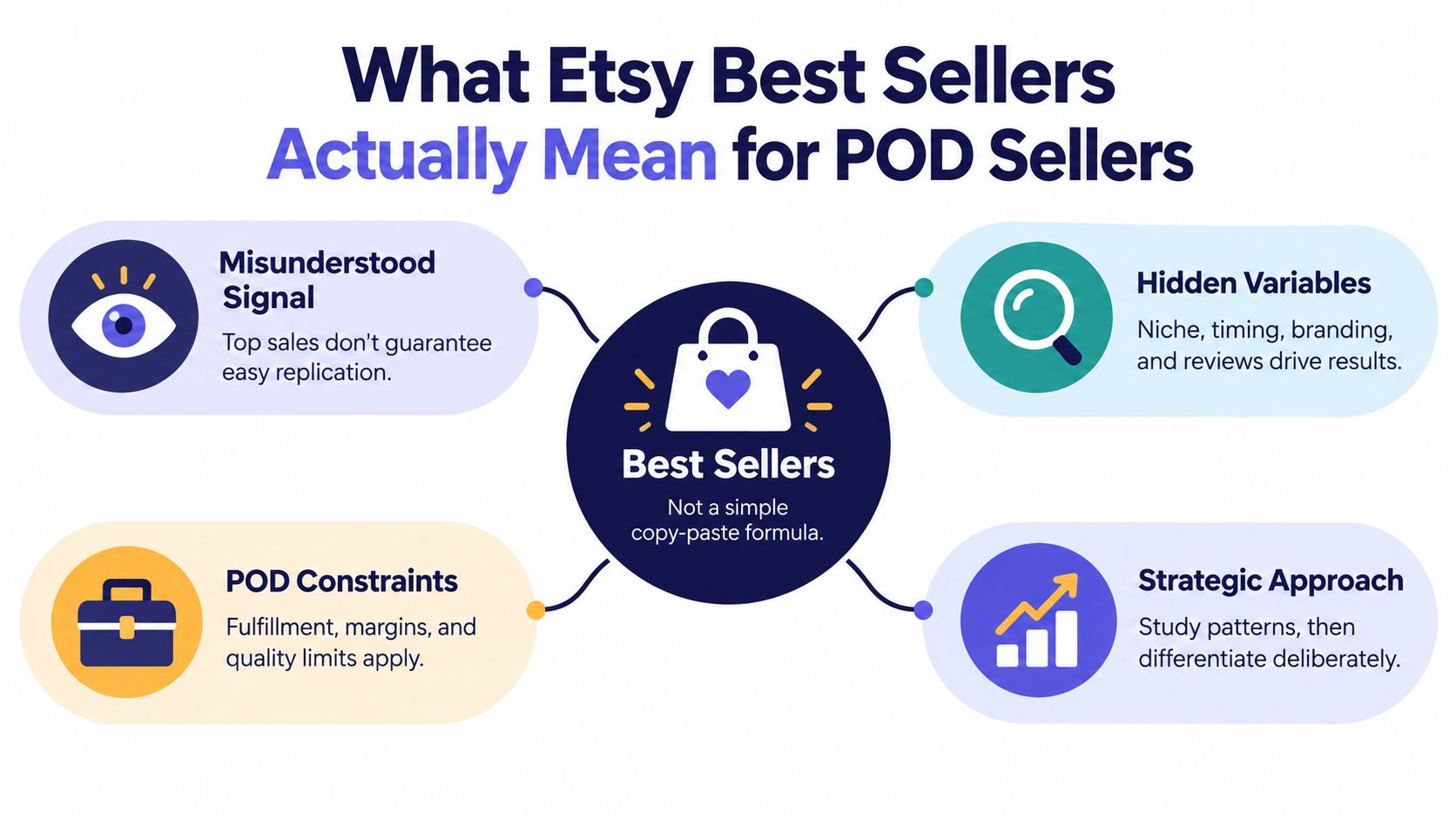
What Etsy Best Sellers Actually Mean for POD Sellers
Etsy best sellers aren't easy templates. They're visible examples of buyer demand inside a marketplace where millions of sellers compete for attention. A shirt with strong sales may depend on a very specific audience, an established shop, excellent mockups, seasonal timing, or hundreds of accumulated reviews. Copying its surface appearance removes the context that made it work.
The better question is not, “What should I copy?” It's, “What buyer problem, identity, occasion, or emotional trigger does this listing satisfy, and can I create a distinct version that serves the same intent?”
Visibility is not the same as opportunity
Etsy's search system operates as a two-stage pipeline. Query matching first identifies listings relevant to the shopper's terms, then ranking orders those listings using relevance, listing quality, engagement, customer-service quality, and other contextual signals, as described in Etsy's explanation of how search works.
That distinction matters for POD sellers. Keywords can make a listing eligible for visibility, but they don't make the listing persuasive. Etsy says clicks, favorites, and purchases after search exposure contribute to listing quality. A technically relevant shirt with a weak thumbnail can lose to a slightly less obvious design that communicates its use case immediately.
Titles, tags, categories, and attributes should describe one coherent buyer intent. If a listing targets “teacher appreciation sweatshirt,” the image, personalization options, description, and delivery expectations should all support that purchase rather than scatter across unrelated audiences.
Study the pattern, not the artwork
A useful bestseller review records the audience, occasion, product format, phrase structure, color approach, mockup style, personalization level, and price position. I'm interested in repeated patterns across successful listings, not in reproducing a competitor's wording or illustration.
For broader context on current Etsy activity, compare live observations with trending products and themes on Etsy, but treat a rising theme as a hypothesis rather than proof of durable demand.
Practical rule: A bestseller gives you evidence that a buyer intent can convert. It doesn't give you permission to copy the listing.
Durable demand usually appears across related products, audiences, or occasions. A short-lived spike may be concentrated in one phrase, one event, or one visual style. The distinction becomes clearer when you examine several shops and then test whether the underlying intent can support original designs.
Understanding the Competitive Environment Behind Best Sellers
A bestseller on Etsy is a visibility outcome inside a crowded marketplace, not a shortcut to product selection. By December 31, 2025, Etsy reported 86.5 million active buyers and 5.6 million active sellers, which is why a listing that looks strong in search still needs to be judged against the sheer number of competing seller accounts in Etsy's 2025 annual filing.
That scale changes the job for POD sellers. I do not read a crowded search page as proof that I should enter the niche. I read it as a test of whether demand is spread across multiple shops or concentrated in a few listings with review history, stronger merchandising, and enough product depth to block new entrants.
Demand and accessibility are different measurements
Etsy's marketplace reached $10.9 billion in marketplace GMS in 2024, while consolidated GMS across Etsy, Depop, and Reverb reached $12.6 billion, as reported in Etsy's 2024 annual report. That confirms real buyer activity at marketplace level. It does not answer the question a new shop has to solve, which is whether a specific niche still has room for another seller with a different offer.
The broader market also softened. Etsy marketplace GMS totaled $10.4607 billion in 2025, according to the same annual filing. A market can stay very large while becoming less forgiving in categories where dominant shops already own visibility and buyer trust.
Buyer mix matters too. Active buyers declined 3.4% year over year to 88.5 million in Q1 2025, while Etsy acquired 4.8 million new buyers and reactivated 6.5 million lapsed buyers, according to Etsy's Q1 2025 results. For sellers, the practical takeaway is simple. You need a listing that converts quickly with the right audience, not just a product dropped into a busy category.
Look for distributed demand
The better entry points usually show sales activity spread across several shops serving the same intent in different ways. That is what I want to see. Different design treatments, price positions, mockup styles, personalization levels, and product formats suggest a niche with room to compete. One shop swallowing nearly every visible click usually points to a harder fight.
A structured competition scoring framework for Etsy niches helps separate raw popularity from realistic access. Then I check the listings by hand, because a score cannot tell me whether the products are practical for POD, whether shipping expectations are manageable, or whether the design angle is original enough to stand out.
A large audience proves that buyers exist. It doesn't prove that your version will earn attention.
For POD, the better opportunity is often beside the obvious bestseller, not directly on top of it. A broad occupation shirt may be saturated, while a tighter audience, occasion, relationship, or phrase pattern gives you a clearer route to conversion without drifting away from proven buyer intent.
How to Identify and Validate Best-Selling Items with Live Data
Copying a bestseller is usually the fastest way to enter a crowded race late. What matters more is whether a visible winner points to repeatable buyer intent you can serve with a different angle, a better fit for POD, and a listing that can still convert once it sits beside established shops.
I start with live listings and work from the product level upward. A broad category label rarely helps me decide what to make. A focused search phrase does. I want to see what buyers are already responding to, how sellers package that intent, and whether the offer is practical for my production setup before I spend time on design work.
Build a useful evidence sheet
For each relevant listing, capture:
- Product type: Note whether it's a shirt, sweatshirt, mug, wall print, tote, sticker, or another format.
- Price position: Record the displayed price and whether personalization, shipping, or a bundle changes the offer.
- Review count: Use it as a maturity signal, not as a direct sales estimate.
- Personalization angle: Separate fixed artwork, editable details, and fully customized orders.
- Listing age: A newer listing with visible traction tells a different story from an established product with a long review history.
- Shop concentration: Check whether several shops succeed or one seller dominates the niche.
- Production fit: Compare the product with your provider's print areas, garment colors, sizing, turnaround, and defect risk.
That last point gets skipped too often. A niche can look attractive on Etsy and still be a poor POD choice if it depends on fast proofing, exact color matching, complex customization, or a product format your supplier handles inconsistently.
Review count helps, but only in context. Etsy does not present reviews as a direct sales total, and sellers should not treat them that way. What I trust more is pattern recognition: similar offers appearing across multiple listings, clear buyer intent in the search phrase, credible engagement, and a product setup I can realistically fulfill without creating support problems.
Validate the opportunity, then validate the offer
The practical question is which Etsy best sellers have enough buyer demand but are not dominated by a handful of mature shops. That framing keeps research grounded. You are not looking for proof that a product type is popular. You are checking whether there is still room to enter with a version that earns clicks and converts.
I test that in three passes. First, compare demand with concentration. If the same few shops hold most of the visible results, the niche may be real but hard to access. Next, check whether you can make something original that keeps the same buyer intent instead of cloning the current winner. Then run the economics. A design can attract attention and still fail once production cost, shipping, personalization time, replacements, and refunds are factored in.
A store-first tool can speed up that process. Trendlytic's Etsy keyword research tool helps surface active designs from real sellers and shows demand, competition, pricing, tags, and related patterns. I still open the listings themselves. Tools reduce manual work. They do not replace judgment.
Treat the first listing as a controlled test
Etsy says search placement is shaped by listing relevance, listing quality, recency, and shopper behavior in Etsy's search guidance. For a new POD listing, that means the first version should be treated as a test, not a finished answer.
Publish it like you expect the early data to matter. Use accurate photos, a focused title, relevant tags, clear personalization instructions, and realistic production details. Send outside traffic only from people who match the product. Untargeted clicks can muddy the signal. Matched visitors give you a cleaner read on whether the offer itself deserves a second iteration.
Marketplace Popularity vs Realistic Opportunity for New Sellers
The broad category is usually the least useful unit of analysis. Jewelry, home décor, apparel, wedding products, and digital downloads can all contain popular Etsy listings, but those labels hide large differences in competition, fulfillment, pricing, and buyer intent.
I compare what a marketplace signal tells me with what it fails to tell me. A category can prove that people shop for a type of product while offering no practical route into its most crowded subniches.
Marketplace Signals vs New Seller Reality
| Signal | What It Shows | What You Should Check |
|---|---|---|
| Frequent bestseller appearance | Buyers repeatedly engage with a product type | Whether the same few shops occupy most visible results |
| High review counts | A listing or shop has accumulated buyer feedback | Listing age, review concentration, and whether newer products gain traction |
| Broad keyword popularity | Many shoppers use a general term | More specific audiences, occasions, relationships, or use cases |
| Strong seasonal visibility | A product may benefit from timely demand | Whether the intent remains useful outside the event window |
| Several related product formats | Buyers may accept the concept across products | Which format gives you manageable production and sufficient margin |
| Numerous personalization options | Customization may increase relevance | Proofing, message handling, production errors, and turnaround pressure |
| High displayed price | Buyers may accept a premium offer | Actual costs, shipping conditions, personalization labor, and refund exposure |
Find the gap beside the category leader
Suppose a broad search shows a crowded occupation-themed apparel niche. I wouldn't respond by making another generic occupation shirt. I'd examine which audiences, occasions, or relationships appear repeatedly in the successful listings, then look for a narrower version with a distinct visual or personalization angle.
The useful distinction is category demand versus shop-accessible demand. Category demand asks whether buyers exist. Shop-accessible demand asks whether several sellers can win attention, whether the product is compatible with your workflow, and whether you can present a differentiated offer without relying on another seller's protected phrase or artwork.
Seasonality needs the same discipline. A wedding, graduation, holiday, or event product can sell strongly during a narrow window, but the listing may require fast production and precise delivery. If your provider can't reliably meet those expectations, visible demand becomes operational risk rather than opportunity.
Use concentration as a filter
I look for three conditions before creating a test batch of designs:
- Multiple successful interpretations: More than one shop has built traction around the buyer intent.
- A clear underserved angle: The leading listings leave room for a different audience, format, message, or visual style.
- A repeatable workflow: I can produce variations without turning every order into a manual project.
This approach won't make a crowded niche easy. It does prevent a common mistake, which is confusing the largest visible market with the most sensible first market.
Personalization and Product Format in POD Viability
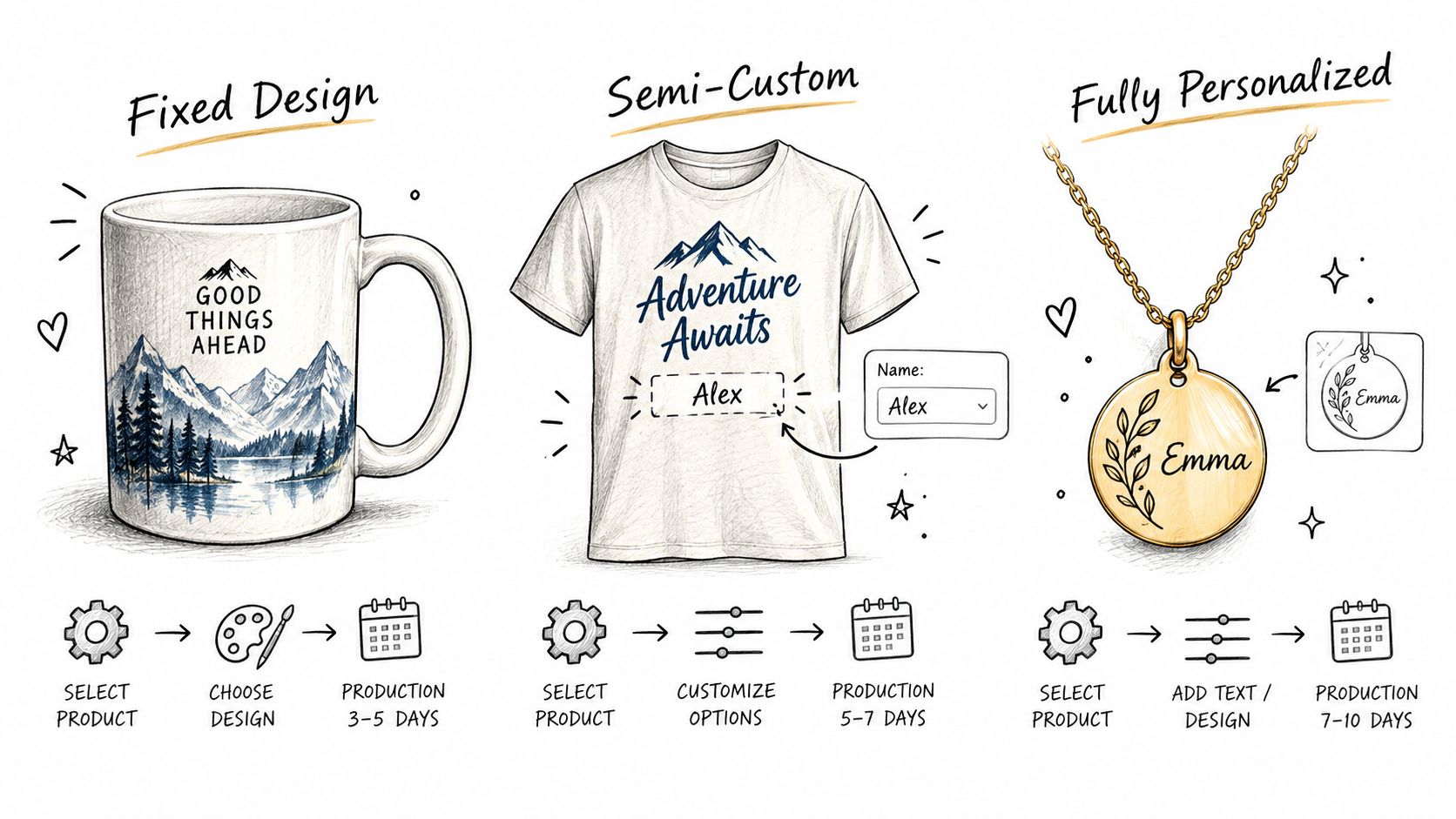
Personalization can improve relevance, but it also changes the business. A fixed design may be simple to produce repeatedly. A semi-custom product can offer a name, date, role, or short phrase without requiring a new composition for every order. Fully personalized work demands more proofing, communication, and error control.
Available coverage repeatedly names customized jewelry, apparel, home décor, wedding products, and digital downloads as leading Etsy segments, yet it rarely explains which forms of personalization are operationally compatible with POD, as reflected in the Etsy seller census.
Choose the format your workflow can support
Fixed-design products are the cleanest operationally. You create the artwork once, use consistent files, and focus your optimization on the thumbnail, title, offer, and audience. The trade-off is that differentiation must come from concept, presentation, and niche specificity.
Semi-custom products can create a useful middle ground. A buyer might choose a profession, year, name, or short personalization field from a controlled set of options. Templates reduce production variation, but your listing must make the input rules unmistakable.
Fully personalized products can command stronger attention, especially for gifts and occasions, but every order creates additional opportunities for spelling errors, unclear instructions, proof delays, and customer-service friction. I wouldn't choose this route because a competitor's personalized listing is visible. I'd choose it only if I can design a dependable approval and fulfillment process.
Separate conversion value from fulfillment cost
Personalization may help a buyer feel that a product is meant for them, but the extra operational work can reduce the value of each order. Evaluate the product through four questions:
- Repeatability: Can you create the next variation from a reliable template?
- Proofing: Does the buyer need to approve a design before production?
- Turnaround: Can your provider meet the expected delivery window?
- Error exposure: What happens if a customer submits incomplete or incorrect information?
Digital products deserve separate treatment. They don't carry the same physical production constraints as POD, but that doesn't automatically make them a better business. If you're considering AI-assisted artwork or digital downloads, resources such as this guide to monetize AI art on Etsy can help frame the product and compliance questions before publishing.
Here's a short visual reference for thinking about the operational differences between customization levels:
The best-selling personalized product isn't automatically the best product for a small shop. A semi-custom design that you can produce accurately and market repeatedly may be more sensible than a high-touch offer that consumes your time with every order.
Avoiding Trademark Traps and Copyright Issues
A listing's presence on Etsy doesn't prove that you can reproduce it. Etsy's intellectual-property policy places responsibility on the seller, not on a research tool or production partner, and Etsy's intellectual-property policy states that sellers must have the necessary rights to the content they post.
That makes legal screening part of bestseller research, not an administrative task to complete after the design is finished. A popular phrase may be protected. A character, logo, sports reference, slogan, or distinctive artwork may belong to someone else even if many shops appear to use it.
Break the idea into separate risk areas
Before designing, split the concept into:
- Word marks: Names, phrases, slogans, and recurring expressions.
- Logos and symbols: Brand identifiers, team marks, badges, and recognizable emblems.
- Characters and likenesses: Fictional figures, mascots, celebrities, and recognizable personalities.
- Artwork: Illustrations, photographs, compositions, and copied design elements.
- Fonts and assets: Typefaces, mockups, stock graphics, and design resources with usage restrictions.
Then search the relevant trademark databases and confirm the license terms for every asset. A tool can help you identify an obvious risk, but no automated result establishes full legal clearance in every country or context.
Trendlytic includes a built-in USPTO trademark check for screening U.S.-focused phrases. I'd use it as an initial filter, not legal advice. For typefaces and downloadable design resources, a practical reference such as Font Checker Pro's digital asset compliance guide can help you review licensing questions before the files enter your workflow.
Don't treat enforcement as a popularity contest
Etsy may remove material after a compliant infringement report and can disable a listing, shop, or account for policy violations. Its terms also state that repeat infringement can lead to account termination. Those consequences make “other sellers are doing it” a poor defense.
Create original wording and artwork after screening the concept. Keep records of licenses and source files. If a trend depends on a protected name or recognizable property, move to a broader buyer intent instead of trying to disguise the reference.
The same caution applies to search manipulation. Etsy's seller policy prohibits actions such as manipulating clicks, carts, or sales to influence search, and it restricts duplicate-shop behavior used to circumvent policy. Honest testing, accurate listings, clear production details, and dependable fulfillment are safer ways to improve performance.
Building Your Best Seller Research Framework
A practical framework should end with a decision, not an endless spreadsheet. I use five filters:
- Demand evidence: Do several listings show meaningful buyer engagement around the same intent?
- Competitive concentration: Is the niche distributed across multiple shops, or controlled by a few mature sellers?
- Differentiation: Can you create an original design, message, or personalization angle?
- Operational fit: Can your POD provider produce it consistently at a workable margin and delivery speed?
- Legal safety: Have you screened names, phrases, artwork, fonts, and other assets?
If a niche passes the first two filters but fails operational fit, I drop it. If it looks easy to fulfill but depends on a protected phrase, I drop it. A strong concept needs demand and a credible path to visibility, but it also needs a workflow you can repeat without constant customer-service problems.
For the creative side, a tool such as the LunaBloom AI video generator may help produce short promotional assets for testing mockups or product angles. It shouldn't replace listing research or clear product photography. Content only helps when it presents a relevant offer to the right audience.
Decision test: Don't ask whether a product is already selling. Ask whether you can make an original, legal, profitable, and repeatable version for a defined buyer.
Trendlytic can shorten the manual part of this process by analyzing live bestseller data across Etsy and other POD marketplaces, surfacing seller-led designs, comparing demand and competition, and checking U.S.-focused phrases against its USPTO trademark database. It won't decide whether a niche fits your skills or fulfillment setup, but it can give you a more structured starting point than copying whatever appears first in search.
Trendlytic offers live niche research across Etsy, TeePublic, Amazon Merch, and Redbubble, with bestseller designs, demand and competition signals, pricing, tags, and an Opportunity Score in one report. If you want to test Etsy ideas with more evidence and less manual scrolling, visit Trendlytic and compare a few focused niches before you create the next product.