Trending Now on Etsy: A Real Guide for POD Sellers
Etsy ended 2025 with 86.5 million active buyers, 5.6 million active sellers, and more than 100 million listed items, so “trending now on Etsy” means finding a precise demand signal inside a very crowded marketplace, not discovering a guaranteed bestseller. The useful signals come from Etsy search behavior and trend reporting, then need to be tested against competition, product fit, and trademark risk.
You've probably had the same experience as many POD sellers. You notice a promising aesthetic, open a design tool, make several variations, publish them, and wait. A week later, the trend feels less exciting, the listings have no traction, and the listing fees are still real.
The mistake usually happens before the design stage. Sellers choose a broad vibe such as cottagecore, retro, or minimalist decor instead of identifying the specific phrase, visual attribute, audience, or occasion that shoppers are actively searching for.
Table of Contents
- What Trending Now on Etsy Actually Means
- How Etsy Surfaces Trend Signals
- Why Micro-Trends Beat Broad Aesthetics
- Spotting Sellable Niches Before Competition Fills Them
- Using Trendlytic to Validate Trends Safely
- Practical Next Steps for Etsy Sellers
What Trending Now on Etsy Actually Means
The most common mistake is treating trending now on Etsy as a permanent leaderboard. It isn't. Etsy trend signals are closer to a live weather report. They can show where shopper attention is moving, but they can't tell you whether your product will sell, whether the audience is large enough, or whether the niche is already crowded.
Etsy's own Marketplace Insights uses real Etsy search data to show what buyers are looking for in real time. It can show how often shoppers search specific terms and how much competition those terms attract, as described in Etsy's Marketplace Insights guidance. That makes it more useful than guessing from social media aesthetics or copying the first page of popular listings.
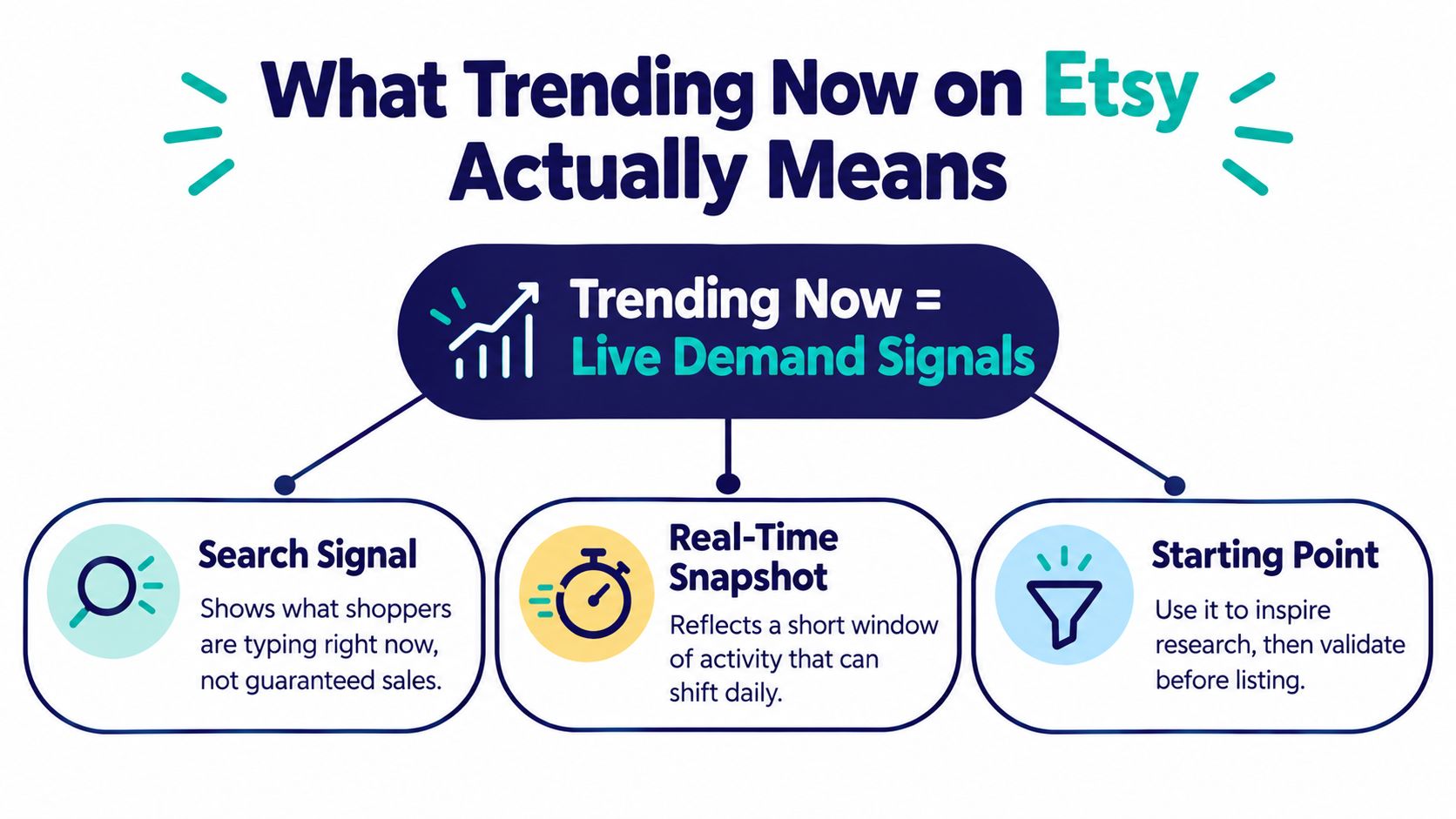
A signal is not a product decision
Suppose you see rising interest in embroidered bags. That broad observation still leaves important questions unanswered:
- Is the opportunity in a particular color, phrase, audience, or occasion?
- Can you produce a relevant POD design without copying handmade work?
- Are buyers looking for the item itself, or for a related gift or accessory?
- Does the search term describe a temporary event, a seasonal window, or a more durable preference?
Etsy's 2025 filing shows the scale of the problem. The marketplace ended the year with 86.5 million active buyers, 5.6 million active sellers, and more than 100 million items listed, while 74% of marketplace GMS came from U.S. buyers and 26% came from buyers outside the United States. That means Etsy is globally relevant, but still heavily anchored in the U.S. market. Etsy's annual filing also makes the competitive environment hard to ignore.
Practical rule: Use a trend as permission to investigate, not as permission to mass-produce.
Why specificity matters
Etsy trend reporting often reveals movement inside a narrow style attribute rather than inside an entire category. A shopper may not want “wall art” in general. They may want a particular print style, color treatment, phrase, or gifting context.
That distinction also affects product execution. If you're developing apparel, a practical Cobra DTF blank t shirt guide can help you think through blank selection and print suitability before a trend turns into wasted inventory or weak mockups.
How Etsy Surfaces Trend Signals
Etsy gives sellers several ways to investigate demand, but each source answers a slightly different question. Marketplace Insights is the most direct starting point because it uses Etsy search data and reports how often specific terms are searched alongside their competition level. That helps you compare a phrase with another phrase instead of relying on a broad aesthetic label.
Etsy's Seller Handbook also says its trend guidance is based on Etsy search data and industry forecasting. The distinction matters. Search data reflects shopper behavior on Etsy, while forecasting adds broader interpretation about seasonal, cultural, or design direction. One is closer to current intent. The other helps frame where that intent may go.
Read reports as evidence, not instructions
Etsy's 2026 wedding trend report illustrates how uneven trend movement can be. It reports that embroidered straw bags rose 20,000%, embroidered bags rose 77% among Gen Z, crochet clothing sales increased 36%, and searches for wall art decor rose 110%. Those figures appear in Etsy's 2026 wedding trend report.
The figures don't mean every product connected to weddings, crochet, or wall art is equally attractive. They show that a precise attribute can move sharply within a defined audience or occasion. A seller who turns “wedding trend” into a generic bridal design may miss the actual source of momentum.
Etsy's trend notes also highlight examples such as polka dot phone cases up 835%, beginner needlepoint kits up 175%, journal charms up 395%, and gallery print searches up 80%, as summarized in its trend report community. These examples point toward a useful pattern: shoppers often respond to a narrow object, motif, or activity rather than a broad mood board.
A practical reading sequence
Use the signals in this order:
- Start with the exact search term. Check whether the phrase describes an item, an audience, an occasion, or only an aesthetic.
- Compare demand with competition. A rising phrase can still be difficult if established listings dominate it.
- Inspect the product context. A search signal for charms may suggest a design direction, but not necessarily a T-shirt design.
- Check timing. Wedding, holiday, and event-related demand can move quickly.
- Turn the phrase into a testable product idea. If you can't describe the buyer and use case clearly, the signal is still too broad.
For a more focused process, the Etsy trend search workflow is useful as a companion to Etsy's own tools. The goal isn't to replace first-party evidence. It's to make the path from a search phrase to a shortlist of possible niches more deliberate.
Why Micro-Trends Beat Broad Aesthetics
Broad aesthetics are easy to recognize and difficult to enter. “Boho,” “retro,” and “minimalist” can inspire a design, but they don't tell you what a buyer is typing, what product they want, or why your version should win attention.
Micro-trends are more useful because they add a specific attribute. That attribute might be a motif, color combination, audience, phrase structure, hobby, or gifting purpose. Etsy's trend reporting has shown sharp movement in sub-niches such as embroidered straw bags, polka dot phone cases, and journal charms. The examples are documented in Etsy's trend report listings, and they show why “accessories” or “stationery” alone is too vague for serious product research.
Move from mood to search language
A workable micro-niche usually answers three questions:
- Who is the buyer? A bride, a journal keeper, a hobby beginner, or a particular age group?
- What precise feature attracts them? Polka dots, embroidery, a keepsake theme, or a playful accessory detail?
- What can you sell naturally? A shirt, tote, sticker, phone case, printable, or gift-oriented product?
POD sellers need the third question because not every Etsy trend transfers cleanly into print. A handmade crochet item may be trending, but reproducing the craft itself isn't the same as creating an original print inspired by the surrounding audience or visual language.
| Trend Type | Example | Useful For | Risk Level |
|---|---|---|---|
| Broad trend | Cottagecore apparel | Generating initial creative directions | High, because the phrase covers too much |
| Broad trend | Wedding decor | Understanding an occasion | High, unless narrowed by buyer and product |
| Micro-trend signal | Polka dot phone case style | Developing a specific visual variation | Moderate, after checking competition |
| Micro-trend signal | Journal charm gifting | Exploring a defined hobby and accessory audience | Moderate, with product-fit testing |
| Micro-trend signal | Gallery print searches | Building a focused wall-art concept | Moderate, if the style and room context are clear |
The test I use before designing
I write the idea as a plain sentence: “This product is for [buyer] who wants [specific expression] on [specific product] for [specific occasion or use].”
If the sentence becomes “This is for people who like cute things,” the niche isn't ready. If it becomes “This is a playful journal-themed gift for someone who wants a small, expressive accessory,” you have something more concrete to investigate.
The narrower idea isn't automatically safer. It simply gives you a clearer question to validate.
This approach also explains why analog hobbies, memory-keeping, and playful accessories can deserve attention. They connect an object with an activity or emotion. Generic decor language may attract broad interest, but a specific hobby or keepsake use case gives a POD listing more precise positioning.
Spotting Sellable Niches Before Competition Fills Them
A trend becomes worth testing when its demand signal, product fit, and competition make sense together. Sellers often focus on the first part and ignore the other two. That's how a promising keyword becomes a pile of unused designs.
Etsy's trend reporting places emphasis on expression, keepsakes, and gifting. Independent marketplace reporting also notes that about 33% of Etsy transactions involve personalized items, according to Etsy statistics from Podbase. The implication is practical, not absolute. A product with a personal or emotional use case may fit Etsy's buying context more naturally than a generic design with no occasion attached.
Compare the signal with the entry conditions
| Signal | Good Entry Point | Red Flag |
|---|---|---|
| Search interest | A specific phrase shows current shopper attention | Interest is visible only as a broad aesthetic |
| Competition | Existing products leave room for a distinct audience or use case | The first results look nearly identical |
| Product fit | The trend translates naturally to your chosen POD product | You're forcing a handmade or physical trend onto a product that doesn't suit it |
| Emotional context | The item can work as a gift, keepsake, or personal expression | The design has no clear buyer motivation |
| Timing | You can create, publish, and promote before the relevant occasion | The trend is already tied to a narrow deadline |
| Originality | You can build an original phrase, illustration, or composition | The concept depends on a protected name, slogan, or recognizable character |
The best entry point isn't always the term with the highest visible volume. A smaller, clearer niche may give you a better chance to create a product that feels intentional. That matters especially when buyers compare many similar listings.
Separate demand from volume
A large category can contain plenty of searches and still be a poor choice. The category may attract established shops, low prices, professional photography, and a huge number of similar designs. A narrower term can have less obvious volume but a cleaner buyer problem.
Use the high-demand, low-competition product research guide to structure that comparison, then check Etsy directly before you commit design time.
Personalization can also be useful, but it isn't a magic workaround. Adding a name field to a weak design doesn't make the product meaningful. The personalization should support the occasion, relationship, or identity that brought the buyer to the search in the first place.
Using Trendlytic to Validate Trends Safely
Trend research is where many sellers stop. Validation is where the expensive mistakes usually become visible.
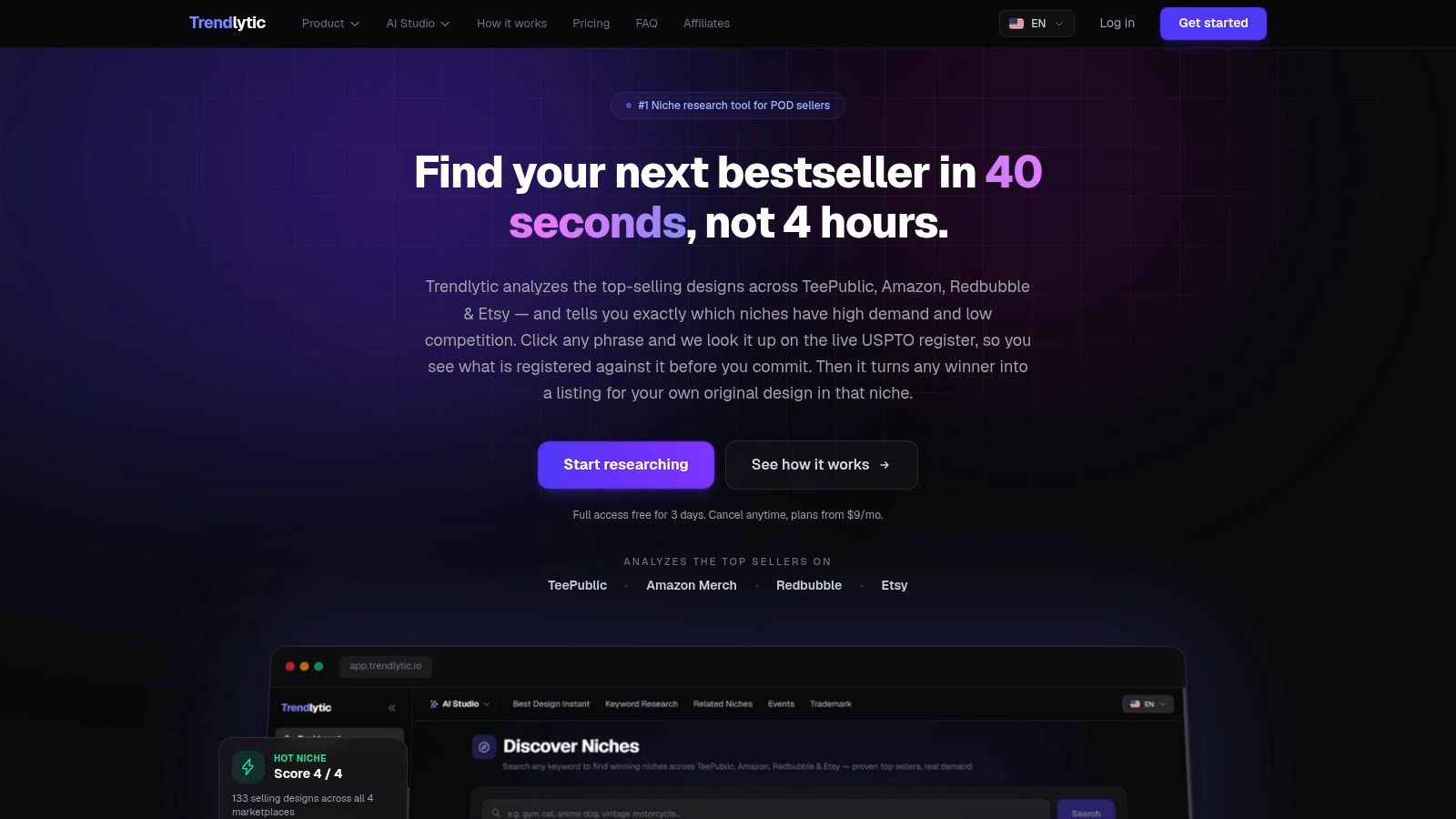
Trendlytic is a POD niche research tool covering TeePublic, Amazon Merch, Redbubble, and Etsy. It pulls each seller's top designs rather than treating random search results as proof, and it includes a built-in USPTO trademark check. That combination is useful when you want to evaluate both marketplace behavior and the risk attached to a keyword.
A safer validation sequence
Start with the exact phrase you found in Etsy Marketplace Insights or a trend report. Then use Trendlytic to inspect the niche across Etsy and other POD marketplaces, looking for patterns in the designs that sellers place at the top of their stores.
The tool checks every keyword against 850K+ active USPTO trademarks, flags ownership and expiry risks, and provides opportunity scores, tags, pricing, and automated niche suggestions. Those functions don't decide whether a product is legally safe in every jurisdiction, but they can help identify obvious terms that deserve caution before you publish.
Account protection matters: A trend can be commercially attractive and still be unusable if the wording creates trademark risk.
The store-first approach is particularly relevant to POD research. Random search results can include weak listings, duplicates, or products that only appear because of temporary ranking conditions. Looking at a seller's leading designs gives you a more coherent view of what that shop is building around a niche.
After checking the initial term, examine related keyword suggestions. Look for adjacent phrases that preserve the audience or emotional use case without copying a competitor's expression. This is often where a broad trend becomes a workable product family.
The tool also provides Trending Now rankings and can surface what is heating up on Etsy, but I still treat those rankings as prompts for investigation. A rising keyword needs an original design, a suitable product, and a listing that explains the buyer's reason for purchasing.
Here is a visual walkthrough of the research context:
Don't skip manual review. Open the relevant Etsy listings, study the language buyers use, note the product formats, and check whether the trend is genuinely compatible with your production process. A research tool can reduce the amount of sorting, but it can't replace judgment about originality and quality.
Practical Next Steps for Etsy Sellers
A sensible Etsy trend workflow is deliberately slower than the hype cycle. Find a precise signal, define the buyer, check the competition, validate the keyword, review trademark risk, and only then create a small group of original designs.
The point is not to avoid every failed experiment. Some will fail because the product is weak, the timing is wrong, or the audience is smaller than it first appeared. The point is to avoid spending heavily before you know which assumption you're testing.
Keep the experiment financially contained
Etsy charges a $0.20 USD listing fee for each individual listing, whether or not the item sells. Listings expire after four months and auto-renew for another $0.20 only if renewed, according to Etsy's official fee policy. That makes dead listings a small but repeated cost when sellers publish large batches without a clear hypothesis.
Use a simple record for each test:
- Search phrase: The exact term or attribute that prompted the idea.
- Buyer context: The person, occasion, hobby, or gifting reason.
- Product choice: Why the design belongs on that product rather than another.
- Competition note: What existing listings do well and where they look interchangeable.
- Safety check: Whether the phrase raises trademark or intellectual-property concerns.
- Decision date: When you'll review the listing and decide whether to improve, retain, or retire it.
If the product involves jewelry or accessories rather than apparel, a practical guide to pricing jewelry on Etsy can help you think through costs and positioning without treating trend momentum as a substitute for margin analysis.
Choose evidence over urgency
A trend is worth pursuing when you can explain why the buyer wants it and how your product adds something distinct. It isn't worth pursuing merely because a screenshot shows a dramatic percentage increase.
For additional idea generation, the low-competition Etsy niches guide can help you explore adjacent directions. Keep the final decision grounded in Etsy's own search context, your production capability, originality, and the cost of keeping a listing active.
The calm approach is often the more sustainable one. You don't need to chase every movement in trending now on Etsy. You need a repeatable way to distinguish a sharp but temporary signal from a niche that fits your shop and gives you room to create something genuinely yours.
Trendlytic brings Etsy and other POD marketplace research into one workflow, with bestseller-focused niche discovery, keyword signals, opportunity scoring, related niche suggestions, and a built-in USPTO trademark check. If you're ready to validate a trend before spending time on designs and listings, visit Trendlytic and use it as one part of a careful research process.