How to Find High Demand Low Competition Products on Amazon
The most popular advice for finding high demand low competition products on Amazon is to look for listings with few reviews. I wouldn't start there. A nearly empty results page can mean you've found an overlooked audience, but it can just as easily mean buyers aren't interested.
I would look for evidence of purchases alongside competition I can realistically improve on. For print-on-demand sellers, that means checking the exact audience, phrase and design angle, not assuming that demand for T-shirts proves demand for another T-shirt.
Table of Contents
- Screening Benchmarks at a Glance
- Why Few Reviews Can Mislead You
- How to Run the Opportunity Screen Step by Step
- Trademark and Policy Checks Before You Design
- Tools and Automation That Speed Up Research
- Decide Whether a Niche Earns a Small Test
Screening Benchmarks at a Glance
Use a scorecard that records review depth, newer entrants, contribution margin, category fees and conversion sensitivity before deciding whether a candidate deserves more work.
Opportunity benchmarks for each candidate niche
| Metric | Where to Check | Benchmark | What It Tells You |
|---|---|---|---|
| 85th-percentile review count, first 30 organic results | Amazon search results | Below 200 | Comparatively easier entry point |
| 85th-percentile review count, first 30 organic results | Amazon search results | 200 to 500 | Commonly treated as accessible |
| 85th-percentile review count, first 30 organic results | Amazon search results | Above 500 | Substantial launch investment |
| Newer entrants in top results | Top organic results | At least 10% | The niche still attracts new sellers |
| Contribution margin after fees, returns and ads | Your own model | Above 25% | Viability threshold with ads at 20% of revenue |
| Referral fee | Amazon fee schedule for the category | Baby Products: 8% up to $10, 15% above, $0.30 minimum | Fees change margin before any advertising |
| Conversion rate | Published benchmark reports | Averages around 9% to 15% | A sensitivity range, not a forecast |
The review, entrant and margin thresholds are screening guides, not Amazon requirements. The underlying framework is attributed in the step-by-step workflow, while the conversion benchmark's dataset limitations are addressed in the launch model.
Amazon's referral-fee schedule lists Baby Products at 8% when the total sales price is $10 or less and 15% above $10, with a $0.30 minimum. That example illustrates why applying a universal fee assumption can distort your shortlist.
Read the numbers as a group
The upper-end review benchmark is more useful than choosing the least-reviewed competitor. It helps you judge how much established review strength appears across the results, rather than building your argument around an unusually weak listing.
Newer entrants provide a different check. Their presence suggests that established products don't occupy every relevant position, but you still need to determine whether those entrants sell consistently and compete at a sustainable price.
Use the competition-scoring guide to keep your assessment consistent between candidates. Don't change the scoring rules because you like a particular design.
Add an execution check
A promising spreadsheet doesn't excuse an unreliable product. For physical gifting products, you can compare quality controls for gifting barware using the resource from ROCKS Whiskey Chilling Stones to frame questions about specifications, inspection and packaging.
For POD apparel, translate that discipline into print readability, garment choice and accurate mockups. Write the scorecard values down for every candidate, alongside the practical reason a buyer would choose your version.
Why Few Reviews Can Mislead You
A low review count looks inviting because it suggests you won't need to overcome an established seller's reputation. The problem is that review scarcity doesn't explain its own cause. A weak product, irrelevant search result and new opportunity can look similar at first glance.
Amazon's product-research guidance recommends examining sales trends, ratings, seasonality, search-volume growth, sales velocity, prices, seller counts, launch dates and returns. It also explains that Movers & Shakers updates hourly, tracking sales-rank gains over the previous 24 hours. That's useful for spotting movement, not establishing durable demand.
Signals that look like opportunity and what they can mean
| Signal | What It Looks Like | What It Can Actually Mean | Check Next |
|---|---|---|---|
| Few reviews on top results | Easy entry | Weak demand, poor conversion or irrelevant results | Twelve months of sales evidence |
| Hourly Movers & Shakers gain | Rising demand | A short spike over 24 hours | Recent search growth and seasonal pattern |
| Few listings for a phrase | Open niche | Restricted, often-removed or hard-to-approve wording | Policy and trademark review |
| Steady sales across a full year | Durable demand | Demand may already be crowded by established sellers | Review depth at sub-niche level |
| Seasonal sales spike | Timely opportunity | Demand may disappear after the event | Same period in prior years |
Separate product demand from design demand
Say you're comparing gardening shirts with shirts aimed at balcony vegetable gardeners. The broad phrase includes gift buyers, hobbyists and people who want unrelated visual styles. The narrower phrase describes a more specific audience, but specificity alone doesn't establish purchasing interest.
Inspect whether relevant designs appear among the selling products. A listing that matches the word gardening but serves a different recipient shouldn't count as strong evidence for your concept.
The same distinction applies to mugs, tote bags and sweatshirts. Buyers may want the product format without wanting your joke, illustration or recipient angle.
Practical rule: An empty niche needs more demand evidence, not less.
Read the time pattern before committing
Seasonal demand isn't automatically bad. A predictable gifting occasion can support a deliberate launch, provided your production and delivery timing fit the buying window. A sudden surge with no recurring pattern requires a different level of caution.
Keep momentum, recurrence and unmet needs separate in your notes. Momentum tells you something changed; recurrence helps you plan; complaints tell you what buyers might prefer.
I would give a niche a closer look only when manageable review depth, sustained sales across a full annual cycle and recent search growth point in the same direction. If they disagree, keep the candidate unresolved rather than calling uncertainty an opportunity.
How to Run the Opportunity Screen Step by Step
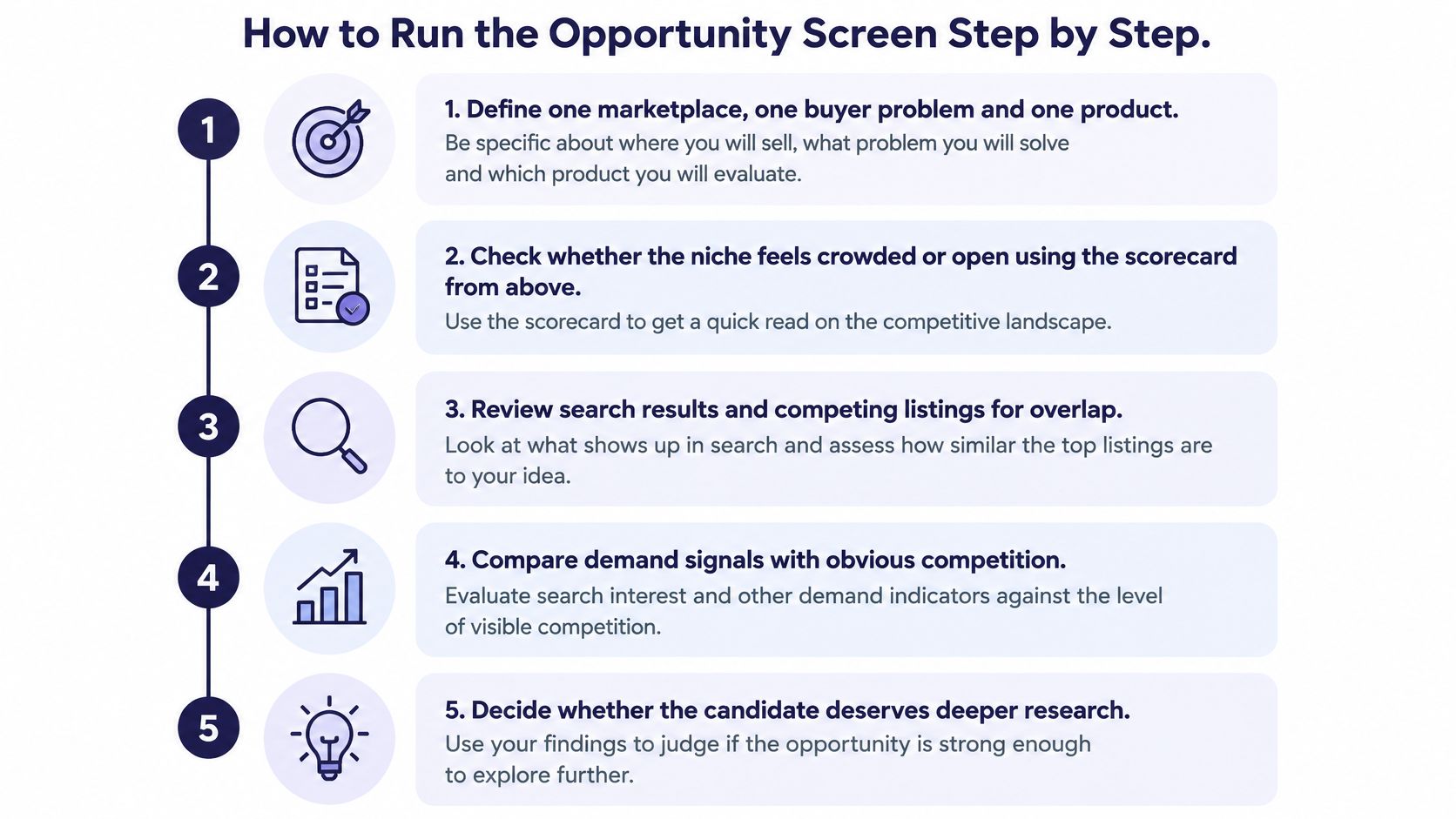
Start with a candidate you can describe precisely enough that another seller could repeat your comparison. Brevlin's marketplace product-research framework combines demand, competition, economics and execution, including the scorecard's review and entrant benchmarks and a contribution margin above 25% with advertising assumed at 20% of revenue. Treat those as working thresholds, not guarantees.
Use this visual overview to keep the initial screening sequence straightforward.
Define and collect
Fix the comparison. Choose one marketplace, buyer problem and product specification. For example, investigate an adult gardening gift T-shirt on Amazon US, not gardening merchandise everywhere. The common mistake is switching between shirts, mugs and bundles while treating them as interchangeable evidence.
Build a comparable listing sheet. Record price, pack size, delivery promise, review count, rating, listing quality and estimated sales over the same observation period. Label each value observed or estimated. A tool's sales estimate shouldn't acquire the authority of an actual order report because you've copied it into a spreadsheet.
Use a consistent keyword cluster rather than whichever phrase produces the most encouraging result. The Amazon keyword-search guide can help structure that work. Keep adjacent phrases separate until you've established that they represent the same buying intent.
Validate and differentiate
Inspect the annual demand pattern. Compare ordinary trading periods with gifting and event peaks. If historical evidence is unavailable, write unresolved rather than inferring stability from current sales.
Apply the competition scorecard. Sample the organic results, excluding sponsored placements from your organic comparison. Calculate the review percentile using a spreadsheet percentile function, and investigate entrant recency with available launch information. Record your definition of newer so you apply it consistently.
Extract deliverable improvements. Mine negative reviews for specific problems rather than collecting complaints indiscriminately. For a POD shirt, clearer artwork at thumbnail size and a better-positioned print might be actionable. Don't promise improved fabric or shipping if your fulfillment arrangement doesn't let you control either.
A walkthrough can complement the worksheet, but keep your own observations and assumptions visible.
Clear the risks and choose a verdict
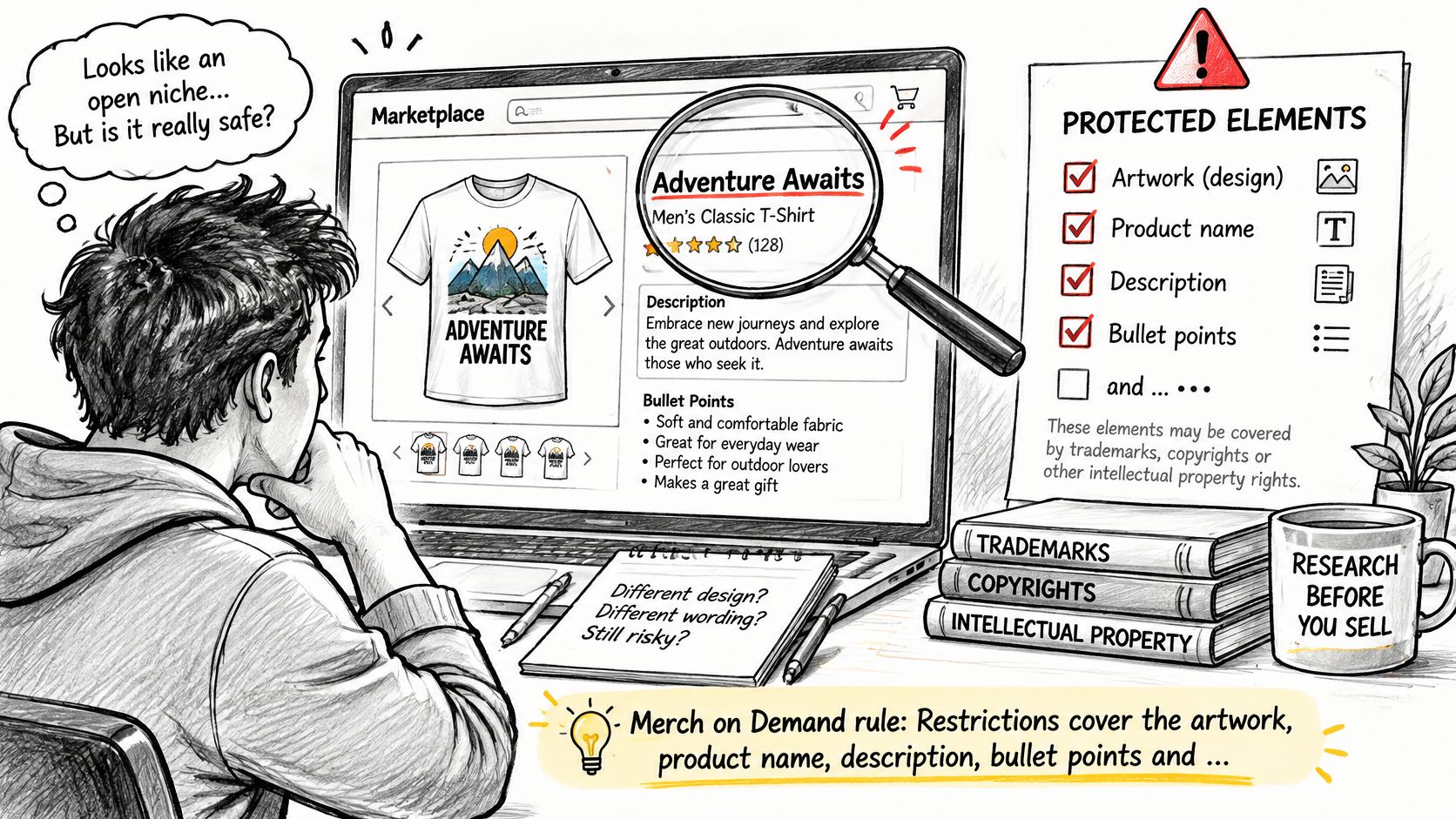
Complete wording and policy checks before designing. Include the intended title, brand wording and listing copy in the review. Checking only the illustration leaves a substantial gap.
Model the actual selling arrangement. For a standard seller listing, include production, fulfillment, referral fees, refunds and advertising. For Merch on Demand, start with the applicable royalty economics rather than subtracting standard seller costs again. Don't mix the models.
Finish with go, pause or drop, plus a sentence explaining the decision. Go means the candidate deserves a controlled test, not immediate expansion. Pause means a material question remains unanswered; drop means the available evidence doesn't justify more work.
Date every observation and retain its source. That lets you rerun the comparison later without confusing changed market conditions with changed assumptions.
Trademark and Policy Checks Before You Design
A phrase can look commercially open because sellers can't safely use it. Amazon Merch on Demand's intellectual-property guidance covers artwork, product names, descriptions, bullet points and selected brand names, and says creators should generally submit content they own or have permission to use. Rejections, removals and account consequences are possible when sellers violate those rules.
Successful POD sellers research niches before they design, check trademarks before they upload, and focus on one marketplace before expanding. I would follow that order rather than finish artwork and then look for reasons to approve it.
Keep the intended wording visible while checking the concept.
Search for confusion, not just identical wording
The USPTO's trademark guidance describes its free search system as covering federally registered marks and prior pending applications, with searches intended to identify potential likelihood-of-confusion problems. An identical-word search alone isn't enough.
Search the exact phrase, singular and plural forms, spelling variants, sound-alike terms and related wording. Read the associated goods and services, then inspect ownership and status. The trademark-search-by-owner guide is useful when related marks appear under the same owner.
Keep a dated record of searches and results. A clean initial search isn't clearance, because unregistered rights and other intellectual-property claims can still matter.
Give platform policy its own pass
Amazon's content policies allow removal without notice and suspension or termination of creator privileges for violations. They also restrict misleading claims, infringing content and content exploiting tragedies, among other categories.
Check references to public figures, organizations, events and products rather than assuming familiar cultural material is free to commercialize. A phrase can pass a preliminary trademark screen and still fail another policy or rights check.
Use this copyable decision list:
- Ownership confirmed: Original artwork or documented permission covers the intended commercial use.
- Wording reviewed: The graphic, title, brand name and listing copy have been checked.
- Similar marks assessed: Relevant goods, ownership and possible confusion have been considered.
- Policy reviewed: The concept complies with current content restrictions.
- Uncertainty resolved: A material flag has been cleared appropriately or the phrase has been dropped.
I would drop an unresolved flagged phrase rather than alter its spelling into a lookalike. A small visual change isn't a dependable way to resolve a rights problem.
Tools and Automation That Speed Up Research
Research sources and what each one is best for
| Source | Refresh | What It Shows | Best Use |
|---|---|---|---|
| Amazon Movers & Shakers | Hourly | Sales-rank gains over the previous 24 hours | Spotting momentum, not long-term selection |
| Amazon search results | Live | First 30 organic listings for the exact phrase | Measuring review depth and newer entrants |
| USPTO trademark search | On demand | Registered marks and prior pending applications | Legal screening before artwork and listings |
| Trendlytic niche reports | Trending niches refreshed hourly | Top-selling designs and phrase competition on TeePublic, Amazon, Redbubble and Etsy | Shortlisting print-on-demand niches to test |
Assign each tool a job rather than collecting overlapping dashboards. Amazon search supplies the competitive sample, a trend view helps establish timing, and the trademark database supports a separate rights review.
A shared worksheet makes those inputs easier to compare.
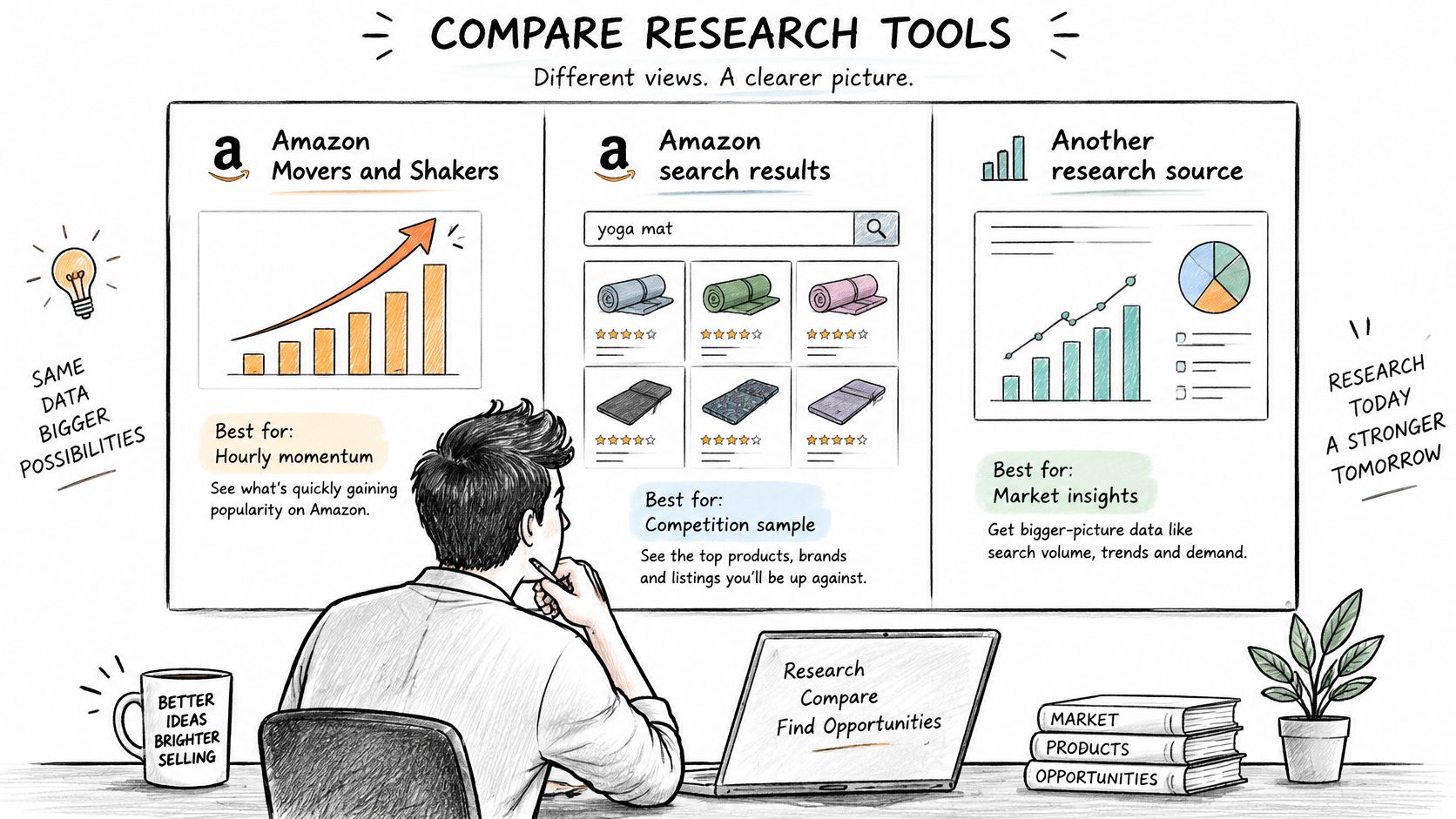
Use cross-marketplace tools for discovery
Trendlytic is a POD niche research tool covering TeePublic, Amazon Merch, Redbubble and Etsy, with a built-in USPTO trademark check. It analyzes top-selling designs to identify high-demand, low-competition niches; Keyword Research shows how many designs compete for each phrase on each marketplace. Trending niches refresh every hour, and each marketplace column shows its last update.
That makes it useful for comparing audience language and spotting design angles worth investigating. The trademark check remains an initial screen, not a legal opinion, and an apparent opening still needs manual review.
Its focus is print-on-demand listings. Researching baby wipes, appliances or other Amazon categories outside Merch requires Amazon-specific product and category evidence, not an apparel niche score.
Automate the recordkeeping
A spreadsheet is enough to make the routine repeatable. Keep separate fields for:
- Candidate identity: Marketplace, exact phrase, audience and product specification.
- Benchmark inputs: Review percentile, entrant share, contribution margin, referral-fee assumption and conversion scenarios.
- Evidence quality: Observation date, source and observed-versus-estimated status.
- Decision notes: Differentiation, unresolved risks and go, pause or drop verdict.
Use formulas for percentile calculations and margin arithmetic. Conditional formatting can flag incomplete inputs, but it shouldn't turn missing evidence into a favorable score.
Automate collection and calculation. Keep interpretation and approval with the seller.
Cross-marketplace demand is a discovery clue, not permission to transfer sales assumptions between platforms. A phrase that works as an Etsy personalized gift may need a different offer on Amazon Merch.
Save dated snapshots rather than overwriting the same row. When you revisit a candidate, you'll be able to distinguish a genuine change in buyer activity from a different search phrase, sample or estimate.
Decide Whether a Niche Earns a Small Test
I would launch a small test only when the conservative scenario remains profitable after advertising and the product has a credible route to qualified traffic.
Sellerite's marketplace benchmark reporting places average Amazon conversion around 9% to 15% in particular datasets. Those averages aren't forecasts for your category, price, traffic source or listing maturity.
Calculate the downside before the upside
Consider a hypothetical product with 2,000 qualified monthly visits, $18 contribution per order before launch advertising, and a $600 monthly advertising budget. These are illustrative assumptions, not market benchmarks, and the contribution amount already accounts for the applicable production, selling, fulfillment and expected refund costs.
Worked example: monthly outcome by conversion scenario
| Scenario | Conversion |
|---|---|
| Conservative | 6% |
| Base | 9% |
| Optimistic | 12% |
Under those assumptions, the conservative case produces 120 orders, generating $2,160 before advertising and $1,560 after advertising. The base case produces 180 orders, generating $3,240 before advertising and $2,640 after advertising. The optimistic case produces 240 orders, generating $4,320 before advertising and $3,720 after advertising.
Subtract any additional launch promotions or costs that aren't already included. These figures represent modeled contribution, not take-home income or guaranteed profit.
The most questionable input may be traffic, not conversion. Explain how you'll obtain those qualified visits within the advertising budget, and separate paid traffic from organic traffic so you don't assume free visibility.
Check whether the model describes a reachable buyer
Compare the required visibility with competitors' review strength, brand recognition and listing quality. Don't assume a new listing will convert like an established product, or budget around rapid review accumulation.
For an audience-led example, Caddie Uniform's golf caddie costume inspiration can help you frame a concrete use case rather than a broad golf-apparel category. Treat that as inspiration for a candidate, not proof of Amazon demand or permission to reproduce another brand's work.
Test boundary: Set the spend limit and the evidence needed to continue before the listing goes live.
A research platform can shorten the first pass, but the final call stays with the seller. If the conservative case fails, revise a defensible input, keep researching or drop the niche. Don't rescue it by quietly replacing cautious assumptions with optimistic ones.
Build the scenario table this week for a candidate you can define precisely. Put the traffic rationale, costs and stop conditions beside the calculations.
Trendlytic brings top-selling POD designs, demand and competition signals, and a built-in USPTO trademark screen into one research workflow. Visit Trendlytic to shortlist a niche, then run it through your own cost model and conservative test before investing in a design family.