High Search Low Competition Niches: How to Score Them
The most popular advice on high search low competition niches is also the most misleading. It usually tells you to find a phrase with a big search count and a small result count, then publish.
I don't treat that as a verdict anymore. A big count can come from people looking for an answer, not a shirt. A small result count can mean nobody wants the product, or that the phrase is owned by someone else.
What works better is slower. I score product-intent demand, count near-identical rivals, check whether the buyer is specific enough to write a clear listing for, and screen for trademark risk before any design work. That order saves time. It also stops you from mistaking an interesting keyword for a sellable niche.
Table of Contents
- What High Search Low Competition Niches Actually Mean
- Where to Find Candidate Niches on Each Marketplace
- Scorecard for Demand and Competition Signals
- Telling Product Intent Apart From Informational Search
- Trademark Screening Before Any Design Work
- Worked Example From Candidate Phrase to Verdict
- Confirm the Niche Before You Publish
What High Search Low Competition Niches Actually Mean
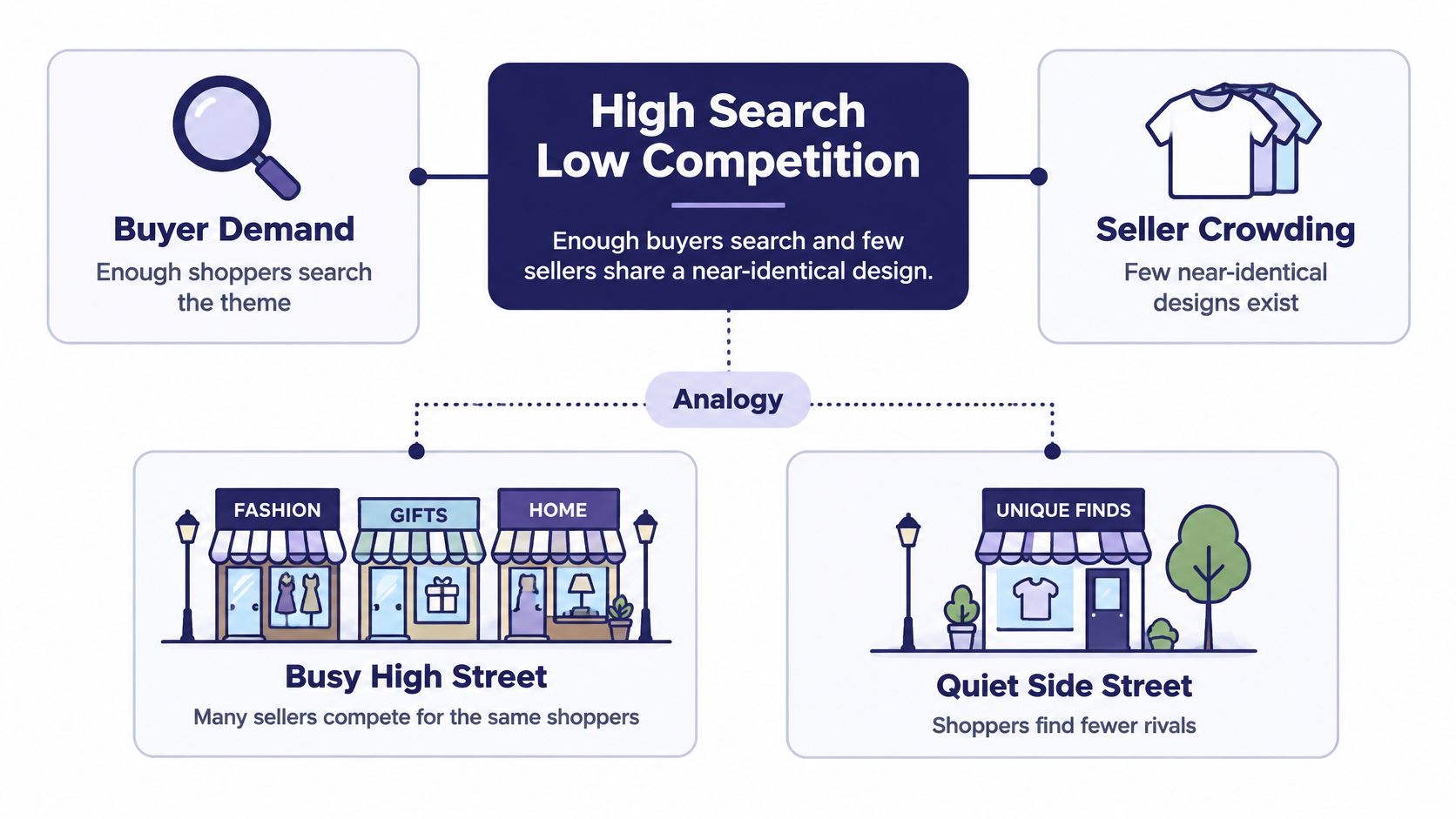
Think of a busy high street and a quiet side street. On the high street, plenty of shoppers walk past, but twenty shops sell almost the same thing. On the side street, fewer people pass, yet the one shop that matches what they came for gets noticed.
A high search low competition niche is closer to that side street. Enough buyers search for the theme, and few sellers offer a near-identical design for the same buyer.
The unit is the phrase and the buyer
The same broad theme can be crowded in one wording and workable in another. "Teacher shirt" tells you almost nothing about who will buy it or why. "Retired teacher summer tee" names a buyer, a moment, and a garment. That's a different competitive set, even though both sit under teaching.
High search only counts when the search points toward a product someone would buy. Low competition only counts when the closest listings don't already serve that same buyer with the same joke, wording, or visual idea.
| Demand level | Competition level | What it usually means | Typical POD response |
|---|---|---|---|
| High demand | Low competition | Sought-after theme with few close rivals; the target case | Test a small set of distinct variants |
| High demand | High competition | Proven theme on a crowded shelf; hard for new shops to stand out | Enter only with a clearly different angle |
| Low demand | Low competition | Few buyers and few sellers; often a very small or fading niche | Skip unless the audience is clearly loyal |
| Low demand | High competition | Usually a fading trend with leftover listings | Avoid |
The first row is the target, but I'd treat it as a hypothesis, not a finding. You still need to confirm that buyers are purchasing, that the leaders aren't entrenched, and that you can say something distinct.
A niche label doesn't promise zero competitors, guaranteed sales, or that a keyword tool's volume figure reflects purchases.
That limit matters. The phrase describes a starting position worth testing. It doesn't remove the need for a good design, a clear listing, or a price buyers accept. The rest of my process is how I check whether a candidate really belongs in that first box.
Where to Find Candidate Niches on Each Marketplace
I start with stores, not random search results. A seller's top designs tell you more than a long list of listings that may never have sold.
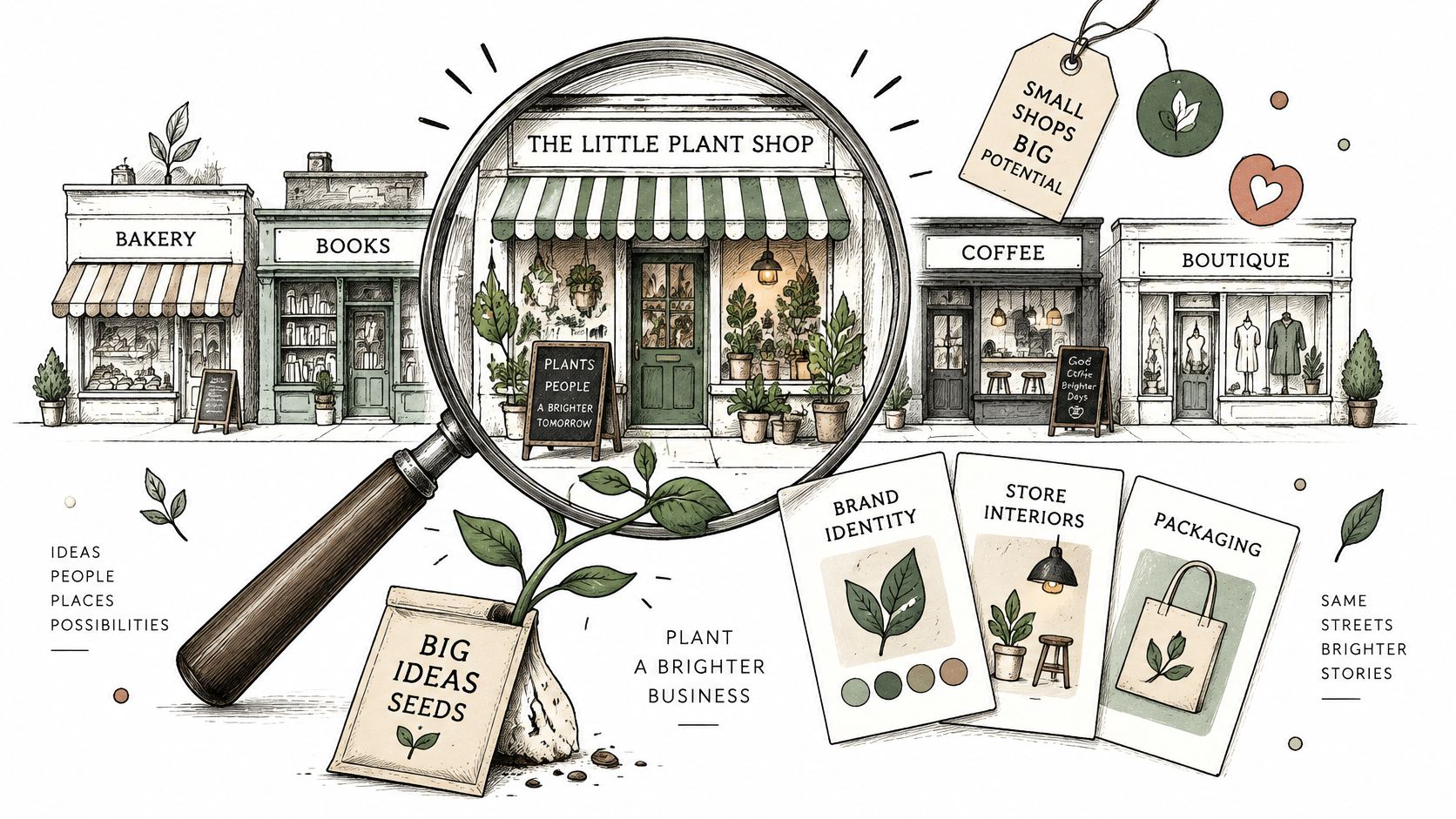
Here's a visual prompt for that store-first mindset, looking closely at one small shop rather than scanning the whole street.
A store-first routine you can repeat
- Pick a seed theme. Start with a profession, hobby, family role, or occasion you understand well enough to judge.
- List the top sellers. Find who ranks for that theme on each marketplace.
- Pull their top three designs. Record the exact phrase, title, tags, and price for each one.
- Compare across marketplaces. Run the same phrase on Etsy, Amazon Merch, Redbubble, and TeePublic.
- Score each phrase. Don't carry a candidate forward on gut feel alone.
That manual route teaches you the pattern. It also helps when you use a research tool later, because you'll know what its score is really summarising. If you're working mainly on Amazon, a focused Amazon keyword search workflow can keep that comparison tidy.
| Marketplace | Where demand shows | Competition read | Watch for |
|---|---|---|---|
| Etsy | Search suggestions, top listings and shop bestseller sections | Listing count and conversion quality of the leaders | Shop signals such as reviews and response rate favour established shops |
| Amazon Merch | Bestseller and new-release pages for apparel | Number of near-identical designs on the results pages | Large brand phrases can carry legal exposure |
| Redbubble | Search results and artist pages showing top designs | Designs per phrase across artist pages | Artist pages show a seller's best work, not a full sales history |
| TeePublic | Browse and search results for tees | Count of close variants on the first page | Compare the same phrase across marketplaces before committing |
Etsy deserves extra caution. As Etsy's guide to how Etsy search works explains, ranking weighs title and tag relevance, listing quality, customer and marketplace experience, recency, shop location, and shop diversity. Purchases after views also signal buyer interest and can improve placement.
So a phrase can attract searches and still be hard for a new shop to win. Established sellers may convert better and carry stronger review and response signals from recent months.
The walkthrough below shows the same kind of close inspection in practice.
Scorecard for Demand and Competition Signals
I don't score a niche on keyword volume alone. I use four rows, each from 1 to 5, and I set the pass line before I start.
My rule is simple. A phrase needs at least 3 on each row to move on, and any row scored 1 holds it back until that gap is closed. I write that threshold in the sheet header so I don't move it later for a phrase I happen to like without anyone noticing.
| Dimension | Stronger signal | Weaker signal | How to check |
|---|---|---|---|
| Sales recurrence | Same theme in bestseller lists across several weeks | Theme appears once during a recent spike | Record bestseller appearances on each marketplace over 3-4 weeks |
| Competing designs | Few near-identical designs in the top results | Dozens of close variants on the first page | Count designs in the top 20 results with the same audience and wording |
| Listing specificity | Titles and tags name a buyer, occasion or garment | Generic wording such as 'funny shirt' | Read the titles and tags of the top listings |
| Commercial completeness | Price range, product types and full tags are visible | Thin listings with missing tags | Compare price range and product types across top sellers |
What each row is really asking
Sales recurrence asks whether demand repeats. One spike can be news, a holiday, or a single viral post. A theme that keeps showing up over several weeks is easier to trust.
Competing designs asks how close the rivals are, not how many listings exist in total. Count only the top 20 results with the same audience and wording. Fifty unrelated teacher shirts don't block a retired teacher gift in the same way fifteen near-copies do.
Listing specificity is where many candidates fail. "Funny shirt" gives you nothing to write, tag, or photograph differently. A gift for a named profession, tied to retirement, graduation, or a first day at work, gives you a buyer and a reason.
Commercial completeness checks whether the market looks like a real product category. Visible price ranges, several product types, and full tags suggest sellers are merchandising it properly. Thin listings may mean weak demand, or just careless sellers, so I read this row alongside recurrence.
There's a search logic behind specificity too. Google's product structured data guidance shows that precise attributes such as price, availability, ratings, and shipping can be exposed in Search and help Google verify product information. Clearer attributes make a product easier to interpret. A vague phrase can't support that clarity.
Practical rule: Keep one row per phrase, with the four scores and the date checked, so you can compare decisions over time instead of relying on memory.
If you want the competition count handled more systematically, this overview of competition scoring for POD phrases covers that one row in more depth.
Telling Product Intent Apart From Informational Search
A search box works like a shop window. Plenty of people stop, read the sign, and walk on. Search volume counts the people who stopped. It doesn't count who came inside.
I split queries into three types before I trust any volume figure.
- Informational. "How to care for screen-printed shirts" usually ends with an answer, not a purchase.
- Product intent. "Personalized nurse graduation tee" points to a specific thing to buy, for a specific person.
- Mixed. "Dog grandma shirt ideas" starts with inspiration. Some of those searchers will buy, many are just browsing.
Four checks and one quick test
For product intent, I look for recent bestseller movement, review activity where the marketplace shows it, price points that match the rest of the category, and the same phrase selling as a product on more than one marketplace. One signal on its own is weak. Several together are harder to fake.
Then I run a five-minute test. Search the phrase and look at what ranks. If the top results are guides, blog posts, and listicles rather than product pages, I treat the volume as informational and discount it heavily.
Recent search behaviour supports that caution. The Semrush search trends summary reports that only 40.3% of U.S. Google searches produced an organic click in March 2025, down from 44.2% a year earlier, while AI Overviews appeared on 13.14% of searches, up from 6.49% in January 2025.
A query answered on the results page can draw searches without drawing sales. That's the trap in chasing big numbers.
A smaller phrase with recurring product sales is usually a better bet than a large count built on answer-type results.
Trademark Screening Before Any Design Work
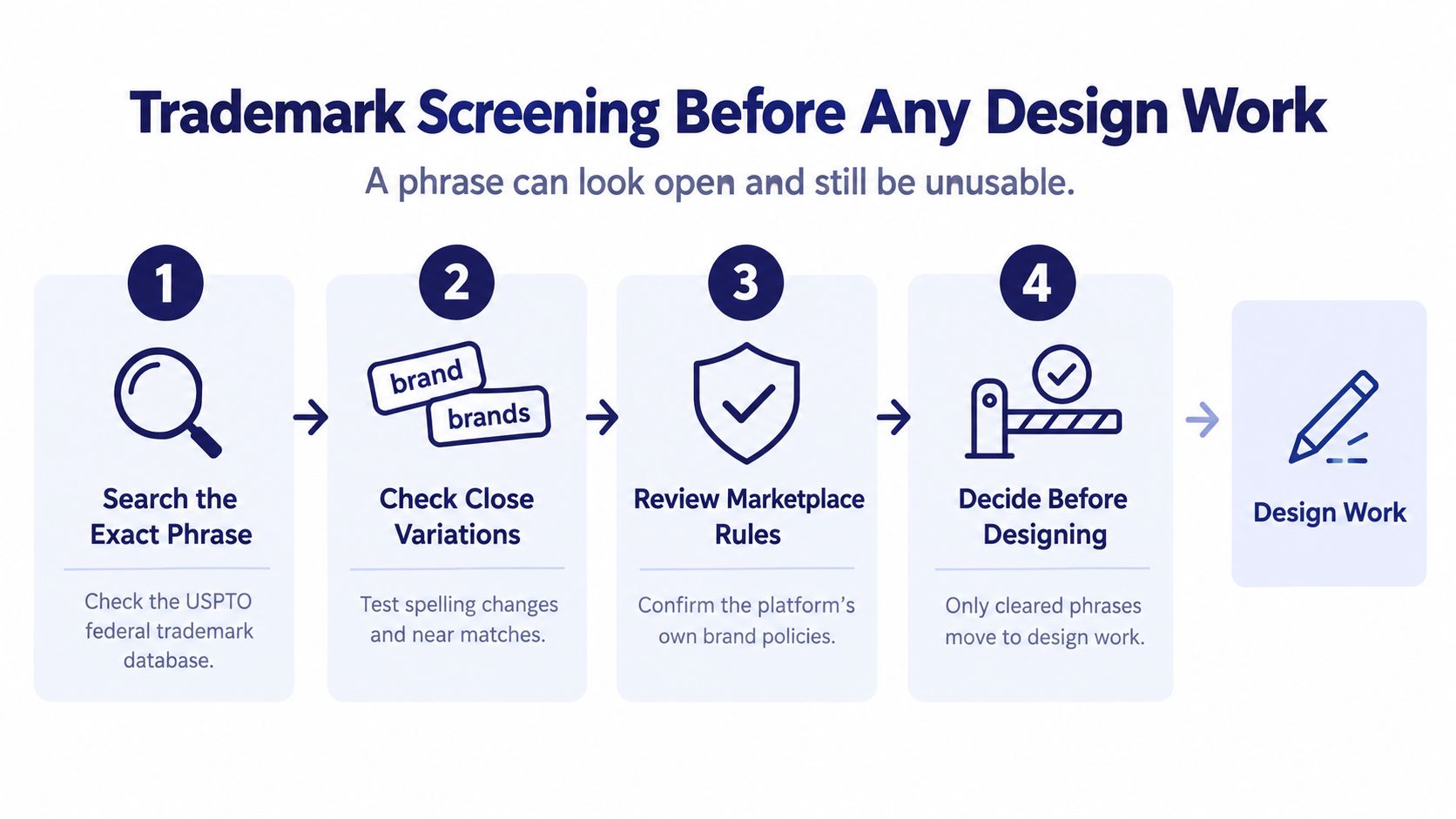
A phrase can look open and still be unusable. Sometimes competition is low because other sellers already learned that the hard way.
That's why I screen before design work, not after. A listing removal costs you the design time, the listing work, and sometimes standing with the marketplace. Checking first costs minutes.
Seven steps in order
- Search the exact phrase in the USPTO federal trademark search.
- Repeat for close versions. Try plural and singular forms, spelling variants, abbreviations, and sound-alike versions.
- Read the goods and services. For each live match, note whether apparel or merchandise is included.
- Separate live from dead records. Note the owner and status for live applications and registrations.
- Judge similarity broadly. Consider look, sound, meaning, and overall commercial impression, not exact wording alone.
- Record the outcome in your scorecard. Drop the phrase when a live, related mark is close. Don't swap one letter and hope.
- Note the market. A U.S. check doesn't settle other countries.
That fifth step is the one people skip. As the USPTO federal trademark searching guidance sets out, potentially conflicting marks are assessed for similarity in appearance, sound, meaning, or overall commercial impression, and confusion risk rises when the goods or services are related. Searching federally applied-for and registered marks is part of that clearance work.
So "no exact match" isn't the same as clear. A sound-alike phrase on apparel can still be a problem, and related merchandise counts even when it isn't the identical product you'd sell.
I record a risk penalty in the sheet when a live mark looks close and related. If the penalty is serious, the phrase is out, whatever its demand score says. This pairs well with the habit of checking how to find top-selling items on Amazon through sellers rather than slogans, since brand-led demand is where exposure hides.
One limit, stated plainly. This is a screen, not a legal opinion. For a high-value brand decision, professional legal review is worth paying for.
Worked Example From Candidate Phrase to Verdict
The four candidates below are illustrative, not measured data. I'm using them to show how the screens combine, because the order matters more than any single score.
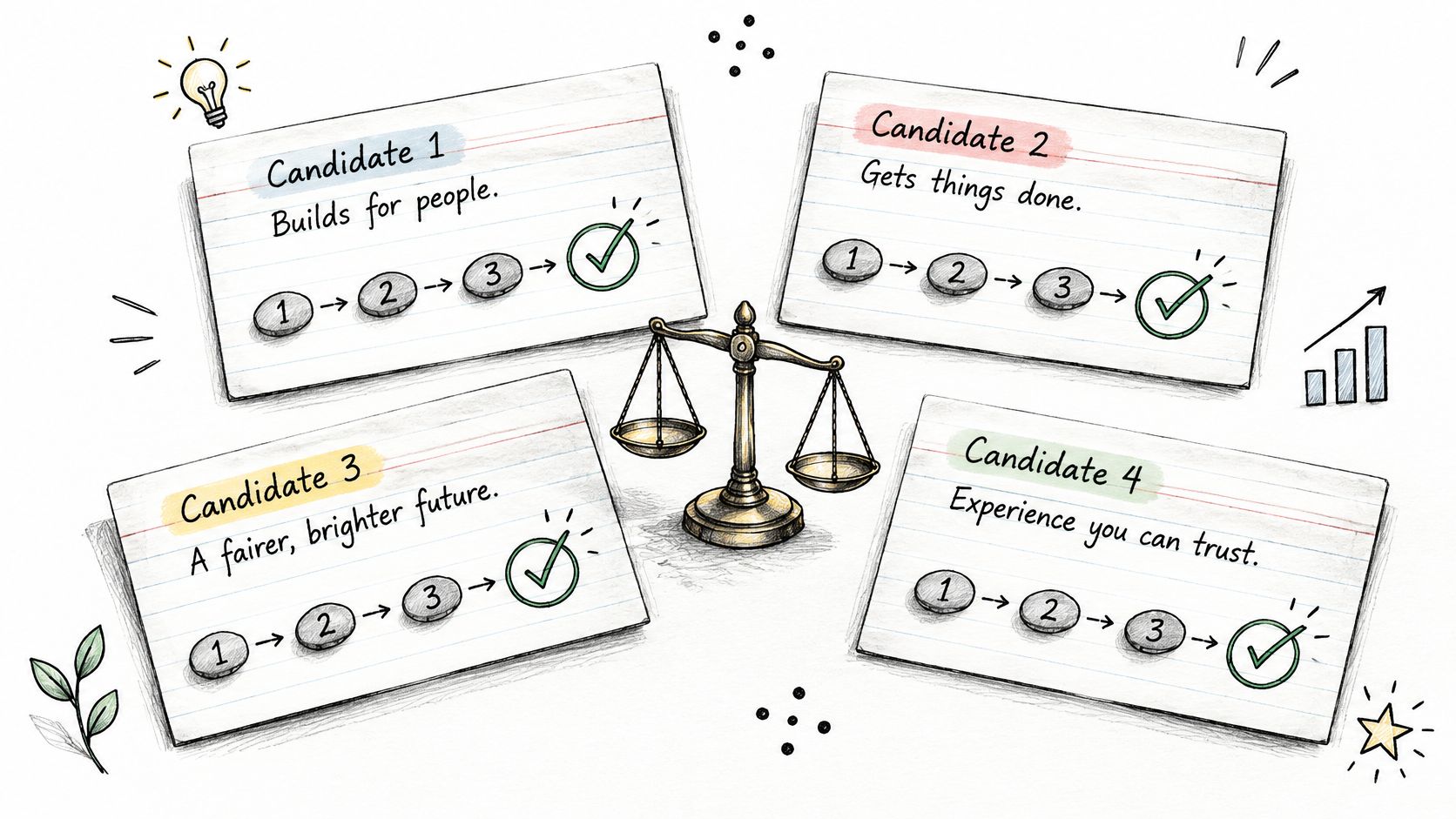
The order of work
- Start with a candidate phrase. Write it exactly as a buyer would search it.
- Score the four dimensions against your pass line.
- Run the intent check on the search results.
- Run the trademark screen.
- Assign a verdict and date it.
| Candidate phrase | Demand evidence | Competition evidence | Trademark screen | Verdict |
|---|---|---|---|---|
| Retired teacher summer tee | Recurring bestseller entries over three weeks on two marketplaces | Six close variants, mostly generic, in the top 20 | No live marks found in the clear check | Pursue with a distinct visual angle |
| Nurse night shift coffee | Product-intent results and repeated sales spikes | Dozens of near-identical designs in the top 20 | Clean | Skip unless the angle is unusual |
| Bass fishing grandpa | Mostly guides and blog posts; little bestseller movement | Three close variants | No live marks found in the clear check | Hold until product intent is clearer |
| Brand-name sports slogan | Strong search and sales interest | Few designs | Live registration covering apparel | Drop despite low competition |
Notice what changes the outcome. The nurse phrase has real demand, but the shelf is full of near-copies, so a new design needs an unusual angle to justify the effort. The fishing phrase looks open, yet the search results suggest people want reading material, not a shirt.
The sports slogan is the clearest lesson. Few competing designs don't outweigh a live apparel registration. Low competition caused by legal ownership isn't an opening.
A verdict is a starting point, not a result. "Pursue" means the phrase earned a small test. It doesn't mean the test will sell.
Confirm the Niche Before You Publish
My decision rule is strict, and it's meant to be. Publish only when the demand, product-intent, competition, and trademark screens are all positive, with a dated note for each one.
If one screen is negative, I don't average it away with strong scores elsewhere. A great demand score doesn't fix a live trademark, and a clean trademark screen doesn't create buyers. Each screen answers a different question.
After a phrase passes
- Launch a small set. Three to five variants, not a full catalogue. Change the visual angle or wording, keep the buyer intent.
- Track for four to six weeks. Use the views and sales each platform exposes, and compare them with what your scorecard predicted.
- Recheck trademark status before expanding. Registrations change, and a phrase that was clear at launch may not stay clear.
- Update the four scores with what the launch showed.
- Pause or drop phrases whose evidence weakens. Keeping weak listings alive out of attachment wastes the time you'd spend on stronger candidates.
Short paragraphs in your sheet help here. Write what you expected, what happened, and what you'll change. Two sentences per phrase is enough, as long as you write them at the time.
The scorecard isn't paperwork. It's how you stop repeating the same expensive guess with a new phrase each month.
The manual method in this article works without any tool, and I'd recommend learning it that way first. Once your sheet grows to dozens of phrases, the pulling and counting gets slow. At that point Trendlytic is one option. It's a POD niche research tool covering TeePublic, Amazon Merch, Redbubble, and Etsy, combining live bestseller data, demand and competition levels, an Opportunity Score, and a built-in USPTO trademark check in one report. It saves time on the collection work. It doesn't replace the judgement about whether your angle is genuinely different.
That judgement is the part no score can do for you. Scores narrow the field. Your design, listing, and price still have to earn the click.
If you'd like the collection work done faster, Trendlytic pulls bestseller data across TeePublic, Amazon Merch, Redbubble, and Etsy and returns demand, competition, and trademark checks in one report. Use it to build your shortlist, then apply the scorecard and intent checks above before you publish anything.