How to Find Top Selling Items on Amazon for Merch Sellers
You've found a shirt sitting at #1 in its Amazon category, and you're already thinking about a design for the same audience. Before opening your design software, check what that position really represents. A bestseller can reveal a buying audience, but it doesn't tell you whether there's room for another seller.
My approach to how to find top selling items on Amazon starts with a hypothesis, not a design: this theme might have repeatable demand. The work is checking that hypothesis before spending time on artwork, keywords, and uploads.
Table of Contents
- Reading Top-Seller Signals and Rank Over Time
- How to Pull a Bestseller Shortlist Step by Step
- Separating Real Demand From Leaderboard Noise
- Spotting Demand Before It Reaches the Bestseller Lists
- Confirm the Trademark Before You Upload
Reading Top-Seller Signals and Rank Over Time
Amazon's Best Sellers Rank, or BSR, is the most useful free starting point. Read it within the relevant category and marketplace, then track it over time. A screenshot of a strong rank gives you a candidate to investigate, not a finished product decision.
According to Amazon's explanation of Best Sellers Rank, BSR uses sales volume rather than page views or customer reviews, incorporates recent and historical sales, weights recent sales more heavily, and updates frequently. That makes it more useful for checking purchase activity than judging a shirt by its review total or polished mockup.
Read the category before the number
A low BSR signals sales activity within a category. It doesn't establish better product quality, and it isn't an Amazon-wide score you can compare across unrelated products.
The ranking is relative. A listing can lose position while its sales remain unchanged because competing products sell more. Marketplace matters too: don't use a strong position in one country as evidence that the same audience exists in another.
There's also no universal conversion from rank to units sold. If you use a category-specific sales estimator, I would treat its output as a directional comparison over time, not a monthly forecast or a basis for projecting royalties.
Practical rule: A strong rank earns a product a place in your research log. It doesn't earn a place in your upload queue.
Amazon signals and what each one can and cannot tell you
Use the signals together. The Best Sellers page helps you find candidates; the individual listing helps you understand what you're really comparing.
| Signal | Where to find it | What it tells you | What it cannot tell you |
|---|---|---|---|
| Best Sellers Rank (BSR) | Product details section | Relative sales activity within one category | Exact units sold or profit |
| Category Best Sellers page | Amazon Best Sellers, by category | Which items lead a category at a given moment, across its top 100 | Whether leaders stay on top for weeks |
| Movers and Shakers | Amazon's rank-gain lists | Items with the largest rank gains over 24 hours | Whether the gain will last past a promotion or event |
| Review count | Product page | Accumulated customer feedback over time | Current sales pace, since reviews lag orders |
| Price | Product page | The advertised price band around active listings | Whether a promotion or discount is distorting the rank |
| Parent vs child ASIN | Variation selector and product details | Clues about whether sales roll up to the parent listing | Which size, colour, or design is actually driving the rank |
Price needs context. A shirt offered at an unusually low price might attract buyers you couldn't serve profitably at your intended royalty. Record the displayed price, but don't assume it represents the listing's normal selling conditions.
Reviews need similar restraint. Read them for audience language, gift occasions, and complaints about readability or fit. Don't treat accumulated feedback as a substitute for current order activity.
The variation selector deserves a deliberate check. Switching colours or sizes can change the product identifier without giving you a clean view of individual variation performance. If the relationship is unclear, mark it as unresolved rather than attributing the parent listing's apparent strength to the design you happen to see.
Keep a log you'll actually maintain
Use a simple tracking log with date, time, BSR, price, and review count as its five columns, recorded at the same time of day. Keep the ASIN, marketplace, and category in the sheet header so you don't accidentally compare different ranking contexts.
When the numerical BSR rises, meaning the position worsens, check the surrounding listings before interpreting it as falling demand. Your log records position, not the product's private order history.
For a consistent comparison process, use a competitor benchmarking workflow that keeps category, pricing, design positioning, and listing quality separate. Otherwise, it's easy to favour whichever shirt has the most appealing artwork.
Treat rank as evidence of sales activity inside one category, and treat everything else as supporting evidence to check.
How to Pull a Bestseller Shortlist Step by Step
Start with a manageable sample, not an enormous spreadsheet. I would rather examine a small group carefully than collect hundreds of listings without returning to them.
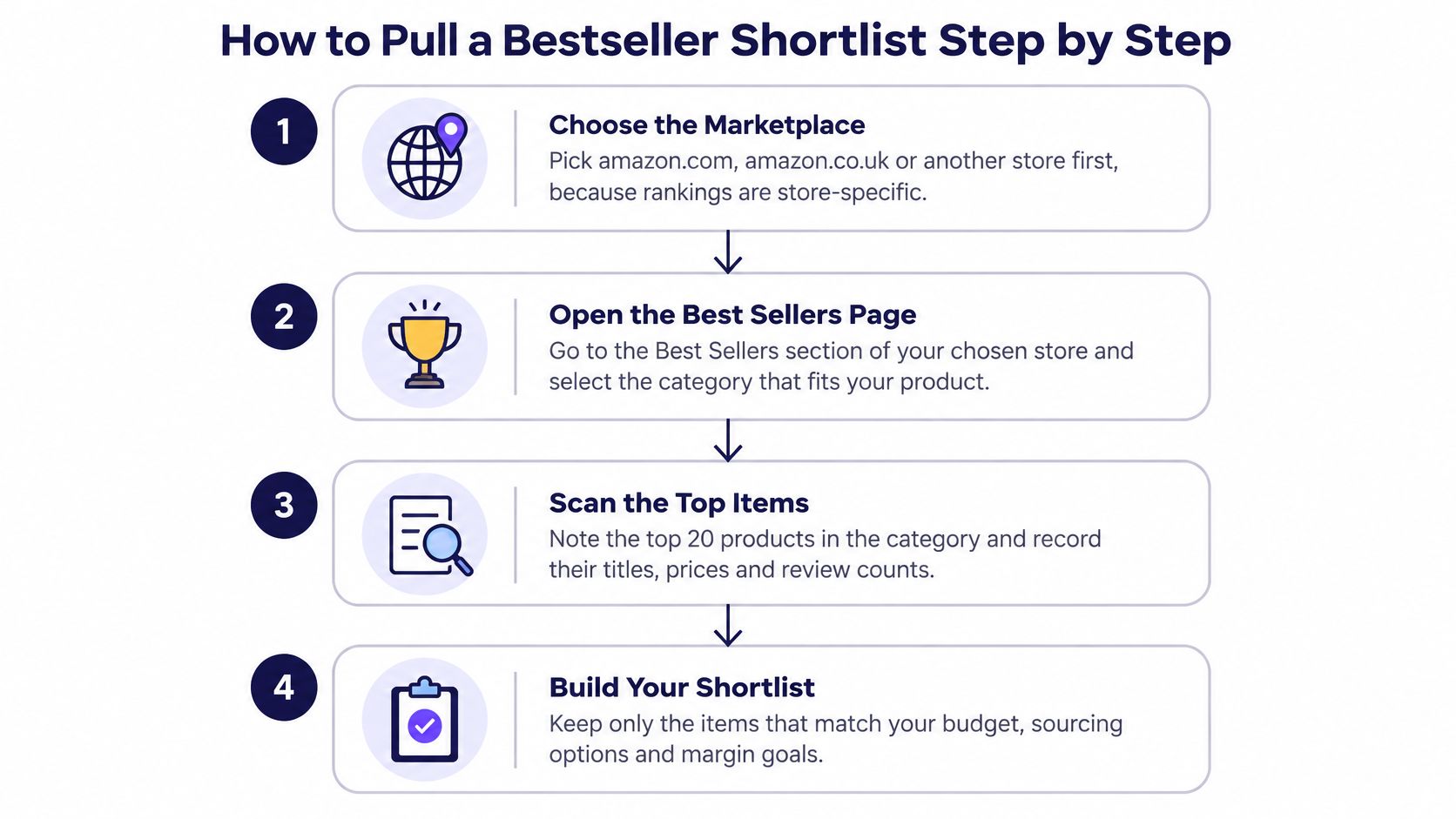
This overview gives you the basic collection sequence.
Collect comparable listings
Choose the marketplace first. Select amazon.com, amazon.co.uk, or the store where you intend to sell, because rankings are store-specific. Keep separate sheets for different stores rather than combining their results.
Open Best Sellers, then move through Clothing, Shoes and Jewelry to the T-shirt or sweatshirt subcategory closest to your intended product. Merch apparel belongs in apparel comparisons, not a mixed list of unrelated popular products.
Record the top 20 items as your working sample. Capture BSR, category path, price, fulfillment method, review count, rating, number of variations, and visible stock status. Add the title and ASIN so you can return to the exact listing rather than relying on a search result.
Flag anything with unclear parent and child ASIN behaviour. Amazon's sales-rank guidance explains why variation-level interpretation matters; rechecking daily for 7 to 14 days is a useful observation window rather than relying on a snapshot. Leave uncertain listings marked for investigation instead of treating every variation as independent evidence.
Group the survivors by theme, not product. Camping humour, birdwatching gifts, and trail-running identity are more useful research groups than individual shirt titles. Several near-identical jokes should count as a cluster, not separate reasons to enter the niche.
Keep 10 to 15 candidate themes as a practical workload limit, then schedule the daily rechecks. Remove obvious brand-led products, themes you can't differentiate, and listings whose product structure you still can't interpret.
Turn observations into a decision
Say you're browsing an outdoor-hobby subcategory and notice three camping-themed shirts holding positions in the top 30 throughout a week. A fourth appears for a single day and disappears. In this hypothetical example, the repeated camping presence deserves more investigation than the isolated appearance.
That still doesn't mean copying camping jokes. Examine whether the persistent listings address different buyers, such as family campers, solo backpackers, or campsite cooks, and whether their artwork offers room for a distinct approach.
For a video walkthrough of the browsing process, use this alongside your own listing checks.
Your finished shortlist should contain themes with evidence attached: the initial listing details, observations that support or weaken the idea, and scheduled recheck dates. Before designing, you should be able to explain which audience you're considering and what would make you reject the theme.
Separating Real Demand From Leaderboard Noise
The highest-ranked shirt must be the best opportunity. That's the assumption I would challenge first.
An established listing may benefit from historical momentum, promotional exposure, or a crowded audience where another similar design adds little. The MDS explanation of Amazon bestseller rank reinforces why a leaderboard position alone can't establish durable demand or profitability.
Run four cross-checks
- Review velocity: Count new reviews between weekly observations, rather than comparing lifetime totals. For a hypothetical listing dating to 2019, thousands of accumulated reviews tell you less about current interest than the recent change.
- Listing age: Compare a newer listing's sustained progress with an established listing's sudden jump. Use the available listing details, but don't assume a first-available date perfectly captures every variation's history.
- Saturation: Count strong, relevant designs addressing the same buyer. If your sample contains five similar top-100 designs, treat that as a crowding warning, not an automatic rejection or a universal threshold.
- Sub-niche fit: Search narrower audience combinations and check whether relevant products perform across related phrases. A birdwatching theme for retirement gifts needs evidence beyond a broad bird shirt.
Rank patterns, likely meanings and the next check
These are working interpretations, not diagnoses.
| Pattern | Likely meaning | Next check |
|---|---|---|
| Stable top 100 across 7 to 14 days | Possible repeatable demand in that category | Count strong designs competing for the same theme |
| One-day jump, then drop | Possible promotion, post, or event spike | Look for a holiday, news hook, or ad push |
| Rank slides while your own sales hold steady | Competitors may be selling more in the same window | Compare within the same category |
| Strong parent rank, uneven child sizes | Parent may aggregate variation sales | Investigate which variant contributes before drawing design conclusions |
| Steady improvement over several weeks | Possible building momentum | Check review growth and listing age |
Say an old novelty shirt has a huge review count, while a three-month-old hobby listing gains reviews each week. The newer listing merits attention, but only if its audience is accessible and you can offer something meaningfully different.
A structured competition-scoring approach helps separate crowded artwork from genuine buyer relevance.
I would require a theme to pass at least three of these four checks before treating it as an opportunity. That's a screening rule, not a promise of sales.
Spotting Demand Before It Reaches the Bestseller Lists
A 2024 survey of 1,000 U.S. online shoppers found that 56% began product searches on Amazon, compared with 42% on traditional search engines and 29% on Walmart.com, according to Practical Ecommerce's coverage of product discovery. Social platforms also shape discovery, so your research shouldn't begin and end with a bestseller page.
Amazon is a strong place to validate purchases already happening. It's less useful for being first to notice an emerging phrase, audience, or visual style.
Separate discovery from validation
External sources suggest what to investigate. Amazon helps you check whether shoppers are buying relevant products, while its search suggestions offer another starting point inside the marketplace.
Early discovery sources and how to validate them on Amazon
| Discovery source | What it shows early | How to validate on Amazon |
|---|---|---|
| Amazon search suggestions | Phrases surfaced as shoppers type into the search bar | Check the top items for that phrase and their BSR trend |
| Google Trends | Relative search interest over months | Confirm matching Amazon bestsellers exist and have stable ranks |
| Social platforms, including TikTok, Instagram, and Pinterest | Visual themes and phrases repeating across posts | Look for relevant listings with reviews growing over several weeks |
| Trendlytic Trending Now and Niche Discovery | Hourly rankings and related keywords across Merch by Amazon, TeePublic, Redbubble, and Etsy | Verify the theme's Amazon BSR, review growth, and competing designs by hand |
I would use those tools to shorten the discovery pass, not replace product-level checks. Repetition across platforms can reflect creators copying each other rather than buyers wanting a shirt.
For example, a recurring gardening illustration style might suggest an audience worth researching. Search the audience's buying language, not just the visual trend's name, and distinguish general enthusiasm from gift or apparel intent.
A phrase people share isn't automatically a phrase people want to wear.
Use an Amazon keyword-search workflow to test related audience terms rather than relying on a single phrase. If you're also working through production and storefront decisions, Cobra DTF's guide to build an online T-shirt business provides broader context beyond niche selection.
Keep discovery notes separate from validated candidates. That small distinction prevents an interesting social post from becoming an upload before you've checked the buyer, competition, and economics.
Confirm the Trademark Before You Upload
Demand and legal risk are separate checks. A phrase can appear on popular Amazon products without being safe for you to use. Existing listings aren't permission, and a clean exact-match search isn't a complete clearance decision.
The USPTO's Basic Facts About Trademarks guide recommends preliminary searching that includes direct or dead-on searches, expanded searches, and alternate spellings, covering both registered marks and pending applications. The USPTO doesn't search a proposed mark for an applicant before filing; the applicant conducts the preliminary search, while the agency searches during examination.
Use this as a separate checkpoint before artwork and uploads.
Keep clearance ahead of design work
- Shortlist themes that pass the demand checks. Don't spend clearance time on every passing idea.
- Search each intended phrase and its variants. Start with the exact wording, then broaden to similar wording, spelling, and potentially confusing alternatives.
- Drop themes with a close active mark from your working shortlist. If you want to pursue an ambiguous case, get qualified legal advice rather than guessing from registration status alone.
- Only then create original artwork and prepare the upload. Screen the title, brand wording, and keywords too, not just the text printed on the shirt.
Trendlytic includes a built-in USPTO trademark check covering more than 850K active trademarks, with ownership and expiry flags. It can speed preliminary screening, but it's a screening aid, not legal advice or a guarantee of clearance.
Pick one theme that survives both demand and trademark screening, then test a small set of original designs. Recheck the rank evidence and your own results before committing to a larger collection.
Trendlytic offers POD niche research across Amazon Merch, TeePublic, Redbubble, and Etsy, alongside keyword discovery and trademark screening. Visit Trendlytic if you'd like a faster way to assemble candidates, then use your Amazon tracking log to decide which ones deserve a small test.