Logistics Planning for Print-on-Demand Sellers
The most popular logistics advice for print-on-demand sellers is to ignore logistics until an order arrives. Since you don't keep shelves of finished products, the thinking goes, the printer and carrier handle everything. That assumption is expensive. You still choose production partners, route orders, absorb split shipments, explain delays, manage international documentation, and decide whether a refund or reprint is cheaper than a prolonged support exchange.
Logistics planning for a POD store isn't enterprise supply-chain software. It's a set of clear decisions that connect product selection, supplier location, production timing, shipping, customer promises, and returns. The strongest small operators don't eliminate every disruption. They make disruptions easier to detect, price, and handle before the buyer does.
Table of Contents
- Rethinking Logistics Planning for Print-on-Demand
- The True Cost of Moving Goods Globally
- Core Components of a POD Supply Chain
- Building a Stepwise Planning Framework
- Navigating International Customs and Documentation
- Measuring Performance with the Right KPIs
- Avoiding Common Mistakes and Scaling Smartly
Rethinking Logistics Planning for Print-on-Demand
A POD seller may not own a warehouse, but the business still has a supply chain. A customer places an order, an app sends it to a print provider, the provider produces the item, a carrier moves it across the network, and the buyer receives either one parcel or several. Each handoff can affect the final experience.
That chain becomes more complicated when a single basket contains products made by different partners. A shirt might leave one facility while a poster ships from another. The customer sees one checkout, but you may be paying separate shipping charges and managing separate tracking events. If one parcel arrives late, the customer usually doesn't care which partner caused the delay. They see your store as responsible.
What you actually control
You can't control every carrier scan or production queue. You can control the decisions around them:
- Supplier selection: Compare product quality, location, production consistency, and communication, not just the base product price.
- Order routing: Decide whether the nearest printer, the cheapest printer, or the most reliable printer gets a particular order.
- Customer promises: Base delivery language on realistic production and transit windows rather than optimistic estimates.
- Exception handling: Define what happens when an order stalls, arrives damaged, or splits into multiple parcels.
- Returns and reprints: Set a policy that protects the customer without treating every problem as an automatic full loss.
The common failure is to optimize one part in isolation. A cheaper provider can become expensive if its longer or less predictable fulfillment creates support work, refunds, replacement orders, and poor reviews. A faster provider can also be the wrong choice if its product quality generates defects.
Practical rule: Treat every customer promise as a logistics decision, even when a third party performs the physical work.
A simple process map exposes the weak points. Write down the path from product listing to delivered parcel, then mark where you depend on another company, where data can be lost, and where you need to make a decision. That exercise often reveals that the biggest risk isn't the absence of advanced software. It's an unclear owner for ordinary exceptions.
The True Cost of Moving Goods Globally
Logistics is a margin issue long before a parcel becomes late. An OECD review of national logistics costs cites an estimate of USD 6.732 trillion in worldwide logistics costs in 2002, equal to 13.8% of global GDP that year. A United Nations Economic Commission for Europe presentation places logistics at approximately 14% of GDP and notes that logistics costs commonly represent 10–30% of a finished product's price.
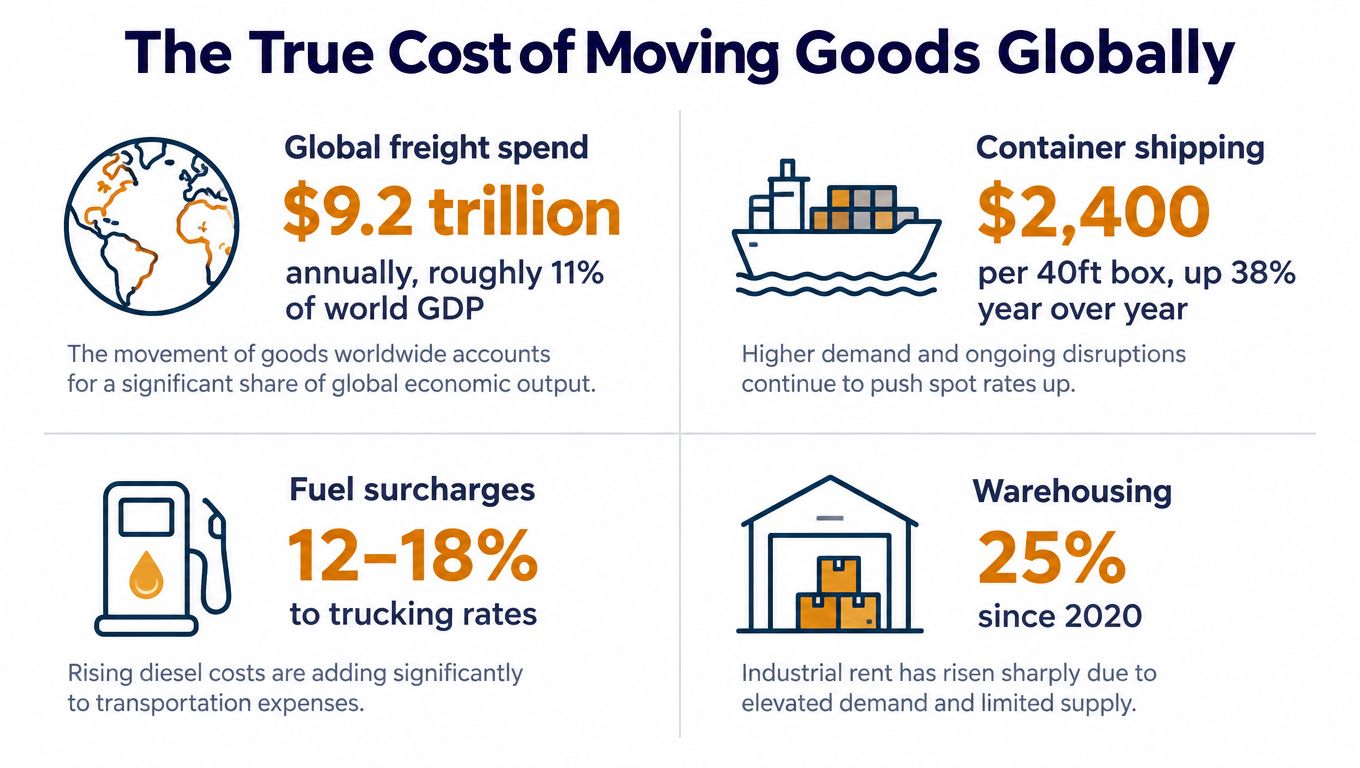
Those figures aren't a POD seller's invoice, but they explain why small operating choices matter. If logistics can represent roughly one-seventh of economic output and a significant portion of product pricing, then supplier location, shipment consolidation, transport mode, and delivery scheduling are financial levers. A small store feels that effect through narrower contribution margins, higher replacement costs, and more customer-service time.
Translate the macro picture into a product decision
Suppose two printers offer the same style of shirt. One has a lower production charge but ships farther from the buyer. The other costs more at production but usually creates a shorter, simpler delivery path. The correct comparison isn't the blank garment plus print charge. It includes:
| Cost or risk | Question to ask |
|---|---|
| Production cost | What do I pay for the finished item? |
| Shipping structure | Is the order likely to travel from one location or split across facilities? |
| Customer support | How much work follows a delayed or confusing delivery? |
| Replacement exposure | What happens financially when a defect or lost parcel requires a reprint? |
| Working capital | Will I need to hold blank stock or other materials in a hybrid setup? |
| Margin protection | Does the customer promise leave room for an exception? |
A POD seller doesn't need to calculate a national logistics model. A simple product-level cost sheet is enough to show whether a low headline price remains attractive after shipping, replacement, and support exposure.
The OECD source also reports that Morocco's total logistics costs were approximately 20% of GDP, illustrating that infrastructure, geography, border procedures, and market scale change the resources required to move goods. Your store faces the same principle at a smaller scale. A provider's location and the buyer's destination can change the economics of an order even when the design, product, and selling price stay the same.
Core Components of a POD Supply Chain
A useful POD supply chain has five connected parts. You don't need to manage each one with a separate application, but you do need to know what decision belongs to each part.
Supplier network
Start with the products that matter most to your store. Record which provider makes each item, where it fulfills orders, what happens when it goes out of service, and how defects are handled. You don't need a backup for every obscure variant immediately. Prioritize bestsellers and products connected to important campaigns.
A backup partner is useful only if its product, print method, sizing, packaging, and customer outcome are acceptable. Test those details before an emergency forces a rushed switch. For broader operational terminology and planning considerations, Genpire's overview of factory-ready supply chain specs offers a helpful reference, even though a small POD shop will apply the ideas with less complexity.
Order routing
Routing determines whether an order goes to the nearest capable facility, a preferred provider, or a partner with the best current capacity. The cheapest route isn't automatically the best route if it creates a split shipment or misses the delivery window.
For Shopify sellers comparing the wider app ecosystem, this guide to print-on-demand apps for Shopify can help frame the technology choice. Keep the operational question in view: can the app make routing rules visible and consistent, or does it just add another opaque handoff?
Fulfillment and printing
Production is where your customer promise begins. Track whether orders enter production as expected, whether the artwork is printed correctly, and whether packaging protects the product. A provider can have a strong catalog but still be a poor fit if its process creates recurring quality issues or unclear status updates.
Shipping and the last mile
Shipping combines carrier choice, destination, tracking, address quality, and delivery conditions. Give customers one clear tracking path whenever possible. If an order must split, explain that before support has to do it for you.
Returns and quality assurance
Write the return and reprint rule before the first difficult case. Separate damage, manufacturing defects, wrong items, buyer mistakes, and carrier loss. The right remedy may differ by cause, and your support team needs enough information to act without negotiating from scratch every time.
A small operating sheet can contain the supplier, product, fulfillment location, routing rule, production status, tracking number, exception owner, and resolution. That modest record creates control without turning a POD shop into an enterprise project.
Building a Stepwise Planning Framework
A small POD shop rarely needs expensive forecasting software or a digital twin first. It needs a process that survives imperfect order history and limited staff time. GoFreight's logistics planning guidance points toward practical foundations: focus on busy shipping lanes, document handoffs, record carrier schedules, and automate repetitive work only after the basics are stable.
Start with a spreadsheet that you will maintain. Use one row per order or shipment and record the product, supplier, destination region, order date, production handoff, ship date, expected delivery window, actual outcome, shipping cost, and exception type. Mark split orders and reprints clearly.
The record does not need perfect history. Consistent fields from today onward are more useful than a polished dashboard built from gaps and contradictions.
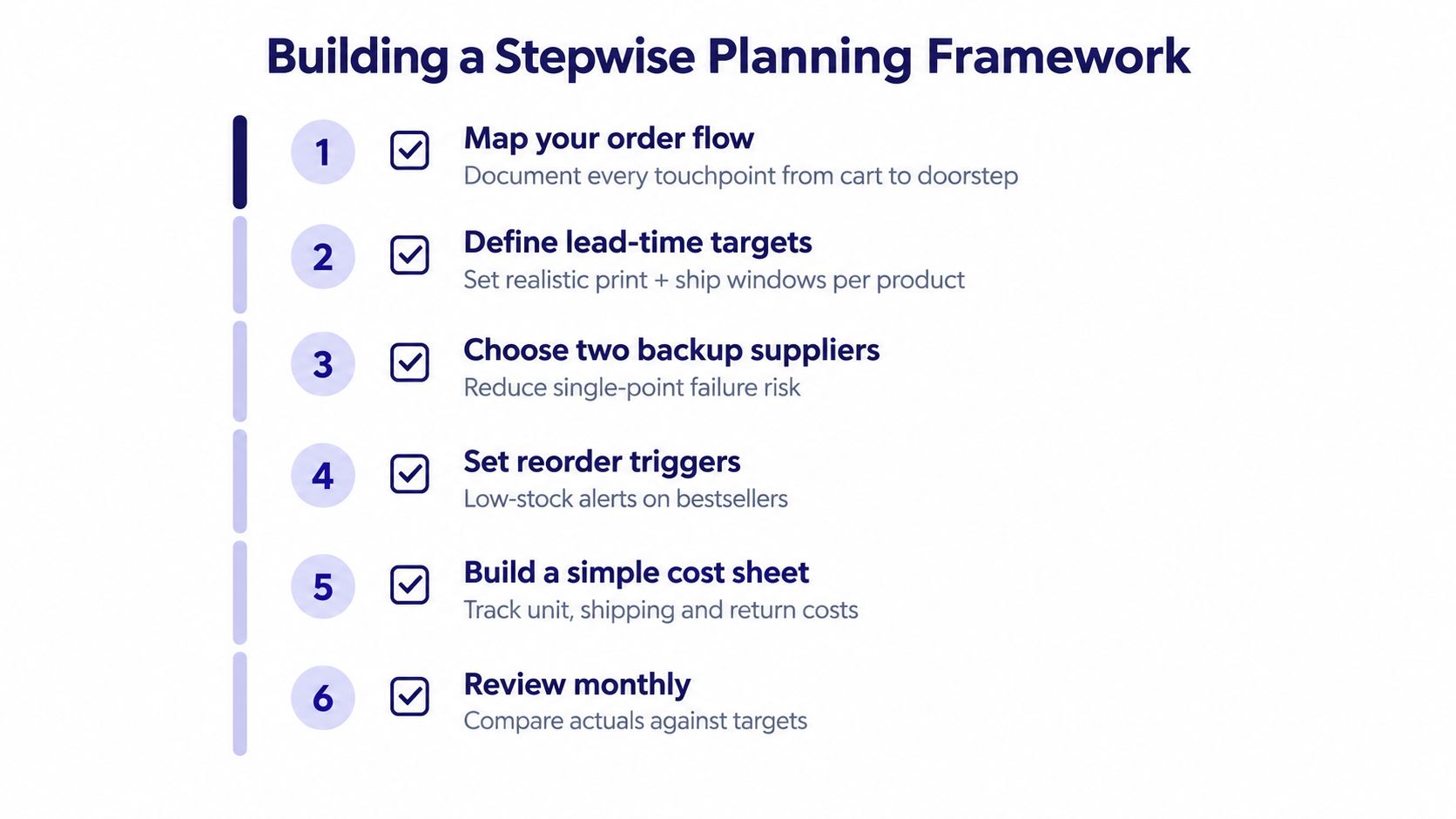
Build the process in this order:
- Map the order flow. Record each handoff from checkout to delivery, including the point where responsibility changes.
- Set product-level expectations. Keep realistic production and shipping windows for priority products and destinations.
- Standardize carrier choices. Set a default route for common destinations, then define when a faster or slower option earns its extra cost.
- Create exception rules. Assign ownership for stalled tracking, provider contact, reprints, and refunds.
- Build a cost sheet. Include production, shipping, replacements, refunds, and reasonably estimated support time.
- Review actuals regularly. Compare the delivery customers received with the promise shown on the product page.
These decisions affect one another. A shorter promise may increase support work when production slips. A supplier change may require different routing. A routing rule may create split shipments that reduce margin.
The first automation should remove repetition, not hide uncertainty.
Once the workflow is stable, automate status copying, customer notifications, and routine record updates. Keep judgment calls visible. If nobody can explain a routing rule, automating it only makes mistakes harder to trace. A focused time-to-market process may remove a bottleneck before a broader system is justified.
Set aside a monthly review. Check which products produce exceptions, which destinations create confusion, and which providers respond when orders go wrong. Use those findings to choose one process improvement, then update the spreadsheet and rules so the change becomes repeatable.
Navigating International Customs and Documentation
Customs problems rarely begin with the carrier. For small POD sellers, they usually begin with a vague product description, an incorrect value, or a package weight copied from the catalog instead of the packed shipment. The sender owns the customs information. USPS requires item-specific descriptions, material and purpose where relevant, separate values for each item, the total shipment value, and gross package weight with its measurement unit, as explained in the USPS customs requirements.
“Merchandise” tells an officer very little about a printed shirt or poster. The declaration should identify what the product is, what it is made from, and why it is being shipped. Prepare that information before buying postage, particularly when several POD facilities fulfill products from the same store.
Build the declaration before the label
A simple product reference sheet is usually enough. Record the description, material, purpose, declared value, and typical packed weight for each item. Match the wording to the actual product, then revise it when the product or packaging changes. Multi-item orders need separate product entries rather than one broad line.
| Data Point | Requirement | Common POD Mistake |
|---|---|---|
| Item description | State what the product is, what it is made of, and its purpose. | Entering “merchandise” or an equally vague label. |
| Item value | Provide the separate value for each item. | Using one combined value without product-level detail. |
| Total shipment value | State the value of the complete package. | Letting the total disagree with the item entries. |
| Gross weight | Include package weight and the measurement unit. | Guessing, omitting the unit, or copying an unpacked product weight. |
| Sender and recipient | Enter the required details accurately. | Assuming the carrier will complete the declaration for you. |
The table is useful only if the fulfillment workflow can supply accurate inputs. A low-budget spreadsheet linked to the order record often works better than expensive software that nobody maintains. Keep one owner responsible for checking the declaration when a provider, product, or packaging format changes.
USPS offers online processing through Click-N-Ship and USPS Customs Form Online. A sender using PS Form 2976-R takes the worksheet and package to a retail counter, where an employee can create and print the appropriate customs form. A handwritten declaration is not automatically suitable for every merchandise shipment or service, so confirm the method before dispatch.
Use this short dispatch check:
- Confirm the product: Match the description to the shirt, poster, or other packed item.
- Confirm the value: Preserve each item value and the total in the order record.
- Confirm the weight: Use the packed shipment weight and measurement unit.
- Confirm the sender: Check which seller or fulfillment arrangement is responsible.
- Confirm the method: Choose the appropriate online or counter-assisted USPS process.
- Confirm the evidence: Save the submitted declaration details with the order.
For terminology and current considerations, Matil's 2026 customs declaration guide provides a useful reference. It does not replace carrier-specific requirements, but it helps sellers gather the information needed before a parcel enters the mail stream.
Measuring Performance with the Right KPIs
A low freight quote can hide an expensive failure. For a POD seller, logistics performance means protecting the delivery promise while keeping production, support, and replacement costs under control.
The World Bank's 2023 Logistics Performance Index assessment collected 4,090 country assessments covering 139 economies. Across potential trade routes, an average of 44 days elapsed between a container entering the exporting country's port and leaving the destination port, with a standard deviation of 10.5 days. For a small store, the practical lesson is clear: an average transit time does not show how often a route becomes unusually slow.
Start with the customer promise, then trace the order backward. Production time, carrier transit, address exceptions, and tracking gaps require separate measures. Otherwise, a late parcel becomes a vague provider complaint instead of a fixable process problem.
Useful measures include:
- Order-to-ship time: How long the provider takes to release the parcel.
- Transit time: The period from carrier acceptance to delivery.
- Promise accuracy: Whether the delivered order fell inside the window shown to the customer.
- Exception rate: How often an order needs manual attention.
- Defect and reprint rate: How often quality issues create replacement work.
- Split-shipment rate: How often one checkout becomes multiple deliveries.
- Support burden: Which logistics events generate customer contacts.
Keep the review affordable. A shared spreadsheet, consistent order fields, and a monthly sample of delayed or replaced orders can expose more than a costly dashboard with incomplete data. Use a documented quality assurance process to connect production defects to the exact product, provider, and resolution.
Compare providers using the same product and destination group. A cheaper, slower printer may suit buyers who accept a longer delivery window. It becomes a poor choice when the store advertises speed, missed promises create support work, and replacement costs exceed the production saving.
| Scenario | Apparent advantage | Hidden exposure | Sensible response |
|---|---|---|---|
| Lower unit cost, variable shipping | Better product margin on paper | More late-delivery contacts and uncertain promises | Use only where the delivery window remains honest. |
| Higher unit cost, stable fulfillment | More predictable customer experience | Smaller margin per order | Test on products where reliability protects repeat demand. |
| One provider for everything | Easier administration | A single operational failure affects the catalog | Keep a tested alternative for important products. |
| Multiple providers by region | Shorter routes and local flexibility | More routing and quality complexity | Standardize rules and monitor split shipments. |
Review the spread of outcomes, not only the average. A provider can look reliable overall while producing frequent exceptions for one product or destination. That detail should determine routing rules, customer promises, and the point at which a backup provider becomes worth its higher unit cost.
Avoiding Common Mistakes and Scaling Smartly
POD sellers usually create logistics problems by adding complexity faster than they add control. New suppliers, new marketplaces, new products, and new destinations can each seem manageable until nobody knows which rule applies to a particular order.
Don't automate a messy process and assume software will repair it. First standardize product names, supplier records, routing rules, customer promises, and exception categories. The smaller-operator guidance cited earlier makes the same practical point: disciplined standardization on important lanes can outperform premature broad AI adoption when master data is unreliable.
Scale the process before the tool
A resilient store keeps a short operating playbook:
- Name the default provider: Record why it receives the order and when the backup applies.
- Limit customer promises: Publish windows you can support across ordinary and disrupted conditions.
- Review peak exposure: Check provider capacity, carrier options, and support coverage before major campaigns.
- Price split shipments transparently: Decide whether the store, the buyer, or the product margin absorbs the extra movement.
- Keep a recovery path: Store the evidence needed for a reprint, refund, or carrier inquiry.
Seasonal demand can expose weak processes, but the answer isn't always a new platform. Sometimes it's pausing a fragile product, narrowing destinations, simplifying packaging, or routing a bestseller to a more dependable partner. Those choices may reduce short-term assortment while protecting the customer experience and your ability to respond.
Logistics planning becomes more valuable as your catalog expands because each added dependency creates another possible failure point. Review the system after meaningful product, supplier, or market changes. Keep the spreadsheet if it remains accurate. Upgrade only when manual work, error rates, or exception volume justify the cost.
Trendlytic helps POD sellers research niches across TeePublic, Amazon Merch, Redbubble, and Etsy, then check keywords against its built-in USPTO trademark database before committing production and launch effort. Visit Trendlytic to find promising product directions with clearer demand and competition signals, so your logistics planning starts with products worth supporting.