Merch by Amazon Designs: A Realistic 2026 Guide
Most advice about Merch by Amazon designs starts with volume: find a trend, upload quickly, repeat. That sounds efficient, but it treats a catalog like a pile of lottery tickets. In practice, random uploads create weak listings, unclear demand, and avoidable intellectual-property risk. A smaller group of researched, clearance-checked designs is usually a more sensible foundation than a large folder of guesses.
Amazon handles production, sales, and shipping, but it doesn't choose the concept, clear the phrase, or make an unprofitable design worth promoting. The useful work happens before upload, in the decisions that protect your account and give each design a reasonable chance to find a buyer.
Table of Contents
- Why Most Merch by Amazon Designs Fade Fast
- Finding Niches That Actually Have Buyers
- Clearing Trademarks and Protecting Your Account
- Building Listings That Meet Amazon Requirements
- Designing for Profitability, Not Just Visibility
- Publishing Workflows and Multi-Platform Testing
Why Most Merch by Amazon Designs Fade Fast
A design can look polished and still fail for ordinary reasons. The niche may be too broad, the phrase may have no buying intent, or the listing may enter a crowded category without a clear angle. A popular screenshot only proves that one product found demand at one point. It doesn't prove that a similar design is safe to publish or that you can attract the same buyers.
Amazon announced Merch on Demand on September 30, 2015, introducing a self-service model where creators submit designs while Amazon manages production, sales, and shipping. The royalty structure made sales performance central, because creators earn money from products sold after applicable costs and fees are deducted, and Amazon said the royalty percentage could increase as T-shirt sales grew. Amazon's launch announcement explains why design selection and demand validation matter as much as artwork.
Volume isn't a strategy
Uploading random designs feels productive because every completed file creates visible progress. It doesn't answer the harder questions:
- Who buys this? A broad audience is often less useful than a specific group with a recognizable identity or occasion.
- Why this version? A familiar niche needs a distinct concept, not a minor rearrangement of an existing product.
- Can it stay live? A design that creates a rights complaint is a poor asset, regardless of its artwork quality.
- Can it earn enough? Visibility without workable economics can turn promotion into an expense.
I use competition research to separate apparent activity from a realistic opening. A practical starting point is this competition scoring framework, then a manual review of the actual products, titles, visual patterns, and seller behavior behind the score.
Practical rule: A design earns its upload slot by surviving demand review, originality review, and rights review before it reaches the marketplace.
The durable workflow is simple, though not effortless. Find evidence of buyer interest, narrow the audience, develop an original angle, check the phrase and visual elements, build a compliant file, and record what you approved. That process won't make every design sell. It does stop preventable mistakes from consuming the limited attention and account trust that matter more than upload speed.
Finding Niches That Actually Have Buyers
I don't begin with an empty keyword list. I begin with live storefront evidence, because an active product tells me more than a vague phrase such as “funny shirts.” The useful question is not whether a niche sounds popular. It's whether buyers are already choosing products in that niche and whether there is room for a meaningfully different design.
Trend research works best when you inspect multiple signals:
- Storefront activity: Look for sellers whose catalog contains several related designs, rather than treating one isolated product as proof of a market.
- Design repetition: Note recurring subjects, tones, occasions, and visual formats. Repetition suggests a buyer language worth understanding, not an invitation to copy.
- Competition quality: Strong competition may indicate demand, but it also raises the standard for originality and presentation.
- Platform overlap: A concept that appears across Amazon Merch, TeePublic, Redbubble, and Etsy can reveal broader interest, while differences between platforms may expose a better angle.
The point is to move from “this topic is trending” to “this audience buys this kind of message for this reason.” A fishing design for a narrowly defined event, role, or inside joke gives you more direction than another generic fishing graphic. The narrower concept also makes it easier to judge whether the artwork adds something instead of echoing the category.
For a deeper research process, this guide to the best niche for Merch by Amazon is useful as a starting reference. I'd still validate the live listings yourself, because marketplace results change and a research snapshot can't replace judgment.
A practical filter for opportunities
Before drawing, write a short opportunity note:
- Audience: Who recognizes the reference immediately?
- Buying moment: Is the shirt for identity, gifting, an event, a profession, or a hobby?
- Existing language: Which words and visual ideas already dominate the niche?
- Open angle: What can you express without borrowing a protected phrase, logo, character, or recognizable brand treatment?
- Distribution: Could a community, creator, email list, or social account reach these buyers outside Amazon?
That final question matters because a design with a small, relevant audience can be more useful than a broad concept dependent on Amazon discovery alone. Research should identify a reachable buyer, not just a keyword with activity.
Clearing Trademarks and Protecting Your Account
Rights clearance should happen before the artwork becomes expensive to revise. A phrase that feels generic may still be used as a mark for apparel, and a visual design can create risk even when no exact wording appears. The USPTO says its database includes federally applied-for and registered marks, but it also makes clear that applicants must conduct their own search.
Search in stages
Start with the exact phrase as a USPTO wordmark. Then expand the search rather than stopping at the first clean result.
- Search variants: Try alternate spellings, truncated terms, plurals, spacing changes, word-order changes, phonetic equivalents, and translations.
- Review owners: Search owner names when a related mark appears, because one owner may hold several relevant registrations.
- Check the class: Apparel commonly falls within International Class 25, but the relevant goods and services still need review rather than assumption.
- Inspect visual similarities: Use design-code and pictorial-equivalent searches for logos, symbols, mascots, and recognizable imagery.
- Record the result: Save the phrase, variants, class, owner, status, date checked, and the reason a mark was considered relevant or not relevant.
An expired or abandoned record isn't an automatic clearance. Earlier marketplace use, related registrations, or a similar active mark can still create questions. Exact-text searching also misses conflicts based on sound, translation, logo treatment, or overall commercial impression.
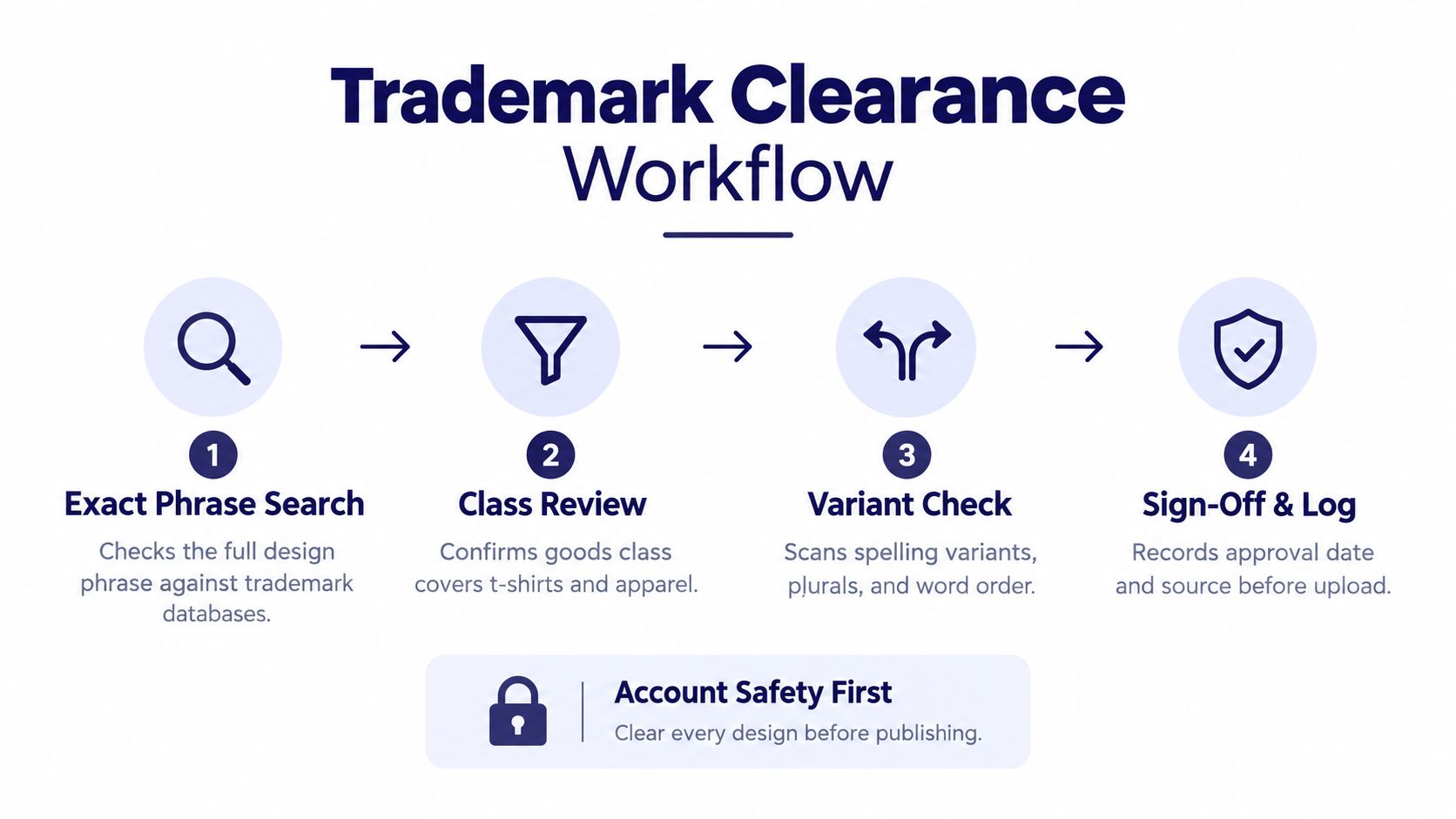
A tool such as Trendlytic can streamline an initial USPTO trademark check, but a tool result isn't a legal opinion. For a broader explanation of the trademark issues that can affect brand use, this resource on trademark for Amazon Brand Registry adds useful context.
Personalization needs a separate check
Personalized products introduce a risk that standard Merch advice often skips. Amazon's personalization terms grant Amazon and its customization providers a worldwide, perpetual, irrevocable, sublicensable, royalty-free license to reproduce, modify, publish, distribute, and display submitted personalization content, without paying the creator for that content. Amazon also says sellers must not submit intellectual property, including trademarks, copyrights, or another person's name or likeness, without authorization.
That means “the customer uploaded it” isn't enough. A buyer's photograph, name, logo, or quote may still belong to someone else or require permission for reproduction and commercial use. Separate original artwork, licensed assets, customer-provided material, public-domain material, and personal likenesses in your review notes.
For ambiguous slogans, fan references, celebrity material, or brand-adjacent artwork, get qualified legal advice. A database search can reduce avoidable exposure, but it can't approve every use case.
Account safety starts with records. Keep creation files, license documents, permissions, search notes, and publication decisions together.
Amazon's account-health process can involve appeals and evidence. Its policy materials describe options such as modifying a detail page and appealing through Account Health when a trademark complaint is alleged, while authenticity complaints may require evidence such as an invoice or order ID. A quality assurance process for product publishing can help turn these checks into a repeatable gate instead of a memory exercise.
Building Listings That Meet Amazon Requirements
A compliant upload is only the starting line. Amazon requires artwork to be a JPEG or PNG measuring at least 1,000 by 1,000 pixels and staying below 25 MB, according to its Merch on Demand file guidance. The minimum canvas contains 1 million pixels, but the minimum isn't an ideal production target. Higher-quality source artwork gives you more protection against soft edges, poor scaling, and disappointing print output.
| Requirement | Minimum | Recommended Practice | Risk if Ignored |
|---|---|---|---|
| File type | JPEG or PNG | Export a clean file with a transparent background when the design needs one | Upload failure or unwanted background elements |
| Canvas size | 1,000 by 1,000 pixels | Work at a higher resolution when your design process allows it | Soft lines, jagged edges, or weak print quality |
| File size | Below 25 MB | Compress carefully without damaging detail | Rejection or failed upload |
| Artwork quality | Technically readable | Inspect edges, contrast, spacing, and small details at print scale | A technically accepted design can still look poor on fabric |
Build the listing around the buyer
Titles and bullet points should identify the audience, subject, and use case naturally. Don't turn the listing into a string of disconnected keywords. A buyer searching for a profession, hobby, or occasion should understand the design quickly, while the copy should avoid claims or references that introduce rights problems.
Pricing requires the same discipline. Amazon calculates royalties from the list or offer price after applicable taxes and Amazon costs, so the displayed price isn't the same thing as your earnings. Check the current economics before treating a low price as a visibility tactic.
A useful listing review asks:
- Does the title describe the actual design?
- Do the bullets clarify who might wear or gift it?
- Are the keywords relevant rather than repeated?
- Does the price leave room for the royalty you need?
- Do the artwork and listing avoid protected names, logos, and implied affiliations?
For layout, hierarchy, and visual presentation beyond the shirt artwork, this guide on listing design for brands provides a helpful reference. The underlying principle is straightforward: technical compliance gets the file through the door, but clarity helps the right shopper recognize it.
Designing for Profitability, Not Just Visibility
A bestseller position can be encouraging and still produce a weak business result. Amazon's royalty is based on the offer price after applicable tax and Amazon costs, not on the price printed in your spreadsheet. Promotion adds another cost, whether you pay for it directly or spend time creating content, partnerships, and outreach.
The design I'd rather build is often the one with a clearly reachable audience, even if the keyword looks less exciting. A narrow profession, hobby, event, or community can support external traffic from a relevant social account or email audience. A broad trend may attract impressions but give you no practical way to reach buyers without competing against established products.
Use scenarios, not screenshots
Before promoting a design, estimate three scenarios qualitatively:
- Organic only: The listing depends on Amazon discovery and must earn attention through relevance and conversion.
- Owned audience: A creator, community, email list, or social profile sends targeted visitors without a direct advertising bill.
- Paid promotion: The design must generate enough royalty to cover the cost of traffic and still leave a worthwhile return.
Recent commercial coverage has claimed a 2026 performance-based royalty model, including a reported $2.44 royalty on a $19.99 standard T-shirt in a default tier, compared with $4.88 in a higher tier and $5.27 in a premium tier. Those figures come from a commercial industry source rather than Amazon's own documentation, so I wouldn't place them in a forecast until the current program rules and calculator confirm them.
The practical calculation is less glamorous than ranking screenshots. Start with the expected royalty, subtract marketplace-related costs and promotional spending, then ask whether the remaining amount justifies the design and distribution work. A design doesn't need to be the most visible product in a niche. It needs a defensible audience, a clean rights position, and economics that don't collapse when you pay for attention.
Publishing Workflows and Multi-Platform Testing
Amazon Merch on Demand is attractive because creators don't buy inventory before a customer orders. Amazon prints, sells, and ships the product, while the creator receives royalties from completed sales. That arrangement removes manufacturing and fulfillment work, but it also means Amazon controls the marketplace environment and the seller must protect the account that holds the catalog.
I publish in batches only after each design passes the same checks. One folder contains the final artwork, source file, license or permission records, trademark queries, listing copy, price decision, and publication date. That organization makes revisions easier and gives me something concrete to review if a complaint arrives.
Choose the platform by the test
| Platform | Useful first test | Main trade-off |
|---|---|---|
| Amazon Merch on Demand | Designs aimed at shoppers already searching Amazon | Built-in marketplace reach, with less control over the selling environment |
| TeePublic | Graphic concepts that benefit from a design-led storefront | Useful for testing visual appeal, but the audience and merchandising context differ |
| Redbubble | Broader artwork and product-format experiments | More product variety, while buyer intent may differ from a focused apparel search |
| Etsy | Designs that can be positioned around a specific occasion or buyer need | More shop management and customer-facing work |
Cross-platform publishing doesn't mean copying a listing everywhere without adjustment. A phrase that works on TeePublic may need different merchandising on Amazon, and a design that attracts browsing on Redbubble may not satisfy a buyer searching for a specific gift or identity product. Reuse the research, not the assumptions.
A sensible batch routine looks like this:
- Research the niche: Save the live products, audience language, and competing angles.
- Create the concept: Produce original artwork rather than tracing a marketplace winner.
- Clear the rights: Search wording, variants, visual equivalents, and supplied personalization content.
- Inspect the file: Confirm format, dimensions, file size, readability, and print contrast.
- Prepare the listing: Write specific metadata and choose a price based on the intended economics.
- Log the publication: Record what went live and monitor complaints, removals, and sales signals.
Trendlytic can support this process by showing live bestseller data across Amazon Merch, TeePublic, Redbubble, and Etsy, comparing demand with competition, surfacing validated designs, and checking keywords against USPTO trademark records. I'd still treat the output as research support rather than an automatic publishing decision.
Account health is worth more than a fast upload schedule. Give each design enough scrutiny to remain a useful asset, and let sales evidence guide the next batch instead of forcing a trend that never fit your audience.
If you want a more disciplined starting point, Trendlytic can help you research live POD niches, compare competition across marketplaces, and run an initial USPTO trademark check before you prepare Merch by Amazon designs. Use it to narrow your shortlist, then apply your own clearance and profitability judgment before publishing.