Niches with Low Competition for POD Sellers
You pick a niche that looks almost too easy. Coffee mugs, nurse appreciation, mom life, or a familiar hobby all seem to offer endless buyers, so you upload fifty designs and wait. A few weeks later, your work has disappeared among nearly identical listings, and the phrase you used may have created a second problem: a trademark notice arriving after you thought the hard part was finished.
I've launched hundreds of designs across TeePublic, Redbubble, Amazon Merch, and Etsy. The lesson I keep returning to is simple: low competition only matters when real demand and legal clearance exist at the same time. The useful question isn't “What niche is easy?” It's “What evidence says this niche is worth entering before I upload anything?”
Table of Contents
- The Real Problem with Easy POD Niches
- What Demand and Competition Actually Mean for POD
- The Four Signals That Reveal a Truly Low-Competition Niche
- How Each Marketplace Defines Low Competition Differently
- A Repeatable Research Workflow with Trendlytic and a USPTO Check
- Three Niches That Pass the Test and Why They Work
- Why Low Competition Without Demand Is a Worse Trap
The Real Problem with Easy POD Niches
A niche can look open because it has few visible listings. That doesn't mean buyers are searching for it, or that the existing listings are weak enough for a new seller to displace them. Conversely, a category can look crowded while still containing narrow audience and design-style gaps.
The first mistake is treating a broad category as a niche. “Coffee” attracts established sellers, generic slogans, and endless variations. “Coffee” for a particular profession, event, identity, or inside joke gives you a more precise audience, but precision still needs validation.
The second mistake is relying on keyword difficulty alone. Traditional SEO tools can tell you that a phrase has low difficulty, but POD marketplaces have their own search behavior, seller turnover, tags, listing quality, and algorithmic preferences. A phrase that looks easy in a keyword tool may already be saturated by sellers who upload quickly and cover every obvious variation.
Practical rule: Don't upload because a niche looks empty. Upload only after you can explain who searches for it, what competing sellers offer, and why your design would be a better choice.
My workflow starts with marketplace evidence rather than a brainstormed list of hot categories. I pull the strongest designs from a seller or store, compare demand with competition, inspect the quality of the current listings, and then check every phrase for trademark risk.
That last step matters because a popular phrase can be commercially attractive and legally unusable. The USPTO's explanation of likelihood of confusion makes clear that a mark doesn't need to be identical to an earlier mark to create a problem. Similarity in sound, appearance, meaning, or overall commercial impression can be enough when the goods or services are related.
The target, then, isn't an “easy niche.” It's a niche with specific demand, manageable competition, visible creative weakness, and a phrase you can use safely. The rest of the process is designed to test those conditions before production begins.
What Demand and Competition Actually Mean for POD
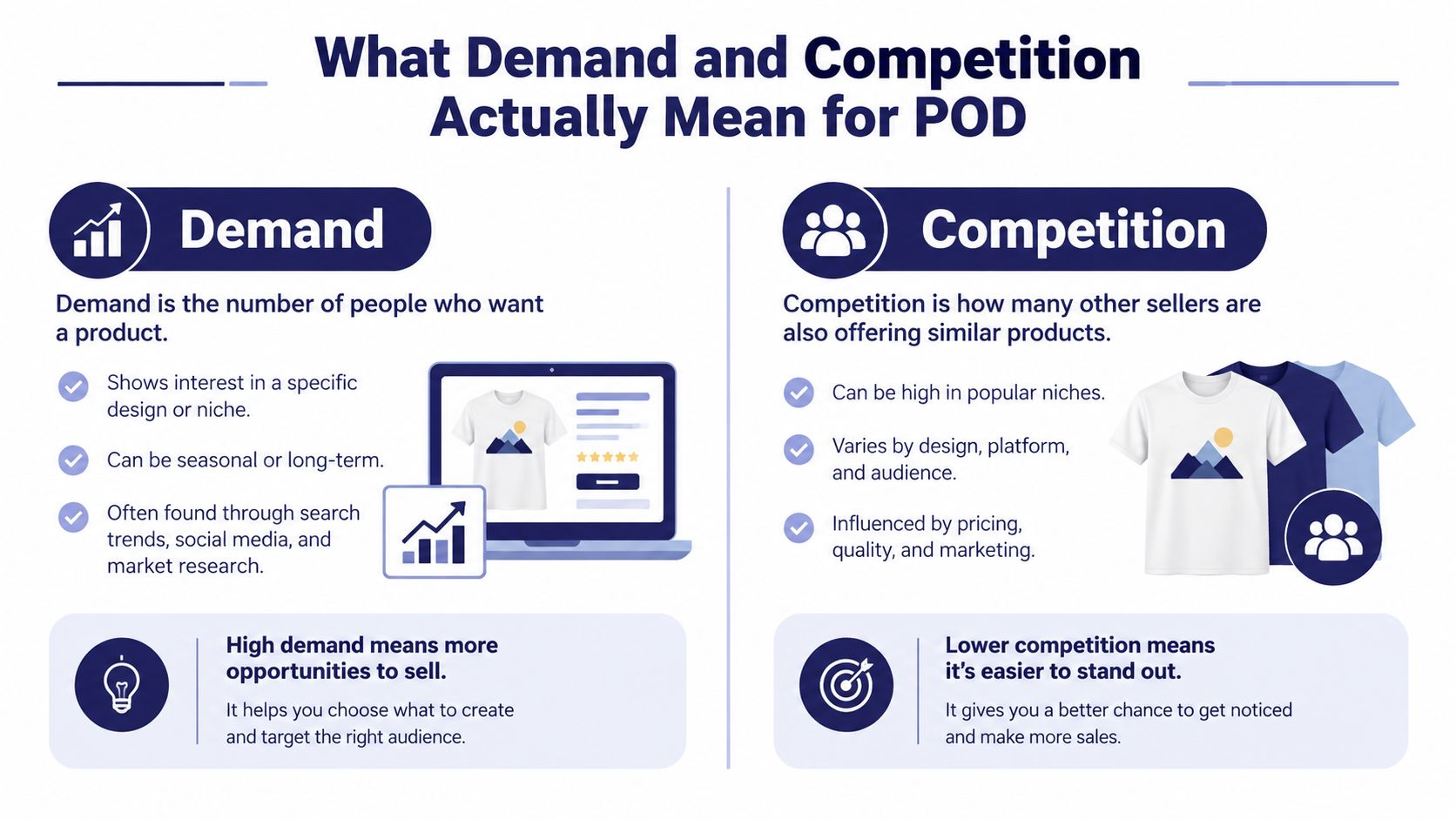
Demand and competition are separate measurements. Think of a coffee stand on a busy corner. Many people pass by, but twelve other stands compete for those customers. That's high demand paired with high competition. An empty side street has little competition, but it may also have too few buyers to support another business.
POD sellers need the same distinction. Demand tells you whether people are looking and buying. Competition tells you how many sellers are trying to capture that attention. Confusing the two is how sellers end up celebrating a low competition score while ignoring the absence of customers.
Reading demand on a marketplace
Demand leaves different traces on each platform:
- TeePublic and Redbubble: Look at matching tag pages, recurring products, favorites, and whether designs appear consistently rather than only during a short spike.
- Amazon Merch: Compare similar products through sales-rank movement and the strength of the subcategory. A design that appears repeatedly among stronger sellers offers more useful evidence than an isolated result.
- Etsy: Watch search appearances, listing engagement, reviews, and the consistency of relevant products in search. Search volume alone can be misleading because Etsy results include handmade and vintage products alongside POD.
Competition has its own signals. Count relevant listings, not every product returned for a broad word. Check how many distinct sellers occupy the visible results, how often the same stores repeat, and whether the top designs look professionally made or merely abundant.
POD differs from conventional SEO because marketplace rankings can change as sellers upload, buyers interact, and seasonal intent shifts. A low keyword difficulty score doesn't account for a fast-moving seller base or a marketplace where dozens of near-identical designs can appear quickly.
For a more formal way to think about the second axis, the competition scoring framework is useful because it forces you to examine supply alongside buyer intent instead of treating listing volume as the whole answer.
Before trusting a “low competition” label, measure four things: search activity, relevant listing supply, the gap between demand and supply, and the quality of the current listings. A niche is promising when those signals point in the same direction, not when one attractive metric distracts from the others.
The Four Signals That Reveal a Truly Low-Competition Niche
I use four signals before I consider a niche ready for design work. None is perfect alone. Together, they turn an appealing idea into a decision you can defend.
Search volume
Start with consistent activity, not a one-day spike. On TeePublic and Redbubble, inspect relevant tag pages and look for repeated engagement around the exact phrase or a close variant. On Amazon, compare keyword request information with the behavior of comparable products. On Etsy, check whether relevant listings keep appearing in search and whether buyers leave evidence through favorites, reviews, or sales activity.
For search-led businesses, long-tail demand is especially useful. An analysis of 306 million keywords reported that 91.8% of queries contain three or more words, and that long-tail terms capture around 70% of total search traffic while converting at 2.5 times the rate of broad head terms according to the cited analysis. The exact numbers aren't a promise for any individual POD listing, but the pattern is practical: specific phrases often express stronger intent than broad categories.
Competition scoring
Count relevant, active designs rather than every loosely related result. A useful starting rule is to treat fewer than a few hundred active designs for a specific phrase as worth inspecting, then narrow further when the audience is small or the phrase has weak buyer intent.
The keyword research guidance from BlazeHive offers a practical SEO-style reference point, with monthly demand around 100 to 1,000 queries, keyword difficulty below 30, and a results page not controlled by entrenched authorities. For POD, marketplace listing counts and seller strength should sit beside those figures, not be replaced by them.
Opportunity scoring
Opportunity is the relationship between demand and supply. A phrase with meaningful activity and thin, weak supply is more useful than a phrase with impressive volume and overwhelming seller density.
I'd rather test a specific audience phrase with modest but steady demand than chase a broad term where every visible design already has a polished concept, strong mockups, and an established seller behind it.
Listing quality
Two niches can contain the same number of listings and offer completely different opportunities. One may be filled with experienced designers and strong reviews. The other may contain repetitive typography, poor mockups, vague titles, and sellers who haven't built much traction.
Review the first page manually. Note whether the designs communicate the audience immediately, whether the typography works at thumbnail size, and whether sellers have covered the obvious concepts without exploring different styles. Weak creative quality can create an opening even when listing counts look uncomfortable.
| Signal | What to Measure | Practical Threshold | Best Marketplace View |
|---|---|---|---|
| Search volume | Consistent searches and buyer activity | Prefer recurring activity over isolated spikes | Tag pages, keyword demand, Etsy appearances |
| Competition scoring | Relevant listings and seller concentration | Start with a specific phrase showing fewer than a few hundred active designs | Marketplace result pages |
| Opportunity scoring | Demand relative to supply | Demand should be visible while supply remains thin or repetitive | Cross-platform comparison |
| Listing quality | Design strength, mockups, titles, and seller authority | Look for weak creative execution among visible results | First-page manual review |
The most useful benchmark isn't a single score. It's a clear mismatch between buyer interest and seller quality. That's where a new design has a reason to exist.
How Each Marketplace Defines Low Competition Differently
The same phrase can be open on one marketplace and crowded on another. I use the same four-signal checklist everywhere, then change what counts as evidence.
TeePublic is often easier to inspect visually because tag pages expose the relationship between phrase, design count, and seller repetition. For a specific root keyword, fewer than 50 active designs plus steady favoriting activity can indicate room to test, provided the phrase attracts a recognizable audience.
Amazon Merch demands more caution. Product visibility doesn't necessarily equal conversion. I look for competitors moving past 250,000 in the parent category without consistently reaching sub-100,000 ranks. That pattern can suggest that shoppers exist but aren't converting strongly enough to make the niche attractive without a sharper concept.
Redbubble requires tag discipline. Broad tags create the appearance of saturation, while exact audience phrases may have much less direct competition. I compare the strongest sellers with the long tail. If the top designs are polished but most remaining listings have weak scores, the niche may still reward a differentiated design.
Etsy adds noise from handmade and vintage inventory. Search volume can look healthy even when POD demand is weaker than it appears. Relevance, listing age, review velocity, and the consistency of comparable products matter more than a surface-level result count. The Etsy niche research guide is useful when you need to adapt the checklist specifically to that marketplace.
| Signal | TeePublic | Amazon Merch | Redbubble | Etsy |
|---|---|---|---|---|
| Demand | Tag activity and favorites | Sales-rank movement | Matching-tag engagement | Search appearances and reviews |
| Competition | Fewer than 50 active designs for a specific root keyword | Compare parent and subcategory rank behavior | Matching-tag saturation | Relevant POD listings, not all results |
| Opportunity | Specific phrase with steady activity | Buyer intent supported by rank movement | Gap between top sellers and long-tail listings | Relevance and commercial consistency |
| Quality | Thumbnail clarity and seller repetition | Product presentation and conversion signals | Design scores and tag fit | Mockups, age, reviews, and relevance |
The numbers above are screening rules, not guarantees. Marketplace algorithms change, and a niche that qualifies today still needs a product that earns clicks and converts buyers.
A Repeatable Research Workflow with Trendlytic and a USPTO Check
I start with a proven seller rather than a blank keyword list. Pick a relevant store on TeePublic, Amazon Merch, Redbubble, or Etsy, then pull that seller's number one through number three designs. The point is to study what already earns visibility, not what a random search result happens to show.
A store-first workflow gives you a more useful starting set of phrases. Trendlytic can generate keyword clusters from those leading designs in roughly 40 seconds, then return demand and competition levels, an Opportunity Score, and validated designs with images, tags, and pricing. It covers TeePublic, Amazon Merch, Redbubble, and Etsy, so you can compare whether an opportunity is isolated to one platform or appears across several.
Score the cluster before designing
I filter each cluster through the four signals:
- Demand: Is there recurring search or buyer activity rather than a short-lived spike?
- Competition: Does the cluster sit in the lower part of the competition range for that platform?
- Opportunity: Does the demand-to-supply relationship justify testing?
- Quality: Are the visible listings repetitive, poorly presented, or otherwise beatable?
I don't treat any automated score as a substitute for opening the result pages. The tool compresses collection and comparison, but the final judgment still depends on audience fit, design quality, and the commercial meaning of the phrase.
Put every surviving phrase through legal screening
The trademark check comes before uploading, not after a takedown. Search the phrase in the USPTO's federal database, then inspect live and pending records, the wording of the mark, and the relevant goods or services. A pending mark in a related class is enough reason for me to skip the phrase until its status is clear.
The USPTO search guidance reduces the decision to two questions: is the mark confusingly similar, and are the goods or services related? The office also explains that related goods don't have to be identical or belong to the same international class, which matters when one phrase could appear on apparel, accessories, home goods, and digital products.
Etsy's trademark policy shows how this risk reaches marketplace operations. Confusingly similar branding and items that violate intellectual property rules can create account problems even when a niche appears commercially open.
After legal screening, I save only phrases that have a defensible audience, manageable supply, and clean enough branding. For the broader operational side, sellers can also review this practical guide on how to market your POD store. The research sequence itself can be supported by Amazon keyword search guidance, but no keyword tool can clear a trademark for you.
Three Niches That Pass the Test and Why They Work
The strongest examples aren't broad categories. They combine a narrow identity with a specific interest, event, or vocabulary.
Competitive bagpipe bands illustrate a micro-subculture opportunity. The audience is small, but the phrase is precise. Mainstream POD sellers often skip it, existing designs can be weak, and the USPTO search may show no conflicting mark. The reason to test it isn't massive volume. It's that the people who search the phrase understand exactly what the design means.
A regional wildfire relief year works for a different reason. Cause-based moments can create a sharp burst of attention while sellers are still preparing products. The opportunity depends on timing, accurate regional relevance, and the absence of a trademark holder. It's also fragile. The window can close quickly, and careless use of names, slogans, or official symbols can turn a timely design into a legal or reputational problem.
Cytotechnologist humor demonstrates profession-specific intent. The vocabulary is dense, the audience is narrow, and generic POD sellers are less likely to recognize the phrase or create strong artwork around it. That leaves room for designs that use the community's language without relying on protected branding.
Each example passes for a different reason:
- Community specificity: Bagpipe bands have a clear shared identity.
- Timing arbitrage: Relief-related demand can appear before marketplace supply catches up.
- Specialized humor: Cytotechnologists understand terms outsiders won't search for.
I'd still validate each phrase through current listings, seller strength, buyer activity, and trademark status. Examples are starting points, not permission to skip research.
Why Low Competition Without Demand Is a Worse Trap
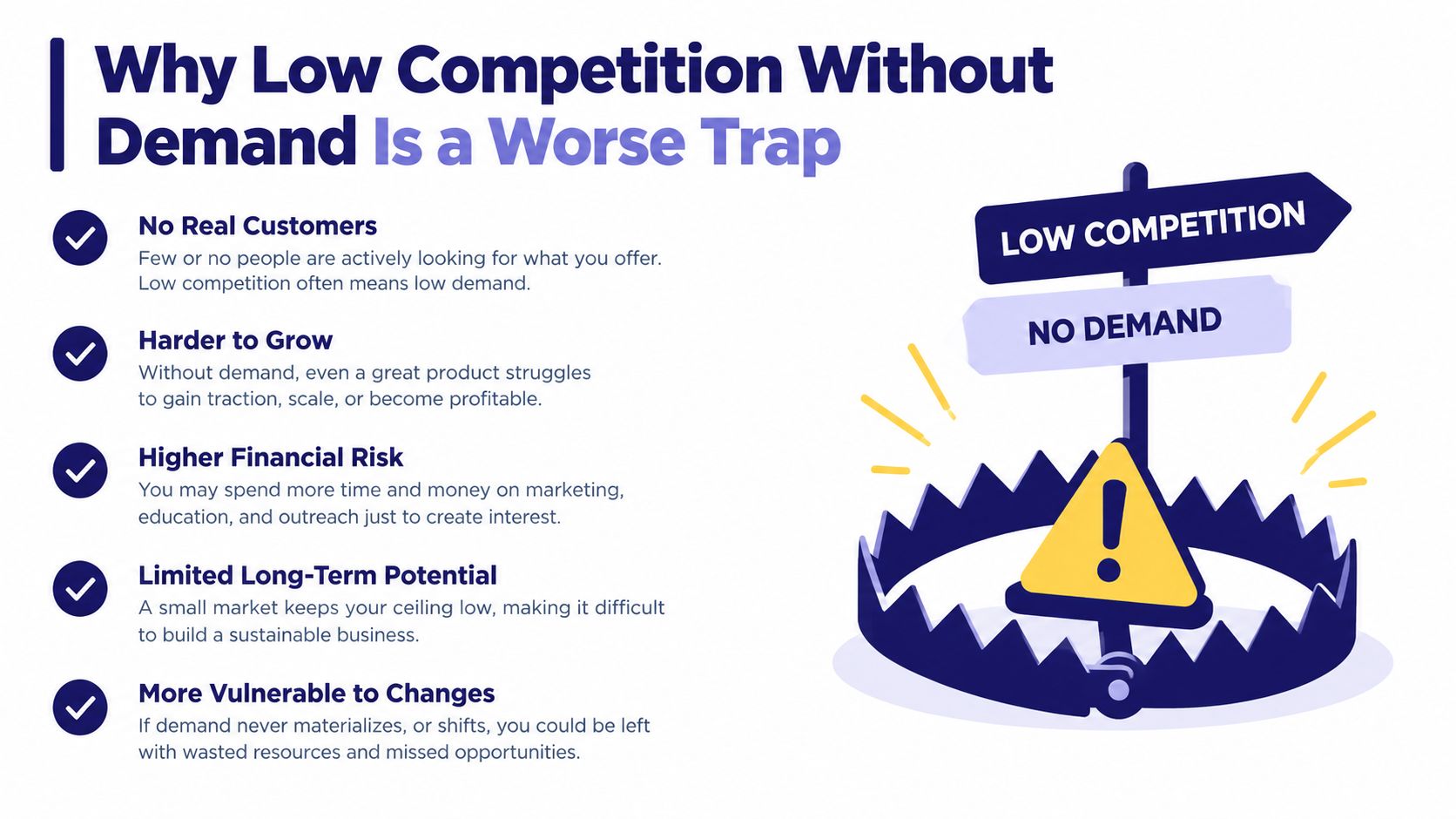
A niche with 40 listings can still be a poor business if the comparable products have a median BSR of 2,000,000. That combination looks attractive in a spreadsheet because supply is low, but the rank suggests that buyers may not be purchasing often enough to support new designs. The same warning applies across TeePublic, Amazon Merch, Redbubble, and Etsy: an empty result page can represent weak demand rather than an overlooked opportunity.
Long-tail research reinforces why volume and intent need to be read together. One industry summary reports that 92% of keywords receive 10 or fewer searches per month, while an Ahrefs-based benchmark cites 94.74% receiving fewer than 10 monthly searches in this long-tail keyword overview. Small phrases aren't automatically bad, but they need a clear audience and a plausible path to repeated purchases.
Decision rule: Low competition is a filter, not a business model.
A crowded niche can still be worth entering when buyer intent is strong and the current designs are repetitive. A low-competition niche with no meaningful activity usually produces a quieter failure. It doesn't trigger a rejection or a trademark warning. It just leaves the designs unseen and the account earning nothing.
Use this sequence every time:
- Demand first: Confirm that people search, browse, favorite, or buy comparable products.
- Competition second: Count relevant listings and assess seller strength.
- Trademark third: Check confusing similarity, related goods, and live or pending status.
- Listing quality fourth: Decide whether your design can improve the visible offer.
Trendlytic brings marketplace bestseller research, store-first design extraction, demand and competition scoring, related keyword discovery, and USPTO trademark screening into one workflow. If you want to test niches with low competition using the same evidence-first process, visit Trendlytic and compare your next ideas before you upload.