10 Art That Sells on Etsy in 2026
Attractive artwork alone doesn't make a product sell on Etsy. Buyers usually need a clear reason to purchase, such as marking a relationship, decorating a particular room, solving a planning problem, or finding a gift that feels personal. The strongest opportunities combine a defined audience, a recognisable visual angle, a practical use or occasion, and a format you can deliver consistently.
Etsy's scale creates real opportunity, but it also creates noise. In 2024, Etsy reported 95.5 million active buyers, 8.1 million active sellers, and $10.9 billion in Etsy marketplace GMS across its marketplaces, while total seller-generated GMS reached $12.6 billion. Etsy's annual report supports the marketplace opportunity, not a guarantee for any individual listing.
I rank the following ten types of art by buyer intent, customization potential, repeatability, seasonality, and print-on-demand fit. I'll also consider the trade-off between fast digital delivery and the stronger perceived value of physical products. Any pricing ranges mentioned should be treated as testing variables, not promises.
For live research, Trendlytic can help compare bestseller signals across Etsy, TeePublic, Amazon Merch, and Redbubble. Its USPTO trademark check is also useful when a promising phrase, character reference, or branded concept needs an ownership check.
Table of Contents
- 1. Custom Pet Portraits and Illustrations
- 2. Motivational and Inspirational Quote Prints
- 3. Downloadable Planners, Journals and Productivity Templates
- 4. Niche Wall Art and Home Décor Illustrations
- 5. Personalized Apparel with Names, Initials and Dates
- 6. Print-Ready Designs and Graphics for Resellers
- 7. Seasonal and Holiday Themed Art and Merchandise
- 8. Book Covers, Book Illustrations and Author Products
- 9. Niche Community and Identity-Based Art
- 10. Educational Materials and Classroom Resources
- Top 10 Etsy Art Categories Comparison
- Choose One Etsy Art Lane and Test It Carefully
1. Custom Pet Portraits and Illustrations
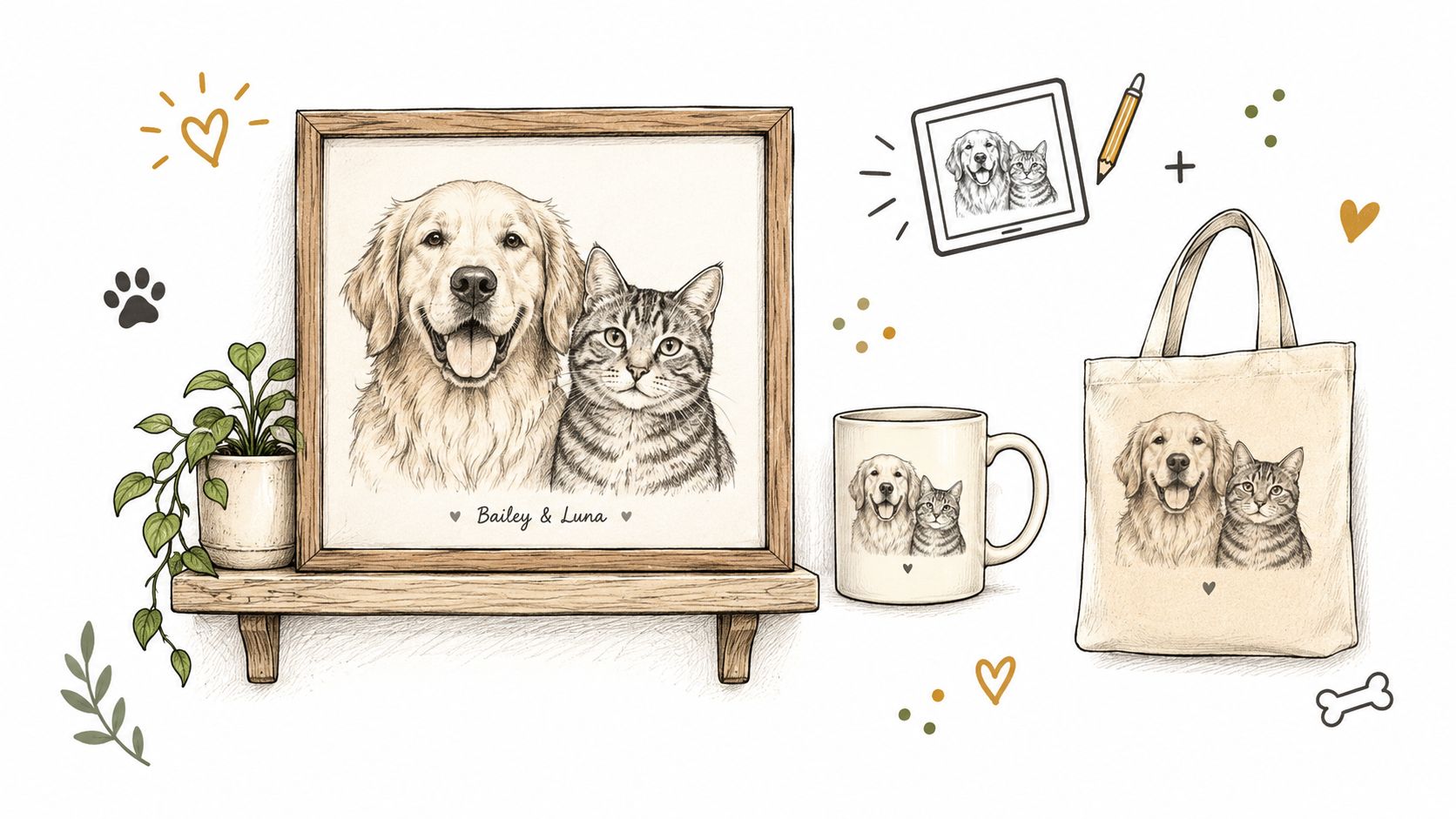
Custom pet art has unusually clear buyer intent. Someone searching for a pet portrait usually isn't browsing for vague inspiration. They're looking for a gift, a memorial, a keepsake, or a way to display affection for a specific animal.
The strongest formats include watercolor-style portraits, pencil sketches, cartoon caricatures, memorial illustrations, and coordinated portraits of several pets. A digital file is easy to deliver, while canvas, framed prints, mugs, totes, and apparel create additional ways to use the same artwork.
Independent Etsy market tracking describes custom pet portraits as sitting at maximum demand, with an average around $51, while personalized art leads demand in the category. The market analysis from Listadum also highlights a personalized pet portrait product with 13,360 lifetime sales. Those figures indicate commercial activity, but they don't prove that a new shop will achieve the same result.
Make customization manageable
Unlimited revisions can turn a repeatable product into a service business. I'd start with a small set of portrait styles, pose options, background treatments, and color palettes. The buyer still gets a personal result, but you keep production predictable.
Practical rule: Sell a defined transformation, not unlimited artistic labor.
Useful search directions include “custom watercolor dog portrait,” “memorial cat illustration,” “three pet portrait,” and breed-specific combinations. The more specific the occasion and animal combination, the easier it is to build a relevant sample listing.
For a validation workflow, compare live Etsy bestseller signals in Trendlytic, then check whether the same visual concept adapts to a mug, tote, or shirt on another POD marketplace. If you use breed associations, sports mascots, or branded pet characters in promotion, run the wording through Trendlytic's USPTO check before publishing. The safest opportunity is your own interpretation of the pet, not a protected logo or character.
2. Motivational and Inspirational Quote Prints
Quote art sells best when the message belongs to a particular situation. Generic motivation has a wide audience, but that breadth also makes the product easy to ignore. A quote for a therapist's office, a first-time founder's workspace, a runner's training room, or a student's desk gives the buyer a clearer reason to click.
Digital prints, framed wall art, desk cards, and apparel can all work. The visual treatment matters as much as the words. Hand lettering, restrained typography, botanical details, geometric composition, and carefully chosen color palettes can make a familiar sentiment feel less interchangeable.
I'd avoid building a shop around famous quotes or celebrity phrases without checking ownership. A phrase associated with a public figure, brand, book, or song may create a trademark or copyright problem even when the wording looks short.
Narrow the emotional use case
Start with collections rather than isolated slogans. Possible directions include affirmations for small business owners, supportive messages for mental health spaces, LGBTQ+ encouragement, workout motivation, and calm reminders for home offices.
- Define the buyer: Write for a specific person and setting, not “everyone who likes positivity.”
- Build a visual system: Keep lettering, margins, and color treatment consistent across a collection.
- Test occasion language: Compare “desk affirmation print” with “entrepreneur office wall art” and similar intent-led phrases.
- Review attribution risks: Check famous names and recognisable quotations before creating mockups or tags.
For validation, I'd create a small set of designs around one audience, then compare clicks and favorites between a plain typographic version and a version with original illustration. Trendlytic can help identify related Etsy keywords, but the tool's signals should guide testing rather than replace judgment. A high-demand phrase may still be too broad if the first-page results look nearly identical.
3. Downloadable Planners, Journals and Productivity Templates
The best digital planner products solve a specific organisational problem. “Printable planner” is a category. “Freelancer invoice tracker,” “new puppy routine planner,” “homeschool lesson organiser,” and “wedding budget workbook” describe a job the buyer wants completed.
This format has strong repeatability because one well-built file can be sold repeatedly without physical fulfilment. The trade-off is that buyers judge usability immediately. A beautiful page with poor spacing, unclear instructions, or awkward printing won't retain value just because it looks polished.
Etsy digital listings can contain up to five files, with each file limited to 20 MB, and buyers generally don't have a limit on when or how often they download a purchased digital item unless the transaction is canceled or removed. Etsy's digital download guidance makes file planning part of the product design.
Design around the workflow
A useful bundle might combine a meal plan, grocery list, budget page, and pantry inventory. For professional buyers, an editable Canva version may be more useful than a static PDF. For home printing, include a clean grayscale option alongside a color version.
I'd test one audience with several related files before expanding into unrelated planner categories. Search directions could include “freelance invoice template,” “fitness coach client tracker,” “pet care planner,” or “teacher weekly organiser.” Seasonal refreshes can support resolution planning, academic organisation, and holiday preparation, but the core workflow should remain useful beyond the season.
For keyword discovery, use Trendlytic's Etsy keyword research guide as part of a broader process. Compare the actual wording used by strong listings, inspect the preview images, and download your own files on different devices before publishing.
This demonstration can help show how a digital product workflow might be presented:
4. Niche Wall Art and Home Décor Illustrations
Generic wall art attracts heavy competition, so broad abstract prints give shoppers little reason to choose one shop over another. Independent tracking has identified about 20.8 million live Etsy listings for wall art, 14.4 million for art print, and about 2.5 million for canvas print, according to Listadum's Etsy art analysis. Treat those figures as a competition signal, not a demand forecast.
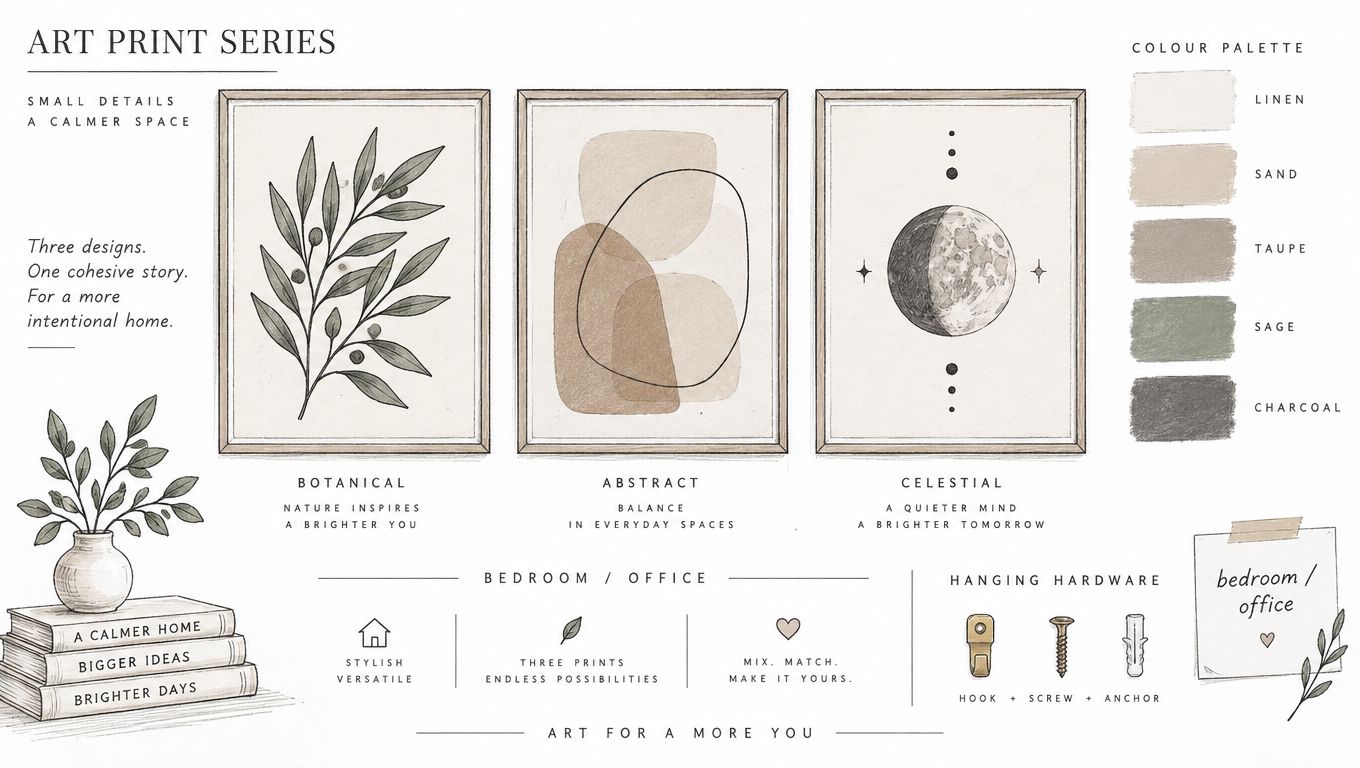
Buyer intent improves when the artwork solves a specific decorating problem. Examples include cat-themed botanicals for a pet-friendly room, celestial designs for a dark bedroom, heritage-inspired patterns, nursery art in a defined palette, and coordinated pieces for a home office. These ideas also offer stronger customization potential through color, size, subject, or room-specific sets.
Etsy's spring and summer 2026 trend report identifies “wall art decor” growth of 110% and “gallery prints” growth of 80%. Etsy's trend report offers directional evidence for curated display arrangements, although those trends do not guarantee demand for any particular style.
Sell a collection, not just a file
Build a repeatable series with a shared palette, composition, and subject. Show the full collection in one room mockup, then provide close details and size information. Digital files usually offer the quickest, lowest-risk test. Framed products and POD versions can support higher perceived value through scale, texture, and room context, but they introduce fulfillment, quality, and return considerations.
Search directions could include “dark academia bedroom art,” “neutral botanical gallery wall,” “celestial office decor,” and “cultural pattern wall art.” Price by format, customization effort, and production costs rather than treating every file as equivalent. Check cultural references, logos, characters, and recognizable phrases for trademark or other intellectual-property risks before publishing.
I'd compare competing visuals, then use Trendlytic to test a small group of related search directions. Launch one collection in digital and one POD format, review clicks and buyer questions, and expand only where the audience response supports the added production work.
5. Personalized Apparel with Names, Initials and Dates
Personalized apparel has strong buyer intent when it solves an event problem: a wedding party needs coordinated clothing, a family wants reunion shirts, or a graduate needs a timely gift. The occasion gives the listing a clearer audience, deadline, and design brief than a generic custom-shirt product.
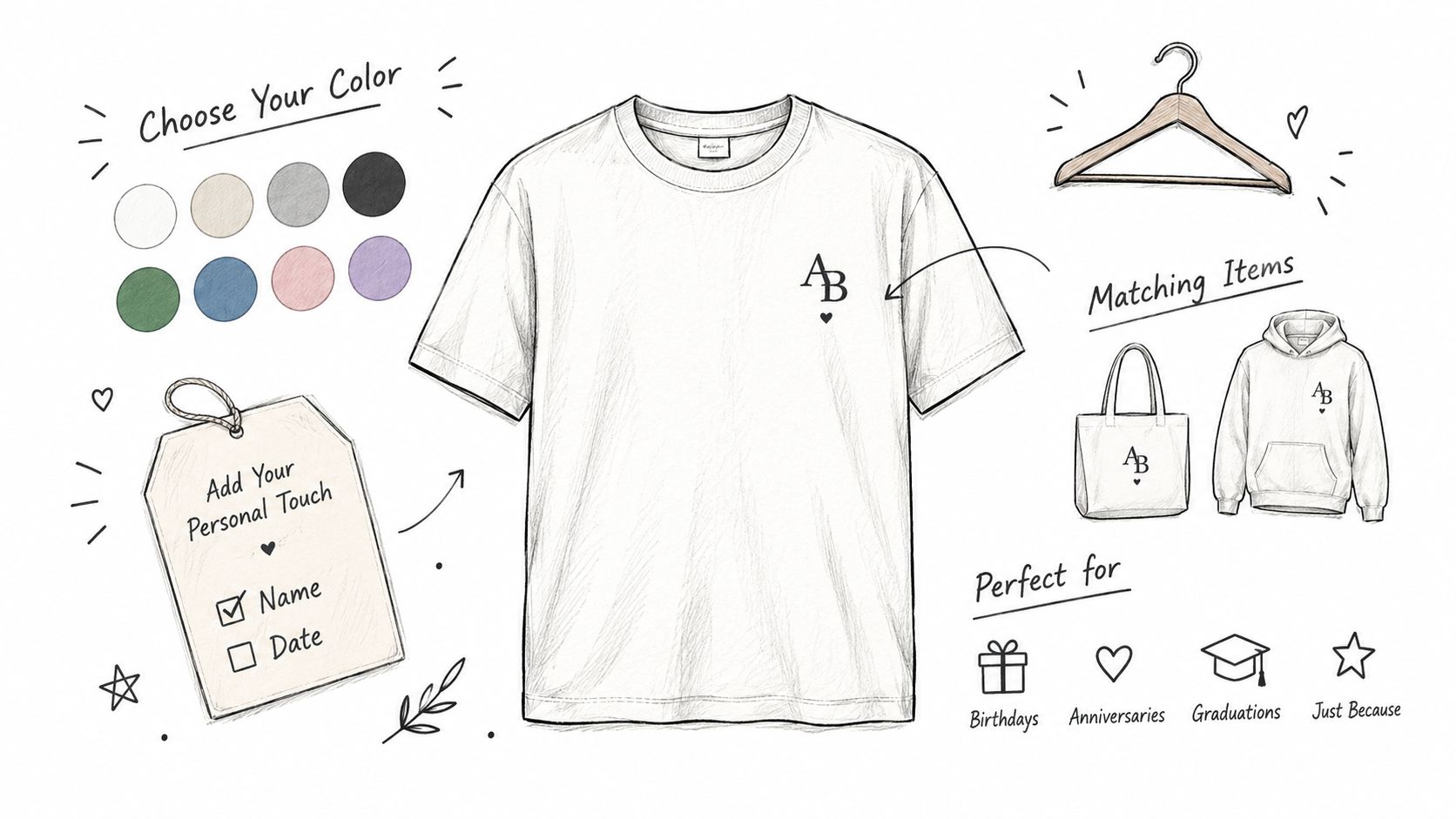
Prioritize repeatable formats such as shirts, hoodies, totes, and sweatshirts with names, monograms, roles, or dates. Family reunion shirts, wedding-party apparel, book-club hoodies, sports-team-inspired designs, and playful “Momager” products can all work, provided the wording and artwork are original.
Keep the customization system controlled. Offer a small font selection, a limited color palette, and one clearly labeled personalisation field. A proof or approval step makes sense for names and dates, since one spelling mistake can spoil the order and create replacement or support work.
Search language should describe the event and audience. Test directions such as “bachelorette party shirts,” “family reunion matching tees,” and “personalized book club hoodie” against the broader “custom shirt” term. Event-specific phrases usually reveal a more defined purchase need.
Build the listing around four checks:
- Show the use case: Present the garment in a believable group or gifting context.
- Clarify the deadline: State production and delivery expectations plainly.
- Separate templates: Give each event its own listing so shoppers can choose quickly.
- Check protected language: Sports teams, school names, slogans, mascots, and recognizable phrases may belong to someone else.
Price according to garment cost, design setup, personalization time, proofing, and replacement risk. POD adaptation is strong, but sizing information, print quality, color accuracy, and fulfillment reliability affect the buyer's experience more than offering endless garment types.
For validation, I'd compare Etsy search interest with apparel signals on TeePublic, Amazon Merch, and Redbubble through Trendlytic. I'd then create one original design system, test a small set of event terms, review clicks and customer questions, and expand only when the response justifies additional variants.
6. Print-Ready Designs and Graphics for Resellers
This opportunity targets a different buyer, namely another creator or small business owner who needs a usable design quickly. Social media templates, book covers, flyer graphics, branding kits, and product photography backdrops can all work when they solve a narrow professional task.
Generic “social media templates” are difficult to differentiate. A therapist practice kit, real estate agent launch pack, photographer pricing guide, or coach's content system gives the buyer a clearer reason to purchase.
Make usage rights impossible to miss
Reseller products create avoidable disputes when buyers don't understand what they can edit, sell, or redistribute. State whether the buyer receives personal use, commercial use, client-use rights, or an editable template. Don't imply that a buyer can claim exclusive ownership unless that is genuinely part of the offer.
A useful bundle might include social posts, email headers, a business card, and a lead magnet cover. The preview should show the assets in a realistic setting, such as a completed Instagram post or a branded client presentation.
The Julip digital products guide offers another way to think about digital product categories, but your own buyer research still needs to determine the niche.
For search validation, compare business-specific phrases and review the actual listings behind them. Trendlytic's earnings guide can sit alongside that process when deciding whether one design can extend across multiple products or marketplaces. I'd test one professional audience first, measure questions about licensing, and revise the listing before producing a larger catalogue.
7. Seasonal and Holiday Themed Art and Merchandise
Seasonal art follows a predictable buying calendar, but the discovery and fulfillment window can be short. Christmas designs, Halloween illustrations, winter décor, cultural holiday art, and seasonal gifts need to be ready before shoppers reach peak intent. Buyers often have a specific deadline, so delivery time can matter as much as the artwork.
The strongest concepts pair a seasonal cue with an identity that lasts. A cozy winter illustration, a horror design with a Halloween angle, or a family tradition print can remain relevant after the main event. Custom names, dates, or family details can raise buyer intent, while a repeatable visual system makes the same concept easier to adapt for apparel, wall art, cards, and print-on-demand products.
Match the offer to the calendar: Search phrases such as “Halloween party printable,” “winter family gift,” or “Christmas hosting décor” point toward different use cases. Compare the effort behind each format with its price. Digital wall art carries little fulfillment risk, while apparel and physical décor require enough margin for production, shipping, and possible delays.
Build a core collection: Keep one visual language across related products, then add nearby uses such as hosting, decorating, gifting, or family activities. Prepare alternate concepts before launch so weak early engagement does not leave the season without a replacement.
Protect the wording: Check holiday slogans, character references, and branded event names before publication. Tools like biography drafting software can also help when a seasonal design draws on a personal story or family history. Don't imply that a buyer can claim exclusive ownership unless that is part of the offer.
For validation, compare Etsy results with POD signals in Trendlytic before producing a collection. Check whether demand appears tied to one moment or a durable subculture, test a small set of listings early, and review clicks, saves, questions, and production constraints before expanding.
8. Book Covers, Book Illustrations and Author Products
Authors buy art to complete a publishing project, so the intent can be stronger than in general décor browsing. They may need a cover, interior illustration, author branding, bookmarks, social graphics, or a coordinated launch package.
Genre specificity is essential. A paranormal romance author and a dark academia fantasy author may both want dramatic art, but their visual conventions and audiences differ. Search directions should reflect that distinction, such as “dark paranormal romance cover,” “fantasy author branding,” or “LGBTQ+ romance cover design.”
Build for the author's workflow
A cover template must leave room for title, author name, series information, and platform-specific dimensions. Show the design with realistic placeholder text so the buyer can see whether the hierarchy remains legible.
A useful offer may combine a cover with bookmarks, social media graphics, and a launch banner. That increases the practical value without requiring an entirely new visual concept for every asset. Editable files can be attractive, but the listing must explain which software is required and what the buyer receives.
I'd validate by studying current genre packaging across legitimate publishing channels, then comparing Etsy bestseller signals with author discussions and search terms. The aim isn't to imitate a successful book cover. It's to understand the conventions a reader already recognises and add an original point of view.
Trademark caution matters here. Series names, fictional characters, publisher marks, and recognisable franchise language can create problems. Use original genre language, and check potentially branded phrases before turning them into a product line.
9. Niche Community and Identity-Based Art
Identity-based art sells when it addresses a clear need for recognition, belonging, or celebration. The strongest opportunities usually combine high buyer intent with a specific audience problem, such as finding respectful LGBTQ+ wall art, culturally relevant family gifts, disability representation, religious artwork, or social justice products.
Rank ideas by four practical factors: buyer intent, customization potential, repeatability, and POD adaptation. A personalized print for a particular faith community may command stronger intent and pricing than a generic identity slogan, while a repeatable collection of affirming apparel may adapt more easily to print-on-demand. Customization can add value through names, family details, languages, or celebration dates, but it also increases production time and review risk.
Use precise search directions rather than broad labels. Examples include “disabled queer gift,” “Latina family celebration print,” “inclusive religious wall art,” and “disability pride shirt.” These phrases point toward audience context and product use, not just identity categories.
Research community voices before designing. Read how people describe themselves, check whether symbols or patterns carry sacred or historical meaning, and seek collaboration when lived experience is absent. The audience should recognise itself in the work without encountering stereotypes or token imagery.
I would test a small set of related designs with community feedback before expanding into POD apparel or décor. Trendlytic can help compare adjacent search demand and competition. Then review competing listings manually, assess the specificity of their offers, and ask whether the product feels affirming rather than opportunistic.
Trademark and usage checks belong in the workflow. Flags, campaign phrases, religious iconography, and community slogans may have restrictions. Keep original wording, document permission where relevant, and price the work according to customization and production effort rather than assuming broad appeal guarantees sales.
10. Educational Materials and Classroom Resources
Educational art sells when it saves a teacher time or improves a lesson. Worksheets, classroom posters, study guides, lesson plans, and subject-specific bundles are more practical than decorative products alone.
The buyer's search often includes a grade level, subject, skill, or teaching approach. “High school literature unit,” “ESL classroom resource,” “inclusive special education worksheet,” and “project-based learning activity” are more useful directions than a broad “teacher printable” label.
Package the teaching outcome
A complete unit can include student pages, answer keys, teacher notes, extension activities, and differentiated versions. Editable files can help teachers adapt names, examples, or school branding, but static PDFs may be easier for buyers who want immediate printing.
I'd build around one grade and subject combination first. Test the material yourself, check every answer, print the pages, and make sure the instructions are clear without a private explanation from the seller. A polished cover won't compensate for a worksheet that creates extra work.
Trendlytic's high-demand, low-competition niche guide can support the early keyword stage. Compare related phrases, then inspect whether competing products solve the same classroom problem or merely use similar words.
Trademark and curriculum language also deserve attention. Standards references may be useful when accurate, but don't imply official endorsement. Avoid branded characters and protected educational programmes unless you have permission. The best POD adaptation is usually classroom posters, teacher apparel, or visual aids, while the core product remains digital.
Top 10 Etsy Art Categories Comparison
| Item | Implementation Complexity 🔄 | Resources & Skills ⚡ | Expected Outcomes ⭐ / 📊 | Ideal Use Cases | Key Advantages & Tips 💡 |
|---|---|---|---|---|---|
| Custom Pet Portraits & Illustrations | High 🔄🔄🔄 | Illustration skill or hired artists; template systems; POD/print partners ⚡⚡ | ⭐⭐⭐⭐, High perceived value, strong repeat/custom orders 📊 steady margins (digital > physical) | Memorials, gifts, pet-owner bundles, POD collections | 💡 High margins on digital; limit customization options; research trending breeds |
| Motivational & Inspirational Quote Prints | Low–Medium 🔄🔄 | Typography + layout skills; minimal production, POD or digital ⚡⚡⚡ | ⭐⭐, Broad appeal but price pressure; 📊 evergreen demand with seasonal spikes | Office décor, gifts, wellness, event favors | 💡 Niche-target quotes + unique lettering; combine with imagery; verify quote ownership |
| Downloadable Planners, Journals & Productivity Templates | Medium 🔄🔄 | Layout/design (Canva/PDF); editable formats; instant delivery ⚡⚡⚡ | ⭐⭐⭐⭐, Very scalable, 100% margin digital; 📊 high ROI in targeted niches | Niche planners (wedding, finance, students), bundle sales, seasonal launches | 💡 Bundle related templates; offer editable + PDF; update seasonally |
| Niche Wall Art & Home Décor Illustrations | High 🔄🔄🔄 | Strong illustration + presentation skills; POD/manufacturer coordination ⚡⚡ | ⭐⭐⭐, High AOV for premium formats; 📊 impulse/social sales; trend-sensitive | Room-specific decor, cohesive series, trend-driven collections | 💡 Create series for set sales; test palettes across POD platforms |
| Personalized Apparel with Names, Initials & Dates | Medium 🔄🔄 | Template systems, clear customization workflow, POD suppliers ⚡⚡ | ⭐⭐⭐, Good conversion for gifts; 📊 seasonal/occasion-driven revenue | Weddings, family matching, sports teams, milestone gifts | 💡 Limit font/color choices; require approval to avoid errors; use templates to scale |
| Print-Ready Designs & Graphics (Resellers) | Medium 🔄🔄 | Professional design tools, licensing knowledge, multiple file formats ⚡⚡⚡ | ⭐⭐⭐⭐, Passive B2B income; 📊 high lifetime value per asset when licensed | Small businesses, coaches, social templates, branding kits | 💡 State rights clearly; target specific business niches; include real-world demos |
| Seasonal & Holiday Themed Art & Merchandise | Medium 🔄🔄 | Design + advance planning; limited editions, inventory or POD coordination ⚡⚡⚡ (fast sales during peaks) | ⭐⭐⭐, Predictable high spikes; 📊 revenue concentrated in short windows | Christmas, Halloween, Pride-adjacent seasonal collections | 💡 Plan 4–6 months ahead; create holiday-adjacent evergreen pieces |
| Book Covers, Book Illustrations & Author-Related Products | High 🔄🔄🔄 | Genre knowledge, professional cover/print-ready skills, formatting expertise ⚡⚡ | ⭐⭐⭐⭐, High per-sale value and licensing; 📊 niche but profitable market (authors) | Indie authors, pre-made covers, author branding bundles | 💡 Study genre trends; offer cover + marketing asset bundles; ensure print specs |
| Niche Community & Identity-Based Art (LGBTQ+, Cultural, Disability) | High (authenticity required) 🔄🔄🔄 | Community insight, culturally informed design, sensitive research ⚡⚡ | ⭐⭐⭐⭐, Highly engaged, loyal buyers; 📊 strong word-of-mouth, smaller TAM | Pride merch, cultural heritage art, fundraising collaborations | 💡 Be authentic; engage communities; consider partnerships/donations |
| Educational Materials & Classroom Resources (Digital) | Medium–High 🔄🔄🔄 | Education expertise, curriculum alignment, editable formats (PDF/Slides) ⚡⚡⚡ | ⭐⭐⭐, Scalable with motivated buyers; 📊 seasonal (back-to-school) spikes | Teacher bundles, grade-specific units, ESL/special education resources | 💡 Include answer keys and differentiated versions; target grade/standards |
Choose One Etsy Art Lane and Test It Carefully
The ten opportunities don't have equal operating demands. Custom pet portraits and personalized apparel offer strong emotional or event-led intent, but they require customer communication and approval management. Digital planners, reseller graphics, and educational resources are more repeatable, but buyers can compare them quickly and expect clear instructions. Wall art and seasonal merchandise can adapt well to POD, but broad visual categories face dense competition.
I'd start with one audience and one primary format. Don't launch pet portraits, classroom resources, quote prints, and holiday shirts at the same time. A narrow start gives you a better chance to build a coherent shop, understand your buyer questions, and identify which part of the offer creates work.
Begin with a small group of related keyword ideas. Look for the intersection of a person, a problem, a room, an occasion, or a specific aesthetic. “Art print” describes a product. “Neutral botanical office print set” gives you a buyer, a setting, and a visual direction.
Build a collection with a controlled test
Create a coherent initial collection rather than unrelated experiments. Keep the visual system consistent, but vary the subject, personalization field, room, event, or use case. This lets you learn whether buyers respond to the audience, format, or design treatment.
For each listing, test the parts buyers can see:
- Primary image: Make the artwork readable at thumbnail size and show its real use.
- Title and tags: Use buyer language, not internal design terminology.
- Description: State dimensions, files, materials, customization limits, and delivery expectations.
- Offer structure: Compare a single product with a relevant bundle.
- Fulfillment: Check print quality, packaging, file access, and response time before expanding.
Etsy charges a $0.20 USD listing fee per item, and each listing expires after four months. Auto-renewing a listing triggers another $0.20 USD charge and starts a new four-month period, according to Etsy's fee policy. For multiple-quantity listings, Etsy charges the initial listing fee once and then charges $0.20 USD for each additional quantity sold, as explained in Etsy's fee and tax guidance. Include those costs in your test plan rather than treating them as an afterthought.
A renewal creates a new listing date and expiration date, but the listing keeps its original views, favorites, and web address. Etsy's renewal guidance makes that useful when you refresh inventory without discarding accumulated listing history.
Trendlytic can help compare live bestseller signals across Etsy and the other covered POD marketplaces. I'd review its Opportunity Score, validated designs, related keywords, and current bestseller patterns as research inputs, not as a substitute for original design judgment. Use its USPTO trademark check before publishing phrases or branded concepts, especially in apparel, fandom-adjacent art, community products, and quote collections.
Track clicks, favorites, conversion, revision time, customer questions, and fulfillment quality. One listing can't tell you whether an idea works, and a strong click-through rate won't help if the product creates refunds or production problems. Keep a simple record of each change so you know whether a new image, clearer personalization process, better keyword, or different format made the difference.
Etsy art buyers clearly respond to personalization, printable formats, décor-friendly collections, and emotionally specific products, but competition remains intense. The practical question isn't only “what art sells on Etsy?” It's whether you can make a product that feels relevant to one buyer, present it clearly, deliver it reliably, and repeat the process without losing quality.
Trendlytic helps POD sellers research live bestseller signals across Etsy, TeePublic, Amazon Merch, and Redbubble, with niche reports, keyword insights, validated designs, pricing information, and an Opportunity Score. If you want to reduce manual cross-platform research before choosing your Etsy art lane, visit Trendlytic and test the ideas against your own audience, designs, and production capacity.