Etsy Keyword Research: A Seller's Honest Guide

Most Etsy keyword advice starts in the wrong place.
It tells sellers to chase the biggest words in the market. Jewelry. Wall art. Stickers. Personalized gifts. Those terms look important, so people build listings around them and hope volume will carry them. In practice, that usually means walking straight into the most crowded part of Etsy.
For most shops, especially POD shops, Etsy keyword research works better when it gets narrower, not broader. Broad terms attract broad competition. Specific phrases attract buyers who already know what they want.
Table of Contents
- Why Most Etsy Keyword Research Starts Wrong
- How Etsy Search Works
- A Practical Etsy Keyword Research Workflow
- Demand vs Competition on Etsy
- Etsy Keyword Research for POD Sellers
- Title and Tag Best Practices for Etsy Listings
- Putting It All Together
Why Most Etsy Keyword Research Starts Wrong
The usual advice sounds sensible and fails a lot of shops.
Sellers are told to start with the biggest obvious phrase in their category, then work outward from there. I've done that. It usually leads to listings built around words with heavy competition, weak buyer intent, and too little room to stand out, especially in POD where ten shops can sell nearly the same product with slightly different art.

Broad keywords feel safe, but they usually waste effort
A broad term like "wall art" or "funny shirt" looks attractive because it describes a whole market. The problem is that it rarely describes a specific listing well enough to help a smaller shop win. It also attracts shoppers who are still browsing, comparing styles, or figuring out what they even want.
That matters because Etsy buyers often search in short phrases, but short does not mean vague. A two or three word search can still carry clear intent if it includes a style, audience, occasion, or product type. "Teacher coffee mug" is different from "mug." "Retro camping shirt" is different from "shirt."
POD sellers get hit hardest here. Competing on giant category terms usually means sitting beside thousands of lookalike listings, many with stronger shop history, more reviews, or better conversion signals.
Long-tail keywords do the filtering for you
The better starting point is usually a phrase that narrows the product on purpose. That can be a recipient, niche interest, design style, holiday angle, or use case. Good long-tail terms filter out casual browsers and bring in buyers who are closer to a decision.
That does not mean every longer phrase is worth targeting. Some are too obscure to matter. Some describe a product nobody searches for. Some look promising until you realize the wording brushes up against trademark problems, which is common in POD.
The trade-off is simple. Broader phrases can bring more potential impressions, but they also put you into tougher auctions for attention. Narrower phrases bring less total volume and often convert better because the match is tighter.
What usually works better:
- Start with the product's real angle, such as recipient, hobby, style, occasion, or message
- Choose phrases a buyer would type, not internal category labels
- Check competition before committing, because a relevant keyword can still be too crowded
- Screen phrases for trademark risk early, before you build titles, tags, and designs around them
What usually goes wrong:
- Using giant category terms as the core keyword
- Copying the same generic tags used by established shops
- Forcing high-volume phrases into titles that stop sounding like the product
- Treating keyword research as separate from compliance, then having to rework listings later
The goal is not to find the biggest keyword. The goal is to find the clearest phrase you can realistically compete for and safely use.
One published Etsy keyword analysis found that high-opportunity terms are rare, many searches are short, and competition drops sharply as phrases become more specific, which lines up with how long-tail targeting behaves in real shops (Listogics Etsy statistics and search analysis).
How Etsy Search Works
Etsy search rewards fit, not keyword stuffing.
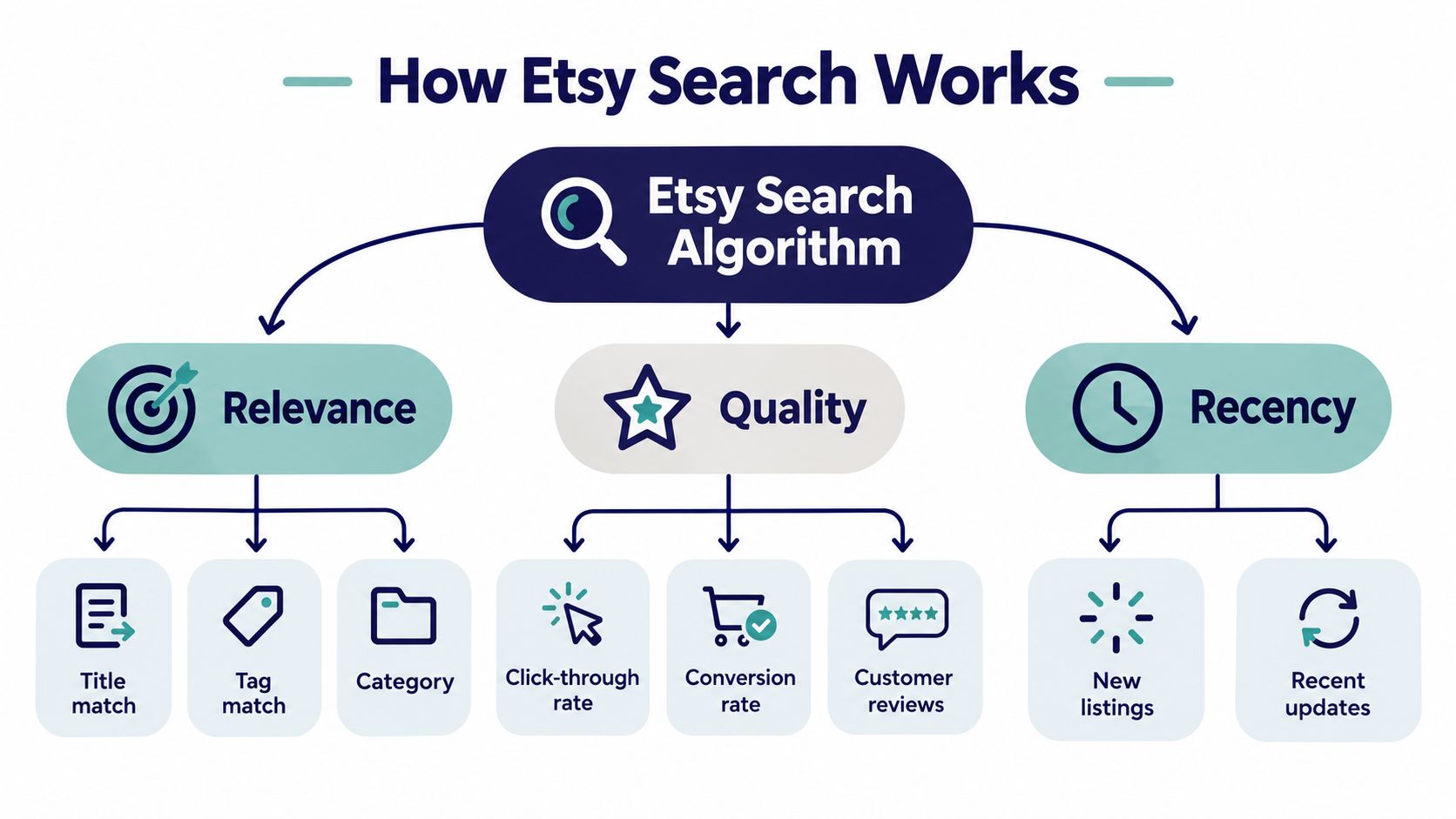
A listing can contain the right phrase and still sink if the rest of the listing sends weak signals. That is the part newer sellers miss. Search starts with matching the query, but ranking does not end there. Etsy explains that search considers keyword relevance across titles, tags, categories, attributes, and other listing details in Etsy's explanation of how search works.
Relevance gets you into the results
Etsy needs a clear answer to a simple question. Is this listing a strong match for what the buyer typed?
That is why wording still matters so much, especially for long-tail searches. If someone searches for "retro camping shirt for dad" and your listing is built around broad tags like "funny tee" or "gift for him," you have made Etsy guess. Guessing usually loses to listings that spell out the product, audience, and intent more clearly.
For POD sellers, long-tail terms do real work. They narrow the search, reduce direct competition, and bring in buyers who already know what they want.
Useful keyword phrasing usually does three things:
- Describes the item in buyer language
- Fits naturally in the title
- Shows up again through tags, attributes, and category choices
If the phrase sounds unnatural, it usually performs like it.
Quality signals decide how long you hold position
Getting matched is only the first step. Staying visible depends on whether shoppers respond well to the listing.
Etsy has said that search placement is influenced by listing quality, customer and market experience, and recency in its Seller Handbook keyword guidance. In practice, that means the thumbnail has to earn the click, the product has to match the promise of the keyword, and the page has to do enough to convert.
I have seen this happen with POD listings that target a good phrase but pair it with a weak mockup. The keyword was fine. The click-through rate was not. In other cases, the mockup got the click, but the title promised one style and the design delivered another. Conversion fell, and the listing slid.
A keyword can be relevant and still be the wrong keyword for your listing if it attracts the wrong buyer.
Search performance is tied to the whole listing
This is why Etsy SEO is never just a title exercise. Search reads your listing as a package.
A practical way to evaluate that package:
- Use the target phrase where it helps relevance most, especially title, tags, category, and attributes
- Make the first image match the search intent
- Keep the product, wording, and design style aligned after the click
- Avoid terms that raise trademark risk, even if demand looks good
- Support the listing with a reliable shop experience
That fourth point gets ignored in a lot of Etsy SEO advice, but POD sellers cannot afford to treat keyword research and compliance as separate jobs. A phrase with demand is useless if you cannot use it safely.
If you want to spot changes in shopper wording before you rewrite listings, Trendlytic's guide to Etsy trend search is a useful reference.
A Practical Etsy Keyword Research Workflow
Good Etsy keyword research is slower than people want it to be.
The mistake is chasing big category phrases because they look important. For most POD sellers, that usually means fighting stronger shops for traffic that is too broad to convert well anyway. The better workflow starts narrower, with the language real buyers use when they already know the style, audience, or occasion they want.
Step one, mine Etsy autocomplete
Start with a plain seed term in Etsy search and record the autocomplete suggestions. Those suggestions are useful because they come from shopper behavior, not seller guesswork.
Then push the phrase in small directions. Change one variable at a time: product type, recipient, style, use case, mood, or occasion. A generic shirt idea can branch into phrases around teachers, new moms, retirement gifts, book lovers, camping trips, or a specific design style. That is usually where the better long-tail options show up.
If you run out of useful variations too fast, this guide on how to find related keywords is a practical way to expand the list without drifting into irrelevant terms.
Keep a rough sheet while you do this. Do not clean it up too early. Messy collection first, filtering second.
Step two, validate the phrases against real listings
Once you have a list, check each phrase inside Etsy search results. I look for three things:
- How crowded the results are
- Whether the top listings show real buyer interest
- Whether the pricing leaves enough margin for the product
That approach lines up with the process outlined in this Etsy keyword research guide, and it holds up in practice because it forces you to look at a market, not just a phrase.
This step matters more for POD than a lot of sellers realize. Some niches look attractive until you see race-to-the-bottom pricing. Others have manageable competition, but the top results are weak, outdated, or poorly matched to the search. Those are often better opportunities than the obvious high-volume terms everybody is targeting.
I have wasted time on keywords that looked easy because the listing count was lower, then found that nobody was engaging with the products ranking there. Low competition by itself is not a win.
Step three, choose one clear keyword theme per listing
One listing needs one main search intent.
Sellers get into trouble when they try to force a single shirt or mug to rank for multiple unrelated audiences. The title gets messy, the tags lose focus, and the listing starts attracting mixed traffic. Etsy can index that listing, but it often struggles to rank well for any one thing.
A cleaner setup is to pick one primary phrase, place it early in the title, and support it with closely related secondary phrases in the rest of the title, tags, categories, and attributes. Keep the variations tight. If the primary term is about a funny nurse gift, the supporting terms should stay close to that buyer intent. Do not suddenly wedge in teacher gift, mom shirt, or coworker present unless the product fits all of them, which it usually does not.
Here is the workflow in a usable format:
| Stage | What to do | What to avoid |
|---|---|---|
| Discovery | Collect autocomplete phrases and wording from relevant competing listings | Making up terms shoppers do not use |
| Validation | Check result volume, engagement signals, and pricing patterns | Choosing keywords on instinct alone |
| Selection | Pick one primary long-tail theme that matches the exact product | Mixing unrelated buyer intents in one listing |
| Deployment | Put the main phrase early, then support it with related tags and attributes | Repeating the same wording everywhere or stuffing broad terms |
The shops I have seen improve fastest usually stop trying to rank one listing for everything. They build more focused listings instead. That takes more discipline, but it gives Etsy a much clearer read on what each product is for, and it reduces the trademark and relevance mistakes that happen when sellers chase every phrase that looks popular.
Demand vs Competition on Etsy
This is the balancing act that matters most.
A keyword can have clear demand and still be a poor target. Another can look small at first glance and turn out to be far more usable because the competition is manageable and the buyer intent is sharper.
Etsy's scale is why this matters. One marketplace update cited about 86.6 million active buyers in Q1 2026 and about $2.5 billion in marketplace gross merchandise sales in that quarter, while a later Q2 2026 update reported roughly $2.58 billion in marketplace GMS, according to this Etsy marketplace statistics summary. There's plenty of buyer activity on Etsy. The hard part is surfacing in the right slice of it.
Broad terms attract broad competition
The broad category terms get attention because they're visible. They also pull in huge numbers of competing listings, vague intent, and lots of established sellers.
That doesn't mean broad phrases are useless. They can still help with categorization and secondary relevance. They just rarely make sense as the main phrase a smaller listing is trying to win.
Niche phrases give you a fairer fight
Specific phrases narrow the field. They also do a better job of matching the buyer who already knows the style, audience, or message they want.
Here's the practical difference:
| Keyword Type | Example | Avg Monthly Searches | Competing Listings | Best For |
|---|---|---|---|---|
| Broad | jewelry | Qualitatively high, but usually crowded | Very high | Large established catalogs, secondary relevance |
| Broad | wall art | Qualitatively high, but usually crowded | Very high | Shops with deep category authority |
| Niche | birth month flower sweatshirt | Lower, but often more intentional | Lower than broad parent terms | Focused POD listings with clear intent |
| Niche | funny camping dad shirt | Lower, but often more actionable | Lower than broad parent terms | Gift-driven and audience-specific products |
| Niche | minimalist teacher tote bag | Lower, but often more specific | Lower than broad parent terms | Listings built around one style and buyer |
The sweet spot isn't the biggest keyword. It's the phrase where demand exists and your listing still has room to compete.
If I'm choosing between a huge parent term and a cleaner long-tail phrase that matches the design exactly, I'll usually take the second one. It gives the listing a real identity. On Etsy, that tends to matter more than sounding broad.
Etsy Keyword Research for POD Sellers
POD sellers have a different problem from handmade sellers with a single custom product line. The catalog can grow fast, but that doesn't mean every design deserves a listing. Good Etsy keyword research helps decide which ideas are worth publishing and how they should be framed.

POD shops need narrower intent, not broader reach
Most public keyword roundups still push sellers toward broad winners like jewelry, wall art, stickers, and personalized gifts. A recent roundup also noted that seasonal gift-related searches can swing 300 to 800%, which is useful context, but it doesn't solve the problem of choosing keywords that aren't already saturated, as discussed in this review of Etsy search trends.
For POD, the better question is usually narrower:
- Is this phrase evergreen or event-driven?
- Does it fit a design style I can produce well?
- Is the buyer intent clear enough to support a strong mockup and title?
- Will the niche still make sense after the seasonal spike passes?
A phrase can trend and still be a bad listing target if everyone rushes into it with nearly identical products.
Trademark checks are part of keyword research
This is one of the least glamorous parts of the process, but it matters.
The USPTO trademark database distinguishes between live and dead status, and USPTO search guidance notes the [ld] field for checking whether a mark is live or dead, while also recommending dead-on searching in the [comb] field in this USPTO advanced search PDF. If a phrase is protected and active, it doesn't matter how good the search demand looks. It's not worth the risk.
I treat trademark checking as part of ideation, not a final cleanup step. That saves time and keeps bad keywords from spreading into drafts, filenames, tags, and design variants.
A workable POD routine
This is the routine I'd use for a new POD niche:
- Start with a design angle that has a clear audience, not a giant market label.
- Collect actual Etsy phrasing from autocomplete and listing language.
- Check whether the phrase looks evergreen or seasonal.
- Run a trademark check before building the listing.
- Choose the phrase only if the design, mockup, and wording all line up.
For sellers working across marketplaces, one option is Trendlytic. It covers TeePublic, Amazon Merch, Redbubble, and Etsy, and it includes a built-in USPTO trademark check. That's useful when you want to compare niche language across platforms without doing each step in a separate tool.
A quick walkthrough helps if you're building a repeatable process for product ideas:
Title and Tag Best Practices for Etsy Listings
Once the keyword is chosen, placement matters.
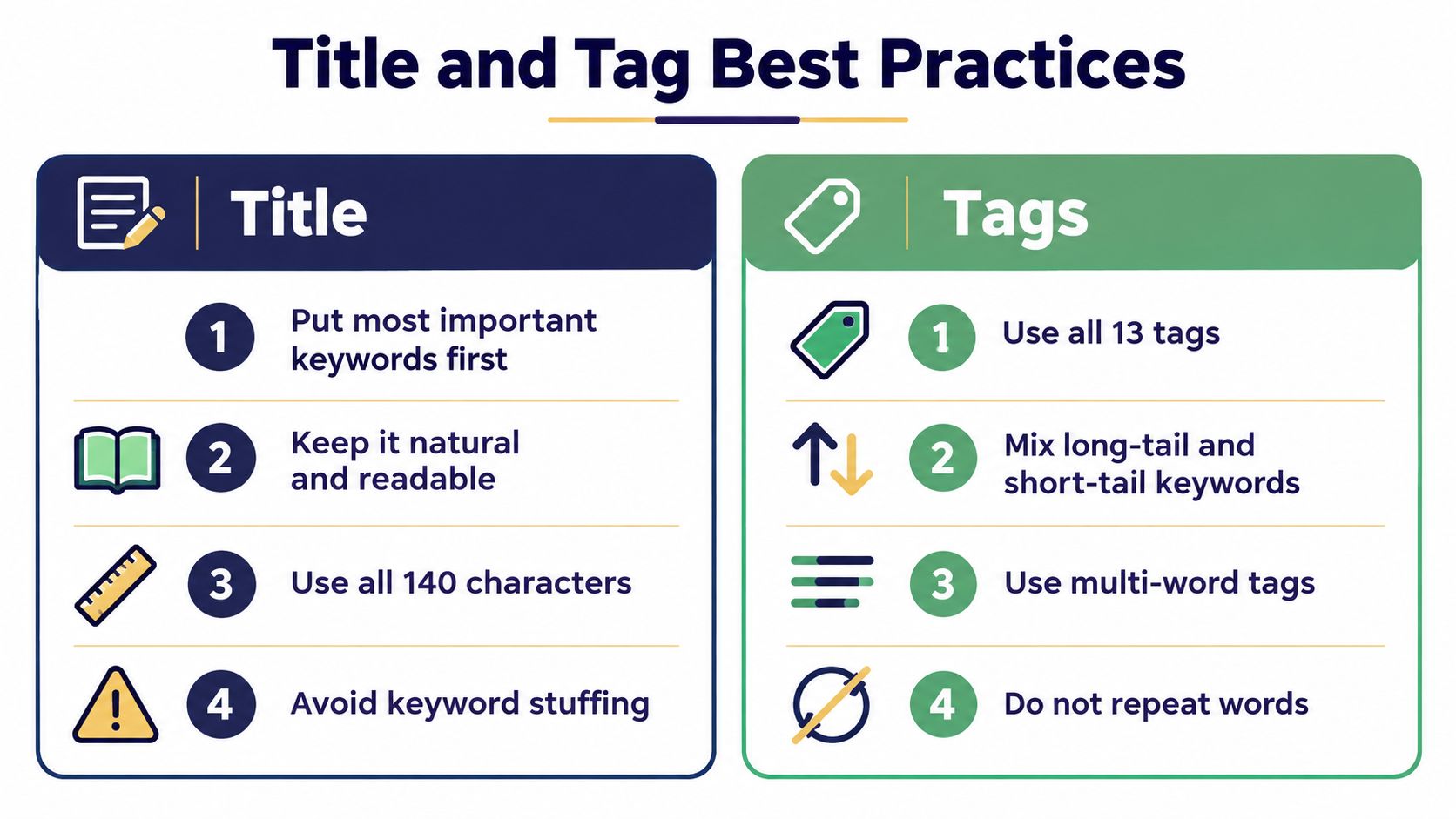
Etsy says keywords in the title help match a shopper's query, titles are only one factor in search, and search also considers keywords and phrases in listing descriptions. Etsy also advises placing the strongest keywords at the beginning of titles and in the first line of descriptions in Etsy's keywords handbook article.
Build the title around one main phrase
A clean Etsy title usually performs better than a title trying to jam in every variant you found during research.
Use the strongest phrase early. If the primary keyword can fit inside the first part of the title naturally, that's usually the right move. Then add closely related modifiers that support the same product theme.
A practical title approach:
- Lead with the primary phrase in the opening part of the title.
- Add related descriptors such as recipient, style, or occasion.
- Keep it readable because humans still need to click it.
Bad titles usually have one of two problems. They're either too vague, or they're stuffed with disconnected keyword fragments.
If a title sounds like it was written for a machine, shoppers usually treat it that way too.
Use all 13 tags, but make them varied
Etsy's handbook emphasizes using all 13 tags, adding variety, filling all relevant attributes, and choosing the most specific categories possible because attributes can act like additional tags, as explained in Etsy's seller guidance on search fields.
Missing attributes can reduce your reach.
A simple listing framework looks like this:
| Listing Element | What to prioritize |
|---|---|
| Title opening | Primary keyword |
| Rest of title | Secondary phrases that support the same intent |
| Priority tags | Closely related variations and sub-intents |
| Remaining tags | Tertiary long-tail phrases and alternate buyer wording |
| Attributes | Every relevant option that matches the product |
| Category | The most specific accurate category |
If you're refining listing structure for apparel and similar products, this guide on SEO for print-on-demand is a useful reference.
Keep the theme tight
The easiest mistake is trying to make one listing rank for multiple unrelated niches.
Don't make a teacher shirt also try to rank as a nurse gift, mom gift, and graduation shirt unless the design supports all of those intents. Most of the time, that weakens the listing because the title, tags, and message stop pointing in the same direction.
One listing. One main theme. One buyer intent cluster. That discipline fixes a lot.
Putting It All Together
Good Etsy keyword research is less about chasing magic phrases and more about making solid decisions repeatedly.
Start with language buyers already use. Narrow it down with competition and demand signals. Keep the listing focused on one intent. Protect yourself with a trademark check before you publish. Then write a title, tag set, and description opening that all support the same product idea.
That process isn't glamorous, but it's dependable.
The other thing worth accepting is that keywords don't live alone. A strong phrase can still struggle if the first image is weak, the product-market fit is off, or the listing promises one thing and shows another. Etsy search rewards alignment. The keyword, mockup, title, tags, and shopper expectation all have to agree.
I've made the usual mistakes here. Chasing broad phrases because they looked important. Publishing listings that tried to target too many angles at once. Treating keyword research like a one-time setup job instead of an ongoing habit. The fix was rarely a trick. It was usually better judgment and tighter wording.
If you sell POD on Etsy, the long-tail approach tends to age better than broad-category chasing. It's slower, more deliberate, and less exciting on the surface. It's also much more workable when you're trying to rank without copying what every other shop is already doing.
The sellers who stay steady usually aren't guessing less because they're lucky. They're guessing less because they built a process.
If you want help speeding that process up, Trendlytic gives POD sellers niche research across Etsy, TeePublic, Amazon Merch, and Redbubble, along with built-in USPTO trademark checks. It's useful when you want to validate keyword ideas, compare niche language across platforms, and spend less time doing the manual digging.