How to Create Bundles That Protect Your POD Margins
You've got a few designs that look good together, and you're considering turning them into a set. The tempting next move is to add a discount and hope a larger cart makes up for the lower margin. I've found it's better to decide what the bundle does for the buyer first, then work out whether discounting makes financial sense.
To create bundles that hold up, start with a clear theme, check whether the items suit the same buyer, and account for each platform's pricing mechanics. A bundle can earn its place by saving someone time or making a coordinated gift easy to choose, even when the price stays the same.
Table of Contents
- Why Bundles Help Buyers Decide Faster
- Knowing When a Bundle Should Not Be Discounted
- Choosing Designs and Products That Belong Together
- Setting Up Bundles on Etsy, Merch, Redbubble, and TeePublic
- Pricing a Bundle Without Eroding Your Margin
- Checking Trademarks, Images, and Tags Before You Publish
- Tracking Bundle Results and Choosing Your Next Test
Why Bundles Help Buyers Decide Faster
A buyer searching for a teacher gift might find a tote, a mug, and a sticker set built around the same classroom theme. If the listing presents them as a coordinated set, the buyer can understand the purpose quickly. They don't have to open separate listings, compare unrelated designs, and decide whether the products will feel like a thoughtful gift together.

That convenience matters when shoppers are juggling other decisions. In a controlled grocery-shopping experiment with 250 consumers, the odds of choosing a bundle under high cognitive load were 3.98 times higher than under no load. Participants were also more likely to choose a bundle even when it didn't save them money, as reported in the study of bundle choices under cognitive load.
The study doesn't guarantee that a POD bundle will sell better. Grocery choices and print-on-demand purchases aren't identical. But it offers a useful way to think about the buyer's experience: a well-curated set can make the decision easier by showing what belongs together and why.
Coherence is part of the offer
A bundle isn't automatically helpful because it contains several products. It needs to tell a simple story. The teacher set makes sense because each item suits the same recipient and occasion. A mug with a classroom illustration, a tote with an unrelated joke, and a sticker featuring a different aesthetic may create more questions than value.
When I assess a possible set, I ask whether a buyer can grasp its purpose from the thumbnail and listing title. If the answer is no, adding more products probably won't fix it. Start with a clear use case, then choose items that make that use case easier to act on.
Knowing When a Bundle Should Not Be Discounted
A discount isn't a required part of a bundle. Sellers often reach for one because a lower price seems like the simplest way to explain the offer. But if the products already work together and the buyer understands the set, discounting may give away margin without improving the reason to buy.
The distinction I use is between a value bundle and a clearance bundle. A value bundle brings together coordinated items for one hobby, identity, or event. A clearance bundle groups whatever needs moving, even if the designs don't share an audience or purpose. The first can make shopping simpler. The second may look like a pile of leftovers unless the buyer has a reason to want the combination.
A 2025 consumer report found that 69 percent of shoppers intended to reduce spending, while 45 percent ranked bundle discounts such as buy-one-get-one offers among promotions that drive online purchases, according to the 2025 consumer research report. Those findings make price worth considering, but they don't mean every set needs a markdown. A clear bundle can meet a buyer's need without competing on discount alone.
Choose the lever that fits
Before publishing, work through these questions:
- Does the set solve a specific use case? Coordinated gifts or products for one shared interest have a clearer reason to exist than unrelated designs grouped together.
- Can the margin support a discount? Include platform fees, production costs, shipping, and the likely effect of refunds before choosing a lower price.
- Would another benefit make the offer clearer? Depending on the platform, free shipping, an exclusive design, or a bonus digital file may be more suitable than cutting the item price.
- Would the buyer still understand the set at full price? If not, improve the product selection or listing presentation before using a discount to make it seem worthwhile.
If a discount would erase profit, I'd test a different lever or offer the set without one. The right choice depends on the costs and customer use case, not on a blanket rule that bundles must be cheaper.
Choosing Designs and Products That Belong Together
I'd begin with what customers already buy, not with the products I happen to have available. Review order data for products bought together, or look at which designs in a niche seem to fit the same buyer and occasion. Then shortlist themes such as a profession, hobby, holiday, or identity.
The reason to favor a shared theme isn't just visual neatness. Foundational bundling research found that complementary products generate higher purchase intentions than similar or unrelated products. That supports building a coherent collection rather than automatically packaging top sellers together, as discussed in this foundational analysis of product bundling.
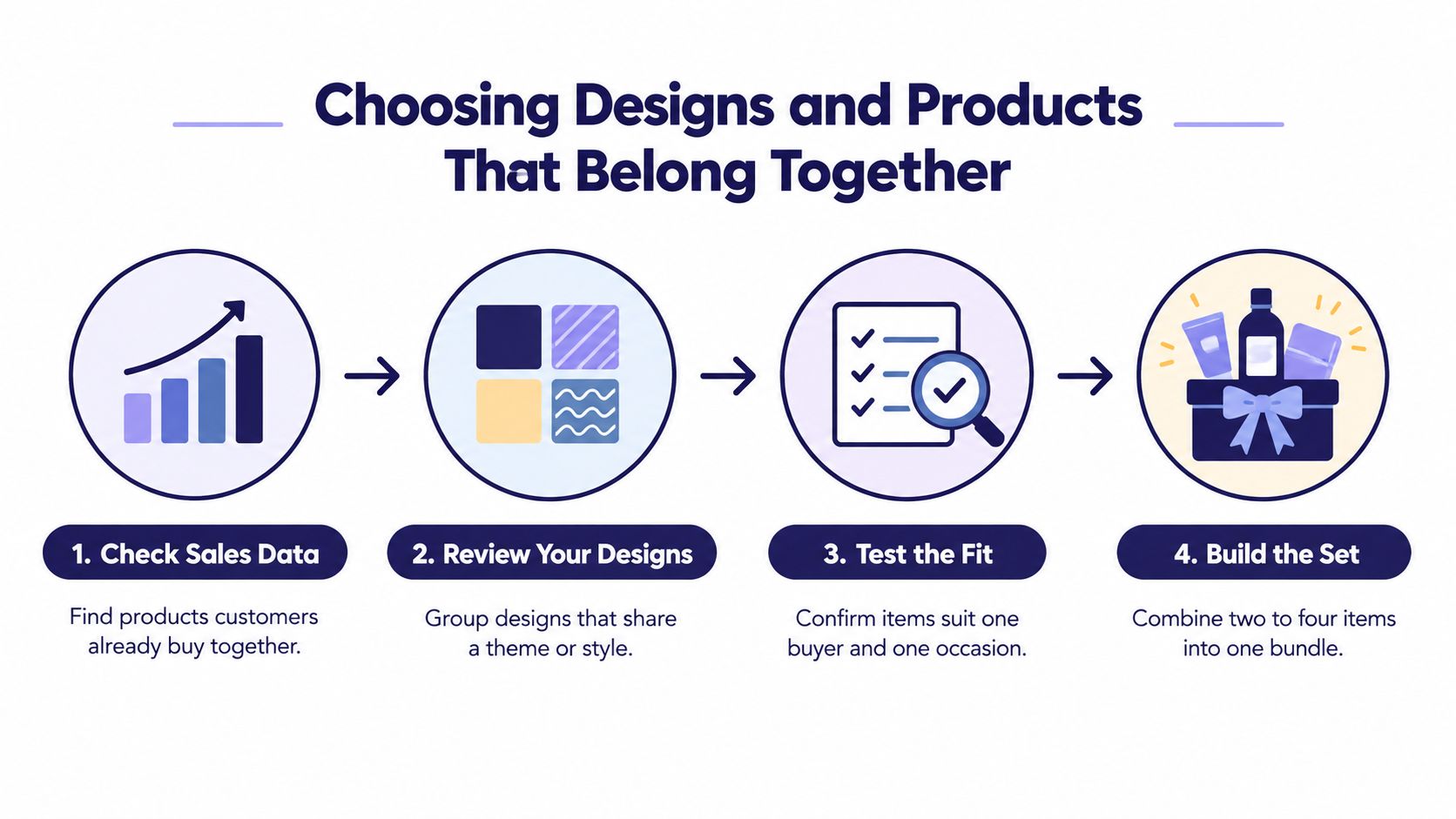
Shortlist by theme, then check the fit
A complete-the-look set could pair a hoodie, tote, and mug that share one design system. The products serve different uses, but the same colors, illustration style, and audience connect them. The larger order may also spread shipping economics across more items, though that only helps if the fulfillment setup and costs support it.
Keep the first candidate set focused. A smaller group of complementary products is often easier to understand than a large pack with several styles and use cases. The point isn't to include as much as possible. It's to make the connection between the items obvious.
Before settling on a shortlist, check practical fit:
- Audience and occasion: Would one person plausibly buy these items for the same reason?
- Style and theme: Do the designs look like a collection rather than a mix of unrelated bestsellers?
- Variants: Are the relevant sizes and colors available across the products?
- Fulfillment: Could different production or shipping arrangements lead to split shipments or a confusing delivery experience?
Write down two or three candidate bundles and the buyer each one serves. If you can't describe the common theme in plain terms, keep refining the set before building listings.
Setting Up Bundles on Etsy, Merch, Redbubble, and TeePublic
A bundle's presentation depends on the marketplace. A coordinated collection can be shown as a group even when the platform doesn't support one combined order at a single bundle price. Before publishing, check the current listing and pricing tools rather than assuming that every marketplace offers the same setup.
| Platform | How a Set Is Presented | Pricing Mechanic to Verify |
|---|---|---|
| Etsy | Present the set in listing images and explain what's included in the title and description. Check the available listing and variation options. | Verify the current price, shipping, fees, and whether your chosen listing structure supports a combined offer. For broader listing guidance, see this article on selling artwork on Etsy. |
| Amazon Merch on Demand | Related designs are generally presented as separate products unless current merchandising tools support another format. | Amazon says creators set product prices and earn royalties per unit sold. Compare the combined royalty from separate purchases with the buyer's total checkout cost, and check the current Merch on Demand program details. |
| Redbubble | Show coordinated items as a collection, and make clear whether the customer is buying separate products or a combined offer. | Redbubble's artist margin is a percentage markup on the base price. Its example shows a $20 base price with a 20 percent markup producing a $24 retail price before tax. Check the artist payment and markup explanation. |
| TeePublic | Use listing images and wording to connect related designs, then verify the platform's current options for presenting products together. | Confirm current pricing, fees, and any limits on promotions or multi-item presentation before calculating expected earnings. |
Whatever the platform, the first listing image should show the whole set clearly. A buyer shouldn't have to infer whether the bundle includes one product or several. Use a title that names the theme and states what's included, then make sure the description matches the actual listing structure.
For Amazon Merch, a set of related shirts isn't automatically a discounted bundle. The royalty model is based on units sold, so check the program's current terms before describing separate listings as one combined offer. Platform features and terms can change; verify them when you prepare each listing.
Pricing a Bundle Without Eroding Your Margin
Start with the price of each item at its individual listing price, then account for production, fulfillment, shipping, platform fees, payment processing, discounts, and refunds. What remains is more useful than the cart total. A bigger order can still be a worse sale if the discount and costs consume the contribution margin.
For a worked calculation, use your own product and platform numbers in this order:
- Add the individual item prices. This gives you a comparison point for the set.
- Choose a proposed bundle price. Show it beside the combined individual price so the buyer can judge the offer.
- Subtract platform and payment fees. Use the actual fee rules for the marketplace and listing structure.
- Subtract production and fulfillment costs, shipping, and expected refund costs. The remainder is the estimated profit per order.
- Repeat the calculation at each proposed discount. Don't assume that a larger cart means more profit.
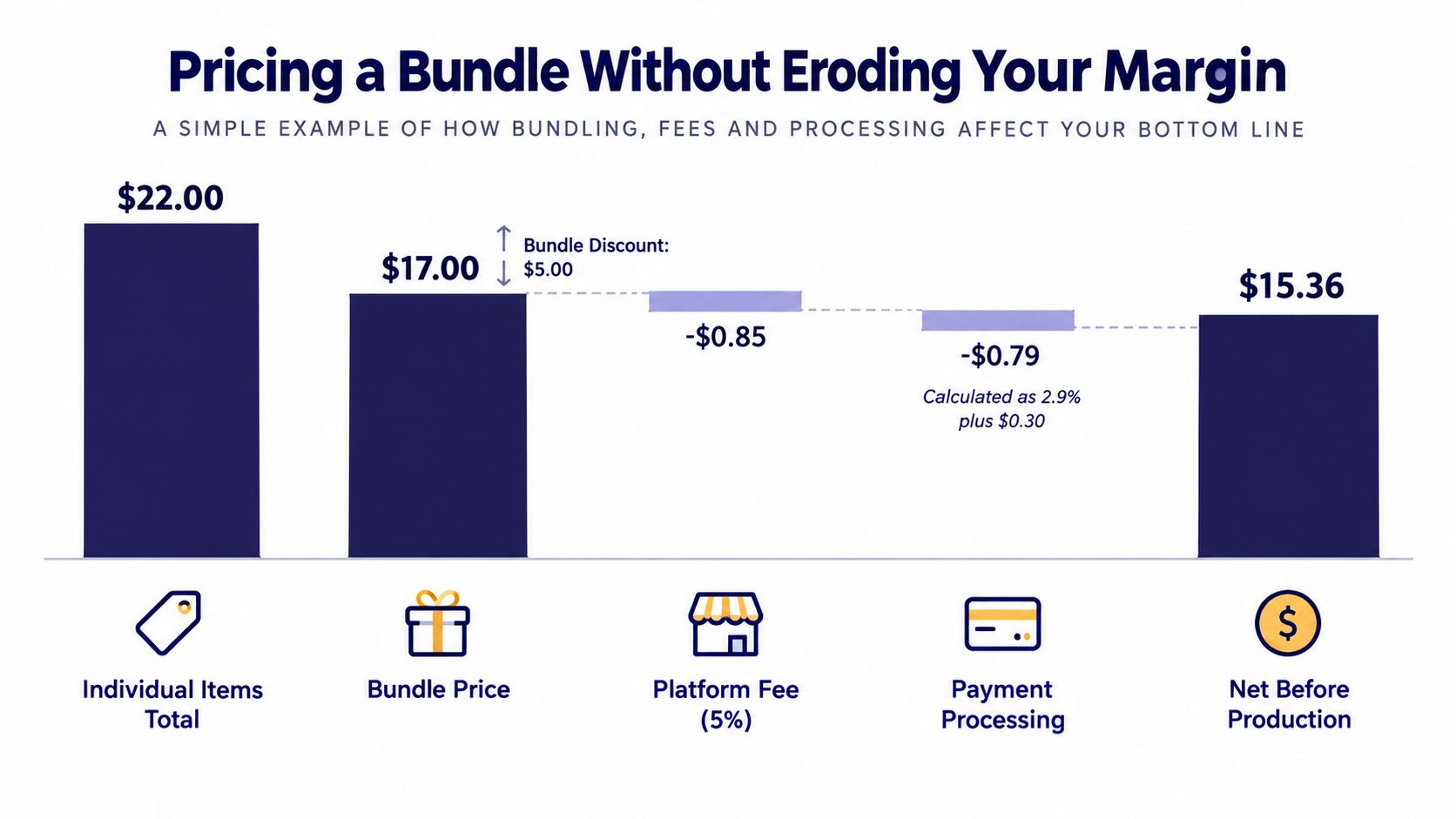
Preserve the individual-item prices in the comparison, state the combined bundle price, and show explicit savings only when the math supports them. That makes the value legible without hiding what the buyer would pay for each item separately.
An industry analysis reports that complete-the-look bundles may lift cart size by 80 percent or more and retain roughly $12 to $20 per garment after a 15 percent bundle discount. Treat those as directional benchmarks, not sales guarantees or a substitute for calculating your own costs, as explained in this guide to pricing POD bundles.
Compare the offer with a control
Keep individual-item prices intact, then compare a no-bundle control with at least two discount levels. Track profit after all relevant costs, not just the order value. If a discount lifts cart size but cuts contribution margin, reduce it or replace it with another benefit. For more ideas about assessing earnings, see this guide to increasing earnings.
Checking Trademarks, Images, and Tags Before You Publish
A phrase used across a shirt, mug, and sticker puts more of a collection at risk than a phrase on one listing. Screen shared wording before adapting it across products, particularly when it carries the design or listing's identity.
A web search can reveal existing uses, but it may not show trademark applications, registrations, owners, or the goods covered. The USPTO database includes active and inactive registrations and applications. The USPTO's trademark search tools offer a structured starting point for checking potential conflicts, not a legal opinion or a guarantee that a design is safe to use.
Use a repeatable screening workflow
Search the exact phrase in the USPTO wordmark search first. Then check similar wording and the goods and services connected to the products you plan to sell, such as apparel, accessories, or mugs. The USPTO search help explains wordmark, general, goods-and-services, and owner searches. A result deserves review, but a database match alone does not prove infringement.
Next, check every image and listing detail across the set. Confirm you have permission to use each design, and that product images accurately represent the items. Review titles, tags, and alt text for the same potentially risky phrase. Repeating one unchecked term across listings can spread an oversight throughout the collection. A repeatable quality assurance process can help you make these checks part of publishing rather than relying on memory.
Practical rule: Screen shared wording before adapting it across products. If the phrase appears risky or results are unclear, pause and seek appropriate advice before publishing.
Tracking Bundle Results and Choosing Your Next Test
A bundle is an experiment, not a verdict on the whole shop. Before launch, record your baseline for average order value, conversion rate, revenue per visitor, and profit per order. Tag each bundle listing so you can isolate its funnel instead of guessing which products drove the result.
Launch one mixed bundle first. Keep the first test focused on the theme and presentation, then consider quantity breaks or mix-and-match formats after you have a stable baseline. If you change the price, imagery, contents, and promotion at the same time, you won't know which change affected the outcome.
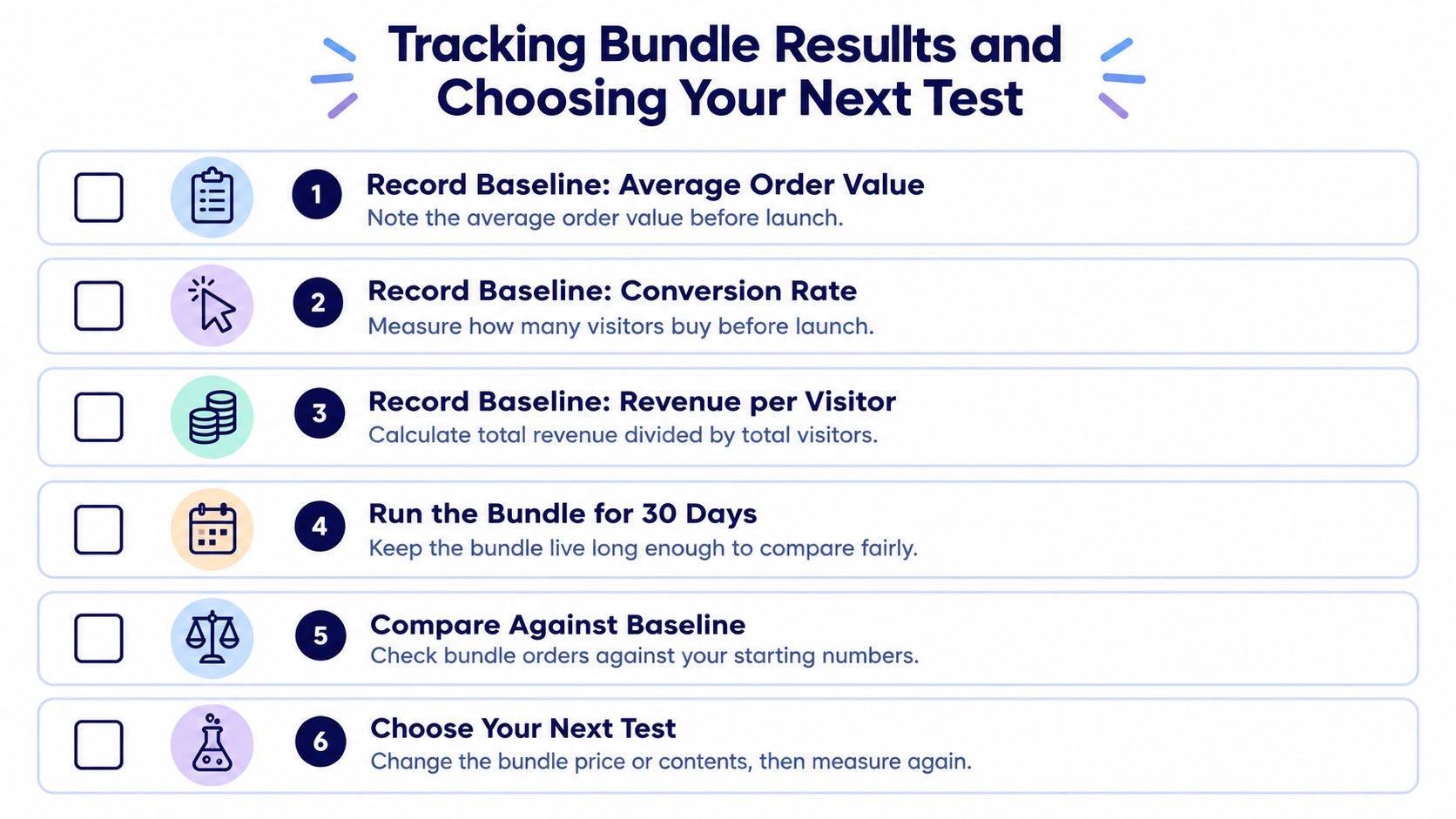
Review the measures that explain the sale
Review results monthly using bundle attach rate, bundle-view-to-purchase conversion, AOV lift, and profit. A rise in average order value isn't enough if the bundle discount cuts the money left after costs. Compare the figures with the baseline and check whether the set created additional demand or merely shifted existing buyers from individual listings.
A simple checklist keeps the next test manageable:
- One theme: Pick a clear audience or occasion, then keep the items visually and practically related.
- One price test: Compare the bundle offer with your control and calculate profit after costs.
- One measured month: Leave the listing stable long enough to review its performance consistently, then decide what to change.
If finding a validated theme is the slow part, Trendlytic researches POD niches across TeePublic, Amazon Merch, Redbubble, and Etsy, and includes a USPTO trademark check. It can help you shortlist designs and related keywords for a bundle, but I'd still check platform fit and run the margin math before committing.
If you want to shortlist a POD theme before building your first set, Trendlytic surfaces niche research across major POD marketplaces and includes a USPTO trademark check. Use it to find candidate designs and related keywords, then verify the bundle's platform costs and profit yourself before you publish.