How to Sell Artwork on Etsy and Build a Real Shop
You've got artwork ready, a folder of mockups, and an Etsy shop name in mind. Then you start comparing print providers, reading about fees, and wondering whether the phrase on your design is safe to use. Publishing a listing suddenly feels like the easy part.
When I think about how to sell artwork on Etsy, I start with the order rather than the upload. Can you produce what the buyer expects, deliver it without surprises, and keep enough money to justify the work? A useful shop starts with those answers, not a crowded catalog.
Table of Contents
- What Selling Artwork on Etsy Actually Requires Today
- Setting Up Your Etsy Shop the Right Way
- Building Listings That Match Real Buyer Intent
- Pricing Artwork for Margin, Not Just Sales Count
- Choosing How Each Order Ships and Fulfills
- Finding Niches That Beat Generic Uploads
- Avoiding the Legal and Shipping Pitfalls That Kill Shops
What Selling Artwork on Etsy Actually Requires Today
Etsy isn't an empty storefront waiting for your art. It's an established marketplace where you need a recognizable offer, credible presentation, and an order you can fulfill profitably.
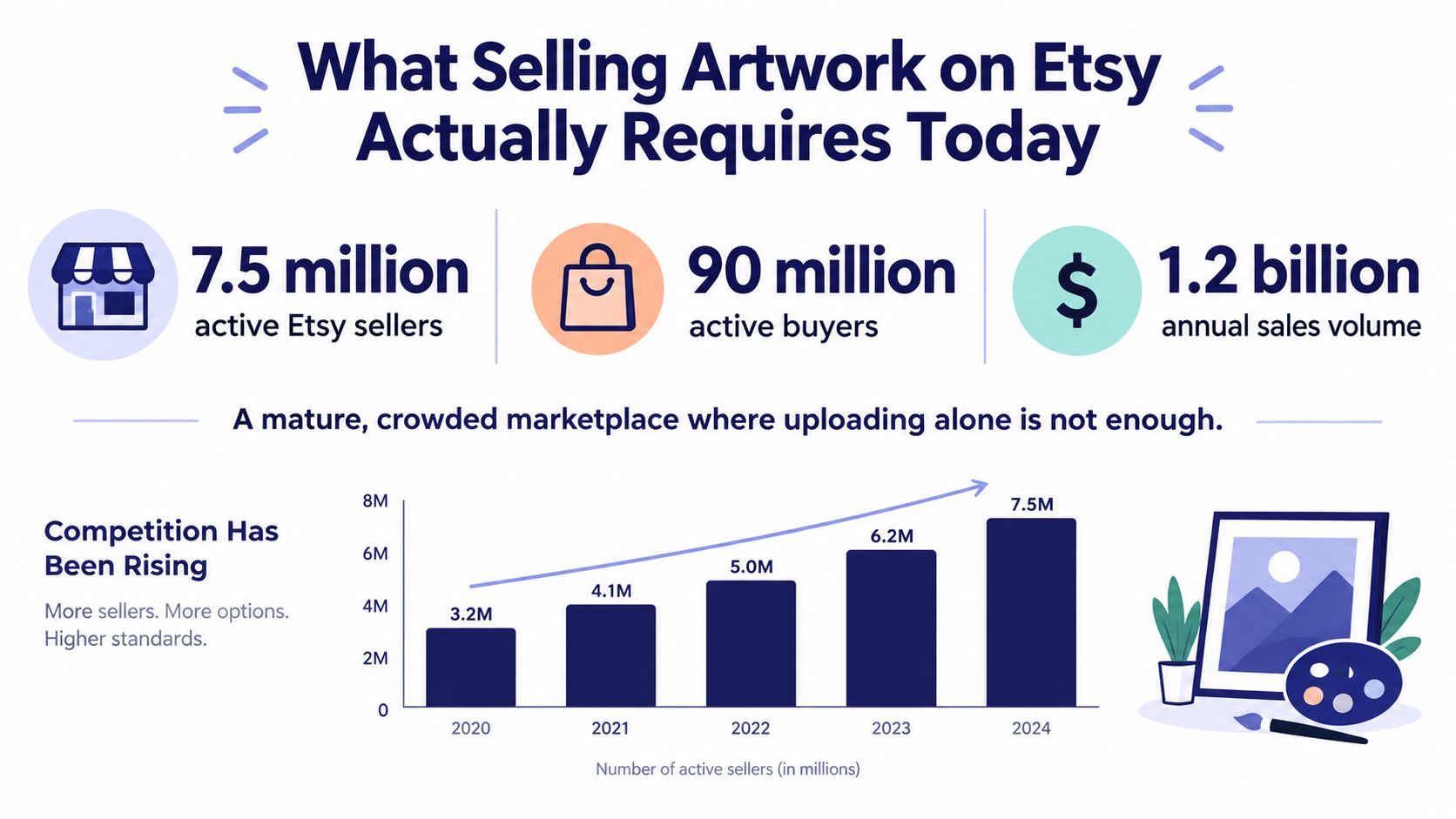
The platform reported 88.5 million active buyers in Q1 2025, down 3.4% year over year, in its first-quarter results. Those figures describe an opportunity, but they don't tell you whether someone wants your particular artwork.
The illustration below conveys the competition problem. I wouldn't use its displayed figures as a current marketplace benchmark.
Start with a manageable offer
I'd rather launch a coherent collection of botanical kitchen prints than a shop mixing unrelated posters, mugs, portraits, and shirts. That's not because variety is bad. It's because a focused collection makes the buyer, photography, product specifications, and costs easier to understand.
Before opening, write down:
- The buyer: Someone decorating a kitchen, buying a pet memorial, or choosing a housewarming gift.
- The product: A physical print, original artwork, personalized commission, or downloadable file.
- The constraint: Your available production time, fulfillment budget, or ability to handle customer revisions.
- The reason to choose it: A distinctive style, useful customization, or a collection that solves a particular decorating need.
Practical rule: If you can't explain what arrives and why someone would choose it, don't spend money promoting it yet.
Build the business around the artwork
A sale creates work beyond making the image. You'll manage product information, payment deductions, delivery expectations, customer messages, and records.
If fulfillment terminology is still unfamiliar, the guide to start a print business with Striped Circle provides a useful companion for thinking through a POD business before committing to a catalog.
My preferred sequence is simple: choose the audience, establish an honest shop, prepare a clear listing, calculate the economics, and validate fulfillment. Expand only when those pieces work together. More products won't repair an offer that's confusing or consistently unprofitable.
Setting Up Your Etsy Shop the Right Way
Your shop should describe the business you can run, not the business you hope to become. A believable About section and realistic policies are more useful than polished language that hides how orders work.
Start with the practical decisions before spending too long on branding.
Choose details you can stand behind
Pick a shop name that fits your style without tying you to a product you might stop selling. A name built around quiet botanical illustration leaves more room than one promising only framed kitchen prints.
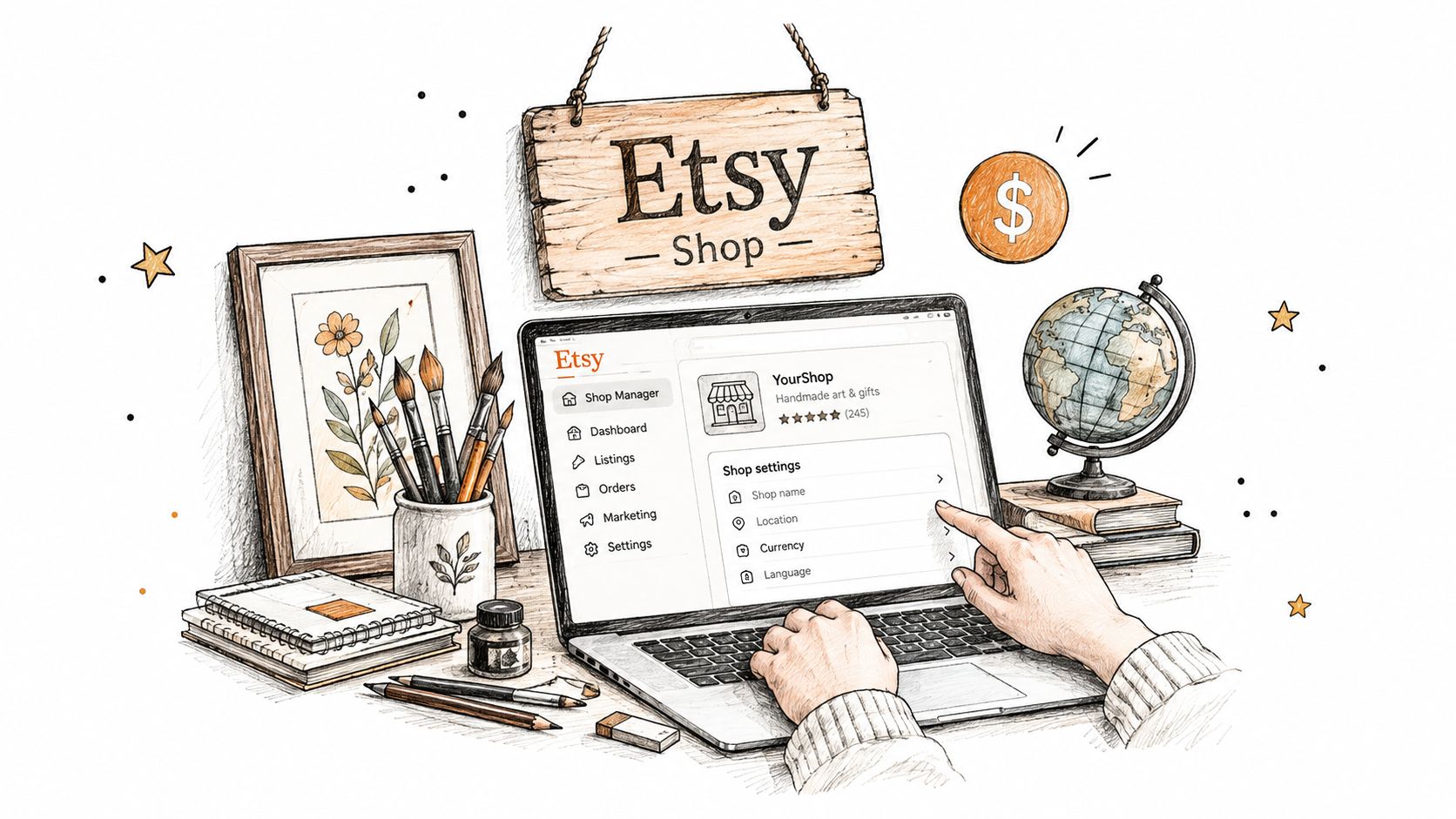
Use your actual operating location and choose your currency deliberately. Follow the payment setup prompts using details that match your banking and registration records. Don't choose an individual or business designation because it sounds more professional. Use the status that accurately reflects your circumstances, and get local accounting advice if you're unsure.
Etsy Payments rates depend on your bank-account country, and processing is calculated on the total sale amount, including shipping and applicable sales tax, according to Etsy's selling information. That makes accurate account setup a financial decision as well as an administrative one.
For the About section, explain your contribution plainly. Describe what you draw, how you develop a collection, and which parts of the process you handle yourself. Don't invent a studio team or imply that you personally print products when someone else does.
Write policies for your actual workflow. A competitor's return policy doesn't become suitable just because their shop looks successful.
Make policies operational
Before publishing, draft answers to the questions you'd otherwise have to improvise in messages:
- Shipping: Where will orders originate, and what production and transit expectations can you support?
- Returns: How will you handle unwanted purchases, damaged deliveries, and personalized work, subject to applicable law?
- Privacy: What customer information will you use, and for what purpose?
- Customization: What can the buyer change, and when does an approved design become final?
Treat these as operating decisions, not decorative shop text. For example, promising unlimited portrait revisions creates a different workload from offering a defined approval process.
Finally, prepare a simple record for each product: source artwork, finished file, supplier, specifications, and policy exceptions. You don't need an elaborate system. You need to be able to answer a buyer's question without reconstructing the order from scattered messages.
Building Listings That Match Real Buyer Intent
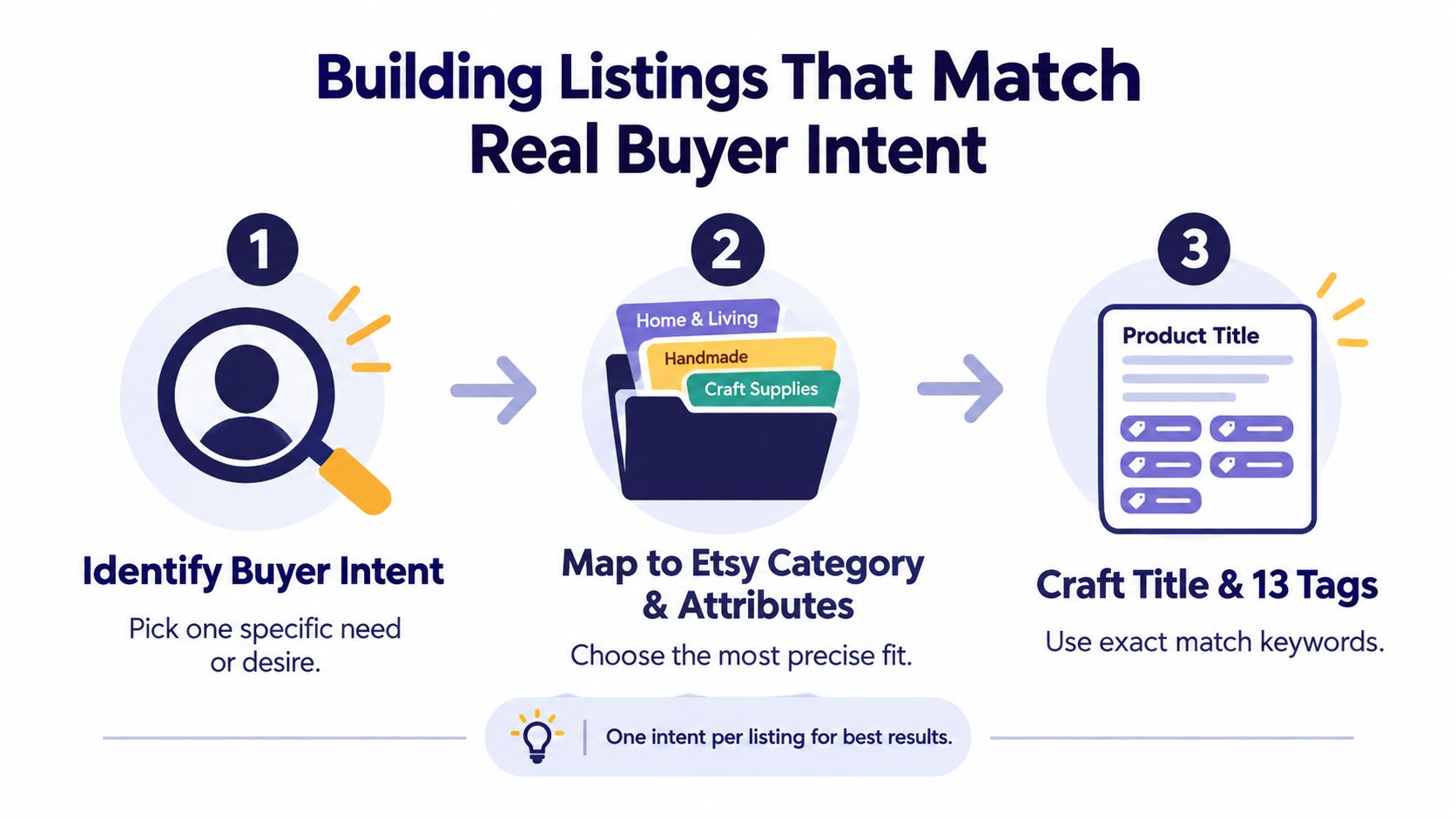
A buyer looking for a botanical kitchen print isn't necessarily shopping for a downloadable nursery set, even if both feature leaves. One clear intent per listing makes the product easier to describe and the results easier to interpret.
Use the workflow below as a planning aid, not a reason to force identical wording into every field.
Build around a concrete purchase
Consider an illustrative product: an unframed botanical print set intended for a kitchen.
A workable title might be Botanical Kitchen Print Set, Green Herb Wall Art, Unframed Paper Prints. It communicates subject, setting, and format without pretending the product is also a canvas, download, and framed gift.
Choose the most precise available category and complete relevant attributes. Then use the available tag slots for natural variations that describe the offer, rather than repeating the title mechanically. A focused Etsy keyword research workflow can help organize those phrases before you publish.
The description should answer the purchase questions immediately:
- Included: Identify the prints and whether frames or accessories are excluded.
- Materials and size: State the actual paper, dimensions, finish, and available variations.
- Appearance: Explain any relevant color differences between screens and printed output.
- Personalization: Define what can change and what information the buyer must supply.
Make the first image unmistakable
Show the actual artwork clearly, then add close-ups, scale references, and framing examples. If a frame isn't included, don't leave the buyer to infer that from fine print.
Etsy's search guidance explains how titles, tags, categories, and attributes support matching, and how shopper actions can influence ranking. Its listing-image guidance recommends a shortest side of 2,000 pixels at 72 PPI and advises against collages as primary images because they can obscure the product.
For composition and presentation work, Nim's guide to how to create better product visuals is a useful reference. Keep the commercial promise accurate even when the room styling is attractive.
This video provides another format for reviewing the listing process.
After publishing, record impressions, visits, favorites, and orders over a consistent observation period. Change a major variable deliberately, such as the thumbnail or offer, rather than rewriting everything together.
Low visits suggest a different investigation from visits without purchases. Neither proves a single cause, and a handful of interactions isn't enough to declare a winner. I treat listings as experiments, not verdicts on the quality of the art.
Pricing Artwork for Margin, Not Just Sales Count
I wouldn't price a print by copying the cheapest similar listing. You can see a competitor's price, but you can't see their production agreement, advertising costs, support time, or profit.
Start with the deductions you know, then add the costs specific to your fulfillment model.
Fee Math on a $25 US Artwork Order
For this hypothetical order with free shipping, Etsy's published fee schedule supports the $0.20 listing fee, 6.5% transaction fee, and US payment-processing example of 3% plus $0.25, producing the breakdown below.
| Cost line | Amount | Notes |
|---|---|---|
| Customer payment | $25.00 | Hypothetical artwork order with free shipping |
| Listing fee | $0.20 | Nonrefundable listing charge |
| Transaction fee | $1.625 | Applied to the order total |
| Payment processing | $1.00 | US example rate applied to this order |
| Remaining before other expenses | Approximately $22.18 | Not profit |
The same fee guidance states that qualifying Offsite Ads orders can carry an additional 12% or 15% fee, depending on seller sales volume. Model the applicable advertised-order scenario before setting your price, not after receiving an attributed sale.
Margin check: Money remaining after marketplace fees still has to pay for making and delivering the product.
Build a usable cost worksheet
Keep a worksheet for each product variation, especially when print size or framing changes the supplier charge.
- Production: Record the actual supplier cost for the selected variation.
- Delivery: Include packaging, postage, and any fulfillment handling.
- Marketplace deductions: Use the rates applicable to your account and order.
- Customer-service exposure: Allow for reprints, refunds, and the work involved in resolving problems.
- Your work: Account for customization, proofing, and order administration.
- Overhead: Track software, samples, and other shop expenses separately so contribution margin isn't mistaken for take-home profit.
Free shipping is a pricing choice, not a disappearance of shipping costs. If you include delivery in the item price, your worksheet still needs the actual charge.
When testing prices, keep the product and presentation stable enough to interpret the result. Compare contribution per order alongside purchases, rather than celebrating a lower price because it generated activity.
For personalized artwork, watch the time spent obtaining usable customer instructions. A price that works for a straightforward print may fail for a commission with repeated revisions. High sales volume at the wrong price gives you more work, not necessarily a healthier shop.
Choosing How Each Order Ships and Fulfills
An original watercolor, a repeatable poster, and a printable file don't need the same fulfillment model. I'd choose the method for each product line rather than force the whole shop through a single workflow.
This comparison is a starting point. Actual risk depends on the product, provider, packaging, and destination.
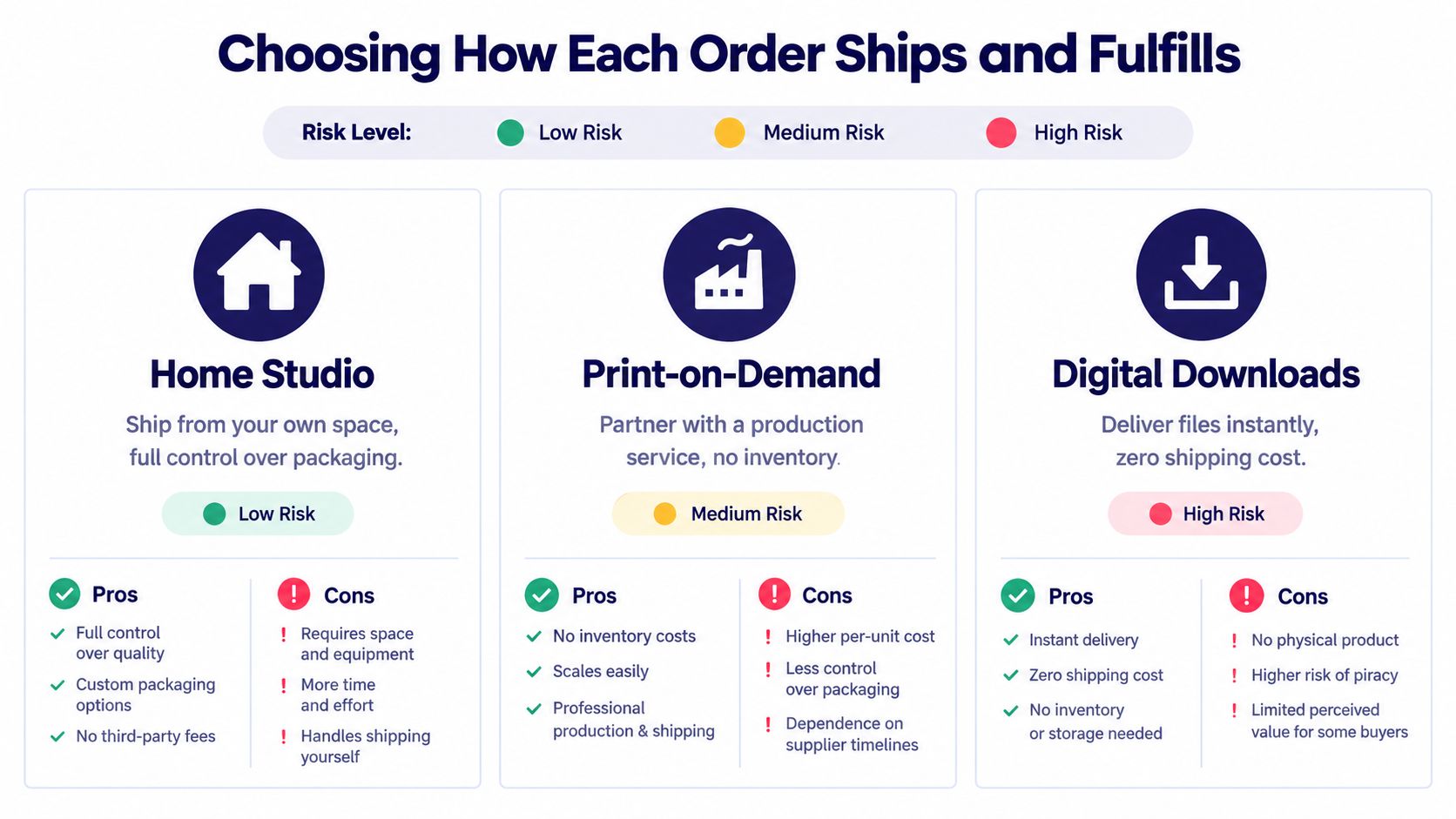
| Method | Where I'd consider it | Main trade-off | Check before launch |
|---|---|---|---|
| Home studio | Originals, signed work, specialist presentation | Direct control requires your time and storage | Packing method and replacement options |
| POD partner | Repeatable prints and other original-design products | Less handling, less direct production control | Samples, dispatch origin, and issue resolution |
| Digital download | Artwork intended for customer printing | No physical parcel, but printing support remains | File clarity, instructions, and usage terms |
Choose control where it matters
Studio shipping lets you inspect the finished piece and manage presentation. That can matter for originals or artwork whose value includes your finishing process. It also means sourcing materials, packing orders, and dealing with carrier problems yourself.
POD can be a sensible choice when repeatable production matters more than handling every print personally. Order samples and examine the crop, paper, color, packaging, and arrival condition. Don't rely solely on a mockup to decide whether the product is ready.
For studio parcels, measure the packed item rather than the artwork alone. Framing and protective materials can change the shipping quote substantially. Aeros Couriers' resource on how to pack parcels efficiently for lower costs is relevant when you're comparing packaging approaches, while a written logistics planning process helps keep dispatch decisions consistent.
Disclose outside production clearly
Etsy's production-partner guidance allows outside production of your original designs, including printing services, but requires disclosure on applicable listings and accurate shipping-origin information. It doesn't make unaltered wholesale resale compliant because a supplier fulfills it.
Etsy's handmade policy also describes the partner information sellers must provide, including location, the partnership and design process, and the work performed. Explain your role clearly instead of presenting outsourced printing as personal manufacture.
Digital delivery removes parcel handling, not customer expectations. State what files the buyer receives, how they should use them, and whether the purchase includes customization. A clear instruction sheet is part of the product, not an afterthought.
Finding Niches That Beat Generic Uploads
Uploading more designs is easy to measure. Whether those designs belong in the same shop is a harder question.
I prefer collections built around a recognizable use: botanical artwork for a kitchen, restrained pet memorial portraits, or personalized illustrations for a particular recipient. These are product hypotheses, not claims that those niches are automatically profitable.
Research the store, not just the search result
A random attractive listing tells you very little about the seller's broader offer. Look at the collection around it. Does the shop repeat a visual language, serve a consistent audience, or make customization especially clear?
Store-first research across TeePublic, Amazon Merch, Redbubble, and Etsy can help you inspect prominent designs in context rather than collecting disconnected search hits. But don't assume that a design seen on apparel will translate directly into wall art. The buyer's purpose, product format, and presentation are different.
Use a structured niche market identification process to separate useful observations from imitation:
- Audience: Who would recognize this product as being for them?
- Occasion: What prompts the purchase?
- Format: Does the artwork make sense on the product you plan to sell?
- Differentiation: What can you contribute beyond another seller's existing concept?
- Feasibility: Can you produce variations without making every order operationally different?
A collection of herb illustrations might support different kitchen styles through palette and composition. That's a more coherent experiment than placing the same unrelated slogan on every available product.
Research should help you understand a purchase decision, not give you permission to copy someone else's artwork.
Test audience context
Etsy has described work on personalized recommendations and messaging in the company results referenced earlier. I take that as a reason to think beyond broad search phrases, not as proof that a particular collection will receive preferential treatment.
Separate different offers by intent. A personalized family-name illustration and a non-personalized scene may share a visual style, but they ask the buyer to make different decisions.
Compare favorites, purchases, and support requirements at the collection level. If personalized work attracts interest but creates extensive back-and-forth, improve the ordering instructions before expanding it.
Refresh weak listings with a clear hypothesis. Perhaps the room context is wrong, the product format is unclear, or the customization feels difficult. Adding more tags won't resolve those problems, and publishing more variations can make them harder to diagnose.
Avoiding the Legal and Shipping Pitfalls That Kill Shops
I'd rather reject a questionable phrase before designing around it than build a collection that depends on it. A USPTO trademark check belongs before publication, alongside reviewing the rights to artwork, fonts, and other assets. A screening tool is a starting point, not legal clearance or a substitute for professional advice when the result is ambiguous.
Run a pre-publication check
- Rights: Review the wording and visual assets, and retain the licenses you rely on.
- Authorship: Keep source files and records of your design process.
- Disclosure: Confirm that the listing matches the production arrangement already documented.
- Destination: Check delivery costs, applicable requirements, and how problems will be handled.
International delivery needs a deliberate market-by-market decision. Etsy's customs and VAT guidance states that orders may incur import taxes, duties, and destination fees; buyers generally pay customs charges on delivery, while sellers remain responsible for destination-country compliance.
Distinguish customs-inclusive delivery from buyer-paid import charges before promising either. For framed prints and originals, obtain packed shipping quotes and consider damage, returns, and replacement feasibility. Restrict destinations when you can't establish a workable process. Accepting every possible order isn't a requirement for running a serious shop.
Trendlytic offers POD niche research across TeePublic, Amazon Merch, Redbubble, and Etsy, with a built-in USPTO trademark check. If you'd like another way to evaluate a collection before producing it, visit Trendlytic and use the findings alongside your own margin worksheet and fulfillment checks.