How to Use Etsy and Pinterest Together to Drive Sales
You've got a new Etsy design, a clean mockup, and a Pinterest account that looks active enough. Yet the Etsy dashboard stays quiet. Pinterest shows saves, perhaps even a few promising clicks, but you can't tell whether those visitors bought anything or collected another idea for later.
That gap is where most Etsy and Pinterest strategies fall apart. Pinterest creates discovery, Etsy handles the purchase, and the useful question is whether a specific Pin sends qualified shoppers to a specific listing. The workflow below treats both platforms as one measurable funnel, from niche validation through listing quality, creative testing, and delayed conversion.
Table of Contents
- Why Etsy and Pinterest Are a Natural Pair for POD
- What Each Platform Actually Rewards
- Validating a Pinterest Trend for an Etsy Listing
- Setting Up Rich Pins and a Focused Board Structure
- Scheduling, Repinning, and A/B Testing Creative
- Measuring Real Etsy Conversions From Pinterest
- Putting the Workflow Together and Avoiding Common Pitfalls
Why Etsy and Pinterest Are a Natural Pair for POD
Traffic is difficult to earn when you sell print-on-demand products. Etsy Ads can become expensive before a design has proved that it converts, while Pinterest keeps appearing in advice for visual sellers because people use it to discover products, styles, gifts, and occasions.
The pairing makes sense because the platforms do different jobs. Etsy is the conversion environment, where shoppers compare listings, read reviews, inspect variants, and place orders. Pinterest is the discovery environment, where someone may save a shirt, mug, or wall-art idea before they're ready to buy.
Etsy's scale gives that conversion environment real weight. In 2025, the Etsy marketplace recorded $10.46 billion in gross merchandise sales, with 86.5 million active buyers and 5.6 million active sellers reported at year end (Etsy's 2025 filing). That's a substantial demand pool, but it's also a large supply base. A listing still has to appear for a relevant search and convince the shopper to act.
Pinterest brings a different kind of scale. Pinterest reported 619 million global monthly active users in 2025, with activity centered on visual discovery and planning (Pinterest's annual report). Monthly users aren't the same as buyers, but they create opportunities to reach people before they search Etsy directly.
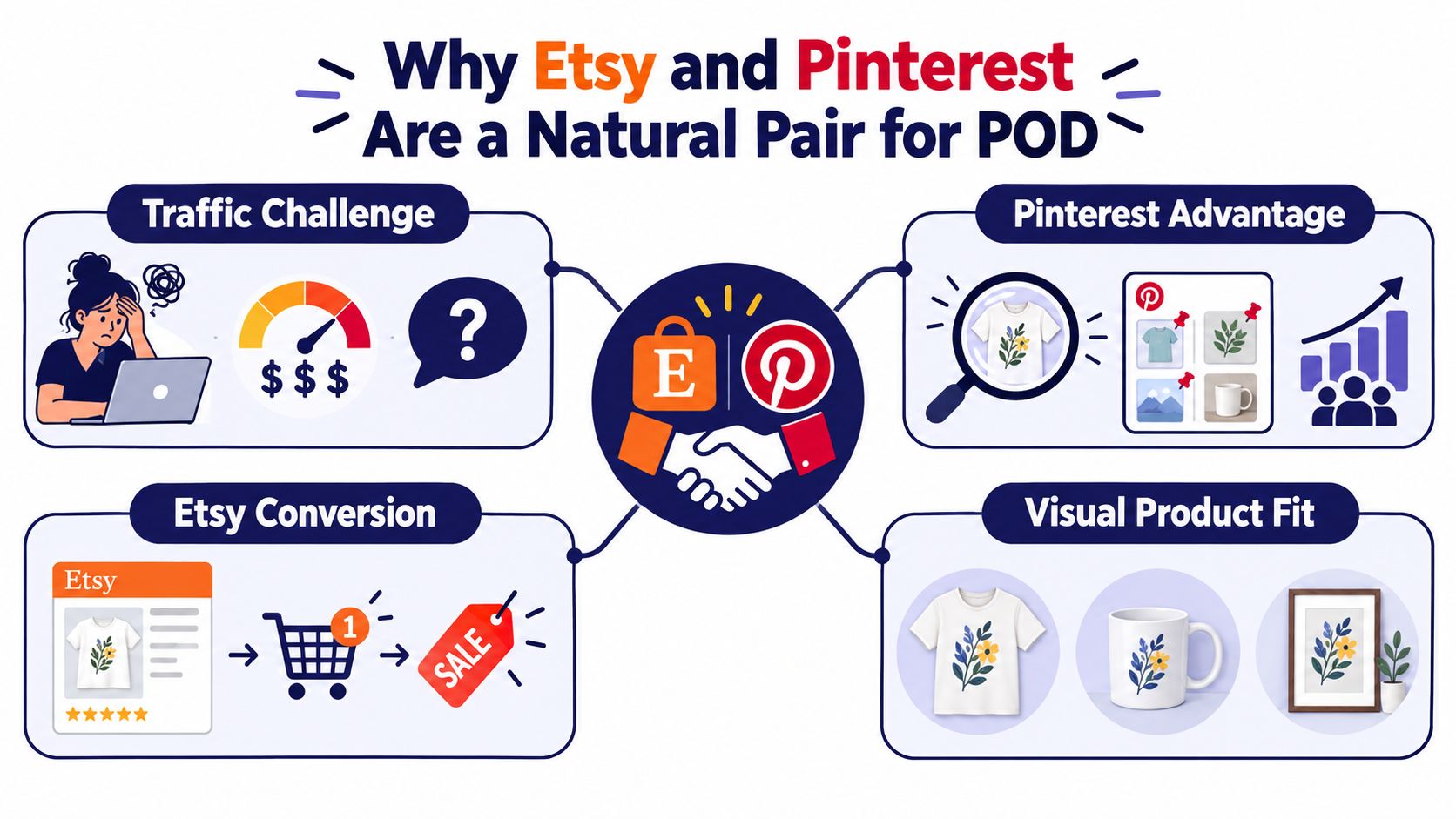
The practical implication is simple: Pinterest can create qualified attention, while Etsy must convert it. A Pin with a beautiful mockup but a mismatched destination creates weak traffic. An excellent Etsy listing with no visual distribution may never receive enough qualified visits to generate useful feedback.
I use Pinterest as a way to test positioning, not as a scoreboard for saves. For sellers who want to connect social publishing with broader workflows, the Pinterest API for social teams is a useful reference point. For Etsy-specific trend observation, I also keep an eye on what's trending now on Etsy, then check whether the trend has a plausible product angle rather than copying the first popular phrase I see.
What Each Platform Actually Rewards
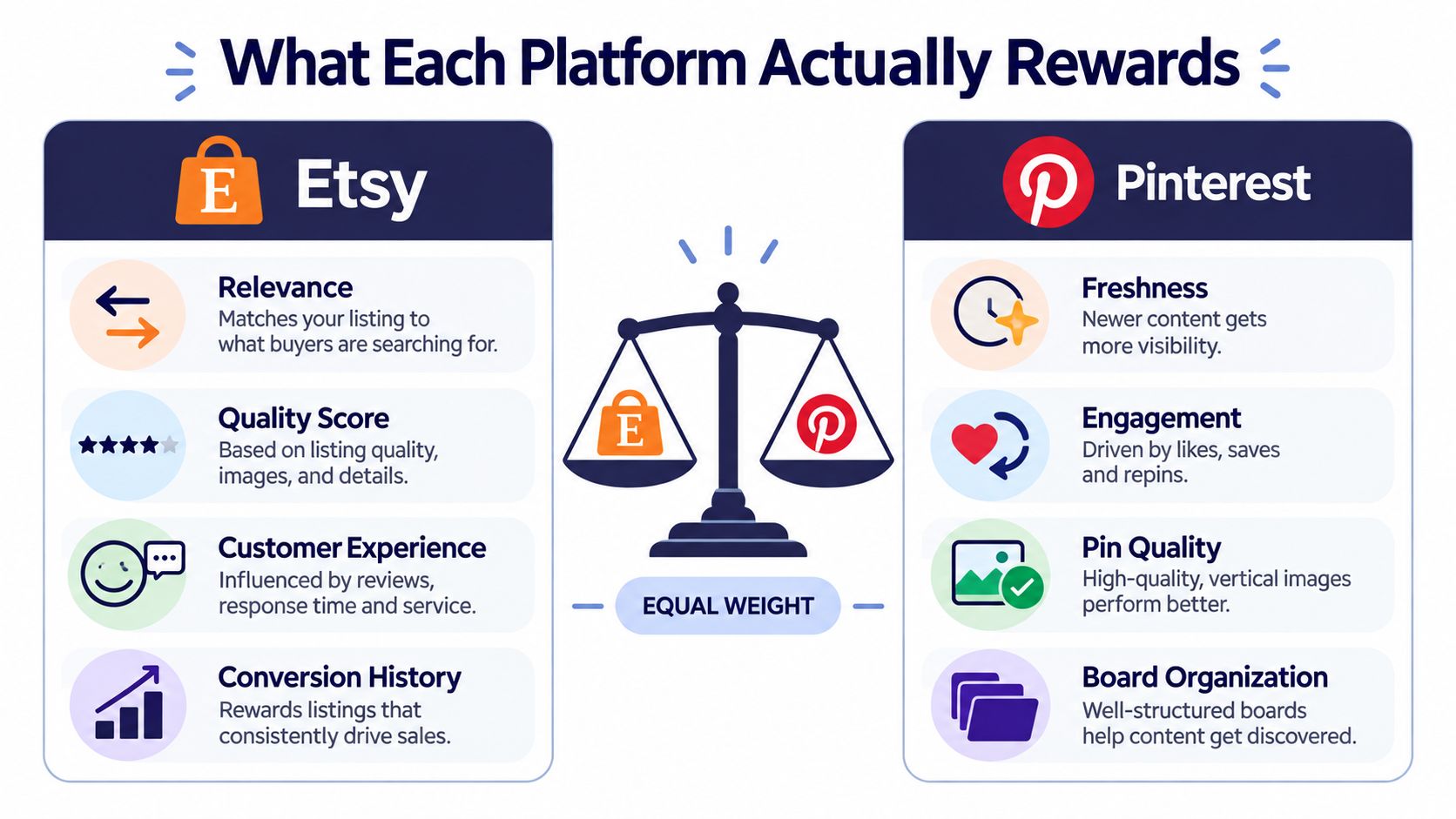
Etsy and Pinterest can send traffic to each other, but they don't evaluate content in the same way. Etsy search considers relevance, listing engagement, and customer-service quality. Engagement includes how views turn into purchases, while customer-service signals include review rating, message response rate, and case rate (Etsy's explanation of search).
That means a Pin can generate attention without helping the Etsy side if the landing listing is unclear, overpriced for its niche, poorly photographed, or unavailable in the advertised variant. Pinterest can deliver the click, but Etsy decides what happens after arrival.
| Platform | What matters most for a POD seller | Practical implication |
|---|---|---|
| Etsy | Relevance, engagement, conversion behavior, and customer service | Match the listing to the shopper's intent and make the purchase easy |
| Fresh visual content, clear titles, saves, and outbound clicks | Give each product a searchable visual angle and a precise destination | |
| Both | Message consistency | Use the same product promise from Pin to listing |
Pinterest's merchant rules add an operational requirement. Product information supplied to Pinterest must keep price and in-stock status accurate within seven days, through feed synchronization or product-page data collection (Pinterest merchant guidelines). An outdated price, unavailable shirt color, or image that materially differs from the Etsy product can undermine both trust and platform compliance.
The Etsy cost stack also belongs in the decision. Etsy charges a $0.20 USD listing fee for each listing, and a listing stays active for four months or until it sells. The platform also charges a 6.5% transaction fee on the order amount, including shipping and gift wrapping where applicable. Payment processing is separate and varies by the seller's bank country, so a niche can look attractive until all three cost categories are included (Etsy fee basics).
For keyword alignment, I start with the shopper's language, then check whether it fits naturally in both places. The guide to Etsy keyword research is useful for structuring that process, but keyword placement can't compensate for a product that doesn't satisfy the click.
Validating a Pinterest Trend for an Etsy Listing
A rising Pinterest phrase is a lead, not a product decision. People save broad inspiration for many reasons, and a trend can be visually popular while carrying weak buying intent on Etsy.
I validate a potential niche in four passes.
Start with the visual demand
Search the phrase directly on Pinterest and inspect the context around it. Are people saving finished products, gift ideas, outfit combinations, room layouts, or only mood boards? A phrase that repeatedly appears beside a specific product type gives a stronger starting point than an aesthetic that stays abstract.
Suppose Pinterest begins showing increased interest in a wedding sub-niche. I wouldn't immediately create a generic wedding shirt. I'd separate the audience, occasion, product, and tone. A design for bridal-party apparel has different intent from reception signage, honeymoon gifts, or keepsake wall art.
Cross-check live marketplace evidence
Next, compare the idea across TeePublic, Amazon Merch, Redbubble, and Etsy. Look for:
- Listing saturation: How many close alternatives already compete for the same phrase?
- Bestseller concentration: Are sales signals spread across many sellers or dominated by a small group?
- Price bands: Can a new design fit the market without destroying margin?
- Product specificity: Do shoppers appear to buy the exact product type you intend to make?
A niche research workflow can save time. Trendlytic analyzes live bestseller data across those marketplaces, uses a store-first approach to surface top seller designs, and includes a USPTO trademark check against 850K+ active marks. I still treat any tool output as evidence to inspect, not permission to publish.

Reject weak ideas early
A trend is probably too broad when you can't describe the buyer or the product in one sentence. It may be too crowded when the first pages show near-identical designs, concentrated bestseller visibility, and little room for a distinct angle.
Trademark review should happen before design work, not after a listing receives attention. A phrase that looks harmless in a Pin can still create an avoidable takedown risk. The niche market identification workflow provides a useful way to think about demand and competition together.
Make the decision explicit
I write one of two conclusions:
Proceed: The trend has a defined buyer, a specific Etsy product, visible demand across marketplaces, manageable competition, and no unresolved trademark concern.
Discard: The phrase is broad, saturated, commercially unclear, or legally risky.
That written decision prevents a common mistake. Sellers often design first, then use Pinterest activity to justify the work. Validation should do the opposite. It should decide whether the design deserves production time before the mockup, listing, and Pin exist.
Setting Up Rich Pins and a Focused Board Structure
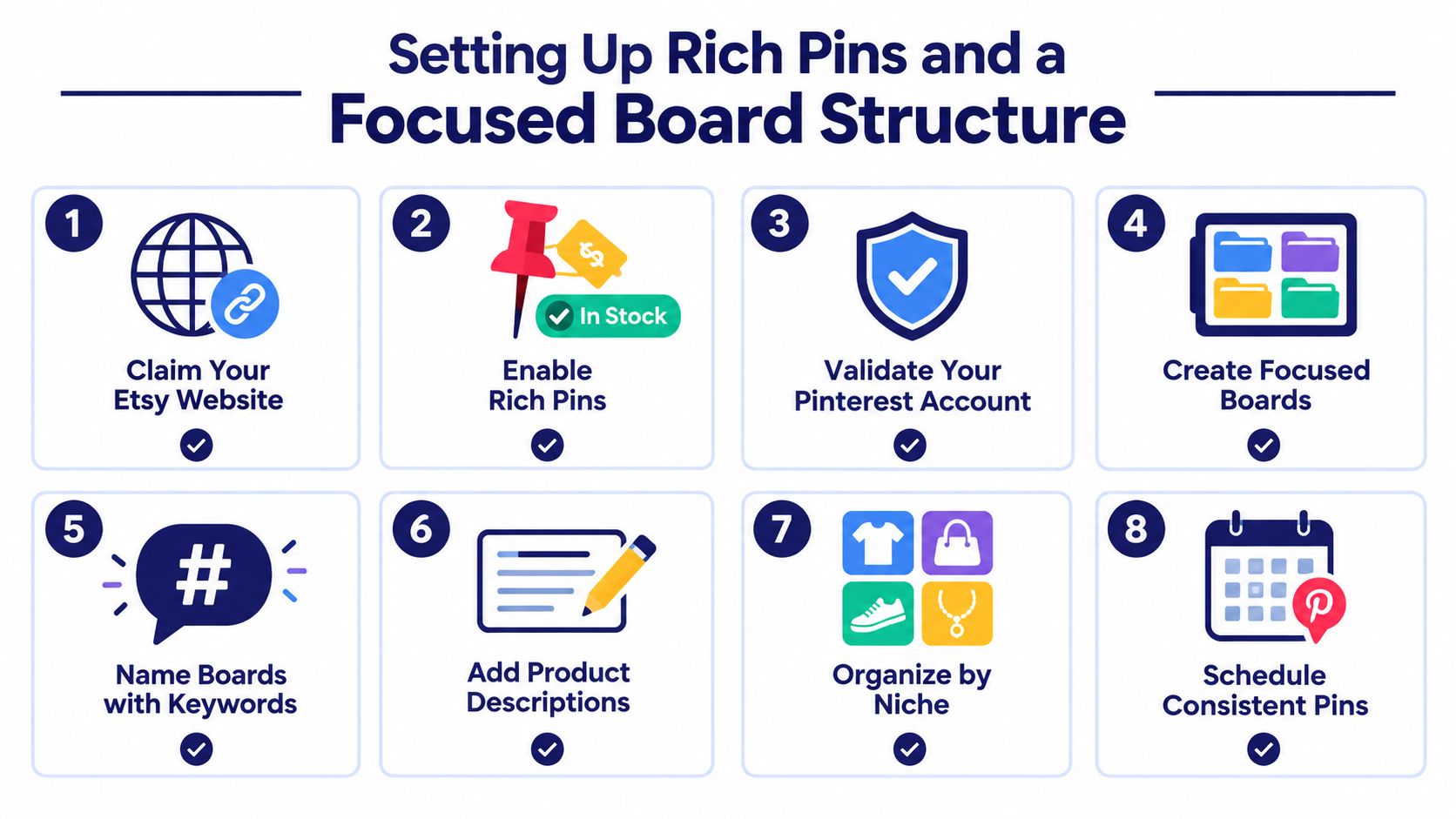
Once a niche survives validation, connect the Etsy shop to Pinterest as cleanly as the platform allows. Use a Pinterest business account, connect the Etsy account under claimed accounts, and check that the product information Pinterest receives matches the live listing.
Rich Pins can help pull product context into Pinterest, but don't assume the setup is correct because the connection appears active. Open a Pin, inspect its destination, compare the displayed product details with Etsy, and confirm that the product remains available.
Build boards around buyer intent
A single giant board makes the shop difficult to interpret. Thirty nearly empty boards create a different problem. I prefer a small structure organized around the validated niche:
- Occasion board: Such as wedding gifts or graduation apparel.
- Audience board: Such as bridesmaids, teachers, new parents, or pet owners.
- Aesthetic board: Such as minimal typography, retro illustration, or botanical artwork.
- Shop board: Only live Etsy products, with every Pin linked to the exact listing.
Board names should describe what someone searches for, not how the shop is organized internally. “Modern Wedding Gifts” is more useful than “Collection One” because it tells Pinterest and the visitor what belongs there.
Use one repeatable Pin template
For each Etsy design, prepare a vertical 2:3 image, a benefit-led title with the main phrase near the beginning, supporting wording that clarifies the audience or occasion, and a direct link to the exact listing. Keep the typeface, accent color, and product framing consistent enough that the account feels coherent without making every Pin identical.
| Pin element | What to include | Why it matters |
|---|---|---|
| Main image | Clear product or mockup with one focal point | The shopper should understand the item quickly |
| Headline | Primary keyword plus a concrete benefit or use case | It connects discovery with intent |
| Supporting copy | Audience, occasion, or style phrase | It narrows the promise |
| Destination | Exact live Etsy listing | It reduces post-click confusion |
| Metadata | Accurate product details and availability | It supports trust and merchant compliance |
I don't create a Pin that promises “custom wedding sweatshirt” and send it to a generic shop page. That adds friction and makes later attribution harder. If you want to estimate the economics of creator-led promotion around a niche, an estimate creator campaign ROI resource can help frame the inputs, but the Etsy listing still needs to carry the conversion work.
Scheduling, Repinning, and A/B Testing Creative
Random posting creates random data. If I publish several unrelated Pins in one burst and then disappear, I can't tell whether a result came from the niche, the image, the wording, or timing.
A manageable schedule matters more than an ambitious one. Use Pinterest's native scheduler or a tool such as Tailwind to spread fresh creative across relevant boards. Keep the destination listing constant when you're testing creative, and avoid repeatedly looping the same image and URL as if volume alone will create demand.
Test one meaningful variable
For one Etsy listing, create two Pins:
- Version A uses a full product mockup and a headline focused on the occasion.
- Version B uses a closer crop and a headline focused on the recipient.
- Both link to the same listing and use comparable descriptions.
Then compare outbound clicks and click-through rate, not saves alone. If one version earns attention but neither creates Etsy sessions or orders, the issue may be the listing, the price, the product itself, or the match between the Pin and the destination.
Refresh the image or headline on a weak Pin rather than changing everything at once. When the listing is stable, a single creative change gives you a cleaner read. Near-duplicate Etsy listings create noisier data and can divide traffic between products that compete with each other.
Plan for the buying window
Seasonal products need lead time. A wedding design should be visible while people are collecting ideas and planning, not only when the event is close. Back-to-school aesthetics should be tested before the audience reaches peak planning, while holiday products need to stop receiving attention when the relevant shopping window has passed.
I treat timing as a hypothesis. I don't assume a saved Pin will create an immediate order, and I don't kill a promising design because it hasn't converted after a short period. I compare creative over a consistent observation window, then keep the versions that produce qualified downstream activity.
Measuring Real Etsy Conversions From Pinterest
Attribution is the difficult part because Etsy doesn't support installing the Pinterest tag directly. Pinterest can report engagement and outbound clicks, while Etsy can show listing activity and orders, but the two systems don't always join into a complete customer journey.
I use four signals together:
- Pinterest outbound clicks: Name campaigns consistently, using a structure such as
niche_audience_product_creative. - Etsy listing sessions: Check whether the specific listing receives more activity during the Pin campaign.
- Unique coupon codes: Give a code to a defined Pin campaign or product angle.
- Time-lagged orders: Review redemptions and related sales over a rolling three-month period instead of judging the same day only.
This isn't perfect attribution. A shopper may discover a product on Pinterest, return through Etsy search, and purchase without using the code. Still, combining listing-level traffic with campaign-specific codes is more defensible than treating Pinterest saves as revenue.
Etsy's own listing data provides the feedback loop. Watch views, favorites, purchases, review quality, message response rate, and case rate. A design that earns impressions but fails to attract qualified clicks needs a Pinterest diagnosis. A design that earns clicks but no orders needs an Etsy diagnosis.
| Symptom | Likely cause | First fix |
|---|---|---|
| Many impressions, few outbound clicks | Weak image or vague headline | Make the product and benefit clearer |
| Many clicks, few Etsy sessions | Broken, indirect, or mismatched destination | Link to the exact live listing |
| Etsy sessions but no orders | Price, mockup, reviews, variants, or product mismatch | Improve the listing before creating more Pins |
| Saves without clicks | Inspirational content has weak shopping intent | Test a more product-specific angle |
| Orders appear later | Delayed decision or cross-channel return | Compare campaign dates with listing activity and code use |
For mockups and short product videos, a tool such as an AI fashion model video generator can help create additional creative angles. I'd only use it when the result represents the actual product accurately. A polished visual that makes the garment, fit, or design look different can increase clicks while damaging conversion quality.
Putting the Workflow Together and Avoiding Common Pitfalls
The operating rhythm is straightforward:
Validate, design, list, Pin, measure, refresh.
Validate the Pinterest idea against live marketplace evidence and trademark risk. Design for a defined buyer. Build one accurate Etsy listing. Create Pins that link directly to it. Measure clicks, sessions, codes, and orders. Refresh the weakest variable instead of rebuilding the entire funnel.
Keep these rules visible:
- Use one board per validated niche: Don't scatter a focused product across unrelated boards.
- Change one variable at a time: Otherwise, you won't know what affected the result.
- Judge Pinterest by qualified activity: Saves are useful context, but clicks and orders matter more.
- Avoid near-duplicate Etsy listings: They split data and can dilute conversion feedback.
- Don't chase every trend: A rising visual phrase still needs a buyer, product, and defensible competitive position.
- Delay expensive creative work: Validate the niche before investing heavily in mockups or video.
Pinterest traffic isn't automatic, and Etsy sales don't appear because a product is attractive. The connection works when the same promise survives every step, from trend signal to Pin, listing, checkout, and review.
Trendlytic can shorten the validation stage by comparing live bestseller data across Etsy, TeePublic, Amazon Merch, and Redbubble, while its built-in USPTO trademark check helps flag risky phrases before you design. If that fits your workflow, visit Trendlytic and use it as a research aid, not a replacement for careful listings and measured Pinterest testing.