How Does Print on Demand Work for New Sellers
A tired cat in a sweater can sit on your laptop as a finished design file for months. It doesn't become a shirt until someone finds the listing, pays for it, and triggers an order. That's the basic appeal of print on demand, especially if you're new and don't want boxes of unsold shirts taking up space.
The trade-off is just as important: you avoid buying inventory in advance, but each sale carries production and fulfillment costs, and you have less control over how the item is packed and delivered. I'd treat POD as a way to test demand, not as a way to make the hard parts disappear.
Table of Contents
- What Print on Demand Actually Does
- The Path From Design File to Doorstep
- Who Prints, Lists, and Talks to the Buyer
- Where the Money Goes on Each Order
- Where Sellers Actually Use This Model
- Quality Shipping and Trademark Problems
- Choose a Channel Then Check the Niche
What Print on Demand Actually Does
With print on demand (POD), a digital file becomes a physical product only after a customer places an order. In a bulk model, you pay to manufacture a batch before you know how many items will sell. With POD, the seller keeps the artwork, product specifications, and listing, rather than a shelf of finished stock.
A typical shirt order starts with your design and a product page. After the buyer pays, a marketplace or print partner retrieves the file, prints it on a blank shirt, and ships that individual item. You don't need to forecast how many shirts to manufacture, but you do need accurate files, product choices, and listings.
A publishing study of POD reported an 86% decrease in waste and a 33% reduction in distribution costs in the publishing context it examined. Those findings don't automatically apply to apparel: blanks, ink, production methods, and shipping create different costs and impacts for a shirt or mug. The practical exchange is lower exposure to unsold stock for a higher per-unit cost and less control over packing and delivery, as the publishing study on print-on-demand production describes.
| Trade-offs of print on demand | Upside | Trade-off |
|---|---|---|
| Inventory | No bulk stock to buy or store | Higher cost per unit than bulk production |
| Testing | Test a design without a batch | Less control over packing, carriers, and timing |
| Product range | One design across many products | Quality depends on the provider's process |
| Customization | Personalized items are possible | A replacement can erase the royalty on one sale |
The next useful question is what happens to one order after that customer clicks buy.
The Path From Design File to Doorstep
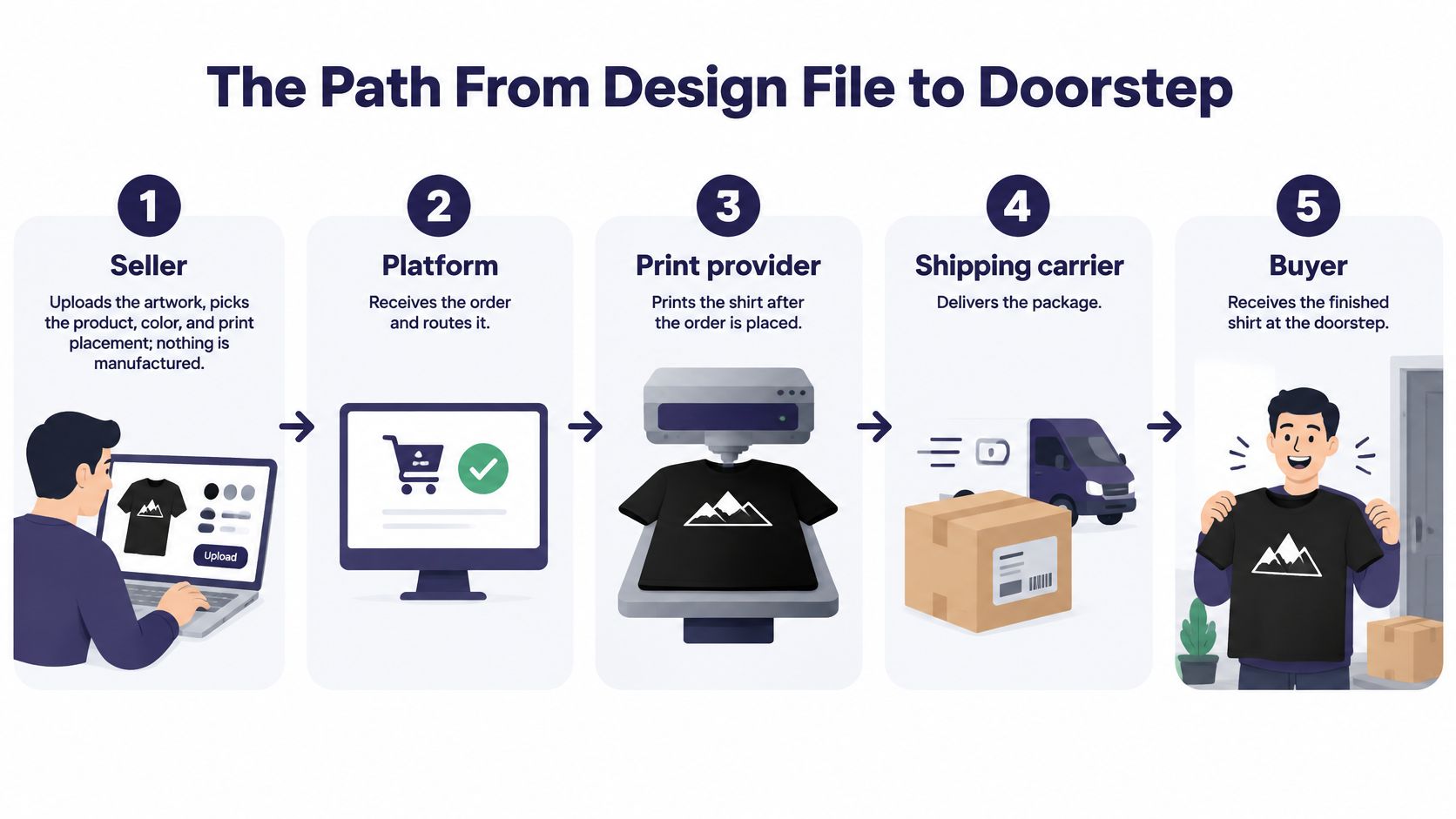
A black T-shirt might look like a single product on a listing, but several people and systems handle the order. The steps below show who acts and why each handoff matters.
Seller: Upload the artwork and choose the shirt, color, and print placement. Nothing is manufactured yet. Check the provider's product template before uploading so the design fits the available print area.
Seller or marketplace: Create a product page with a mockup, price, and size options. The mockup helps buyers understand the item, but it isn't proof that the actual print will match perfectly.
Buyer: Place the order and pay. That payment triggers production. Until then, the shirt exists only as a listing and a digital design.
Marketplace or app integration: Match the order with the right artwork, size, and color. This is the point where accurate product setup matters. If a listing is connected to the wrong file or variant, the provider may print the wrong design on the wrong blank.
Print provider: Retrieve the artwork, prepare the shirt, print the design, and cure the ink with heat. The cure helps set the print, and the correct process depends on the provider's materials and equipment.
Provider or platform: Check and pack the finished item, then hand it to a carrier with the buyer's address. One order means one item is being packed and dispatched, rather than picked from a shelf of finished inventory.
Seller, platform, or both: Handle a problem after delivery under that channel's rules. A misprint, damaged parcel, late delivery, and incorrect address are different cases, so identify the issue before deciding what remedy to offer.
It works like a kitchen that starts cooking only after the order is received, not before. A personalized name or date follows the same process, except the text changes with each order, so the final item cannot be printed ahead of time. If you're creating many original graphics, a design workflow can also benefit from learning how to discover its image generation capabilities without losing control of the final print file.
| Stages from a stored design to a shipped item | Who acts | What happens |
|---|---|---|
| Design ready | Seller | Artwork and product choices stay as a digital file |
| Listing live | Seller or marketplace | A page shows the mockup, price, and options |
| Order placed | Buyer | Payment is the trigger; nothing was printed earlier |
| File matched | Marketplace or app integration | The order pulls the right file, size, and color |
| Print and finish | Print provider | The design goes onto a blank, then is cured and checked |
| Pack and ship | Provider or platform | That single item is packed and given to a carrier |
| Problem after delivery | Seller, platform, or both | A replacement follows that channel's rules |
Who Prints, Lists, and Talks to the Buyer
Three jobs sit behind most POD sales: the seller supplies the design, a marketplace or shop displays it, and a print provider makes and ships the item. Sometimes one company handles more than one job. That difference determines how much work you do and how much control you retain when a buyer needs help.
| Who does the work on four common POD channels | Who lists | Who prints and ships | Who faces the buyer | Seller's main job |
|---|---|---|---|---|
| Amazon Merch on Demand | Amazon | Amazon | Amazon | Art, product choices, and price inside Amazon's rules |
| Redbubble | Redbubble from the artist upload | Redbubble | Redbubble for the order | Design, tags, and which products to turn on |
| TeePublic | TeePublic from the artist upload | TeePublic | TeePublic for the order | Design and which products to enable |
| Etsy plus a print partner | The seller's Etsy listing | The connected print partner | The seller, with the partner on defects | Listing, price, niche, and buyer messages |
Amazon describes its Merch on Demand arrangement as one where the creator supplies artwork and product choices, while Amazon creates the listing and handles production, shipping, and customer service. That lets a seller test a design without buying a batch, but it also means depending on Amazon's fulfillment and support systems rather than controlling them directly, as Amazon's Merch on Demand overview explains.
Redbubble and TeePublic work more like all-in-one marketplaces: the artist uploads designs and enables products, then the marketplace presents and fulfills orders. That leaves less to operate, but also gives the seller less power to change packaging, carriers, or production location.
On Etsy, the seller usually writes the listing and answers the buyer, while a connected print partner makes and ships the product. If a parcel arrives late, the complaint may still land in the seller's messages, even when the seller can't speed up production or change the carrier. A seller who wants to build a distinctive shop voice may value that direct relationship, but it comes with more customer communication.
The key operational question isn't which channel pays more. It's who owns each handoff when something goes wrong. If you can't choose the printer or carrier, you also can't promise a delivery date you don't control.
Where the Money Goes on Each Order
A shirt's displayed price isn't your profit. One sale can involve the blank garment and print, shipping, checkout tax, marketplace fees or a royalty formula, and possibly the cost of replacing a faulty item. The exact mix depends on the channel and product, so I'd calculate from the order's actual costs instead of assuming a universal margin.
| What comes out of one POD sale | Who sets it | What changes the amount |
|---|---|---|
| Blank and print | Print provider or marketplace | Garment, print size, colors, and print method |
| Shipping | Provider, marketplace, or buyer | Destination, speed, and where it is produced |
| Tax | Checkout rules | Where the buyer is |
| Platform cut or royalty | Marketplace formula | On Merch, offer price minus tax and Amazon's costs |
| Seller margin | What remains | Retail price minus the rows above |
| Reprint or refund | The channel's policy | Defect, damage, late delivery, or a wrong address |
Amazon Merch on Demand doesn't describe creator earnings as a simple percentage of the displayed price. Amazon bases its royalty on the product's offer price, less applicable tax and Amazon's costs. Raising the price can change both the royalty amount and whether a buyer chooses to order, so check the deductions rather than treating the listed price as your payout, according to Amazon's Merch earnings information.
For an Etsy shop connected to a print partner, the seller usually sets the retail price and subtracts the provider's base cost and shipping quote, along with any shop charges for processing the sale. A second print location can change both the base cost and postage. A “free shipping” badge doesn't make delivery free; the seller may have moved that expense into the item price.
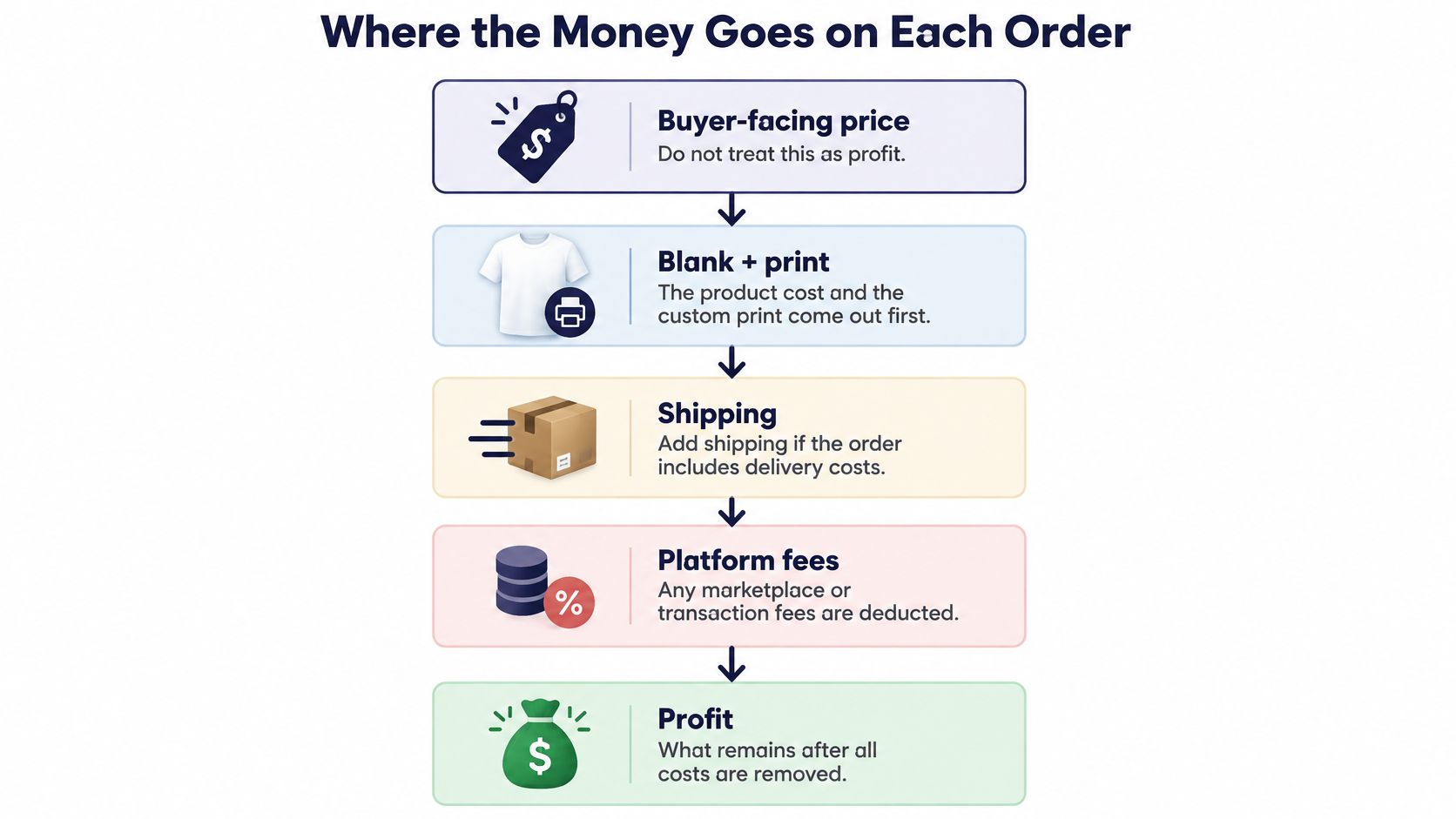
Say an offer price barely clears the blank, printing, and other deductions. If the first shirt needs replacing, that second production and shipping cost can erase the royalty from the original sale. When you're refining your pricing, reviewing ways to increase earnings can help you think about the broader decisions that affect what remains.
I'd set a price that still leaves room for a realistic reprint, not the largest royalty a calculator can display.
Where Sellers Actually Use This Model
POD suits a side project that tests ideas without buying a batch first. A seller could upload a phrase to Amazon Merch on Demand, Redbubble, or TeePublic and enable it on a shirt, poster, and mug. If the design gets no traction, the seller hasn't paid to store a pile of those products; the constraint is that the cost per item can leave less room for price competition.
An Etsy shop can fit a narrower audience, such as hikers who want a local trail series or workers who share a job-specific joke. The seller can use a more personal shop voice, but should be ready to answer buyer messages and manage expectations about production and delivery.
A small team with a large design catalog can use POD to test many concepts without purchasing stock for each one. The practical risk shifts to quality oversight: if nobody orders samples, a color drift or inconsistent placement may go unnoticed until a buyer complains.
Personalized goods are another natural match. A poster with a different name on every order would be awkward to stock in advance, because each version is a different finished item. POD lets the seller use the same basic product setup while the text changes at purchase.
Some products are poor fits. An event that needs delivery in two days leaves little room for production and carrier handoffs, especially when an order crosses a border. A design that must match one exact fabric color on every reorder is also risky, because blanks and print batches can differ between providers or runs.
Practical filter: Use POD when demand is uncertain and buyers can accept a wait. Skip it when speed, exact repeat color, or hands-on packing is part of the product promise.
Quality Shipping and Trademark Problems
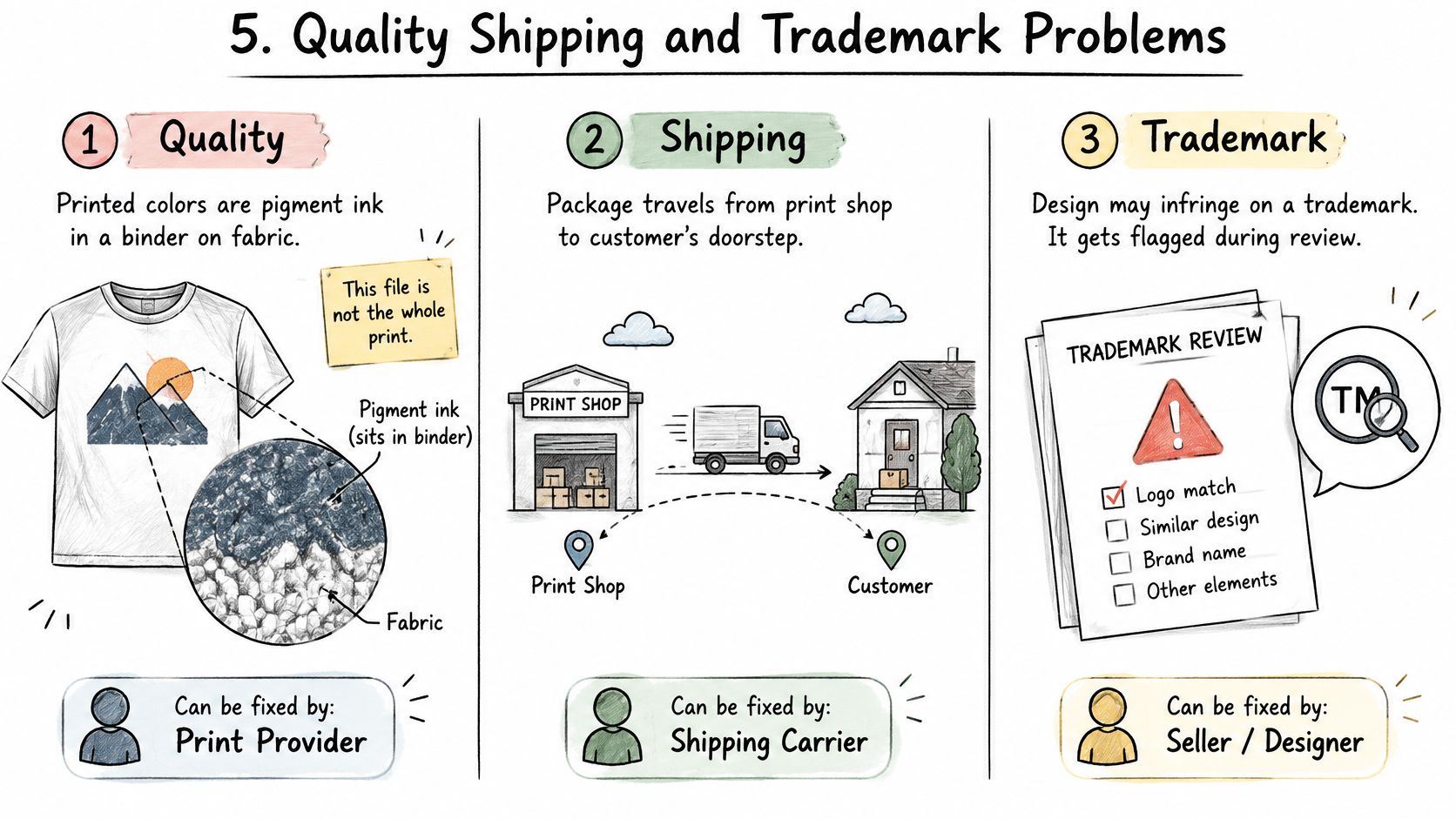
A digital design file doesn't guarantee a good physical print. On apparel, pigment ink contains color particles in a binder, and heat activates that binder so it bonds with the fabric. Published textile procedures commonly report fixation around 150°C for five minutes, while other equipment and ink systems use different curing windows. Too little heat can weaken wash resistance; too much can distort the fabric or change the color, as the digital textile printing chapter explains.
You usually can't stand beside the provider's machine and control its settings. I'd order a sample of the actual product and color, check the placement against the mockup, then wash it before sending traffic to the listing. That tests the finished item rather than relying on the file preview alone.
Shipping problems need a separate diagnosis. A blank or misprinted shirt is a production defect; a crushed package is transit damage; an incorrect address may come from the buyer or listing data. A late tracking scan could point to production, a carrier handoff, or customs on a cross-border shipment. Keep photos and dates, then check the channel's replacement rules before promising a remedy.
The operational challenge is that the seller may control the listing and customer conversation while the provider controls production and shipping. Clear expectations and a documented exception process help; for a broader view of logistics planning for orders, account for the handoffs that sit outside your shop. Sellers handling payment disputes can also benefit from understanding managing excessive merchant chargebacks, particularly when delivery or replacement problems escalate into claims.
Trademark checks are a different kind of risk. The USPTO's federal trademark search guidance says to look beyond an exact phrase: marks can be confusingly similar in appearance, sound, meaning, or overall commercial impression, and related goods can matter even when they're not in the same international class. Its described search process focuses on live applications or registrations as potential barriers, but a federal search doesn't capture every common-law use.
A keyword screen is useful, not a legal clearance. I'd check a phrase before publishing a design that names a brand, team, or character, then get professional advice if the result is unclear.
Choose a Channel Then Check the Niche
Choose the channel based on the customer relationship you want, not a promise of sales. If you want Amazon to list, print, ship, and support the order, Merch on Demand fits that division of work. If you want an Etsy shop with your own voice and can answer messages, connect it to a print partner. If you'd rather upload a public portfolio and let a marketplace fulfill orders, consider Redbubble or TeePublic.
Before publishing, order a sample of the product you'll sell and wash it. Set the price from the actual cost pieces, leave room for a reprint, and describe only a delivery timeline you can support. Screen the design phrase for trademark conflicts, especially when it refers to a brand, team, or character.
For the idea itself, look for signs of demand rather than choosing a niche at random. A focused niche market identification process can help you compare ideas and avoid building a product around a phrase buyers don't use. Trendlytic covers TeePublic, Amazon Merch, Redbubble, and Etsy, with niche research and a built-in USPTO trademark check. If you're also planning how to present a new product across channels, this guide to building your media marketing mix offers a useful way to think about where your message belongs.
The model works best when the file is ready, the price can absorb a bad day, and the words on the product are yours to use.
If you're weighing a POD niche, visit Trendlytic to compare research across TeePublic, Amazon Merch, Redbubble, and Etsy, and check keywords against USPTO trademarks. Use it to inform your next design decision, then validate the product with a sample and a price that leaves room for a replacement.