How to Handle Negative Feedback for POD Sellers
An Etsy review lands saying the print faded after one wash. You're checking the listing, wondering whether the buyer followed the care instructions, and drafting a reply before you've checked the order. That's the moment to stop typing. Learning how to handle negative feedback starts with separating what the customer experienced from what you can verify.
Table of Contents
- The First Hour After a Negative Review
- A Practical Response Protocol That Works on Every Marketplace
- Marketplace Differences That Change Your Reply
- Handling Vague, Indirect, or Unfair Criticism
- Preventing the Same Complaint From Coming Back
- Metrics That Actually Predict Improvement
- Building a Storefront That Absorbs Feedback Well
The First Hour After a Negative Review
A faded-print complaint feels different when it's attached to your design. You remember the artwork adjustments and mockup checks, so it's tempting to explain how much care went into the product. The buyer, understandably, is judging the shirt they received.
I treat that first reaction as a reason to investigate, not a reason to publish. Tight shoulders and an urge to defend the listing aren't useful evidence.

Make the complaint specific
Before answering, I'd pull up the product variant, fulfillment record, listing description, and any previous messages. A fading complaint belongs under print quality, but its cause is still unconfirmed. Don't turn a category into a diagnosis.
For a seller juggling Amazon Merch, Etsy, Redbubble, and TeePublic, the immediate job is to preserve enough context to investigate later.
- Save the evidence: Record the review text, product, date, and relevant order information securely.
- Check the immediate risk: A damaged print, threatening message, and intellectual-property allegation need different handling.
- Choose a next action: Decide whether you need clarification, a support escalation, or an available remedy.
There's a business reason not to leave legitimate complaints unattended.
Microsoft's 2017 Global State of Customer Service Report found that 56% of consumers had stopped doing business with a brand because of poor customer service, and 47% of those customers had switched within the previous 12 months.
That's historical, cross-industry evidence, not a prediction about your shop. Still, it supports treating a complaint as a potential retention problem rather than an irritating comment.
If you need help organizing your wording, SupportGPT's guide on how to respond to unhappy customers is a useful companion. Use guidance to build a deliberate reply, not to avoid reading the actual complaint.
The first hour isn't a universal resolution deadline. It's a useful window for replacing a defensive reaction with a clear, workable next step.
A Practical Response Protocol That Works on Every Marketplace
I use the same internal sequence across storefronts, but not the same customer-facing paragraph. The process can be consistent even when the wording and available support channels differ.
Acknowledge, categorize, and draft
Acknowledge the specific experience. Name the reported problem without accepting an unverified explanation. “The print faded after washing” is more useful than “You're unhappy with your purchase.”
Then categorize the complaint. I'd keep separate labels for sizing, print quality, shipping, design accuracy, and trademark or intellectual-property concerns. These categories point toward different records, escalation routes, and possible remedies.
The response should match the evidence and severity. A 2025 experimental study comparing review-response styles found that defensive replies worked better for ordinary negative text reviews, while accommodative replies performed better when a significant service failure was involved.
I wouldn't interpret “defensive” as permission to argue. A factual explanation of an accurately described design is different from dismissing a buyer whose garment arrived damaged.
Adaptable wording for a reported quality or shipping problem:
I'm sorry the shirt arrived with a damaged print. Please use the order's support channel to share a photo so the available replacement or refund options can be checked. I can't confirm the remedy until the order has been reviewed.
Only promise actions you control. If the marketplace handles fulfillment and customer support, don't write as though you can personally authorize a replacement.
Resolve privately and log the outcome
Move addresses, order identifiers, payment information, and other sensitive details into the appropriate private channel. Keep any public response useful without exposing the customer.
For an unclear or opinion-based comment, use a narrower reply.
Adaptable wording for vague feedback:
Thanks for the feedback. Was the problem with the garment, the printed artwork, or how the product compared with the listing? That will help identify what needs checking.
Afterward, record what happened:
- Ownership: Who's responsible for the next action?
- Commitment: What follow-up was promised, and when?
- Outcome: Was the issue resolved, escalated, refunded, replaced, or left unanswered?
- Prevention: Does the complaint justify a listing or production change?
An analysis of managerial responses found that overly lengthy, formulaic, or disorganized replies could reduce perceived review helpfulness. Keep reusable structure behind the scenes. In public, identify the issue, state the next action, and stop.
Marketplace Differences That Change Your Reply
The risky assumption is that every POD marketplace gives artists the same relationship with buyers. Before replying, I check whether I'm dealing with a product review, an artist message, a seller-support case, or an order-support request.
A reply framework isn't permission to use a feature. The available account interface and current marketplace policies determine what you can publish, change, or escalate. I wouldn't assume that a visible comment provides permission to contact its author elsewhere.
Response Rules Across Major POD Marketplaces
This is a channel-checking reference, not a substitute for current platform documentation.
| Marketplace | Response Visibility | Edit or Delete | Tone Expectation |
|---|---|---|---|
| Amazon Merch | Verify whether the issue belongs in product reviews, an account-support route, or customer order support. Don't assume a public reply is available. | Check current permissions. Don't plan around removing a buyer's review. | I'd use concise, factual wording and avoid implying direct control over fulfillment. |
| Etsy | Distinguish private order communication from any available public review response. | Check current rules before publishing or changing a response. | I'd personalize the opening and name the actual product problem. |
| Redbubble | Establish whether the feedback is an artist-facing comment or an order issue needing marketplace support. | Verify the controls for that particular content type. | I'd use approachable language while keeping operational promises limited. |
| TeePublic | Confirm the appropriate artist or customer-support channel before answering. | Treat moderation and review controls as platform-dependent. | I'd acknowledge the concern and identify who can act on it. |
I wouldn't claim that a particular reply automatically damages Amazon rankings or violates TeePublic guidelines without checking the applicable rule. That kind of unsupported warning can make sellers afraid to communicate at all.
The useful distinction is who owns the remedy. If you control the Etsy listing and fulfillment arrangement, you may have actions available that aren't available for a marketplace-managed order. For delivery complaints, connect the conversation to your logistics planning, rather than improvising a delivery promise.
Adjust the channel, not just the greeting
International customers won't necessarily interpret bluntness, informality, or public discussion the same way. I'd offer private clarification for sensitive matters and avoid treating indirect wording as evidence that the concern is minor.
The same caution applies across age groups. Don't infer a buyer's preferred tone or response expectations from a username, avatar, or writing style. Ask what information they need, use plain language, and give a follow-up commitment you can keep.
Handling Vague, Indirect, or Unfair Criticism
“Quality. Sure.”
That comment doesn't tell you whether the buyer dislikes the fabric, received a damaged print, or thinks the mockup looked better than the garment. An elaborate apology at this point risks answering a complaint they haven't made.
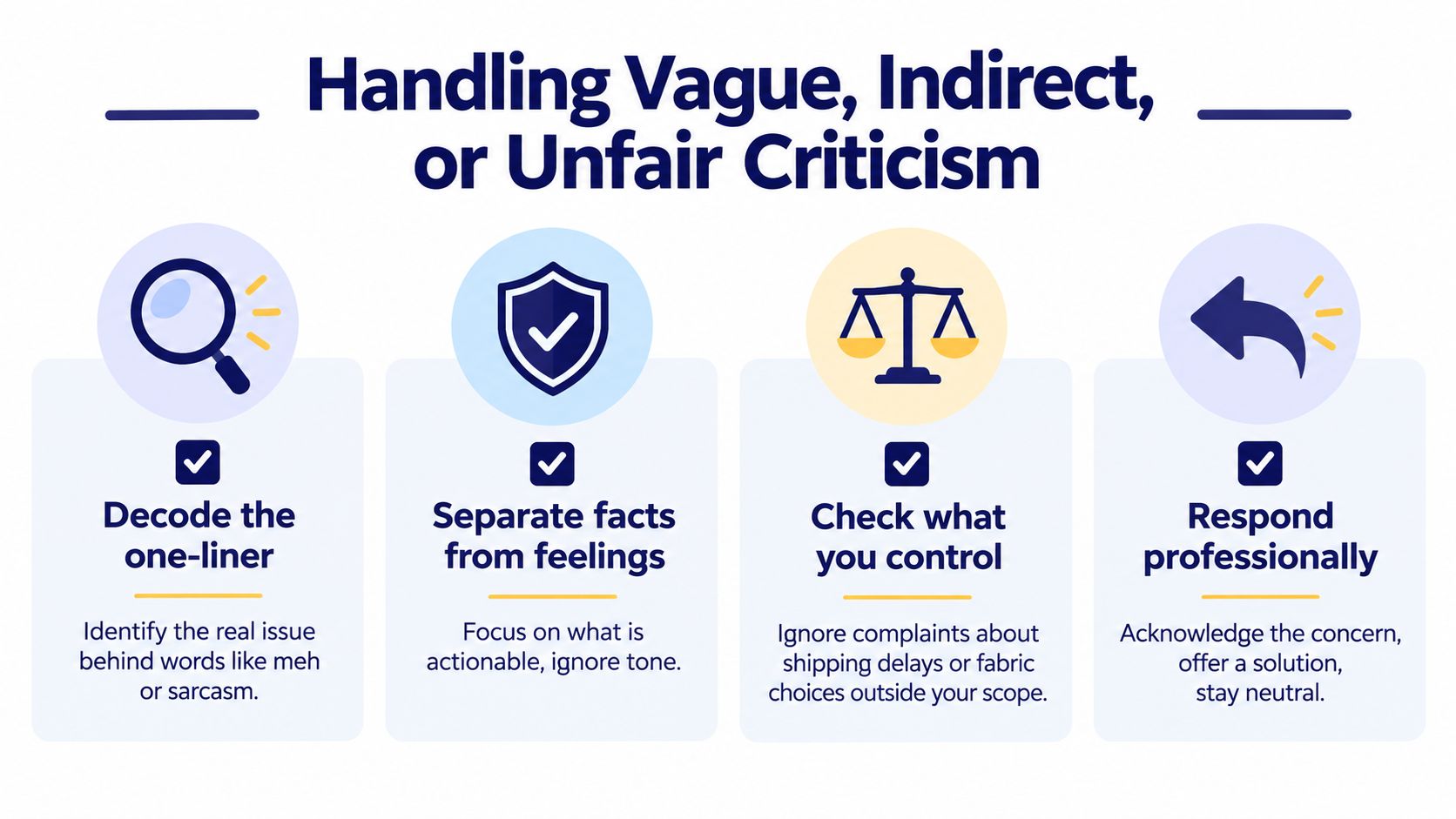
I'd treat the following checklist as a starting point, with an important qualification: an external cause doesn't make the customer's problem irrelevant.
Separate the claim from its delivery
Use a short decision framework before choosing your wording:
- Decode the claim: Identify what the comment alleges, rather than responding to its sarcasm.
- Ask for clarification: “Was the issue with the fabric, the print, or the fit?” gives the buyer something concrete to answer.
- Check controllability: Separate your listing and artwork decisions from production or carrier events.
- Match the response: Correct a factual misunderstanding briefly, but take responsibility for a verified failure within your control.
For example, suppose an indirect review says the shirt is “premium quality, apparently.” If clarification reveals that the print cracked, classify it as a print-quality complaint. If the buyer prefers heavier fabric and the listing accurately described the garment, clarify that distinction without suggesting their preference is wrong.
Research involving 467 online shoppers found that explanations framing a problem as external, uncontrollable, and temporary caused less trust damage than explanations framing it as internal, controllable, and stable, as described in EKU's discussion of negative-review research. That's not a reason to manufacture an external excuse.
Give context without abandoning the buyer
For a verified carrier disruption, explain what the tracking establishes and identify the available support route. “The carrier caused it” isn't a resolution, even when it's accurate.
For tense exchanges, SignalZen's guidance on how to turn customer frustration into loyalty offers another way to think about de-escalation. I'd keep the ambition modest: understand the issue and help where possible, rather than expect every unhappy buyer to become loyal.
Preserve evidence of threats, suspected fraud, or coordinated abuse and use the marketplace's reporting process. Don't publicly debate motives, and don't confuse criticism you dislike with content that violates policy.
Preventing the Same Complaint From Coming Back
A replacement can resolve an individual order while leaving the next buyer exposed to the same defect. I'd consider a complaint fully reviewed only after deciding whether anything needs to change upstream.
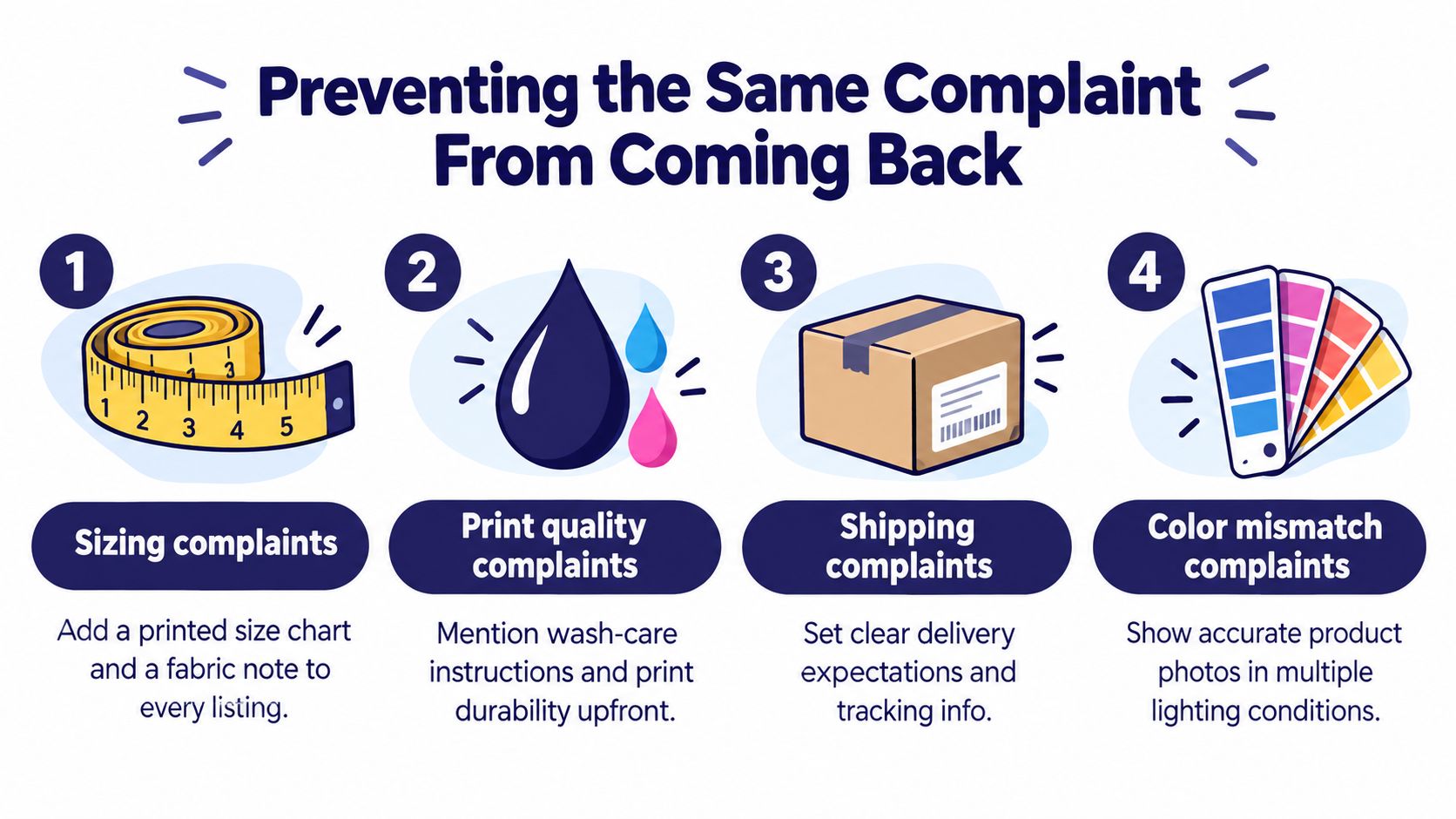
This prevention checklist is useful, provided each change matches the product and the controls your marketplace gives you.
Change the source of the mismatch
Sizing complaints need better reference information. Add a legible size chart wherever supported, explain what the measurements represent, and include an accurate fabric and fit note. Don't reuse one garment's chart for a different blank without checking it.
For print-quality complaints, compare the garment, artwork file, production method, and care guidance. Where you control sourcing, test an alternative blank or provider before switching. Where you don't, document the pattern and escalate through the available support route.
Wash instructions are useful, but they shouldn't become an automatic defense. A customer reporting fading deserves an investigation, not an assumption that they washed the garment incorrectly.
Shipping and design accuracy require different changes:
- Delivery expectations: Separate production time from transit estimates, and avoid presenting an estimate as a guarantee.
- Artwork presentation: Check print placement, scale, cropping, contrast, and whether the mockup suggests detail the finished product can't reproduce.
- Color expectations: Use accurate imagery and explain relevant limitations without treating every mismatch as unavoidable.
- Intellectual property: Screen proposed keywords and artwork before launch, then review questionable results rather than treating a database search as legal clearance.
I'd connect these actions to a documented quality assurance process. Record the change, the products affected, and what evidence would tell you whether it helped.
Verify the correction
Don't close a recurring defect investigation just because the latest buyer accepted a refund. Check subsequent feedback and, where possible, inspect a sample produced after the change.
The embedded video can sit alongside that review, but it shouldn't replace product-specific checks.
Prevention rule: A corrected listing or production process is more valuable than a polished explanation for a defect you keep shipping.
There's no honest basis for promising that one fix will eliminate a set number of complaints. The practical advantage is simpler: a verified root-cause correction can protect future orders, rather than compensate only for past ones.
Metrics That Actually Predict Improvement
A higher star average is encouraging. It doesn't tell you whether fewer shirts arrived with defective prints, whether customers needed repeated follow-ups, or whether refunds became more expensive.
An analysis of tens of thousands of hotel reviews found that businesses received 12% more reviews and their average rating increased by 0.12 stars after management began responding. The researchers also found changes in the negative reviews customers posted, so the rating movement shouldn't be treated as proof that underlying defects disappeared.
Separate communication performance from product performance
I'd keep these measures next to each other, rather than reduce support quality to a single score:
- Median first-response time: How long customers typically wait for acknowledgment.
- Resolution time and repeat contact: How long a usable outcome takes, and how often buyers must return.
- Resolved in one contact: Whether straightforward cases are handled without unnecessary back-and-forth.
- Recurrence by failure category: Whether the same problem continues after a corrective action.
- Refund or replacement burden: The cost and frequency of remedies relative to sales.
- Rating movement: A visible outcome to interpret alongside operational evidence, not instead of it.
These are management signals, not guaranteed predictors. A faster reply can coexist with worse products, and a generous refund policy can conceal a supplier problem.
Use a weekly tracking sheet
Start with a small template you'll maintain. This blank structure avoids pretending that illustrative rows are real customer cases.
| Date | Marketplace | Category | Response time | Resolution outcome | Recurrence flag |
|---|---|---|---|---|---|
| Enter date | Enter storefront | Select failure type | Record elapsed time | Record actual outcome | Link related incidents |
Keep sensitive order records elsewhere and connect them through an internal reference. Add product variant, provider, or production batch when available and useful.
Compare complaint rates against sales volume. A popular design generating more complaints in absolute terms isn't automatically less reliable than a rarely purchased one.
That distinction also improves how you evaluate customer engagement. More comments aren't necessarily better relationships, and fewer public complaints don't establish that customers are satisfied.
Return to the faded-print review: categorizing it correctly makes it possible to spot related reports involving the same blank or provider during subsequent weekly reviews. Whether a trend emerges depends on the evidence. The log makes that investigation possible without relying on memory.
Building a Storefront That Absorbs Feedback Well
A resilient POD storefront isn't one where nobody complains. It's one where the seller can distinguish a disappointing experience, a misleading listing, and a production failure without treating them all as personal criticism.
I'd rather have an uncomfortable but specific review than a vague reassurance that everything's fine. Specific feedback gives you something to check, even when the customer's wording is difficult.
Keep the operating loop connected
The working sequence is monitor, categorize, respond, log, prevent. It only helps when the person handling messages can connect an incident to the person who controls the listing, artwork, sourcing decision, or escalation.
For a solo seller, that means revisiting your own notes instead of leaving them scattered across inboxes. For a team, it means assigning responsibility rather than assuming somebody else has contacted support.
Use a final review before calling an issue closed:
- Customer outcome: Did the buyer receive the promised next step?
- Operational decision: Was a correction needed, and was it implemented?
- Verification: What will you check before deciding the change worked?
Product selection belongs in that conversation, but it isn't a substitute for service. Researching demand and competition can inform what you launch; it can't make an inaccurate mockup honest or a defective print acceptable.
Accept the limits
No response framework guarantees a revised review, another purchase, or an agreeable conversation. Sometimes the appropriate outcome is a documented remedy and a respectful end to the exchange.
The useful standard is narrower: customers can understand what happens next, your promises match your authority, and recurring complaints lead to a decision. That's a more dependable way to run a storefront than trying to make every public interaction look successful.
Trendlytic offers POD niche research across TeePublic, Amazon Merch, Redbubble, and Etsy, with a built-in USPTO trademark check to support prelaunch screening. If your complaint log points toward product-selection or keyword risks, visit Trendlytic to inform your next research round, while keeping product checks and customer support as separate responsibilities.