What Is Customer Engagement for POD Sellers
You've had a design sell twice on Redbubble, received a five-star Etsy review, and then watched both storefronts go quiet. The designs didn't disappear, but the buyer activity did. It's tempting to read each sale or review as proof of a growing audience, then wonder what went wrong when there's no second purchase.
That gap is where customer engagement matters. For a POD seller, it's not just getting a product in front of someone. It's whether buyers notice, care about, and choose to interact with your work over time. Understanding what is customer engagement in practical terms helps separate useful signals from likes and clicks that don't lead anywhere.
Table of Contents
- Why POD Sellers Keep Asking the Same Question
- A Working Definition for Customer Engagement
- Customer Engagement Compared to Related Concepts
- Components and Metrics That Actually Matter
- Practical Ways to Build Engagement on POD Marketplaces
- When More Engagement Is Actually a Problem
- Two Short Scenarios and Where to Go Next
Why POD Sellers Keep Asking the Same Question
A sale is a transaction. A customer relationship is something that can continue after checkout, but marketplaces often reveal only part of it. You might see an order, a favorite, or a review without knowing whether the buyer has returned to your shop, recommended the design, or moved on.
That makes engagement easy to misunderstand. A design can attract attention without giving a buyer a reason to remember the shop. A five-star review is welcome, but it doesn't necessarily tell you whether the customer will buy again. And a quiet stretch doesn't automatically mean your work or listings have failed. It may mean that the initial design matched a moment of interest, while your other listings, product presentation, or follow-up didn't give the buyer another useful reason to connect.
In POD, the relationship also looks different across storefronts. Etsy buyers may encounter a cohesive shop and shop around. On Amazon Merch, a shopper may see one design in search and never discover your other work. A Redbubble favorite can signal interest, but it isn't a sale. TeePublic shoppers may browse artists' pages, yet platform activity still doesn't tell you everything about what a particular buyer feels.
The practical question isn't, “How do I make every customer come back?” You can't control that, and the marketplace controls much of the customer relationship. Better questions are: Did the buyer understand the listing? Did the design connect with the right person? Did the experience build enough trust to make another interaction worthwhile?
Practical rule: Treat each sale as evidence that a product met one buyer's need, not proof that you've built loyalty.
A useful working model needs to include what buyers think, feel, and do. It also needs metrics that help you make a better decision, rather than a bigger vanity dashboard. That's the difference between engagement as a business idea and engagement as something a solo seller can work on.
A Working Definition for Customer Engagement
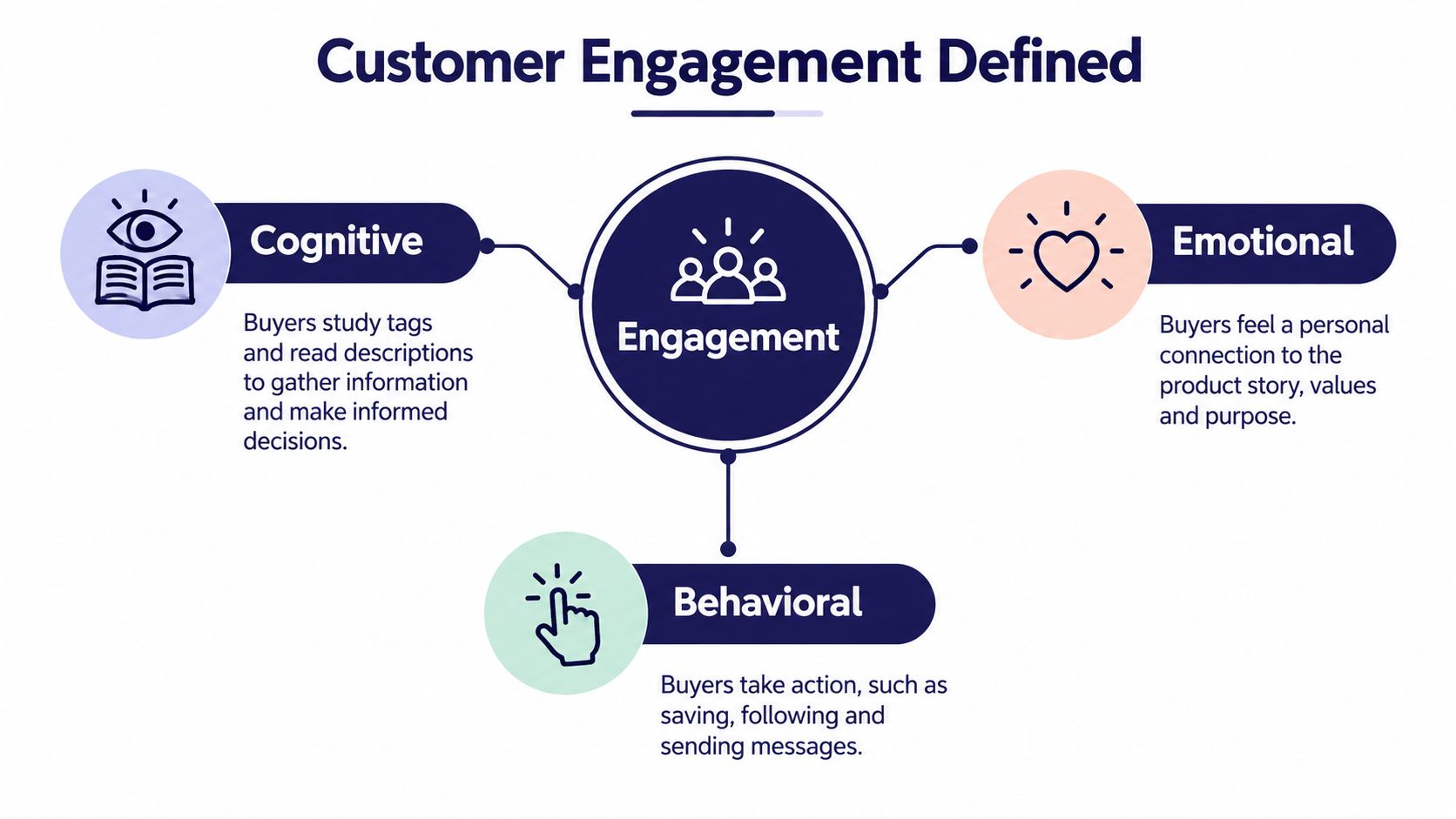
For a POD shop, customer engagement is the buyer's cognitive, emotional, and behavioral investment in your brand or products. A transaction can be part of that relationship, but a purchase alone doesn't show its full depth. A click can show a moment of attention, but it doesn't prove the buyer trusts your work or intends to return.
Cognitive engagement
This is the buyer's attention and thought. They study your tags, read the description, compare products, or look closely at the mockup to decide whether it fits what they're looking for. Someone browsing a TeePublic shop more than once before buying may be showing stronger consideration than a shopper who opens a listing and leaves immediately.
Cognitive signals help you spot relevance. If people arrive at an Etsy listing but don't understand the product or its use, the issue might be the listing details, not the design itself.
Emotional engagement
A design can remind someone of a hobby, a community, or an inside joke they care about. That feeling gives the artwork meaning beyond its placement on a shirt or sticker. A Redbubble buyer who messages to ask whether a design is available in another color may already have a clear connection to the artwork, though the message still doesn't guarantee a purchase.
Trust belongs here, too. Buyers are more likely to feel comfortable engaging when the listing is accurate and the seller's communication is respectful. For ideas on tailoring interactions without making them feel mechanical, this guide to boost loyalty with AI personalization offers relevant background.
Behavioral engagement
This is what the buyer does. They may return to your shop, save a product, recommend it, leave a review, share a photo, or send a question. Some meaningful actions happen outside the purchase itself: commenting on a design or suggesting an idea can give you useful evidence of interest.
Look at the layers together. A buyer who reads an Etsy description, connects with the design, and returns to order has shown more than a click. The point isn't to collect every possible signal. It's to understand which buyer actions reflect real interest in your work.
Customer Engagement Compared to Related Concepts
An Etsy buyer can have a pleasant experience, feel satisfied with a product, and still never return. Those outcomes are related, but they answer different questions. Engagement concerns how much attention, feeling, and active participation the buyer brings to the relationship.
| Concept | What it measures | Typical POD signal | Time horizon |
|---|---|---|---|
| Customer engagement | The buyer's attention, emotional connection, and actions around a shop or product | Browsing more listings, favoriting, messaging, reviewing, recommending, or returning | Across interactions |
| Customer experience | The buyer's perception of their interactions with your shop and its products | Clear listing details, accurate mockups, smooth communication, and a product that matches its description | From discovery through delivery |
| Customer satisfaction | Whether the product or interaction met the buyer's expectations | Positive feedback or a favorable review | A particular purchase or interaction |
| Customer retention | Whether a buyer returns over time | A repeat purchase from the same customer, where the platform makes it visible | Over time |
A buyer, four different questions
Suppose someone discovers your TeePublic design in search. Customer experience asks how the listing, mockup, product options, and purchase process felt to that person. A confusing product image or unclear description can make that experience frustrating, even if the design was appealing.
After the order arrives, satisfaction asks whether the product matched expectations. A positive review may offer a clue. It's still a snapshot of that purchase, rather than proof of an ongoing relationship.
Retention asks whether the customer comes back to buy again. That's a more direct sign of continued purchasing, but marketplace tools may not give sellers a complete view of repeat behavior.
Engagement asks whether the buyer is involved beyond that single transaction. Did they browse other designs, follow the shop where possible, send a question, share the product, or recommend it? A customer might show engagement without making another purchase, and a repeat purchase can happen without much visible interaction in between.
These distinctions keep your interpretation grounded. If a listing gets attention but few orders, the issue may be relevance or presentation. If customers buy but don't appear to return, that could reflect product fit, limited visibility into their activity, or the fact that the marketplace didn't give them a reason to discover your other work. No single dashboard signal explains the whole relationship.
Components and Metrics That Actually Matter
An “engagement rate” can bundle together actions with very different value. A favorite, a product view, a message, and a completed order don't mean the same thing. I'd rather track a few signals that can guide a specific listing or service change than collect activity counts without knowing what to do next.
Pair a signal with a question
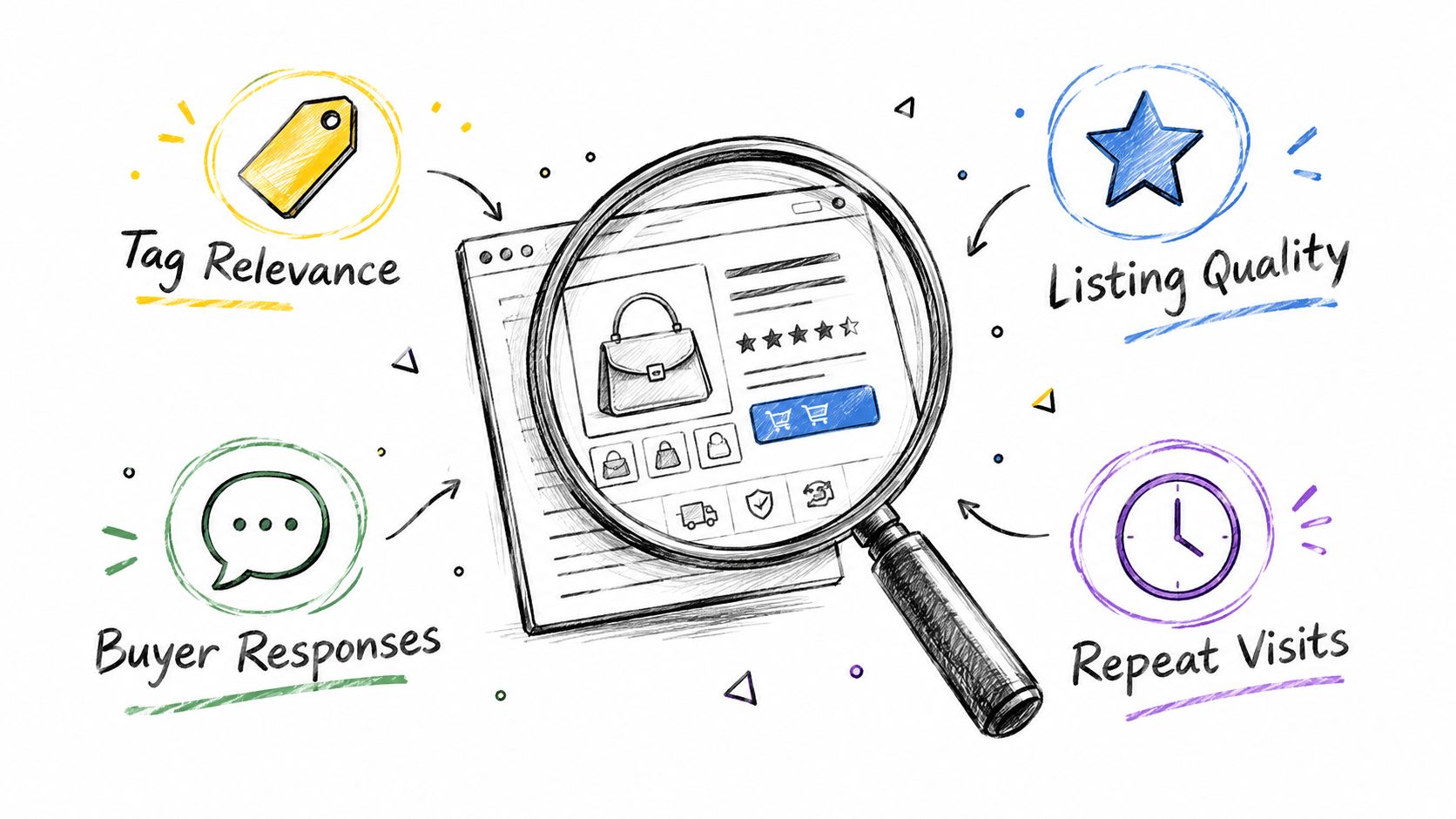
Start by separating listing relevance, buyer behavior, and trust. Listing relevance includes whether tags match buyer language, whether the mockup makes the product clear, and whether the description answers likely questions. Buyer behavior includes returning, saving, asking about the item, and following through to checkout. Trust includes accurate claims, a professional product presentation, and considerate communication.
Then use the marketplace data available to you:
- Amazon Merch: Review session and unit session percentage data where available in your account. Sessions indicate visits; the unit session percentage helps you understand orders in relation to visits. A lot of visits without orders may point to a mismatch between search intent, design, and listing presentation. Neither measure, on its own, proves emotional connection.
- Redbubble: Favorites can suggest that a design caught someone's attention, while tags affect how you describe and classify it. A favorite that doesn't lead to further action is a weaker signal than repeated interest paired with a purchase or direct response.
- TeePublic: Look at star rating trends and written feedback alongside listing performance. A rating can flag an expectation mismatch, but a strong rating alone doesn't tell you whether buyers are exploring the rest of your shop.
- Etsy: Review conversion rate and repeat buyer rate where your shop analytics provide them. Conversion connects visits with purchasing behavior; repeat buying is a more direct sign that some customers return. Read the numbers alongside customer messages and reviews so you can identify what helped or hindered the decision.
Keep the review useful
A weekly check can be simple: identify which listings draw attention, which ones convert, what buyers ask before purchasing, and what feedback repeats. Then make one focused change, such as tightening irrelevant tags or clarifying a product detail, and see whether the pattern changes. Don't change everything at once or treat a short-term fluctuation as a verdict.
A clear quality-assurance habit helps catch inaccurate descriptions, weak images, and inconsistent details before they undermine trust. For a practical checklist mindset, see these quality assurance processes for POD listings.
The best signal is the one that helps you decide what to improve. Views can tell you that people found a listing. Orders, thoughtful messages, useful reviews, and visible repeat behavior can help you understand whether the listing is meeting a buyer's needs. Keep the distinction clear, and don't mistake activity for a relationship.
Practical Ways to Build Engagement on POD Marketplaces
The strongest levers are usually ordinary storefront decisions: whether your tags match how buyers search, whether your images show what they'll receive, and whether your description answers the obvious questions. I'd fix those before chasing more posts or automation.
Make the listing easy to understand
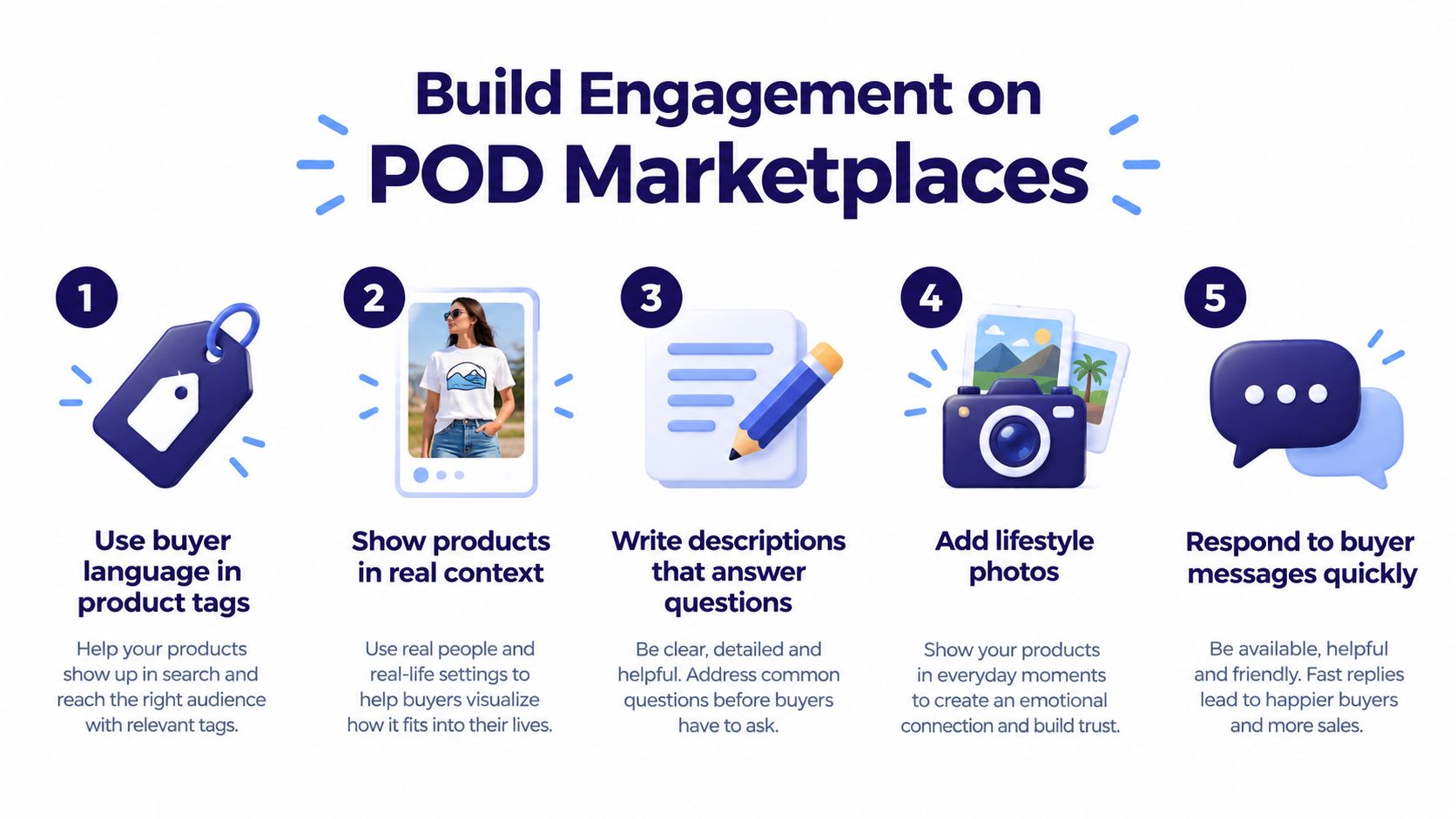
Use tags that reflect the buyer's intent, not just words that describe the artwork to you. If a design is for birdwatchers who enjoy dry humor, tags should describe the audience and the theme in natural language. A cluttered list of near-duplicates may look like broad coverage, but it can make the listing less coherent. Choose precise phrases and remove tags that don't accurately fit the product.
Mockups should help buyers picture the item in use. Show the design clearly, with enough context to understand its placement and scale. A busy mockup that makes the artwork hard to see adds polish at the expense of clarity.
In the description, answer practical questions before the buyer has to ask. State what the design depicts and keep product details consistent with the listing. Don't add promises about fabric, fit, or production that you can't verify from the marketplace's product information.
Make interaction useful
Answer buyer messages promptly, but don't trade accuracy for speed. If someone asks whether a design can be customized, say what you can do. A clear answer that prevents confusion builds more trust than an automatic reply that doesn't address the question.
Ask for feedback in a polite, platform-appropriate way, without pressuring buyers or offering an incentive that could violate marketplace rules. A review can tell you whether your mockup matched the delivered product, or whether buyers found the sizing and description clear. If you have an off-platform audience, an opt-in email list can help you announce new work to people who chose to hear from you. Keep those messages relevant and easy to unsubscribe from.
Short social posts work best when they point to a specific listing with a reason to look. A close-up of the artwork, a sketch, or a brief explanation of its niche can give people more context than a generic “new design” announcement. This practical overview of how to grow social engagement can help you think about social content as a conversation rather than a stream of promotions. For an Etsy shop using Pinterest, these Etsy and Pinterest listing ideas can help connect product discovery with storefront pages.
Here's a quick walkthrough to pair with those actions:
Build around trust as carefully as you build around visibility. If a design uses a phrase, name, or slogan that could be associated with a brand, don't rely on an exact-text search alone. The USPTO's guidance on likelihood of confusion explains that trademark conflicts can involve similar marks used for related goods, even when the wording or products aren't identical. Check spelling, sound, meaning, and the relationship between the phrase and what you sell before publishing or filing.
When More Engagement Is Actually a Problem
More activity can look like progress while making the shop less useful to buyers. Generic tags may attract poorly matched visitors. Repeated promotional messages can irritate people who never asked to hear from you. A high volume of replies isn't a win if customers still don't get a clear answer.
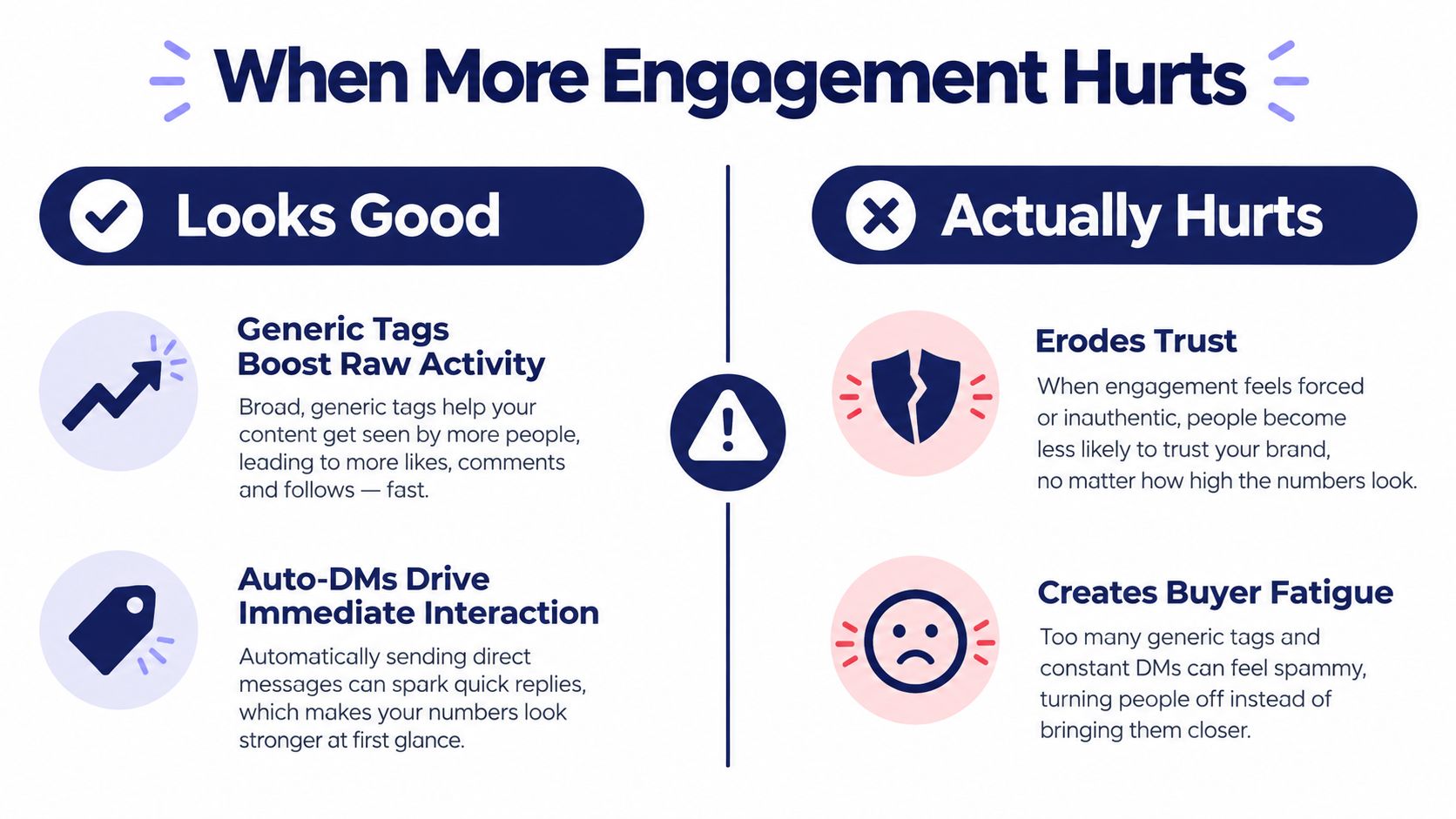
Check the quality behind the count
A favorite or social reaction is useful only when you understand what it reflects. It may show that someone noticed a design, but it doesn't tell you whether they understood the listing, intended to buy, or felt well served. Treat those signals as prompts to investigate, not as proof that a tactic is working.
Customer engagement can also become intrusive when personalization ignores permission or context. First-party information should be used transparently, and buyers should have a way to opt out of off-platform communication. Avoid making sensitive assumptions about shoppers. If automation handles a simple status update, it should still let a person take over when the customer has a more involved question.
For an honest review of a promotion idea, including limited-edition drops, ask whether it gives buyers useful information or just adds urgency. If the appeal depends on pressure rather than a genuinely limited product, you may earn a response without building trust.
Watch for red flags: Attention rises while orders remain weak, the same questions keep appearing, buyers complain about unclear details, or messages increase because your first reply didn't solve the problem.
A healthy pattern isn't necessarily more interaction. It may be fewer questions because the listing is clearer, better-matched visits that lead to orders, or thoughtful feedback that helps improve the next design. Compare similar periods and watch whether meaningful outcomes improve alongside activity. Don't assume a short burst of likes or messages will hold, and don't keep a tactic just because it makes the dashboard look busy.
Two Short Scenarios and Where to Go Next
An Amazon Merch seller notices that one design gets occasional orders but the surrounding listings don't attract much attention. They research the niche, rewrite tags to match buyer language, and make the product mockup easier to read. For customers who've explicitly agreed to hear from them off-platform, they send a concise email about a related design. If buyers start exploring more of the collection or returning, that's a useful signal. The seller still has to check whether the new listings meet expectations.
A Redbubble illustrator sees a seasonal design get a brief burst of favorites. Rather than assuming the spike means the shop has built an audience, they review the listing, refine the description, and respond clearly to customer questions. Over time, they look for more meaningful signs, such as purchases, useful reviews, and buyers engaging with other work. The aim isn't to make every trend last. It's to learn which parts of the shop earn trust beyond a passing moment.
Engagement grows through relevance and follow-through, not a single trick. I'd start with one listing, fix the clearest gap, and review the buyer response before expanding the change across a storefront.
Trendlytic helps POD sellers research niches across TeePublic, Amazon Merch, Redbubble, and Etsy, with live marketplace signals, related keyword discovery, and a built-in USPTO trademark check. If you want another research input before refining your listings, visit Trendlytic and see whether it fits your workflow.