How to Improve Sales on Etsy Without Killing Margin
Publishing more listings, adding more tags, and buying more traffic aren't reliable answers to a shop that isn't selling. They can just give you more products to maintain and more orders that barely pay for themselves.
I would start by separating low visibility, weak conversion, and thin margin. If you're figuring out how to improve sales on Etsy, the useful question isn't how to get more orders. It's which change will help the right buyer purchase a product that still pays after production, delivery, and fees.
Table of Contents
- Find the Bottleneck Before You Edit Listings
- Pick a Narrow POD Niche Worth Promoting
- Match One Buyer Phrase Across the Listing
- Shoot Photos That Turn Visits into Orders
- Price Each SKU After Fees and Shipping
- Protect the Service Score Etsy Rechecks
- Choose One Change and Run It for Two Weeks
Find the Bottleneck Before You Edit Listings
Etsy has plenty of buyers, but access to them isn't automatic. The 2024 Etsy annual report records approximately 89.6 million active Etsy marketplace buyers, meaning people who purchased during the preceding 12 months, and $10.9 billion in marketplace gross merchandise sales; across its broader portfolio, Etsy reported 95.5 million active buyers and 8.1 million active sellers.
That's a substantial opportunity inside a crowded marketplace, not a reason to assume another generic shirt will sell.
What the numbers say to change first
Pull a listing's impressions where available, visits, orders, and estimated contribution margin. Use a 14–28-day observation window as a working test, not a promise of meaningful traffic.
| What you see | Bottleneck | First change | Leave alone for now |
|---|---|---|---|
| Almost no impressions after 14–28 days | Visibility or niche fit | One specific buyer phrase in title, tags, category, and attributes | Photos, price, and ads |
| Dozens of visits and almost no orders | Conversion | First image or the offer, keywords held 14–28 days | Extra tags and new listings |
| Orders that leave little after fees and ads | Margin | Reprice from the full buyer-paid amount or pause ads | More traffic |
| Late orders, slow replies, or rising cases | Shop quality | Processing times and the 48-hour reply habit | A big new upload |
Use the funnel to locate the problem before editing.
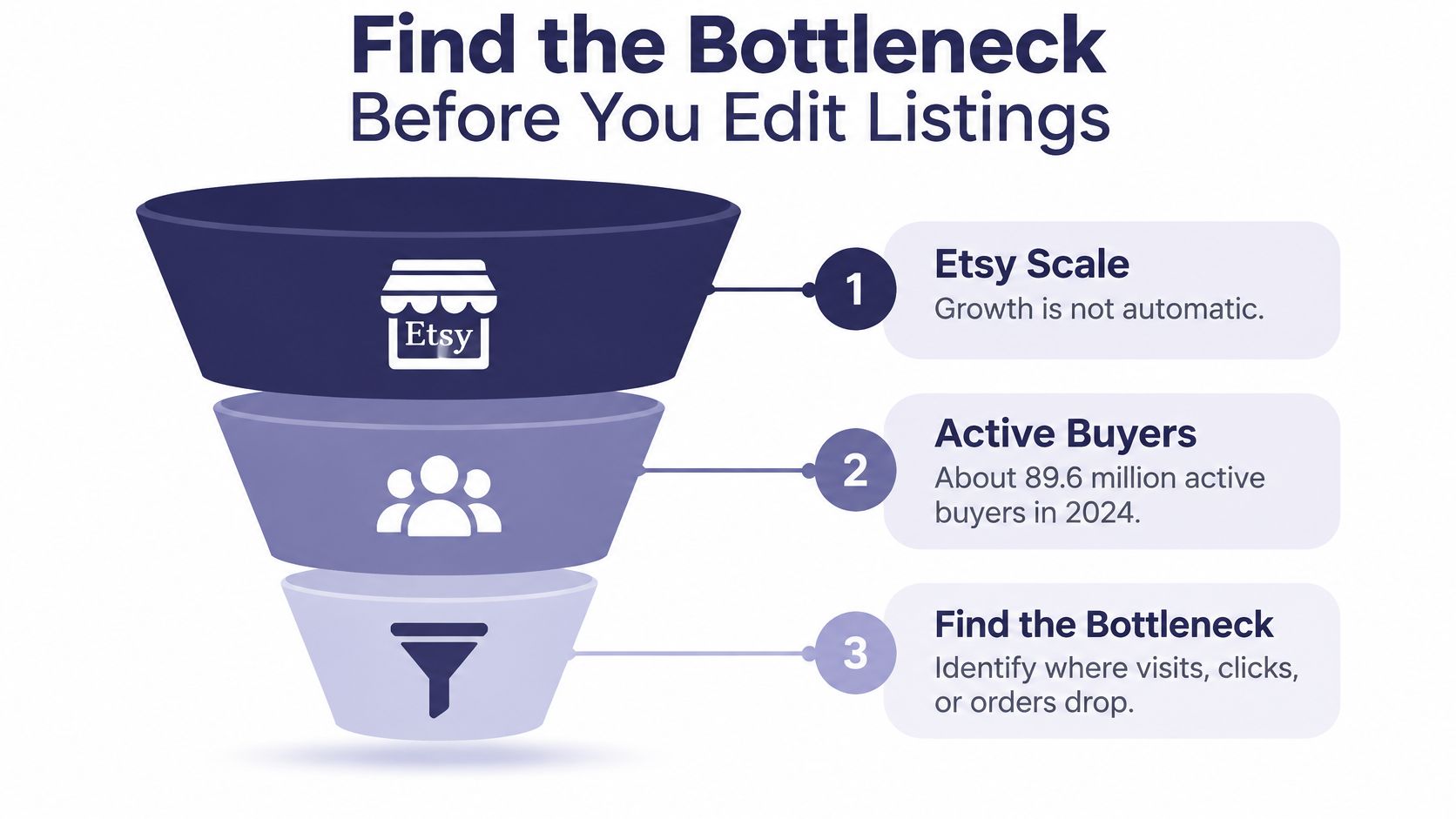
Say a nurse appreciation mug gets 380 visits and two orders. That's a hypothetical conversion problem worth investigating before adding keywords. A generic cat shirt with 15 visits offers much less evidence about its appeal.
Label the bottleneck, then choose the matching fix: buyer phrase, photography, pricing, or service.
Pick a Narrow POD Niche Worth Promoting
Start with a person buying something for a reason, not a trend list. Dog mom shirt describes a broad category; dachshund mom birthday gift gives you a recipient, an interest, and an occasion to design around.
I would keep the narrower direction when the relevant shops' strongest products also address specific buyers. Inspect those products for the purchase reason, not artwork to copy.
Research the buyer before the design
A store-first research pass means examining the strongest items in relevant shops rather than treating a random search page as proof of demand. This guide to high-search, low-competition niches can help organize that comparison.
Trendlytic is an optional POD niche research tool covering TeePublic, Amazon Merch, Redbubble, and Etsy, with a built-in USPTO trademark check. Use a flagged phrase as a reason to investigate ownership and intended use, not as something to work around; an automated check isn't legal clearance.
Product format matters too. If you're considering small gift add-ons rather than apparel, Raccoon Transfers' guide to selling print-on-demand stickers on Etsy is a relevant starting point.
A narrower audience is useful only if you can make a credible product for that audience at a workable margin.
Before promotion, write down:
- Buyer phrase: The recipient and purchase occasion.
- Product difference: What makes the design relevant beyond changing a name.
- Paid-click decision: Yes or no, based on the fee worksheet.
Test ads on an organic seller with a conservative budget, not an unproven catalog. Avoid blanket discounts that consume the margin you're trying to protect.
Match One Buyer Phrase Across the Listing
Use keyword work when the listing isn't reaching relevant shoppers. Don't rewrite a page's search targeting just because buyers who already visit it aren't purchasing.
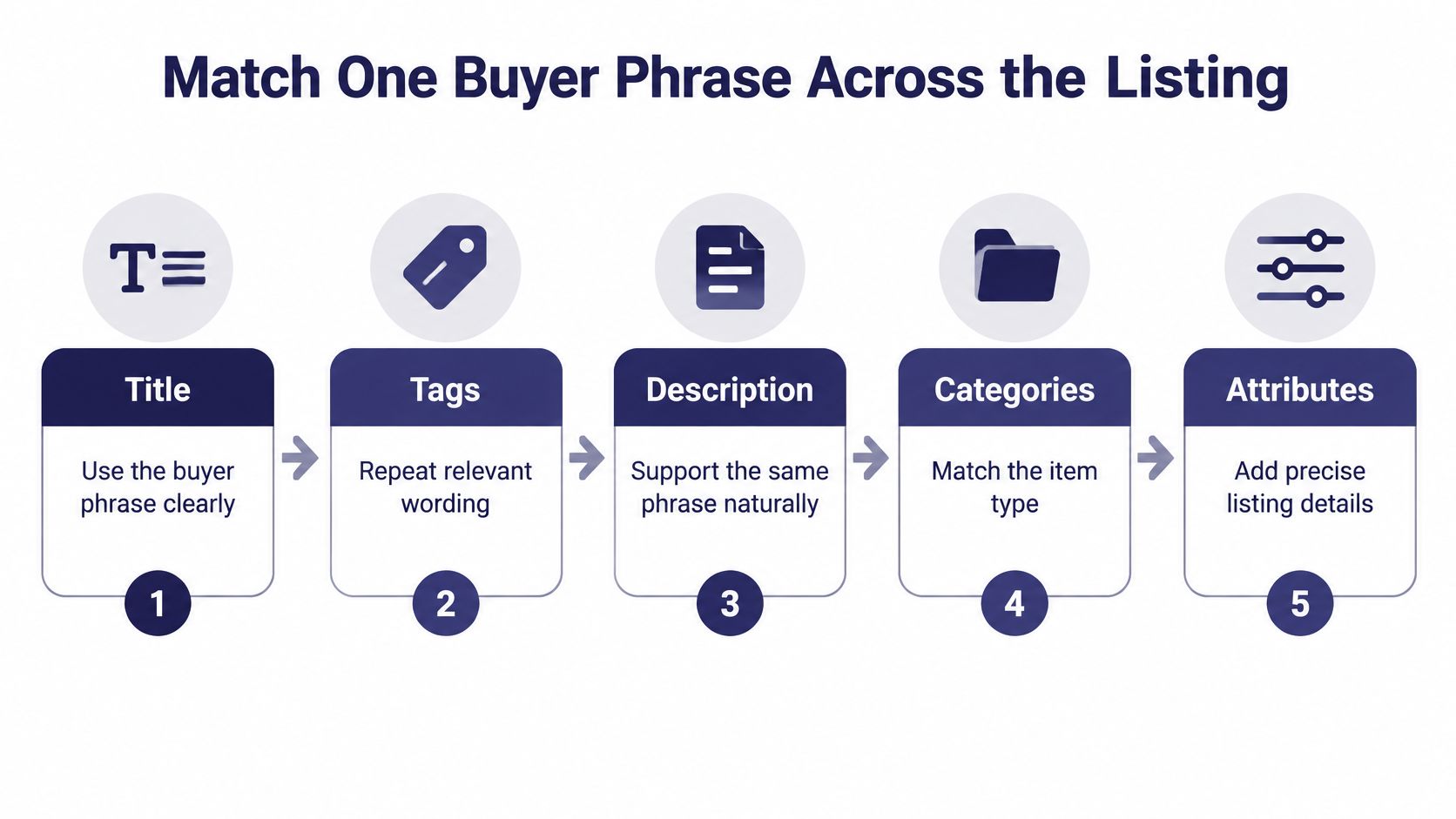
According to Etsy's explanation of search, relevance includes titles, tags, descriptions, categories, and attributes, while exact keyword matches may receive an advantage; engagement, customer experience, and personalization also matter. Etsy also identifies multiple high-quality photos and a return policy as important purchase-decision factors.
Build a coherent listing, not a repeated sentence
Consistency means describing the same product for the same buyer throughout the page. It doesn't mean forcing an identical long phrase into every field, including fields where it doesn't fit.
Write the buyer's phrase first.
For a personalized mug intended for a nurse practitioner, use personalized nurse practitioner gift mug as your working phrase. Funny coffee cup removes the recipient and the customization that distinguish the offer. Choose wording that describes the product you sell, not the busiest phrase you can find.Lead the title with the clearest product description.
A workable example is Personalized Nurse Practitioner Gift Mug, Custom Name Coffee Cup, Graduation Present. The buyer can identify the product immediately, and the occasion adds context. Don't append unrelated professions just because the artwork could theoretically suit them.Carry the relevant wording into tags.
Use suitable shorter components such as nurse practitioner, custom name mug, and nurse graduation. A long working phrase may need to be split across appropriate tags. Tags for teacher gift on this mug introduce a different recipient rather than strengthening the same intent.Choose the actual category and accurate attributes.
Put the item in the appropriate mug category and complete applicable material, color, and other attributes. Select an occasion only when it genuinely fits. A white ceramic graduation mug shouldn't acquire unrelated attributes just to reach additional searches.Open the description with purchase facts.
For this example, state the mug's actual capacity and material, the name buyers can personalize, where the print appears, and the current processing time. Explain exactly what to enter in the personalization box. Put the brand story later, and make the return policy easy to find.Freeze the surrounding offer during the test.
Keep the personalized nurse practitioner mug's price and first photo unchanged while testing the search wording. I would give the edit 14–28 days, extending the observation when visits are too sparse to judge. Record the dates so you don't confuse a keyword edit with a later promotion.
The relationship between the listing fields should remain straightforward.
Keep the test interpretable
Use a simple spreadsheet with the listing, target phrase, edit date, impressions where available, visits, and orders. Compare equivalent observation windows rather than a quiet weekday with a holiday promotion.
This practical approach to keyword research for Etsy can help you develop phrase candidates, but the final wording still needs your judgment. A phrase that attracts the wrong shopper isn't an improvement merely because visits increase.
Avoid changing the title every time you check Shop Manager. Give the listing a chance to produce evidence, then decide whether the phrase reached more suitable buyers.
Shoot Photos That Turn Visits into Orders
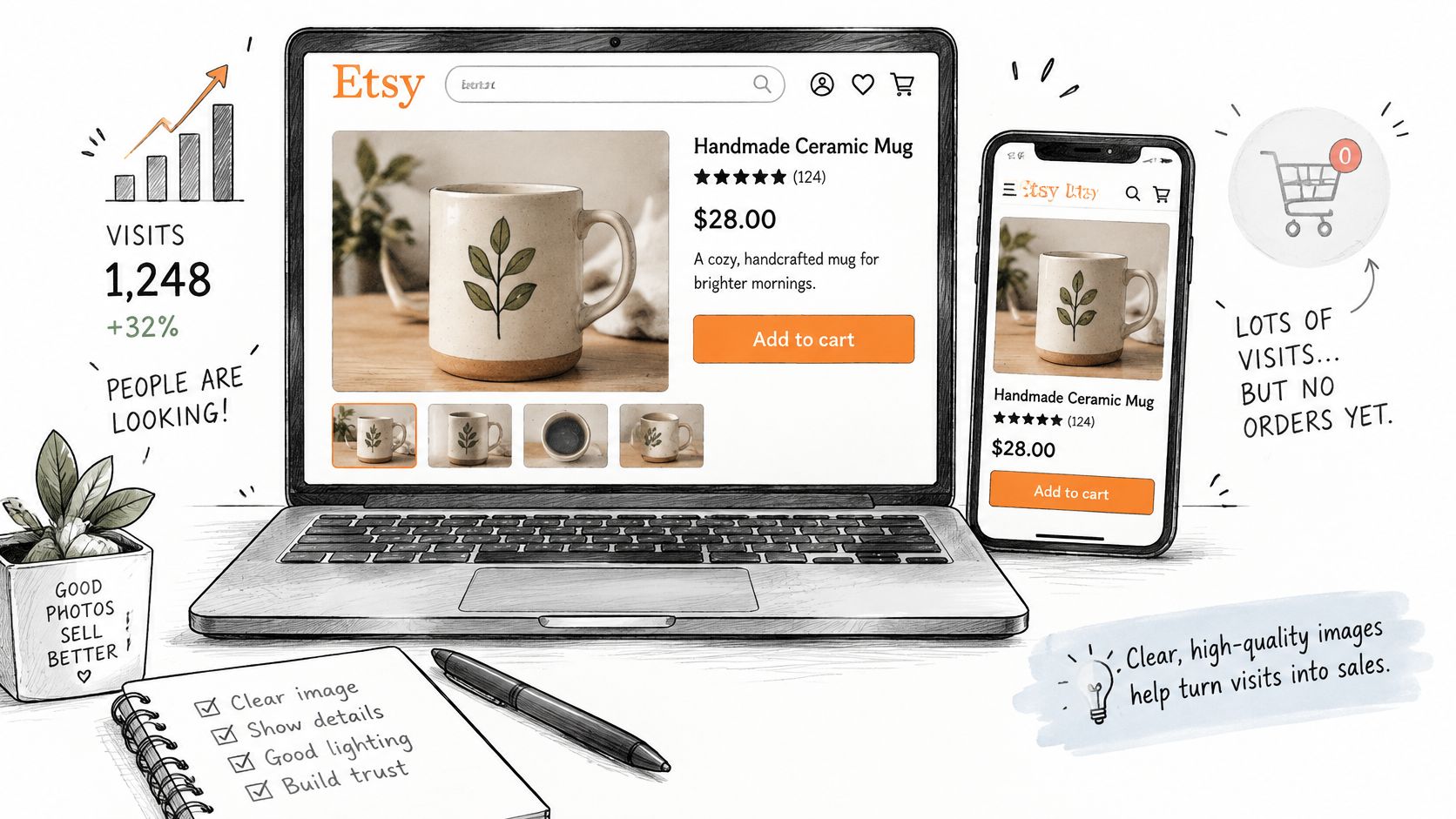
When relevant visits exist but orders don't, inspect what buyers can understand from the listing. A polished mockup can still conceal the print, exaggerate its size, or leave personalization unclear.
Etsy's listing guidance recommends images with at least 2000 pixels on the shortest side and warns that unclear thumbnails or collages can make products difficult to understand on small screens; clicks, favorites, and purchases contribute to engagement, and conversion performance can influence placement.
Use this visual as a reminder to improve the product presentation, not just its decoration.
Give every image a buyer question to answer
Carry the personalized nurse practitioner mug through the photo sequence. The first frame should show a single mug with the profession and example name visible, without a pile of props competing for attention.
Cover the title and look at the thumbnail. Can you still identify the product and recipient, and understand the occasion if the design claims a specific one? If not, simplify the frame before adding badges or decorative text.
- Scale: Show the mug held naturally so buyers can judge its proportions.
- Print detail: Include a close-up that accurately represents the finished printing.
- Choices: Show the actual available variants, with labels that match the ordering menu.
- Personalization: Demonstrate where the buyer's name appears and how the example relates to their order.
- Packaging: Show what the buyer will really receive, not gift wrapping your supplier doesn't provide.
For apparel, photograph a printed sample rather than relying on a flat artwork file. Keep mockups honest about placement, garment shape, and print size.
You don't need elaborate equipment to make the product legible. For practical help with lighting and framing, That Blanket Co's phone photography guide is a useful companion when shooting samples yourself.
The video provides another format for reviewing listing presentation.
Test the first frame before rebuilding everything
Start by replacing only the opening image. Keep the keywords and price fixed for a 14–28-day test, using the same kind of observation window before and after.
Calculate orders per visit by dividing orders by visits. Favorites and add-to-cart activity can help you interpret interest if those counts are available, but they aren't substitutes for purchases.
Practical rule: A photograph should remove a buying question before it adds atmosphere.
If orders per visit don't improve, examine the factual opening of the description next. Missing personalization instructions, unclear dimensions, or an uncertain delivery expectation may be the remaining obstacle.
Don't simultaneously replace every image, rewrite the tags, and lower the price. Write down the before-and-after orders per visit for the single change, while remembering that a small sample can't establish much certainty.
Price Each SKU After Fees and Shipping
Revenue isn't the same as money available to pay yourself. A POD order can look healthy in Shop Manager while production, delivery, and acquisition costs leave very little behind.
I would calculate contribution margin before offering a discount or enabling ads. That's the amount remaining after the order's variable costs, before fixed business expenses and your own pay.
Start with the full buyer-paid amount
Etsy's fee policy sets a $0.20 USD fee for creating or renewing a listing, with no additional listing fee for editing, and a 6.5% transaction fee on the item price plus charged shipping and gift wrapping; a $25 item plus $5 shipping therefore creates a $30 transaction-fee base and a $1.95 transaction fee, before other charges.
The arithmetic starts with everything the buyer pays for the product and delivery, not just the shirt's displayed price. Shipping collected from a customer isn't automatically shipping profit.
| Worksheet line | What to enter | Common mistake |
|---|---|---|
| Buyer-paid total | Item revenue after discounts, plus charged shipping and gift wrap | Starting with the undiscounted price |
| Production | Supplier charge for the selected variant and printing | Using the cheapest variant's cost |
| Actual shipping | What the fulfillment partner charges you | Treating collected shipping as the cost |
| Transaction fee | Apply the policy to the applicable buyer-paid amount | Ignoring charged shipping |
| Payment processing | Your account's percentage and fixed charge | Borrowing another country's fee |
| Listing cost | Applicable creation or renewal cost | Forgetting recurring renewals |
| Refund allowance | A reserve based on your own order history | Assuming every order stays completed |
| Acquisition cost | Applicable advertising cost | Counting attributed revenue as profit |
| Contribution margin | Revenue less the costs above | Calling it final take-home profit |
Etsy's annual filing describes payment-processing fees typically ranging from 3.0% to 6.5% plus a country-specific fixed fee, with an additional 12% or 15% for sales attributed to Offsite Ads. Use the rate applicable to your account and order, rather than assuming every sale has the same fee stack.
Keep Etsy Ads spending separate from Offsite Ads attribution. They affect the worksheet differently, and either can make an apparently successful product less attractive.
Set an acquisition ceiling before spending
Your maximum acquisition cost isn't automatically the entire contribution margin before advertising. That would leave nothing from the order for overhead or owner earnings.
Decide what the order must retain, then subtract that requirement from the amount available before acquisition. Use the remainder as your spending ceiling, and test only products that already demonstrate buyer interest and purchases.
A daily budget below a typical order's contribution margin is a conservative starting restraint, not a guarantee of profitability. You still need to evaluate total spending against the orders it produces.
More orders aren't useful when each additional order leaves you with less money than the work requires.
Shipping presentation creates another trade-off. For US domestic listings, Etsy's shipping guidance says shipping prices below $6 receive search priority, subject to exceptions. That isn't a reason to absorb delivery costs you can't afford or move them into an item price that buyers won't accept.
If a coordinated product set makes sense, consider whether creating bundles can improve the offer. Check the combined production and fulfillment costs first, because separate shipments can remove the expected benefit.
Finally, mark each SKU keep, reprice, or retire. Before another renewal, ask whether a weak listing deserves a clearer positioning test or more money spent maintaining it.
Protect the Service Score Etsy Rechecks
A shop's operating standards matter alongside the offer. Etsy's customer-service standards require responses to at least 80% of first messages within 48 hours; during a three-month period, shops with fewer than 40 reviews should have no more than four reviews rated three stars or lower, while shops with more than 40 reviews should keep those ratings below 10%.
The same standards cover on-time dispatch and tracking, average review rating, and case rate. Falling short can reduce search visibility and may affect Etsy Purchase Protection eligibility.
Run service as an operating routine
Don't set processing promises according to the fastest order your printer has ever completed. Use the production performance you can reasonably rely on, allowing for the actual product and fulfillment location.
Set processing times the POD partner can meet.
Separate production time from transit time. If a supplier repeatedly misses dispatch expectations, adjust the promise or change the fulfillment arrangement before promoting that product.Acknowledge messages, then resolve the question.
An auto-reply can confirm receipt, but a buyer asking about a delayed gift still needs an answer. Use saved replies for routine explanations, then add the order-specific information.Review late orders and cases in Shop Manager.
Group problems by product and fulfillment partner. A recurring defect needs a production decision, not just another apology.Earn reviews without trading for them.
Don't offer incentives for favorable feedback. Resolve problems fairly, communicate openly, and keep any review request neutral.Audit service before a large upload.
Check whether your current workload is already causing missed messages or unresolved orders. More designs add more variant choices, personalization questions, and supplier dependencies.
Etsy's customer-service search guidance says it considers average review rating, message response rate, and case rate over the previous three months, and identifies four- or five-star reviews as confidence signals; new listings can appear without reviews when they have no other quality problems.
That makes buying or manipulating credibility particularly unnecessary. A new product doesn't need a manufactured review history to deserve a fair launch.
Track causes as well as scores
Keep a weekly dashboard for reply rate, dispatch performance, case rate, rating distribution, and orders per visit. Add a short cause beside each complaint so a supplier defect doesn't disappear inside an average.
- Personalization problem: Tighten the order handoff and confirmation process.
- Production delay: Correct processing settings or supplier allocation.
- Repeated damage: Investigate packaging and replacement handling.
- Unresolved question: Assign an owner and a clear next response.
If you also sell through your own website, Bragly's Etsy customer review integration is an option to consider for displaying existing customer feedback. Displaying reviews doesn't replace resolving the problems behind poor ones.
I would pause expansion when the same defect keeps generating cases. Increasing demand for an unreliable product increases the number of buyers you need to help, not the quality of the business.
Choose One Change and Run It for Two Weeks
Choose a listing with recent buyer activity rather than the newest design you're most attached to. Classify its main constraint as visibility, conversion, or margin, then change only the matching variable.
Record the baseline before editing:
- Reach: Impressions where available and visits.
- Purchasing: Orders and orders per visit.
- Economics: Contribution margin on a representative order.
- Context: The edit date, promotions, and unusual disruptions.
Run the change for 14 days, extending to 28 days when traffic is thin. Those are practical observation windows, not statistical guarantees, and a quiet listing may still lack enough evidence for a confident decision.
Keep the result honest
Keep an edit when it improves the relevant outcome without undermining the order's economics. Don't call extra visits a success if they bring no additional purchases, or celebrate discounted orders that no longer cover variable costs.
A flat test doesn't justify adding several rescue edits. Revert a harmful change, retain a clearly useful one, or record the result as inconclusive.
Service failures are the exception to waiting. Correct missed messages, unrealistic processing promises, and unresolved cases immediately rather than preserving a tidy experiment.
The useful outcome isn't a busier-looking shop. It's knowing which offers deserve more attention and which ones don't justify further spending.
Trendlytic offers POD niche research across Etsy and other marketplaces, with a built-in USPTO trademark check to support your phrase shortlist. If choosing the next buyer intent is your sticking point, visit Trendlytic, compare a small set of ideas, and test a narrower listing only after checking its margin.