Keyword Research for Etsy: A Workflow for POD Sellers
You're scrolling through Etsy results for a shirt you've just designed, and everything looks familiar. Similar jokes, similar mockups, similar titles packed with the same words. You've got a product ready to publish, but choosing keywords feels like guessing which crowded queue to join.
I approach keyword research for Etsy as a relevance and conversion problem. The useful question isn't just whether shoppers search for a phrase. It's whether those shoppers would recognize your design as the thing they meant to find.
Table of Contents
- Why Buyer Language Comes Before Keyword Lists
- Why Specific Phrases Beat Broad Terms
- Building and Scoring a Candidate Keyword List
- Placing Phrases Across Titles, Tags, and Attributes
- Comparing Tools and Signals for Validating Demand
- Testing Keywords Without Overspending
- Where to Start Your Next Keyword Session
Why Buyer Language Comes Before Keyword Lists
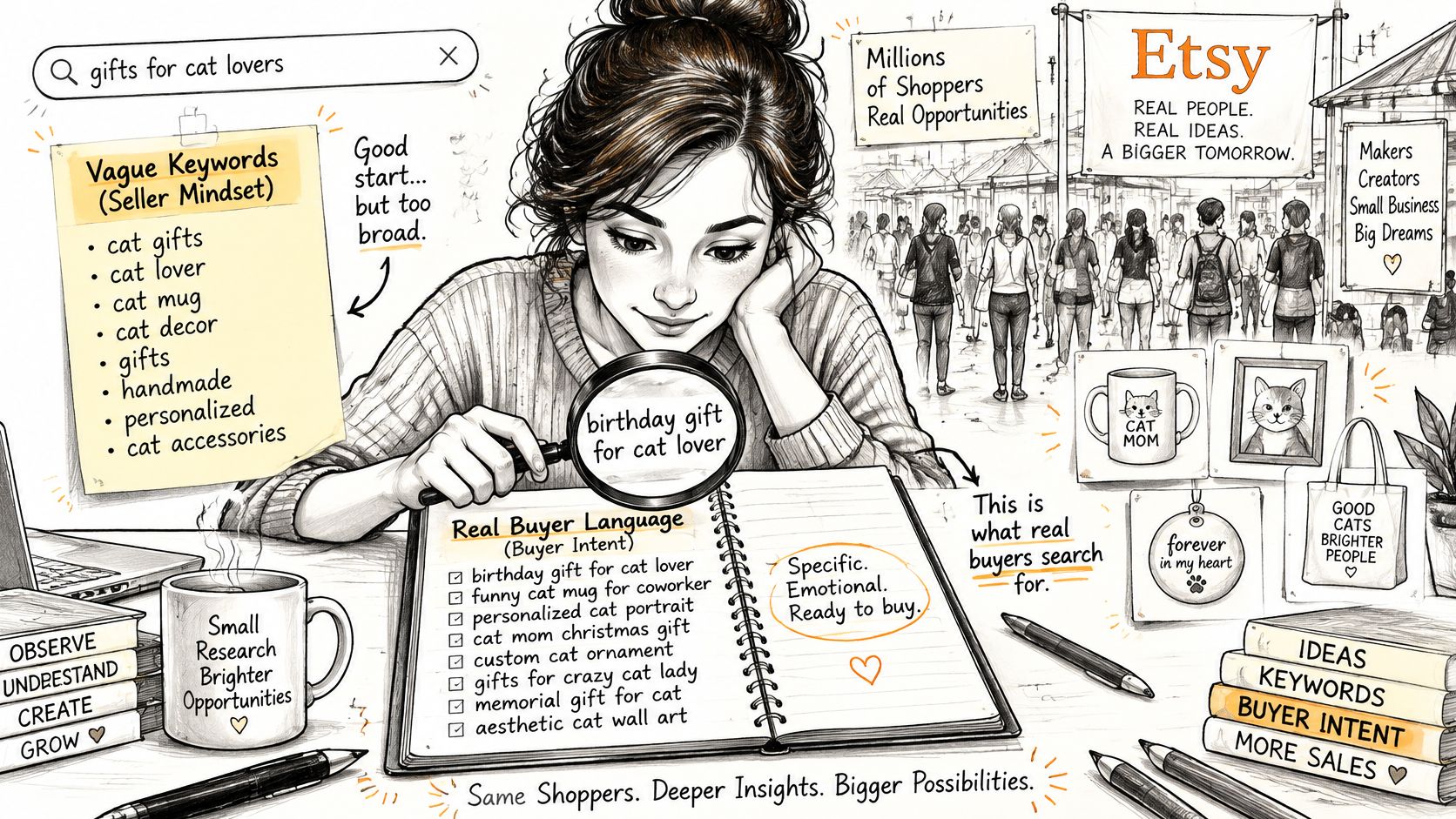
A seller may name a design “Coffee Club Collection,” while a shopper searches for an introverted teacher coffee shirt. The collection name helps organize your shop. The shopper's wording gives you a starting point for research because it describes a purchase in terms a buyer might use.
Marketplace-wide totals can show the scale of Etsy, but they cannot tell you whether shoppers want a particular design. The marketplace figures accompanying Etsy's growth history offer historical context, not evidence of demand for an individual product. For that, start with the product and the person likely to buy it.
Describe the purchase, not the project
A teacher shopping for herself may search differently from a parent choosing a teacher appreciation gift. The same shirt could suit both buyers, but their reasons for buying shape the language they use.
Describe the product plainly before looking for keywords:
- Product: A printed shirt with a coffee cup and a joke about being quiet.
- Recipient: A teacher who enjoys coffee and identifies with introverted humor.
- Purchase context: A shirt to wear personally or a gift for a teacher.
- Visual style: The style the artwork shows, not an aesthetic added to attract extra searches.
These details give your research two practical jobs: matching a relevant shopper query and finding a narrower angle the design can credibly serve. A phrase may sound plausible, but it only helps if the product delivers what the buyer expects.
Keep discovery separate from validation
A phrase that fits the design is a candidate, not proof of demand. Another seller using the same wording shows that the phrase is in use, but not that it leads to sales. Check buyer-language ideas against visible bestseller evidence on other print-on-demand platforms, while treating those listings as clues rather than guarantees for Etsy.
Skup's guide to validate keywords for your POD designs offers another way to examine a keyword idea. Use research to test assumptions, not just to collect more phrases.
Practical rule: Start with what a buyer can recognize about the product. Treat every keyword as a hypothesis until the product and the evidence support it.
That keeps an internal design name from driving your listing when a stranger may not understand what it means.
Why Specific Phrases Beat Broad Terms
A broad phrase isn't automatically a better opportunity. It may describe more products while telling you less about the person searching.
Etsy recommends long-tail keywords because they describe an item more closely and can reduce direct competition compared with broad terms such as tote bag or diamond ring. Its keyword guidance supports specificity, but that isn't a promise that any longer phrase will sell.
Consider a hypothetical coffee-themed teacher design:
| Candidate phrase | What the shopper has specified | What remains unclear |
|---|---|---|
| Funny teacher shirt | Product, audience, humor | Subject of the joke and visual style |
| Introverted teacher coffee shirt | Product, audience, personality, theme | Whether the artwork delivers that combination |
| Teacher appreciation gift | Recipient and occasion | Preferred product and design |
The specific shirt phrase gives you a clearer design brief. It doesn't prove stronger demand or a higher conversion rate.
Judge the promise behind the phrase
I use these decision criteria when comparing phrases:
- Query specificity: Does the wording describe a recognizable product rather than a loose topic?
- Visible buyer intent: Can you understand what someone would expect to buy?
- Image fit: Would the first mockup communicate that expectation without a lengthy explanation?
For the introverted teacher example, a coffee cup alone wouldn't justify the full phrase. The artwork needs something that makes the teacher and introvert connection understandable.
Conversely, a design with a quiet-classroom joke and coffee imagery could make that wording reasonable. The phrase helps describe the offer rather than adding an unrelated audience to it.
Know what specificity cannot tell you
There's a real decision gap when equally relevant phrases have no reliable public search-volume evidence. Etsy's public guidance doesn't give a definitive answer for every such comparison, and I wouldn't manufacture one from a tool score.
My preference is to choose the phrase with the clearest relationship to the artwork, then keep the alternative in the worksheet. That's an editorial choice about relevance, not a claim about hidden demand.
A longer phrase is useful only when the product can keep its promise.
Don't turn specificity into a contest to add more modifiers. An awkward phrase combining every possible recipient, occasion, and aesthetic can be less useful than a shorter description that a shopper immediately understands.
Building and Scoring a Candidate Keyword List
Open a worksheet beside the actual design. Working from the artwork prevents an appealing keyword from gradually pulling the listing away from what you're selling.
Start with separate columns for product type, recipient, occasion, style, material, and use case. Leave a field blank when it doesn't apply. A shirt doesn't need a holiday association just because a holiday phrase looks commercially attractive.
Build phrases from supported details
For the hypothetical teacher design, combine the accurate details into phrases such as introverted teacher shirt, teacher coffee shirt, and teacher appreciation shirt. Keep the original wording you encounter during research beside your proposed version so you can see where you've made an interpretation.
A guide to finding related keywords can help expand that candidate set without drifting into unrelated audiences.
Before scoring, check the listing setup. Etsy says choosing the most specific category and using relevant attributes can improve query matching in its explanation of how Etsy search works. Research should therefore include the available category and attribute choices, not just free-text phrases.
Scoring Each Candidate Phrase
The worksheet below is illustrative, not measured market data. “Needs checking” is deliberate: competition shouldn't receive a confident rating before you've examined evidence.
| Phrase | Relevance | Specificity | Commercial Intent | Competition |
|---|---|---|---|---|
| Introverted teacher shirt | Strong if the joke supports it | Focused | Clear product request | Needs checking |
| Teacher coffee shirt | Strong if both themes appear | Focused | Clear product request | Needs checking |
| Teacher appreciation shirt | Conditional on gift suitability | Occasion-focused | Gift purchase context | Needs checking |
| Personalized teacher shirt | Reject if customization isn't offered | Focused | Clear customization request | Irrelevant after rejection |
| Funny shirt | Technically accurate | Broad | Product request, unclear preference | Needs checking |
I'd score with qualitative labels rather than invent precise-looking totals. The useful output is a decision and its reason, not a number that hides uncertainty.
- Keep: The phrase describes the product and provides a distinct buyer angle.
- Investigate: It fits, but demand or competitive context remains unclear.
- Reject: It promises a feature, audience connection, or use the product doesn't support.
Relevance is the gate, not an average. Strong specificity and apparent commercial intent can't rescue a phrase that misrepresents the item.
Add a short evidence note beside each retained candidate. “Coffee theme is visible, teacher connection is only in the description” tells you more than a confident score with no explanation.
Placing Phrases Across Titles, Tags, and Attributes
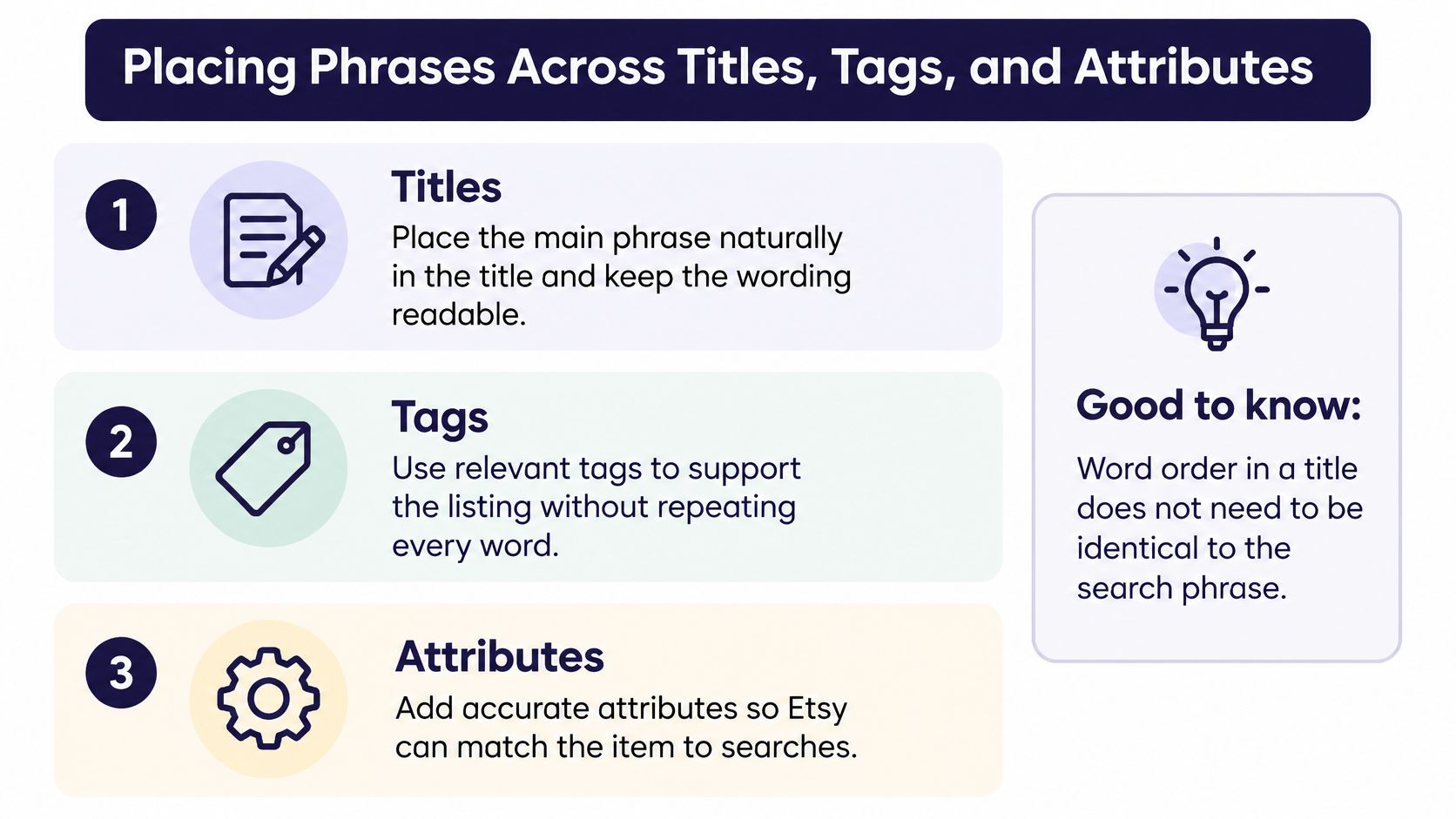
Once you've selected phrases, give each listing field a purpose. Don't paste the entire worksheet into every available space.
This placement checklist keeps the wording readable while separating the jobs of the main fields:
Write the title for a scanning shopper
A possible title for the example design is Introverted Teacher Shirt, Coffee-Themed Classroom Humor. It identifies the item and gives a useful secondary description without repeating every variation of shirt, teacher, and coffee.
Etsy says word order doesn't directly affect search ranking, although putting important terms first can help shoppers understand an offer, as explained in its guidance on effective listing titles. Front-loading is a clarity choice, not a ranking trick.
Read the title aloud. If it sounds like disconnected search queries rather than a product description, edit it before adding more terms.
Give secondary language somewhere useful to go
Etsy recommends using all 13 tags, diversifying phrases, and keeping titles clear in its Keywords 101 guidance. I'd use the available tag space to cover meaningful differences in intent rather than near-duplicates.
- Tags: Add distinct, accurate angles such as recipient, theme, occasion, and product format, within the field's available space.
- Attributes: Select the applicable product details. Don't choose a color, occasion, or style purely to pursue a query.
- Description: Explain the design and product naturally, then answer the questions a buyer needs resolved before ordering.
Avoid treating repetition as an absolute prohibition. Some shared vocabulary is natural when every phrase describes the same item. The problem is spending the available space saying the same thing while leaving useful distinctions unexplored.
For a broader listing-level perspective, this guide to SEO for print-on-demand connects keyword placement with the rest of the product presentation.
The accompanying video provides another format for reviewing listing optimization:
The earlier Etsy guidance also makes clear that search considers the listing as a whole, including the first photo and reviews. I'd therefore compare the finished title with the mockup before publishing: if they seem to describe different products, the listing isn't ready.
Comparing Tools and Signals for Validating Demand
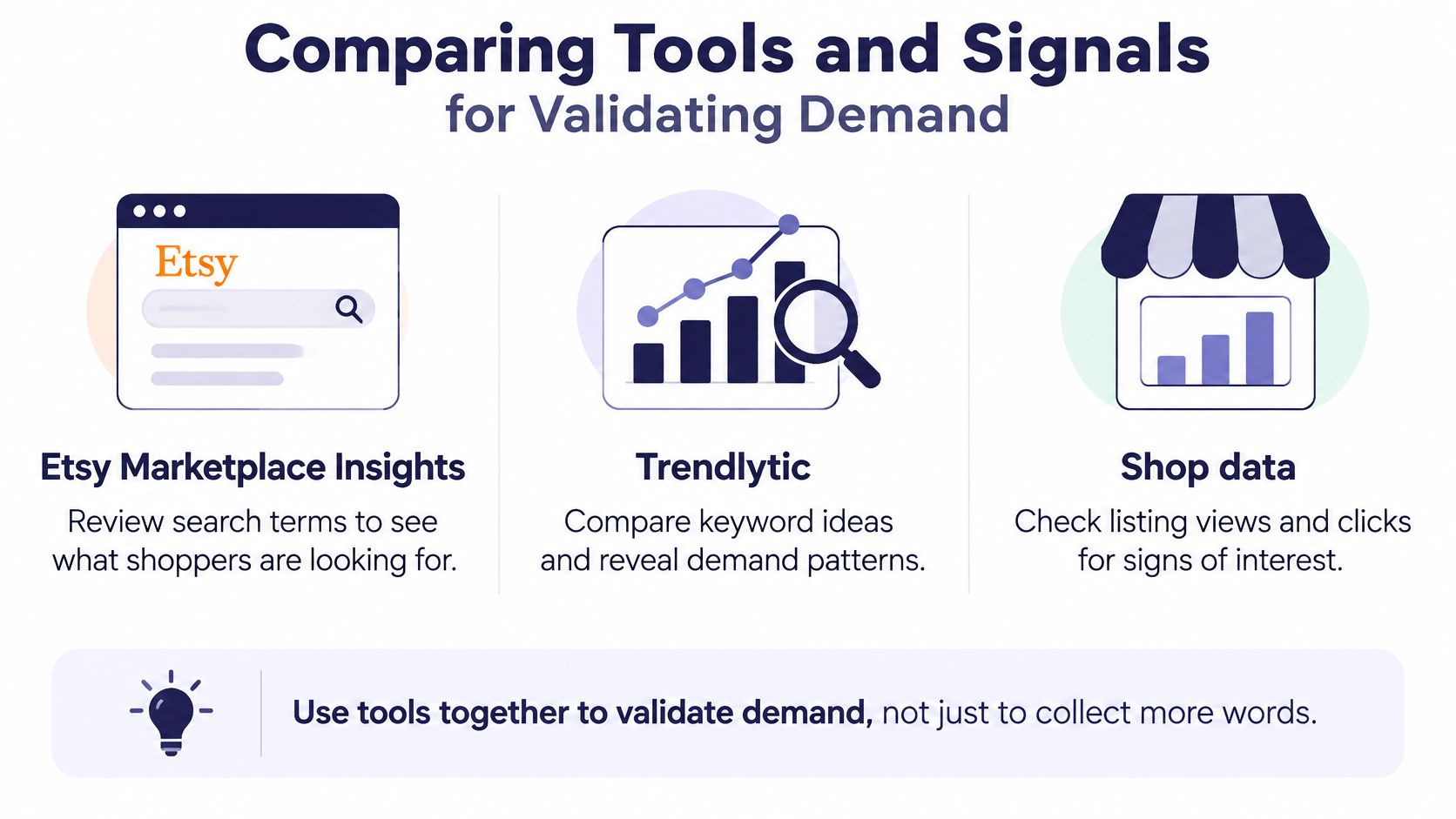
A phrase can match a design and still have little evidence of buyer interest. Check what each research signal can establish, then compare them without treating search activity as a sales forecast.
Etsy's Marketplace Insights helps sellers review search terms, their frequency, and competition through its keyword research resources. Shop Stats answers a separate question: how listings in your own shop are performing.
Match the tool to the question
| Research option | Useful question | Important limitation |
|---|---|---|
| Etsy Marketplace Insights | What search activity and competition surround this wording? | Search interest alone doesn't prove your design will sell |
| Manual worksheet | Which phrases accurately fit this product? | Your judgments still need supporting evidence |
| Cross-platform bestseller research | Does this theme appear among successful POD products elsewhere? | Another marketplace isn't an Etsy sales forecast |
| Shop Stats | How are my published listings performing? | Results reflect the whole offer, not keywords alone |
Trendlytic covers TeePublic, Amazon Merch, Redbubble, and Etsy, and includes a USPTO trademark check. Its product description describes a store-first approach: it examines sellers' top designs and provides niche reports with demand and competition levels, an Opportunity Score, and design images, tags, and pricing.
That cross-platform view can help compare a keyword idea with bestseller evidence, rather than relying only on phrases found in search results. Treat the score as a way to prioritize what to investigate, not as proof that a new listing will convert.
Compare the buying reason, not just the words
Say coffee-themed teacher designs appear in the bestseller examples you review. Look past the repeated keyword and ask what may be attracting buyers: a readable joke, a giftable message, or a particular illustration style.
Keep your interpretation separate from what you observed. “Coffee imagery appears in these examples” describes the evidence. “Etsy buyers will purchase my coffee design” is a prediction that still needs testing.
- Transfer the insight: Identify an audience, joke structure, or purchase context worth investigating.
- Don't transfer the artwork: Use research to develop an original offer, not reproduce another seller's expression.
- Check legal uncertainty: Treat trademark screening as an initial check, not a guarantee of clearance or protection from takedowns.
The Etsy trend-search guide offers another method for organizing this research. Faster analysis can save research time, but it cannot establish demand for a new listing. Bestseller evidence may justify a test; only results from your own listing show how that test performed.
Testing Keywords Without Overspending
Research becomes useful when you can afford to learn from the result. Publishing a large batch because you've collected enough phrases makes the spending easy to count and the lessons harder to isolate.
Etsy charges a $0.20 USD listing fee whether an item sells or not, and a listing remains active for four months or until it sells. Its 6.5% transaction fee applies to the total order amount, including shipping and gift wrap when charged; testing 50 listings would therefore incur $10 in initial listing fees alone, before production, payment processing, advertising, or transaction fees, under Etsy's fee structure.
Define what the test is meant to teach you
I'd start with a tightly related product group and a written hypothesis. For example: “Does recipient-focused language bring more relevant traffic to this design than its general humor description?”
Keep a record of the title, tags, mockup, price, and any changes. If you change the artwork, pricing, and wording together, you can evaluate the revised offer, but you can't attribute the result to keywords alone.
The test loop is straightforward:
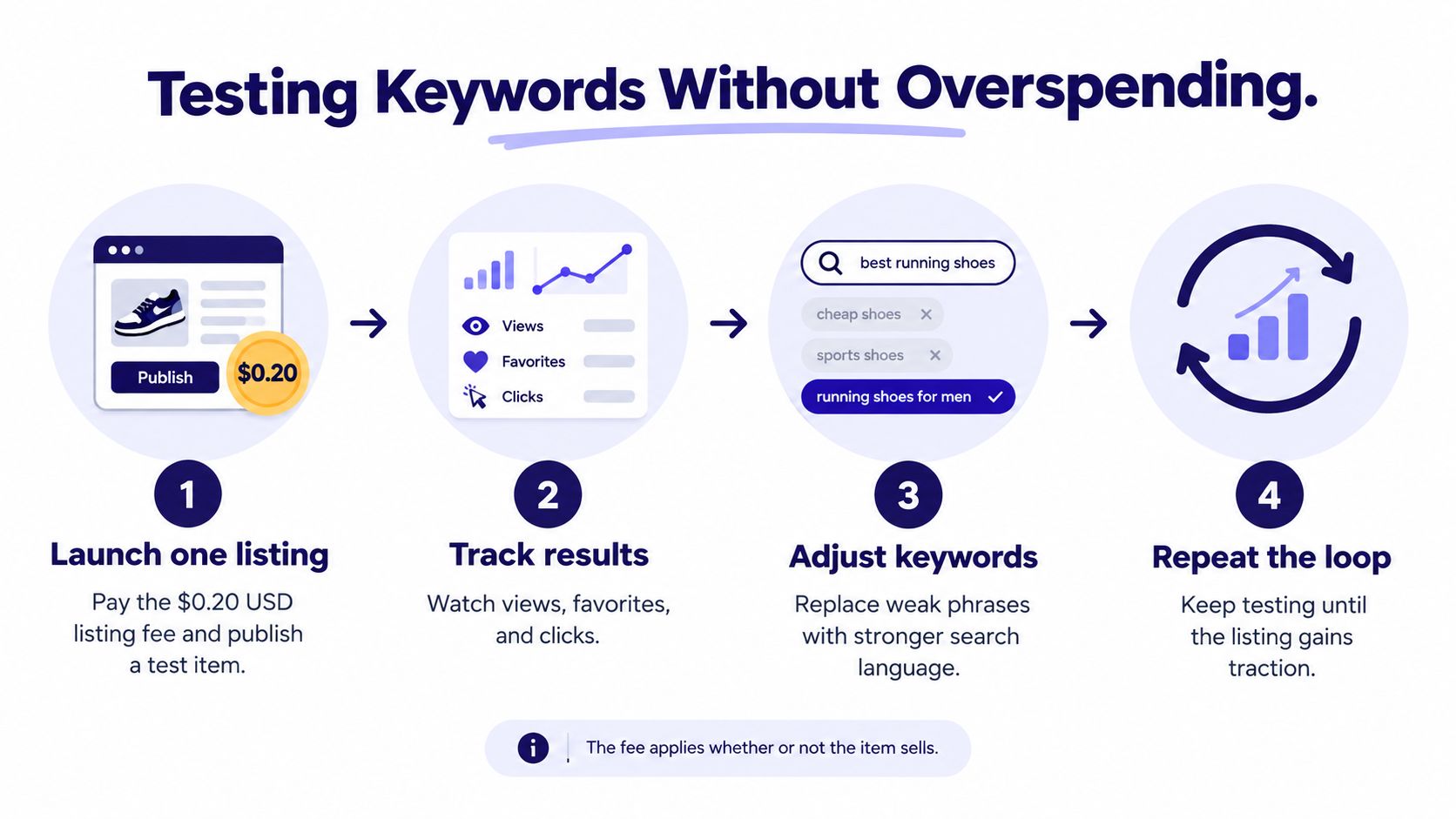
Read results without forcing a conclusion
Use Shop Stats to examine traffic and the search language available to you. As noted in Etsy's earlier keyword guidance, lower-traffic listings are candidates for tag refreshes and more varied phrasing.
- Little traffic: Recheck the candidate phrase, category, attributes, and available demand evidence before expanding the test.
- Visits without purchases: Review whether the mockup, product details, price, and delivery expectations support the purchase.
- Purchases from relevant traffic: Preserve a record of the working offer before making further changes.
A quiet listing doesn't identify its own cause. It may have a keyword problem, but you shouldn't rule out a weak product proposition or unclear presentation.
Set a spending boundary before publishing and keep the cost ledger beside the research sheet. I'd rather finish a small test with a useful explanation than a large test with an impressive-looking keyword list and no clear next decision.
Where to Start Your Next Keyword Session
A teacher shirt can target several different buyers, so start with one product you can realistically publish or improve this week. Keep the session focused on that listing rather than rebuilding the whole shop or choosing a niche that needs extensive setup before you can learn anything.
For example, compare introverted teacher shirt, teacher coffee shirt, and teacher appreciation shirt as possible descriptions. These are ideas to investigate, not evidence of demand. Check that the phrase fits the design and buyer before treating it as a test candidate.
Leave the session with a decision
Write a brief research note that makes your reasoning clear: name the product, intended buyer, candidate wording, and evidence that would change your mind. Then choose what to do:
- Publish: The phrase suits the product, the design makes its promise clear, and available evidence supports a measured test.
- Revise: The audience seems plausible, but the design does not yet deliver the promise implied by the wording.
- Park: The idea relies on assumptions you cannot currently support.
Stopping is a useful outcome. Research has value even when it helps you decide not to publish an idea.
Make uncertainty useful
Record what remains unknown. A gift angle may show promise on another POD platform but remain untested in your shop. Or the artwork may make the coffee theme obvious while giving buyers little reason to read it as a teacher shirt.
Turn each gap into a next action. Rework the design if its promise is unclear. Investigate the niche if demand evidence is weak. If the phrase fits and the evidence is adequate, publish a restrained test.
After the listing is live, compare your research note with your Shop Stats. The goal is not to defend the original keyword choice. Use what you learn to make a better-informed next decision.
A short list of relevant phrases is easier to explain, place, and assess than a long list built around search volume alone.
For a cross-platform bestseller check, Trendlytic can help compare POD niche ideas, review design-level evidence, and screen keyword ideas with its USPTO trademark check. Treat those signals as input for choosing an Etsy test, not as a sales guarantee. Your own listing results are what help you decide which phrases to keep.