Print on Demand vs Dropshipping: How to Choose
The popular advice in Print on Demand vs Dropshipping debates is to pick whichever model has the bigger market or the higher markup. I'd ignore both tests.
A cheap product can still lose money after ads, split parcels, refunds, and chargebacks. A print on demand shirt can cost more to make and still leave more behind if the design is the reason someone buys.
The useful question is narrower. Is the design the product, or is the catalog the product, and what remains from one order after every cost you can name?
Table of Contents
- What Each Model Actually Sells
- Net Margin After Shipping and Fees
- Speed Quality and What Happens After Delivery
- Platform Payouts and Trademark Screens
- Which Model Fits Your Shop
- How to Start or Switch This Month
- Scaling Either Model Without Losing Margin
What Each Model Actually Sells
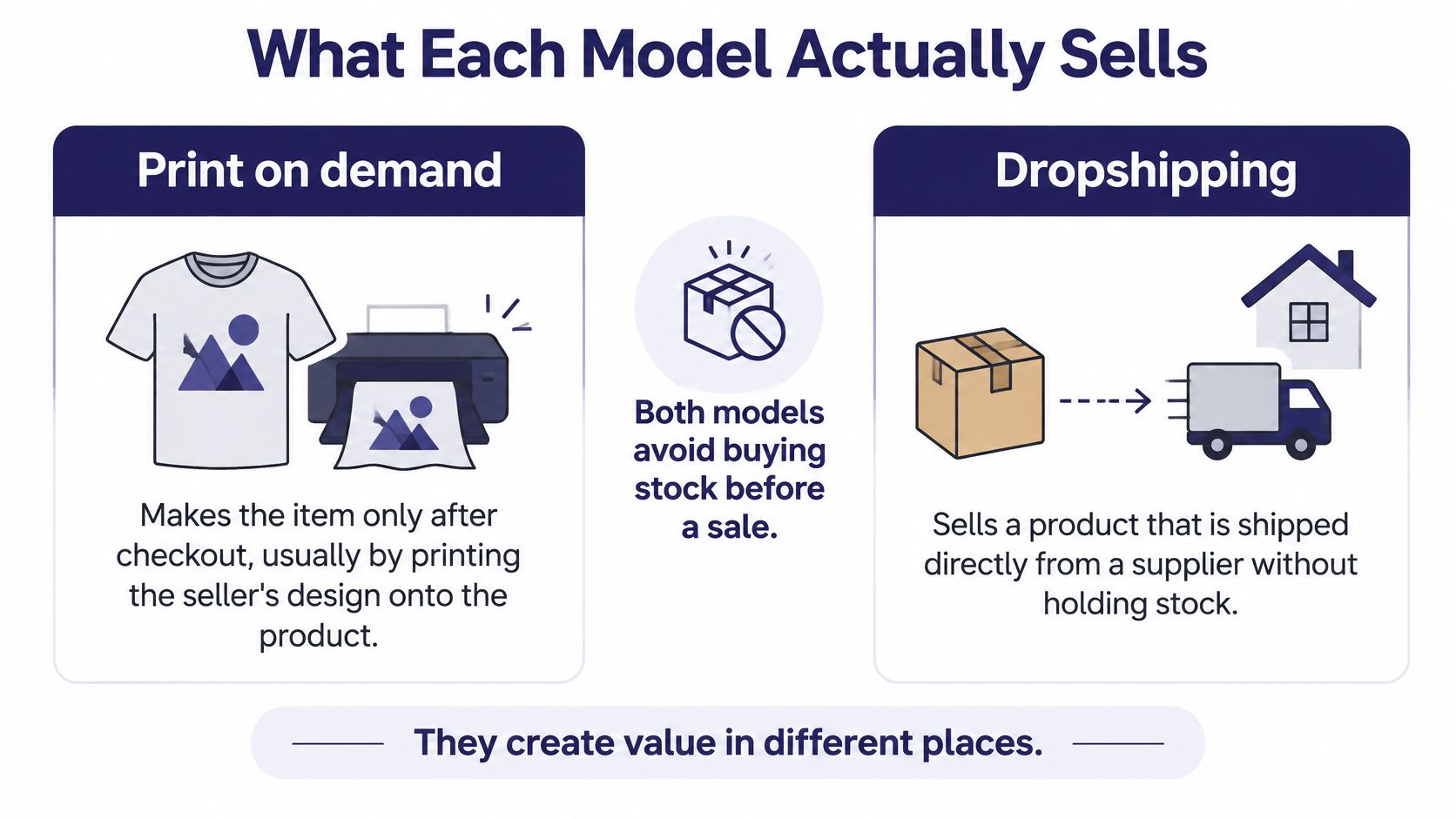
Both models avoid buying stock before a sale. That's where the resemblance mostly ends.
Print on demand makes an item only after checkout, usually by applying your design to apparel, a poster, a book, or an accessory. Dropshipping sells a finished product that a supplier already stores and ships to your buyer.
That difference decides how you compete. POD sellers compete through originality, niche relevance, and design fit. Generic dropshippers compete through product selection, price, advertising, and supplier execution, as the Grand View Research dropshipping market overview explains in its definition of supplier fulfilled retail.
Market reports also count different activities. POD estimates focus on made to order customization, while dropshipping estimates cover far broader retail orders, so I wouldn't use the larger figure as proof of a better business.
Print on Demand Versus Dropshipping at a Glance
| Criterion | Print on demand | Dropshipping |
|---|---|---|
| What the customer buys | Your design on a blank such as apparel, a poster, or an accessory | A pre-made catalog product |
| When the item exists | Printed or made after the order | Already held by a supplier |
| Upfront stock you buy | None | None, but you inherit supplier stockouts |
| Reported net margin band | About 20 to 50% on apparel | About 10 to 30% conventional |
| Time before the carrier | About 2 to 5 business days to print, finish, and pack | Ships from stock when inventory is local |
| Typical delivery | About 7 to 14 days for domestic POD | About 3 to 7 days US/EU stock, or 7 to 21+ days from many Chinese suppliers |
| How you compete | Original niche design and brand | Selection, price, ads, and supplier execution |
| Main account risk | Trademark and artwork claims | Product claims, supplier IP, and quality disputes |
Start with your constraint, not the model. If you already have an original idea, test POD. If you already have a reliable in stock product, test dropshipping.
Neither row removes operational risk. POD still brings production cost, artwork demand, and trademark limits. Dropshipping still brings stock, quality, shipping, and returns risk.
Net Margin After Shipping and Fees
Two stores can book the same $25 sale and keep very different amounts of it. I'd judge Print on Demand vs Dropshipping by what one completed order contributes after the buyer keeps the item and the platform settles.
The formula is plain:
Selling price minus product or production cost, shipping, marketplace fees, payment fees, ads, refunds, and chargebacks.
That order matters. A product screenshot never shows the support messages, the second parcel, or the refund that lands three weeks later. Chargebacks arrive later still and carry their own cost on top of the lost sale.
Why a Costlier POD Unit Can Win
POD apparel can keep a higher net share per order than conventional dropshipping even though each unit costs more to produce. The reason sits in what the buyer is paying for. The design is the product, so an original niche design can hold a price a generic catalog item can't. A catalog item often needs more ad spend because several shops sell the same product with the same photos and the same promise.
That doesn't make POD automatically better. It kills the shortcut that mass production always wins on net. Whether the advantage holds for your shop is a per order calculation, built from your own quotes, fee schedules, and ad results rather than any published average.
Shipping changes the picture again. A representative US apparel example lists $4.95 shipping for the first shirt and $2.20 for each additional shirt in the FollowedApp margin comparison for merch drops. On a low priced single shirt, that first item charge takes a large share of the order. Add a second shirt and the shipping spreads better, so bundles of related designs can work where a single cheap listing can't.
Dropshipping skips manufacturing, but its landed cost still moves with supplier pricing and shipping terms, and a supplier can change either after you've set your retail price. If one basket needs two suppliers, you pay for two parcels and answer for two delivery dates, each one a separate chance for a late or lost shipment.
Contribution Worksheet for One Order
| Line | POD shirt order | Dropshipped item |
|---|---|---|
| Example selling price | $25 assumed, replace with your own price | $25 assumed, replace with your own price |
| Product or production cost | Your printer quote, often the largest line | Supplier unit price |
| Outbound shipping | $4.95 first shirt, $2.20 each extra | Supplier rate; a second supplier can mean a second parcel |
| Marketplace and payment fees | Platform schedule, not a flat guess | Platform plus payment processor |
| Ads allocated per order | Your cost per purchase | Often higher when the product is generic |
| Refund and defect allowance | Reprint plus support time | Return shipping and chargebacks |
| Net result to sanity-check | Positive after every line above, not just production cost | Positive after ads and returns, where generic items bleed margin |
| Delivery promise that affects conversion | About 7 to 14 days domestic | About 3 to 7 days US/EU stock; 7 to 21+ days from many Chinese suppliers |
Use the $25 price only to compare the shape of two orders. Replace every other line with a quote, a fee schedule, or an actual ad result.
Delivery belongs in the same worksheet because it prices the wait. A promise measured in weeks lowers conversion and raises refund exposure, which increases the effective cost of each sale.
For POD sellers who already have traffic, the practical follow up is finding honest ways to increase earnings through pricing, bundles, and stronger niches rather than volume alone.
Practical rule: If an order only works with zero ad cost, zero refunds, and the cheapest supplier quote, it doesn't work yet.
Run the worksheet by product, destination, and fulfillment route. A US printed hoodie and an overseas gadget face different economics even when both listings show the same retail price.
Speed Quality and What Happens After Delivery
A fast dispatch scan looks reassuring. It tells you almost nothing about whether the buyer keeps the item.
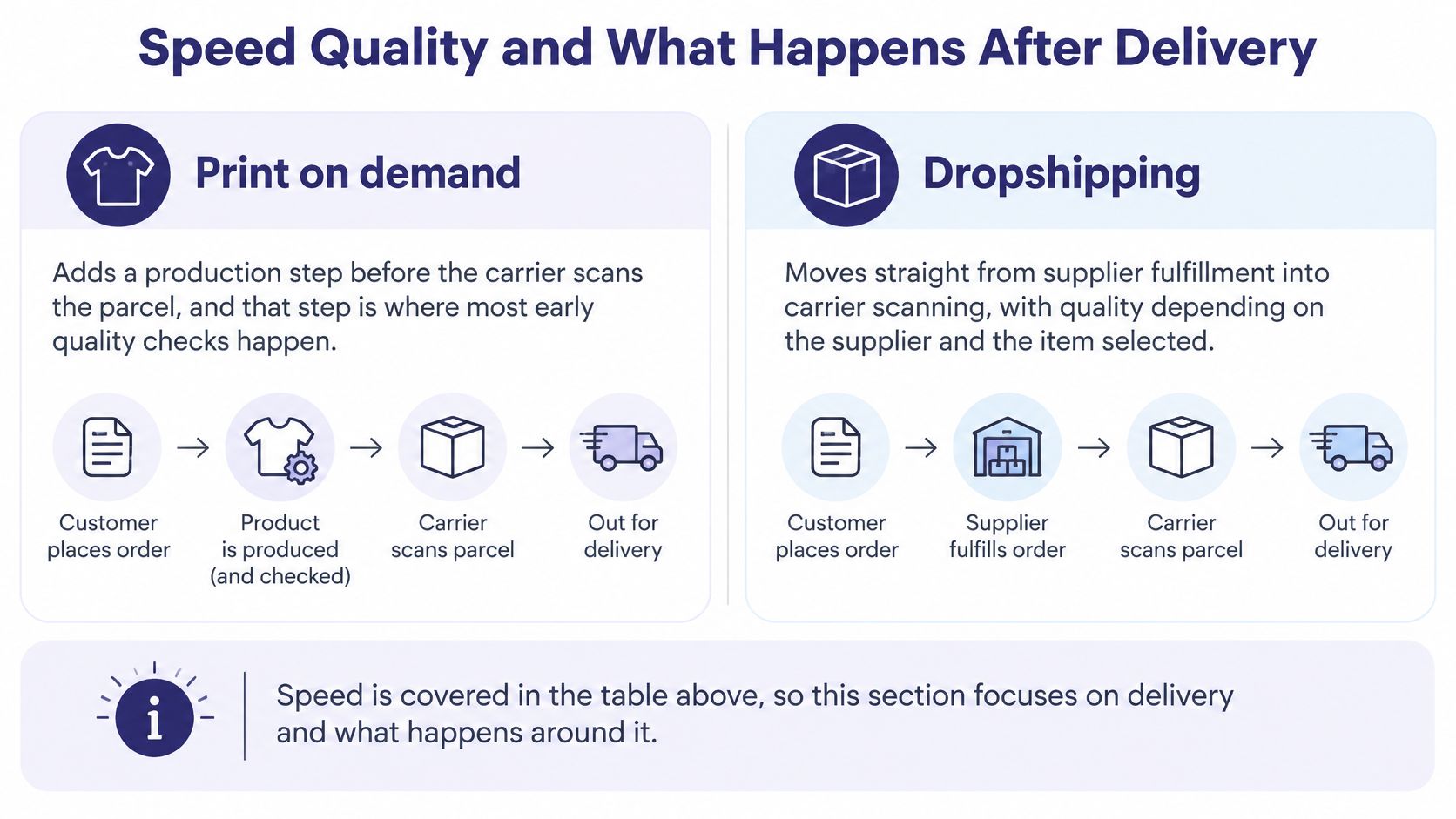
POD adds production before carrier transit. Reported estimates put that added window at roughly two to five business days, because the item must be printed, cured or processed, inspected, packed, and dispatched, according to the Webgru print on demand costs and earnings guide.
Dropshipping can move immediately when stock is local. The same model can also produce a much wider spread when supplier location changes.
Sample the Exact Thing You Sell
For POD, approve a sample made from the same blank, print method, and facility you'll use for buyers. A clean mockup won't reveal a thin print, off center placement, or colors that shift on fabric.
For dropshipping, order the same item from more than one supplier when you can. Compare the product, inserts, packaging, and tracking quality side by side. Supplier photos often hide the parts buyers photograph in a one star review.
Returns also differ in kind:
- POD defect: Usually a reprint, replacement, or refund tied to print or blank quality.
- Dropshipped defect: May involve cross border return shipping that costs more than recovering the item.
- Wrong expectation: Often caused by supplier photos, weak size details, or a delivery promise the listing didn't make clear.
Don't confuse an order entering fulfillment with a buyer receiving it. This plain explanation of fulfilled orders versus delivered orders is useful when you write tracking updates and support replies.
Track Four Numbers Before Scaling
Record these by supplier, printer, and destination:
- Order to dispatch time: How long production or picking takes.
- End to end delivery time: The buyer's full wait, not the carrier leg alone.
- Defect or refund rate: The cost you must carry back into pricing.
- On time delivery percentage: Whether your public promise survives real orders.
That log connects directly to basic logistics planning for a small POD shop, especially when one design sells into several countries.
Neither model is automatically greener. Made to order avoids unsold stock, but each item still creates one off production, packaging, and an individual shipment. A locally warehoused product shipped in consolidated volume can sometimes be the cleaner option.
Judge the actual route. Distance, blank choice, packaging, durability, replacements, and returns matter more than calling a model sustainable in the listing.
Platform Payouts and Trademark Screens
A marketplace can rewrite your worksheet after you've priced the product. Don't model the sticker price. Model the payout rule, because the royalty line, the account fee, and the ad spend are what reach net contribution.
Amazon Merch on Demand creates the product page and handles production, sales, shipping, and customer service with no upfront costs to the creator. Your royalty is based on the offer price after applicable taxes and Amazon's costs, including materials, production, fulfillment, customer service, returns, exchanges, and fraud prevention resources.
Amazon also controls the final purchase price, which may differ from the list price you entered. Higher Merch tiers pay higher royalty rates once you meet Amazon's volume and non-organic sales requirements, so pull the current thresholds from Amazon's Merch terms before you build a royalty assumption into pricing.
You gain simplicity. You give up direct control over price, fulfillment, and customer service.
Redbubble and Etsy Need Different Math
Redbubble defines its base price as including its service fee and the third party manufacturer's fee, with a default artist markup of 10% applied to that base, per the Redbubble payment calculation help page. Account fees then deduct 50% for Standard, 20% for Premium, and 0% for Pro, capped at $150, €150, or £150 per month.
Markup above 20% also faces a 50% excess markup fee for Standard and Premium accounts and 0% for Pro. Push a Standard markup to 30% and the extra ten points are halved by that fee. Raising markup doesn't raise take-home pay in a straight line.
On Etsy, sellers may use production partners but must disclose that relationship in relevant listings under the Etsy seller policy. Separate fee categories apply to listing, selling, advertising, and certain other features, so one universal percentage won't price a shop correctly. Add the production partner's invoice on top, and the true cost of a sale is two fee stacks, Etsy's and the printer's.
If you're still deciding where designed products belong, this overview to compare online print marketplaces helps frame the channel choice before you calculate a single listing.
How Three POD Platforms Shape Take-Home
| Platform | Who fulfills | Who sets the price the buyer pays | Payout rule to model |
|---|---|---|---|
| Amazon Merch on Demand | Amazon | Amazon may differ from your list price | Royalty after taxes and Amazon costs; higher tiers raise the rate once volume and non-organic requirements are met |
| Redbubble | Third-party manufacturer | Artist markup on a base that already includes fees | Default markup 10%; account fee 50%, 20%, or 0% by tier, cap $150/€150/£150 per month; excess markup above 20% fee 50% except Pro |
| Etsy with a production partner | Named production partner | Seller, within Etsy rules | Disclose the partner; subtract listing, transaction, ad, and other fees plus the partner invoice |
Screen the Phrase Before the Design
A popular phrase can still belong to someone else. Search the exact wording and close variants, check which goods and services a registration covers, and avoid branding that could confuse buyers.
The Trademark Checker in Trendlytic's free tools is a first screen against the live USPTO register, not a legal clearance opinion. For a valuable or ambiguous design, get professional advice.
The founder considers checking a phrase against the live USPTO register before printing to be the single most preventable cause of POD account suspensions.
That caution is not bureaucracy. One takedown can erase the margin from many clean orders, and unlike a supplier defect the exposure grows with the design's success: the better a protected phrase sells, the more a complaint costs you.
Which Model Fits Your Shop
I would choose based on what you already have: an idea, a supplier, an audience, or only spare time. Those starting points point to different models in Print on Demand vs Dropshipping.

Choose POD When the Design Is the Reason to Buy
Say you can draw, write a sharp niche joke, or speak to a hobby from inside it. POD fits because buyers aren't paying for a blank shirt. They're paying for recognition, humor, identity, or a gift that feels specific.
A side hustle version could be one marketplace, a small set of related designs, and no ad budget at the start. One evening a week is enough to run that test if you don't spread it across four platforms.
An agency or multi niche seller can also fit POD once research is repeatable. Each new design is a test without opening another supplier account or buying stock.
Before you pay for research software, the free tools at /tools need no account. If you later need a paid plan, every plan starts with a 3-day free trial.
Choose Dropshipping When the Product Solves the Problem
Say you know kitchen gadgets well and can source a useful item from stock in the buyer's country. Dropshipping fits because convenience, function, and price matter more than artwork.
You still need a edge. Better instructions, a tighter bundle, credible photos, and faster support can separate you from another listing using the same supplier images.
I would be careful with paid ads for a product that ships slowly from overseas. The ad may create the sale, but the wait can create the refund, chargeback, and support workload.
Wait When You Cannot Name the Basics
Don't start either model this month if you can't answer four questions:
- Supplier or printer: Who exactly makes or ships it?
- Delivery promise: What date range can you keep?
- Fee line: What does the platform deduct?
- Failure cost: Who pays for a defect or return?
A hybrid can make sense later. A POD shop might add a non printable accessory buyers keep requesting, or a dropshipper might replace a copied graphic product with original designs.
I wouldn't launch both at once. Run one product, one destination, and one channel until samples and first orders match your worksheet. The result you want is a written yes, no, or smaller test.
How to Start or Switch This Month
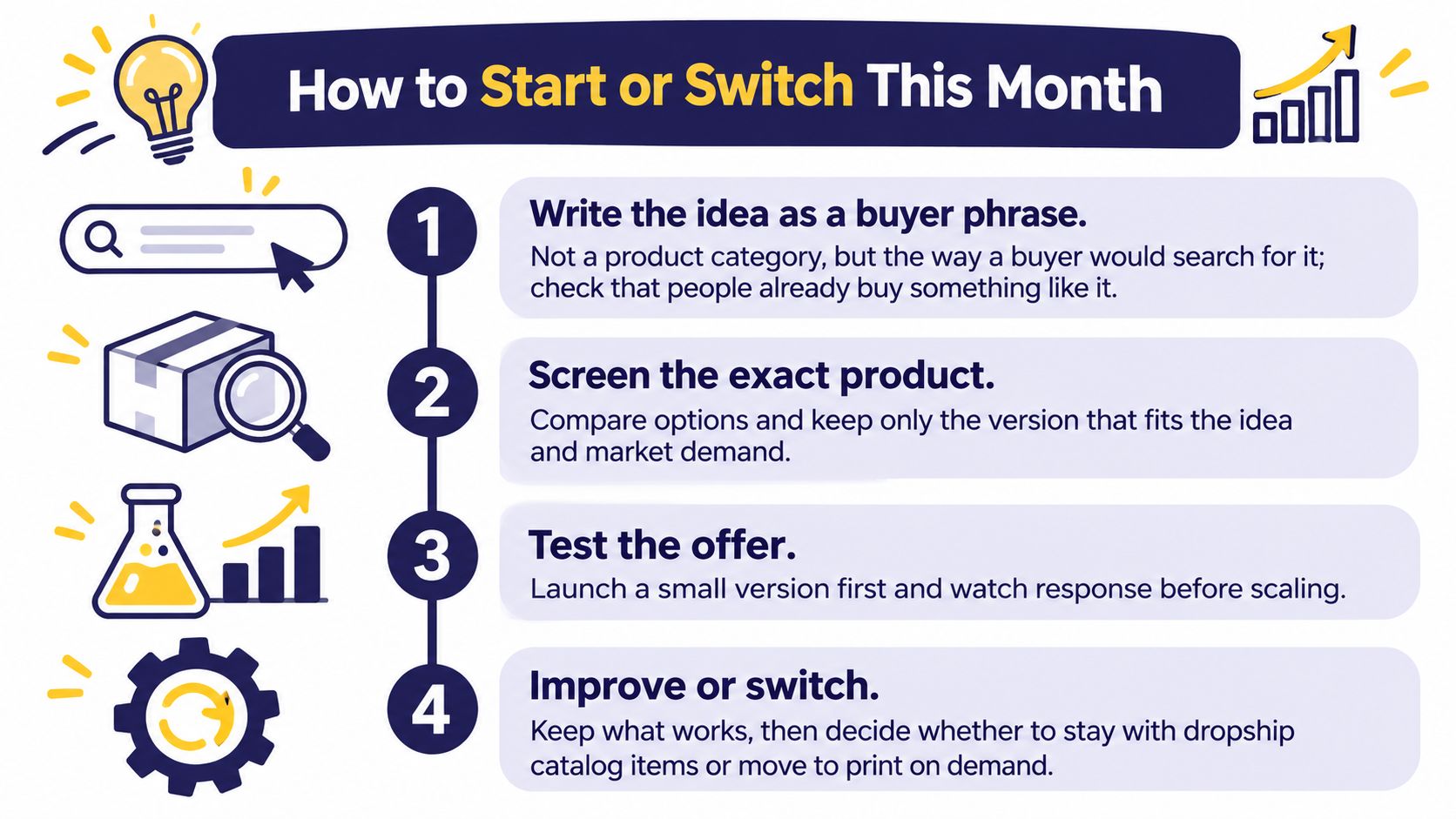
Use the same sequence whether you're starting fresh or leaving a generic dropship catalog. Order matters because design work is wasted when the phrase, payout, or sample fails.
Seven Steps in Order
- Write the idea as a buyer phrase: Use the words a buyer would search, not a broad category like funny shirt. Check that people already buy something like it.
- Screen trademarks before designing: Check the exact phrase and close variants against the live USPTO register, then change anything that looks confusingly similar.
- Choose one marketplace: Learn its payout, listing rules, and production partner disclosure before you open accounts everywhere.
- Price from the worksheet: Include production or supplier cost, shipping, fees, a refund allowance, and realistic ad cost if you'll advertise.
- Order one sample: Send it to a normal customer address, wash or use it, and photograph the item under ordinary light.
- Publish a small set: Keep the related designs or products tight enough that you can see which idea earned attention.
- Log the first deliveries: Record dispatch time, defects, late parcels, and buyer messages. Stop the design or supplier that creates repeat problems.
Research Without Copying Bestsellers
For POD, I prefer looking at what stores already sell rather than collecting search phrases alone. Trendlytic is a niche research tool for print on demand sellers that analyzes top selling designs across TeePublic, Amazon, Redbubble and Etsy and shows which niches have high demand and low competition.
The process has three steps: size the idea with the free Etsy keyword tool or a Trendlytic search, read the market, then decide and design. Use the results to understand buyer language and saturation, not to trace another seller's artwork.
If your shop runs on Shopify, compare fulfillment routes against the options covered in this guide to print on demand apps for Shopify before you connect a catalog you may replace next month.
Dropshippers need a separate tool check for sourcing, order routing, and supplier automation. The ServeApps guide to dropshipping tools is a practical reference when comparing that operational stack.
Switching models doesn't mean discarding everything. Keep the audience, support habits, and products that already produce clean orders. Retire items you can't differentiate, and don't place supplier photos onto POD blanks as if borrowed images were a brand.
A switch is complete when the new offer has its own sample, payout calculation, and delivery record. Changing the supplier behind the same weak listing isn't a switch.
Scaling Either Model Without Losing Margin
Scaling changes cost lines before it changes revenue. That is where a small profitable test in Print on Demand vs Dropshipping becomes a busy shop with thin orders.
A POD catalog grows design by design. Each addition still needs a trademark screen, payout check, product choice, and sample standard. More listings do not make those steps optional.
Recheck the worksheet as order patterns change. Bundles spread first item shipping differently, and marketplace tiers or excess markup rules can change what a price increase leaves you.
Add Suppliers and Channels Slowly
Dropshipping scale often means more suppliers. Add a second only after the first meets your dispatch, delivery, defect, and on time targets. Otherwise you multiply packaging standards and split more baskets into separate parcels.
Connect order flow so staff don't copy addresses, tracking numbers, or stock status by hand. Keep one source of truth for whether an item is in production, in stock, dispatched, or delayed.
Use this order when volume rises:
- Protect contribution: Send paid traffic first to products with known margin after refunds.
- Fix repeat defects: Change the file, blank, or supplier once, then remeasure.
- Cut persistent losers: Remove a design or product when defect and refund numbers stay high after the fix.
- Raise price with evidence: Test after you know conversion at the current price and payout rules.
Customer service is part of margin protection. A prompt, specific reply can keep a delayed parcel from becoming a refund, while a copied apology often invites the buyer to escalate.
Expand one channel at a time. A design that works on one marketplace may face a different fee, audience, and search pattern on another, and a dropshipped product may not survive a marketplace that expects handmade or personalized goods.
Stop scaling when real orders stop matching the worksheet. That pause is not failure. It's the point where you identify whether the problem is price, supplier execution, product quality, or traffic cost.
If you want a first check before uploading anything, start with the research step in the procedure above. Prove one niche, price one order, inspect one sample, and let those results decide the next month.
If you're choosing POD, start by checking whether your idea has real demand, manageable competition, and a clean trademark screen across TeePublic, Amazon Merch, Redbubble, and Etsy. Trendlytic brings that research into one place so you can test a niche before spending evenings on designs. Visit when you're ready to run the first check, and let the numbers decide whether the idea deserves a sample.