Print on Demand Wrapping Paper: A Practical Seller Guide
You've got artwork that already works on a shirt or sticker, and turning it into wrapping paper looks straightforward. Repeat the design, upload the file, build a mockup, and list it. Then you notice the roll's print boundary, the shipping quote, or a supplier's vague description of “eco” paper, and the product stops looking quite so simple.
I'd treat print on demand wrapping paper as its own product, not an extra surface for an existing design. The artwork matters, but so do the parcel it travels in, the folds a customer makes, and the amount left after fulfillment and fees.
Table of Contents
- Why Wrapping Paper Deserves a Second Look
- Finding Niches That Are Quietly Selling
- Building Production Files That Actually Print Clean
- Sheets Versus Rolls and the Suppliers Behind Them
- Pricing, Fees, and the Real Unit Economics
- Mockups, SEO, and Honest Sustainability Language
- Account Safety, Trademarks, and a Realistic Next Step
Why Wrapping Paper Deserves a Second Look
The first useful test isn't whether your illustration looks attractive across a rectangle. It's whether someone would choose that paper for a particular recipient, occasion, and gift.
A gardener's birthday wrap, personalized wedding paper, and branded packaging for a small shop solve different buying problems. I'd rather develop an offer around one of those uses than upload a generic pattern and compete mainly on price.
Gift presentation is the starting point, but the product has to work beyond the mockup.

A substantial category, not a guaranteed opportunity
The global wrapping-paper market was estimated at USD 5.20 billion in 2026, with a projected USD 7.30 billion by 2033, a 4.9% compound annual growth rate, and kraft paper projected to account for 46.5% in 2026, according to the wrapping-paper market forecast. Those figures describe the broader category, not the revenue available to independent POD shops.
The useful opportunity is differentiation. Names, hobbies, cultural themes, and coordinated gift sets give buyers reasons to choose something other than commodity wrap.
The friction is physical. Wrapping paper can be bulky relative to its selling price, and seasonal orders leave little room for fulfillment mistakes. A technically clean design can still disappoint if its scale feels wrong around a gift.
Practical rule: Don't approve wrapping paper solely as a flat image. Approve it as something a customer will unroll, cut, fold, and give away.
The decisions that determine whether it pays
I'd evaluate the product through these connected choices:
- Niche and account safety: Identify a buyer without borrowing protected branding.
- File and supplier: Match the repeat, color workflow, and stock to the artwork.
- Format and pricing: Compare the actual delivered offer, not just the print cost.
- Marketing: Show the paper and describe only properties you can substantiate.
That's a more demanding launch than placing a graphic on another product. It's also a more useful way to decide what deserves a listing.
Finding Niches That Are Quietly Selling
I start with recipient plus occasion plus aesthetic. “Botanical birthday wrapping paper” is a research direction. “Cute pattern” isn't specific enough to tell me who buys it or why.
Trendlytic is one research option alongside direct marketplace searches. It covers Etsy, Redbubble, TeePublic, and Amazon Merch, using live bestseller data and a store-first approach to surface sellers' top designs rather than a random collection of search results.
A niche report is useful for organizing that investigation.

Separate audience interest from product demand
Search gifting occasions and related visual themes across those marketplaces. Use Etsy to inspect actual wrapping-paper offers, then use the other marketplaces to investigate whether the audience responds to similar subjects or phrases. An apparel bestseller isn't proof that the same design will sell as gift wrap.
Trendlytic's demand and competition levels, Opportunity Score, and validated design results can help shortlist directions. I'd examine the designs, tags, and pricing together, then check whether wrapping-paper competitors offer personalization, coordinated stationery, or a distinctive substrate.
The niche market identification guide provides a useful framework for keeping the audience specific. Next Point Digital's market research for product launch tips is another resource to consult when turning a promising theme into a testable offer.
My working checklist stays short:
- Buyer: Who's giving the gift, and who's receiving it?
- Evidence: Are there relevant product offers, or only interest in the general theme?
- Difference: Can I improve the occasion fit, personalization, or presentation without copying artwork?
- Safety: Does the keyword depend on a character, team, or established brand?
Use the built-in USPTO trademark pre-check before spending time on a phrase-led design. A promising keyword shouldn't survive the shortlist because its legal risk is inconvenient.
This walkthrough gives context for the research workflow.
Treat trends as leads
Hourly Trending Now rankings and automated Niche Discovery can suggest related gifting moments. I'd use them to generate hypotheses, not to justify copying whatever appears prominently.
The underlying production category is growing: the digital printing packaging market was valued at approximately USD 36.02 billion in 2025, with a projected USD 76.63 billion by 2034, an 8.80% CAGR, and North America holding 31.84% of the regional market in 2025, according to the digital printing packaging market forecast. That supports the relevance of short-run digital production, but it doesn't establish demand for your particular pattern.
Building Production Files That Actually Print Clean
A screen preview is an artwork check, not a production approval. I'd build the file around the fulfillment supplier's template from the start, rather than squeeze a finished composition into it later.
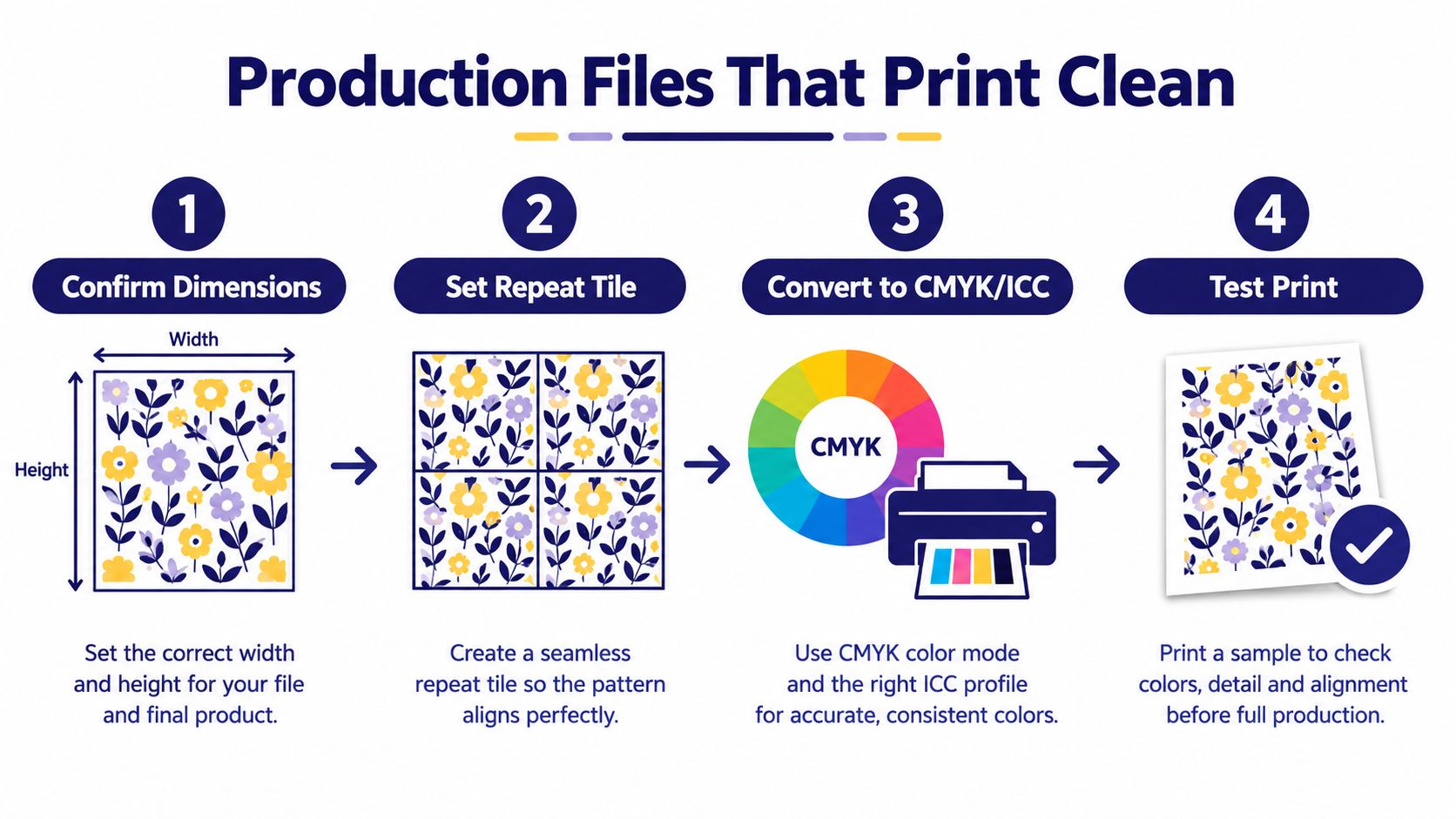
The basic process is straightforward when dimensions, repeat geometry, and color settings are settled before export.
Preflight before paying for a proof
Use the printer's required CMYK/ICC workflow, extend full-bleed backgrounds at least 3 mm beyond trim, and keep important text, logos, and faces at least 5 mm inside trim; lightweight gift-wrap stocks are commonly positioned around 40–80 gsm, while heavier premium-feel products may be 115–135 gsm, as outlined in the wrapping-paper print preparation guidance. The supplier's actual template and export instructions take precedence over a generic setup.
My preflight sequence is:
- Confirm the product geometry. Establish final dimensions, printable area, and the repeat tile before adjusting motif scale.
- Verify color settings. Use the specified profile and check whether the supplier expects you to convert the file or preserve an embedded profile.
- Inspect the repeat at full size. Look beyond the central tile. Check transitions on every side and how neighboring motifs interact.
- Protect the trim. Extend backgrounds and move essential artwork away from cutting boundaries.
- Export to specification. Supply a press-ready PDF or supported raster format at the required resolution.
- Order the intended stock. A proof on a different paper doesn't settle whether the listing is ready.
Don't assume heavier paper is automatically better. It can feel more substantial, but folding resistance and shipping weight belong in the decision too.
Test the difficult parts, not just the attractive ones
Uncoated and kraft paper can absorb ink more aggressively than coated stock, affecting fine detail, color intensity, and edge definition. Include saturated colors, neutral grays, black text, thin rules, and tile boundaries in a proof, then compare them under consistent lighting, following the considerations in this packaging color-fidelity guidance.
A sample that avoids every difficult part of the artwork doesn't tell you whether the design is ready.
I'd also wrap a real object with the sample. Check whether names disappear into folds, whether a face gets awkwardly cropped, and whether dark solids look acceptable after handling.
Use a repeatable quality assurance process to record the approved file, supplier, stock, and sample observations. Keep that record beside the niche report so commercial interest and production readiness remain separate checks.
Sheets Versus Rolls and the Suppliers Behind Them
A sheet pack and a long roll aren't interchangeable offers. They can share artwork while requiring different motif scales, packaging assumptions, and customer explanations.
I'd compare suppliers by the exact variant I intend to sell. A headline product name tells you less than its dimensions, stock, repeat behavior, and fulfillment location.
POD Wrapping Paper Suppliers at a Glance
| Supplier | Sheets | Rolls | Paper weight | Repeat note |
|---|---|---|---|---|
| Prodigi | Individual sheets or packs | Multiple lengths | Satin or kraft | Confirm the template for the selected variant |
| Gooten | Sheet option available | Multiple lengths | Verify the selected product specification | Disclosed repeat interval and faint repeat line |
| Printify | Verify availability separately | Multiple sizes | Fine-art paper | Check printable-area and lead-in details |
Prodigi's wrapping-paper specifications list individual or three-pack sheets at 50 × 70 cm and 75 × 90 cm, plus 70 cm-wide rolls in 1 m, 2 m, 3 m, and 5 m lengths, using 95 gsm satin or 70 gsm kraft. The same product information describes rolled shipment and packaging options that vary by production location, including cardboard tubes in the EU and rigid or triangular tubes in the UK and US.
Gooten's wrapping-paper specifications list 20 × 28-inch sheets, rolls measuring 29.25 × 84 inches and 29.25 × 216 inches, and a repeat every 42 inches with a faint visible line. That disclosed boundary matters especially for stripes, borders, typography, and large motifs.
Choose the format around the buying situation
For a personalized birthday offer, I'd investigate whether a sheet pack gives the customer an appropriate amount without making delivery disproportionately expensive. For a coordinated gifting collection, I'd test a roll, but only after checking its usable printed area and parcel cost.
Packaging Panda's bespoke packaging artwork guide is a useful additional preparation resource when thinking about artwork as manufactured packaging rather than a standalone illustration.
- Record separately: Width, length, paper weight, format, and fulfillment region.
- Compare like with like: Don't rank a short sheet pack against a long roll using base price alone.
- Inspect continuity: Test across the supplier's complete repeat interval, including the transition.
- Verify delivery: Check the packaging and destination assumptions for the selected production route.
Use logistics planning to document those differences. Then compare your niche shortlist against equivalent competitor formats, not every listing that happens to contain “wrapping paper.”
Pricing, Fees, and the Real Unit Economics
I wouldn't launch a wrapping-paper listing until I could explain what remains from an actual order. A selling price that looks reasonable beside competitors can still leave too little after production, delivery, personalization work, and replacements.
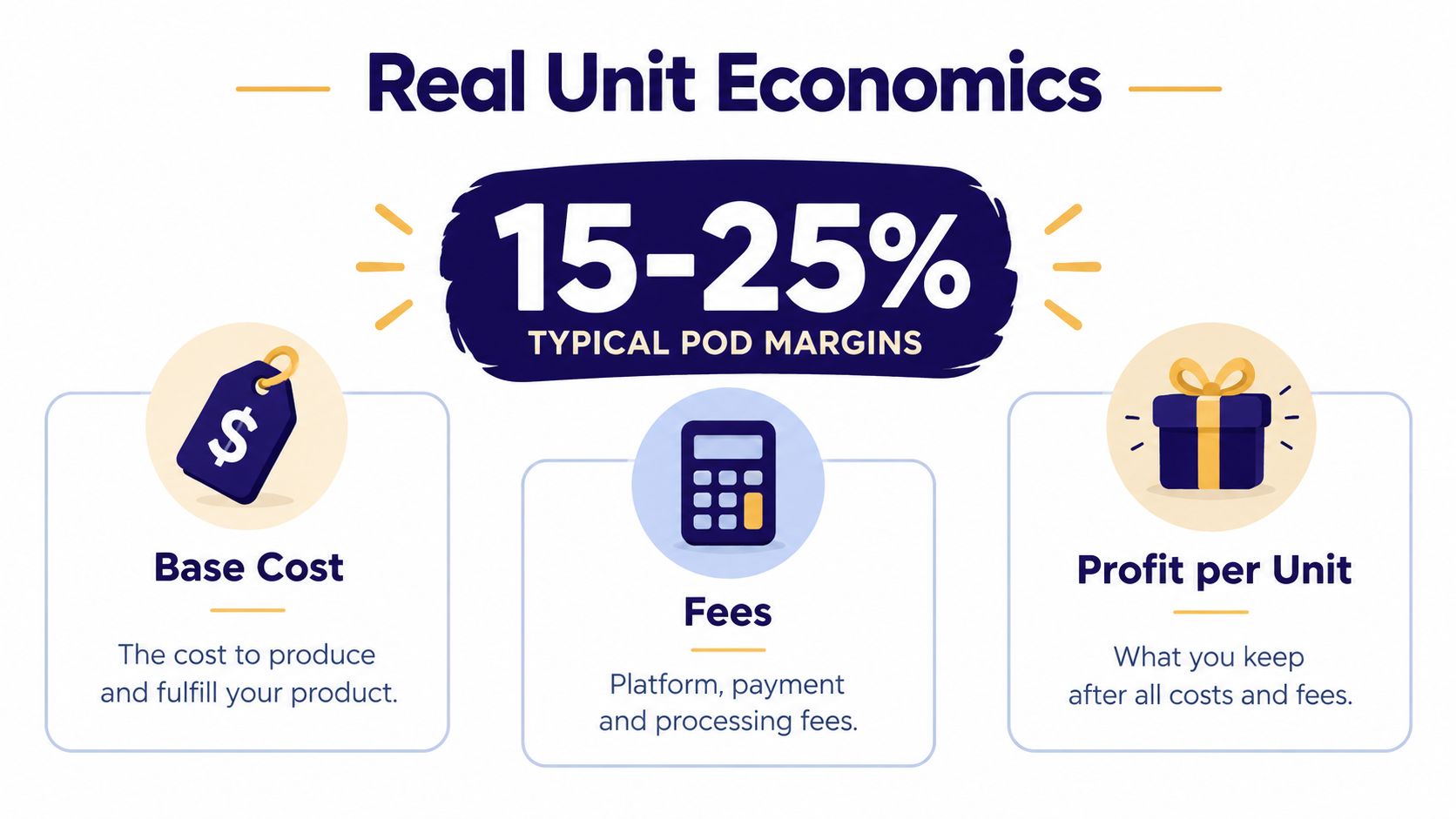
Independent pricing guidance places typical POD-item margins around 15–25%, but that's a broad benchmark rather than a wrapping-paper profit guarantee, according to Marginory's Etsy product-pricing guide.
The cost categories deserve attention before the design catalogue grows.
Calculate the fee base correctly
Etsy's transaction-fee policy charges 6.5% on the displayed listing price, buyer-paid shipping, and gift wrapping; for a $20 item, $6 shipping, and $4 gift wrapping, the fee base is $30 and the transaction fee is $1.95, before other Etsy or payment-processing charges. Additional personalization charges also enter the displayed listing price and are subject to the transaction fee.
That example isn't a profit calculation. Without the supplier invoice and other applicable charges, you don't know what the seller keeps.
I use this working equation:
Order contribution = customer payment − production − fulfillment shipping − seller-paid packaging − applicable fees − discounts − replacement allowance.
Personalization labor also needs a place in the decision. Even when you perform it yourself, handling names, checking spelling, and correcting files takes time.
| Cost or condition | What I'd verify |
|---|---|
| Production | Selected stock, format, and personalized variant |
| Shipping | Actual destination and production route |
| Packaging | Whether it's included or charged separately |
| Fees | Full customer-facing order value and applicable charges |
| Service | Corrections, damaged orders, and replacement handling |
Improve the order, not just the price
A sheet bundle may distribute delivery cost across more product. Coordinated tags can make the offer more complete, but they're only useful if the extra fulfillment and service work leaves worthwhile contribution.
Business buyers are another direction to test. Branded wrapping paper might suit repeated packaging needs, provided you have permission to reproduce the branding and can meet the buyer's consistency requirements.
Margin check: Free delivery is a pricing decision, not a supplier discount.
I'd compare contribution by destination, quantity, and roll length before choosing the public offer. Use niche research to investigate accepted price bands and competing bundles, but don't mistake search interest for permission to ignore costs.
If the numbers only work when nothing goes wrong, I'd change the format, bundle, or target buyer. Sometimes the honest answer is not to list it.
Mockups, SEO, and Honest Sustainability Language
The main product image should help a buyer understand what arrives. I'd show the pattern around a gift, a closer view of the paper, and a view that communicates the selected format rather than relying entirely on a polished square mockup.
State the occasion, dimensions, substrate, and personalization options in the listing. A title such as “Personalized botanical birthday wrapping paper” identifies the use; the description should then explain the actual product instead of repeating keywords.
Describe the product you can deliver
For Etsy wrapping-paper listings, keep the buyer-facing language specific. Use Redbubble, TeePublic, and Amazon Merch research to understand audience vocabulary, but don't transfer product claims between marketplaces or assume identical product availability.
- Show scale: Make the motif size understandable against a real gift.
- Separate inclusions: Explain whether tags, ribbon, or props are supplied.
- Clarify customization: Tell buyers what they can change and what stays fixed.
- Match the selected variant: Don't show one stock while fulfilling a different one.
Replace broad green claims with evidence
The provided U.S. consumer findings report that 54% deliberately chose products with sustainable packaging during the prior six months, 90% were more likely to buy from brands using eco-friendly packaging, and 43% were willing to pay extra, as discussed in McKinsey's packaging sustainability research. Those packaging findings aren't a forecast of wrapping-paper conversion or a justification for an unsupported premium.
I'd ask the supplier for documentation covering recycled content, coatings, ink systems, and any recyclability or compostability claim. Kraft appearance alone isn't evidence.
Plastic lamination, glitter, foil, and unsuitable coatings can undermine recyclability. Disposal language should reflect the shipped material and local collection rules in the United States, United Kingdom, European Union, or whichever market you serve, not imply universal acceptance.
A sustainability-led niche is worth researching only if the supplier can support its central promise. Otherwise, change the positioning before listing.
Account Safety, Trademarks, and a Realistic Next Step
A trademark pre-check is a screening tool, not legal clearance. Trendlytic's built-in USPTO check flags ownership and expiry information; I'd investigate flagged terms rather than assume a keyword is safe because competing sellers use it.
Keep permissions and product details together
Avoid building an offer around characters, sports teams, universities, or gifting brands without appropriate permission. Trademark screening also doesn't establish that you own the illustrations, fonts, or photographs in the file.
Physical specifications matter to account health too. Printify's wrapping-paper product information specifies 90 gsm fine-art paper, one-sided printing, sizes of 30 × 36, 30 × 72, and 30 × 180 inches, a width tolerance of up to 0.5 inch, and notes that some rolls have white barcode and QR-code spaces plus a blank protective lead-in sheet. Don't imply every part of the roll contains printed artwork.
My next-step checklist is deliberately modest:
- Shortlist: Choose contrasting niche ideas and research the intended buyer.
- Screen: Check keywords and document artwork permissions.
- Proof: Approve the actual supplier, stock, and finished product.
- Price: Calculate contribution using the complete order and fee base.
I'd rather launch a small, checked offer than a large catalogue of unresolved assumptions.
Trendlytic offers cross-marketplace POD niche research and a built-in USPTO trademark check to help you investigate a wrapping-paper idea before committing to it. Visit Trendlytic, shortlist a gifting niche, and compare the evidence with your supplier proof and cost sheet. That won't guarantee sales, but it gives you a more grounded reason to list, revise, or pass.